Nyoirin Kannon: the wish-granting jewel and the meditative posture
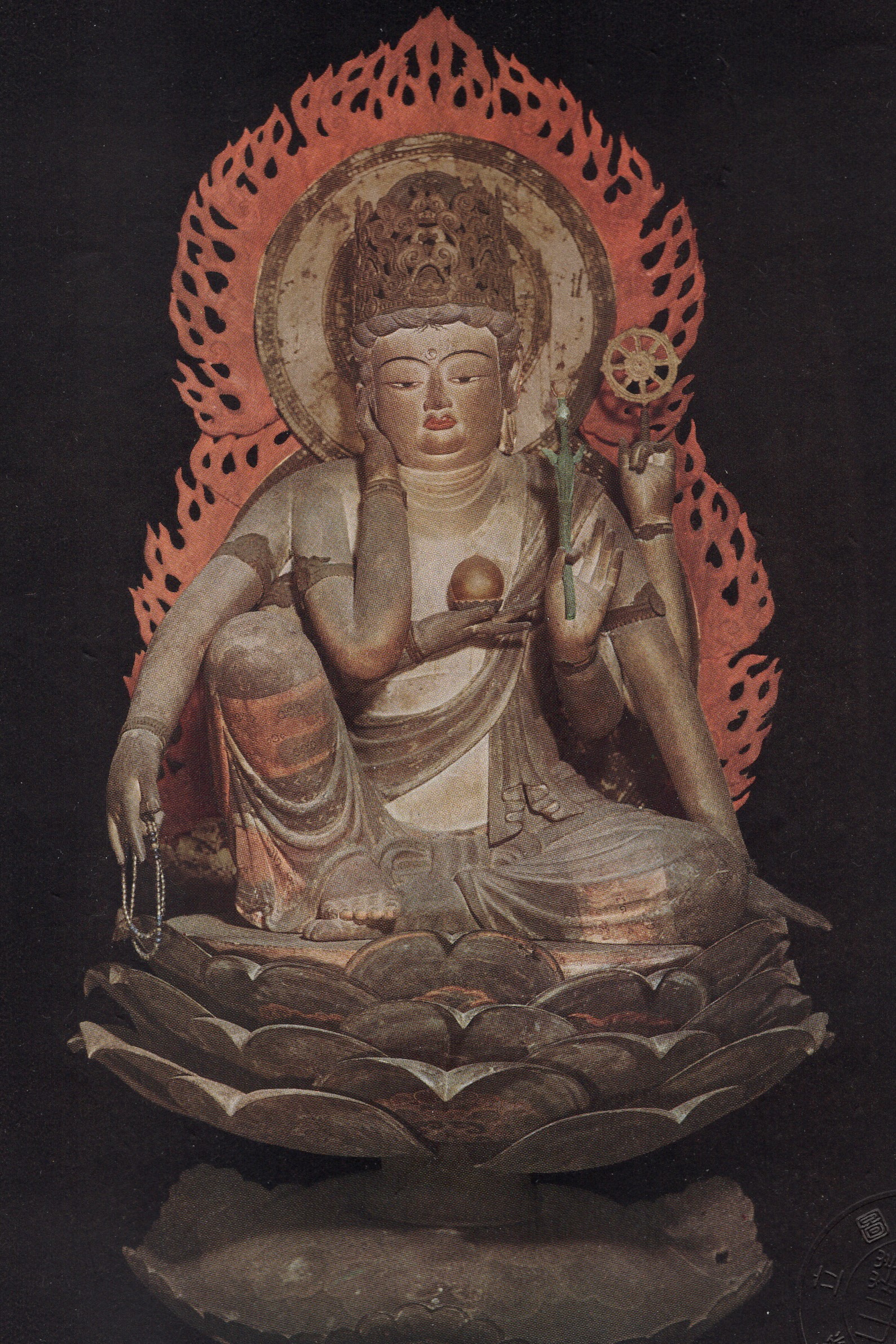
- Title
- Nyoirin Kannon (如意輪観音坐像): Kanshin-ji, Heian, 9th c.
- Period
- Heian period (794–1185), 9th century, Jōwa era ca. 834–848
- Region
- Japan
- Medium
- Wood with lacquer, polychromy, and gold leaf; single-block (*ichiboku-zukuri*) construction
- Collection
- Kanshin-ji (観心寺), Kawachinagano, Osaka; Japanese National Treasure (国宝)
- Rights
- Photograph: 文化財協会 (Bunkazai Kyōkai / Cultural Properties Society), in 『国宝図録 第1集 (Kokuhō Zuroku, National Treasures Catalog, vol. 1)』, 1952; public domain in Japan (PD-Japan-oldphoto, 50-year photo term for pre-1957 photographs). Subject: Nyoirin Kannon Bosatsu zazō, Kanshin-ji (Osaka), Heian period 9th c.; Japanese National Treasure (国宝).
The canonical anchor: Kanshin-ji's 9th-century Nyoirin Kannon (Osaka), Heian, National Treasure: the earliest documented Japanese six-armed Nyoirin and the iconographic reference for the form. The *rinnō-za* posture, the *shiyui-in* cheek-fingertip gesture, the *cintāmaṇi* and the dharma wheel (the four canonical diagnostics) read here together.
Nyoirin Kannon is the seated Esoteric form of Kannon, identified by the cintāmaṇi, the dharma wheel, and the right-hand-to-cheek shiyui-in gesture in the rinnō-za posture. Read the markers off Kanshin-ji’s 109.4 cm Heian honzon (Jōwa-era ca. 840, Tachibana no Kachiko patronage, Kōdō per the 883 shizaichō); the two-armed form is its own canonical line, not only an Edo simplification.
Stand in front of Kanshin-ji
The principal image of Kanshin-ji (観心寺), at Kawachinagano in southern Osaka, is a 109.4-centimetre seated Nyoirin Kannon in kaya (Japanese nutmeg, Torreya nucifera), single-block (ichiboku-zukuri) construction, with the arms separately fashioned and joined to the body, and a dry-lacquer finishing layer over the carved core. Surviving polychromy and gold leaf preserve enough of the colour programme that the iconographic reading carries cleanly. The figure is hibutsu (秘仏, secret image); the doors open on April 17 and 18 each year, the modern accommodation of a once-deeper concealment cycle.
What an unhurried look at the figure shows, in order: the right knee raised against the body’s vertical axis, the left leg folded under, the weight on one hip; the upper right hand brought up the long diagonal from elbow to cheek, two fingers extended against the temple, head inclined a few degrees to receive them; the middle right hand carrying the wish-granting jewel at chest height; the wheel of the dharma balanced on a left fingertip across the body. The colour programme is patient rather than insistent. The face does not perform.
Date the carving to the Jōwa era (834–848) and the patronage attribution to Tachibana no Kachiko (786–850), empress consort of Emperor Saga, who is traditionally credited with prompting the Kōdō (lecture hall) at Kanshin-ji as a vow-fulfilment commission. The Buddhist tradition assigns the carving itself to Kūkai (Kōbō Daishi, 774–835); the modern art-historical reading treats the Kūkai attribution as devotional rather than documentary, and bodhi follows that reading. The figure is plausibly the most up-to-date Esoteric image of its decade (in iconographic dialogue with the Tang Chinese mandala material Kūkai imported from Chang’an in 806), but not literally Kūkai’s own chisel.
The 883 Kanshinji kanroku engi shizaichō (観心寺勘録縁起資財帳), the temple’s official register and inventory, itself a Japanese National Treasure, places the figure in the Kōdō as one icon among a programme of statues and paintings made for the altar. The Kōdō provenance matches the broader Heian pattern: the lecture-hall altar as the setting for the central Esoteric honzon, with the surrounding programme of attendant figures and wall paintings completing the iconographic statement. The figure was designated a former National Treasure in 1897 and re-designated under the postwar regime in 1952.
The markers, as they fall out of the object
The six arms hold an iconographic argument. Read from the figure’s right:
- Upper right: bent at the elbow; the hand to the cheek, index and middle fingers extended against the temple, third and fourth fingers folded, thumb across them. This is the shiyui-in (思惟印, “meditative gesture”). Saunders, Mudrā: A Study of Symbolic Gestures in Japanese Buddhist Sculpture (Bollingen / Princeton, 1960), reads the gesture across the Japanese Mikkyō sculptural repertoire as a meditation-and-discrimination mudra in a specific ritual register, distinct from the contemplation-mudra readings popular literature sometimes uses interchangeably.
- Middle right: the cintāmaṇi (Japanese nyoi-hōju, 如意宝珠), the wish-granting jewel, held at chest height.
- Lower right: hand resting on or above the bent knee; sometimes carrying the rosary beads.
- Upper left: bent at the elbow; the dharma wheel (cakra, Japanese rinpō, 輪宝) balanced on the upraised index finger, a fragile compositional bet that recurs across the corpus and is almost always the first attribute to break or get lost.
- Middle left: a lotus stem or a small lotus.
- Lower left: palm against the lotus throne, or carrying the rosary when these are not in the lower right.
The seat is rinnō-za (輪王座, “cakravartin’s ease”), the partial-cross-legged seat of a wheel-turning monarch: one knee raised, the other folded, the body weight on a single hip. This is not the formal full-lotus kekka-fuza of Buddha figures, and the difference carries iconographic weight. The relaxed, alert pose is what permits the right elbow to rest against the raised knee in support of the cheek-fingertip gesture. The pose is structural, not ornamental: drop the raised knee and the shiyui-in floats.
The diagnostic pair is the cintāmaṇi and the wheel, held in the canonical right-and-left-middle arms. If the figure has both, in those positions, it is Nyoirin. Sharf, On the Allure of Buddhist Relics (Representations 66, 1999, pp. 75–99), reads the cintāmaṇi across the Esoteric corpus as a polyvalent object: relic, wish-granting power, and the substantive object of a class of dhāraṇī practices. Bodhi follows that reading in noting that the jewel here is iconographically a held attribute, not a free-standing ritual object: the figure carries the relic-jewel rather than presents it.
The two-armed form is canonical too
Secondary sources sometimes treat the two-armed Nyoirin as a late, abbreviated form: a Kamakura or Edo simplification of the canonical Heian six-armed figure for lay-devotional contexts. The reading is partly right, partly wrong.
It is partly wrong because the iconographic record contains a substantial two-armed line at Heian institutional scale. The Japanese Wiki Corpus describes a parallel two-armed form in the hanka shiyui posture (half-lotus + finger to cheek) that runs through several Heian-period principal images. That form is most famously associated with the Chūgū-ji Bosatsu (often read as Miroku, occasionally as a related Kannon form) and recurs in the Nyoirin corpus. Ishiyama-dera (Ōtsu, Shiga), the seventh of the Saigoku Sanjūsansho pilgrimage stations, enshrines a Heian seated Nyoirin in two-armed form as its principal image: hibutsu, shown only on enthronement years and at the 33-year cycle, and designated Important Cultural Property. The Kannō-ji honzon (see §4 below) is also recorded as a hanka Nyoirin in the Japanese Wiki Corpus’s reading.
The “abbreviated form” framing is partly right because Edo lay-devotional production picks up the two-armed register at a different scale and in a different ritual context. The Met holding (acc. 56.39, dated 1693 by inscription; see §6) is the textbook example. But the Edo two-armed Nyoirin sits downstream of an existing two-armed canonical line, not as the simplification of the six-armed Kanshin-ji programme.
The honest reading: both the two-armed and the six-armed Nyoirin are present in the Heian institutional record, with the six-armed form more commonly elaborated in the Mikkyō ritual literature and the two-armed form preserved primarily in temple-specific lineages. The diagnostic core survives the reduction. A two-armed seated Nyoirin in the rinnō-za or hanka posture, holding the cintāmaṇi, is fully canonical Nyoirin. What the six-armed form adds is the wheel, the lotus, and the rosary: a richer iconographic statement but not a constitutive one.
The Three Nyoirin Kannon, and the version of that list popular literature confuses
JAANUS, the academic Japanese-art reference, gives the San Nyoirin (三如意輪, “Three Nyoirin Kannon”) as Kanshin-ji (Osaka), Murō-ji (Nara), and Kannō-ji (Hyōgo): the three Heian-period principal images conventionally grouped as the canonical set. The Japanese Wiki Corpus follows the same enumeration. Bodhi treats this as the load-bearing list.
A separate popular tradition substitutes Ishiyama-dera (Shiga) for either Murō-ji or Kannō-ji, sometimes adding Daigo-ji (Kyoto) or Rokkaku-dō (Kyoto) as a fourth candidate. This is not nonsense: Ishiyama-dera, Daigo-ji, and Rokkaku-dō each holds a major Heian Nyoirin hibutsu, and the Saigoku-pilgrimage popularity of all three keeps the Ishiyama version in modern circulation. But the JAANUS / Japanese Wiki Corpus reading is the scholarly anchor. Bodhi commits to Kanshin-ji + Murō-ji + Kannō-ji as the canonical San Nyoirin and treats the Ishiyama / Daigo-ji / Rokkaku-dō expansion as a parallel popular enumeration with its own legitimacy in pilgrimage practice but not in the academic iconographic record.
The three canonical principal images differ from each other in form, which is part of the interest:
- Kanshin-ji: Heian 9th c., 109.4 cm kaya-wood seated six-armed rinnō-za, National Treasure (re-designated 1952). The iconographic anchor.
- Murō-ji: Heian, principal image of the hondō (main hall), wooden seated six-armed Nyoirin in the same iconographic register as Kanshin-ji. Murō-ji’s lineage is Shingon, with the temple known as Nyonin Kōya (the women’s Kōya) for admitting female pilgrims when Mount Kōya did not.
- Kannō-ji (Hyōgo, on Mount Kabutoyama, Nishinomiya): Heian wooden seated two-armed Nyoirin in the hanka posture (如意輪半跏像), Important Cultural Property. Founding accounts vary; one tradition assigns the carving to Kūkai in 830 under the patronage of a queen consort of Emperor Junna, escaping to Mount Kabutoyama in 828.
Reading the three together, the San Nyoirin is not a single iconographic type catalogued three times. It is the institutional consolidation of three Heian temple lineages around a shared deity in two distinct sculptural forms (six-armed and two-armed), both grasped as Nyoirin under one name.
The textual basis: two recensions, one figure
The scriptural anchor is the Cintāmaṇicakra Dhāraṇī Sūtra (如意輪陀羅尼経), preserved in the Taishō Tripiṭaka as numbers 1080 and 1081 (the parallel Chinese translations of Bodhiruci in the early 8th c. and Yijing in the early 8th c.). The dhāraṇī text is the textual source for the iconographic programme; the form arrives in Japan with Kūkai’s 806 return as part of the broader Mikkyō transmission with the Two-Realm Mandala material from Tang China.
A second, Esoteric recension descends from Amoghavajra (Bukong 不空, 705–774) and supports a four-armed variant alongside the two-armed and six-armed standards. The two-armed-to-sixteen-armed range surveyed by the Wikipedia Cintāmaṇicakra entry is the practical iconographic range across the East Asian corpus; bodhi notes the four-armed line as a textually distinct Mikkyō form rather than a simple variant of the six-armed standard. The Japanese tradition centres on the six-armed and two-armed types; the four-armed Esoteric form is the rarest in the Japanese sculptural record.
The dhāraṇī text is also where the figure earns its place in the Japanese imperial ritual repertoire. JAANUS records the deity as one who “offers what one wants either in the world or in monastic life” and as the protector “of the life of the emperor”, a tilt toward the Esoteric ritual function that explains the form’s preservation across institutionally patronised Heian temples.
Three Western-collection comparanda
The Heian institutional record is best read from the Japanese temple holdings, almost all hibutsu, almost none photographable in open view. The Western collections preserve a parallel record at smaller scale and later date that is easier to consult.
Met 56.39 (objectID 49109). Two-armed seated Nyoirin, Edo, dated 1693 by inscription on the base; wood with gold, gold leaf, lacquer, and crystal inlay; 42.1 × 30.8 × 26 cm. Acquired Rogers Fund, 1956. The base inscription records a votive offering in the fifth month of 1693; the Met catalog notes the plausible dedication context as a jūkuya-kō (十九夜講), the Edo women’s assembly that met on the nineteenth day of the month for the safe delivery of children. The Edo two-armed register is here in compact form: the rinnō-za posture preserved at miniature, the cintāmaṇi in one hand, the cheek-fingertip gesture in the other, the four canonical-six-armed implements stripped away. The earlier elevation of this article reported the Met accession as “49109”; that is the Met objectID, the database key; the actual accession number is 56.39. The correction goes in here for the record.
Kimbell AP 1985.15. Seated six-armed Nyoirin, Kamakura, ca. 1230–50; 48.3 × 45.7 × 25.4 cm. Acquired Kimbell Art Foundation, 1985, from Harry Packard (Kyoto). The lotus pedestal is lost; the wheel that originally balanced on the upraised left index finger is gone, recoverable only as reconstruction. The Kimbell figure is one of the strongest Kamakura six-armed Nyoirin in a Western collection and is the closest the Western record gets to a Kanshin-ji-style anchor: a generation or so removed in date, with the iconographic core intact.
Nara National Museum acc. 944 (絵183). Hanging scroll, ink and colours on silk with kindei (gold paint), gold leaf, and kirikane (cut gold leaf); 101.7 × 41.6 cm; Kamakura, 14th c.; Important Cultural Property. Six-armed body in a moon halo on Mount Potalaka, the elegant lotus pedestal carrying lines of kirikane, robes decorated with rising-cloud, lattice, and swastika patterns in cut gold leaf. The Nara NM scroll is the Kamakura painted register against which the Heian sculptural anchors read: the figure as the centre of an iconographic landscape rather than a stand-alone honzon, and a corrective to the temptation to read Nyoirin only as a sculpture form.
Smithsonian NMAA F1961.6. Six-armed Esoteric form, Freer collection, cintāmaṇi and dharma wheel iconography described in the catalog directly.
Where the iconography is read down the wrong register
Three readings recur in popular sources that the iconographic record does not support:
- The right-hand-to-cheek gesture is not a “thinking” pose in the Western philosophical sense. It is a Mikkyō meditative gesture (shiyui-in) with a specific ritual function in the Nyoirin practice cycle, read by Saunders 1960 across the Japanese sculptural repertoire as a meditation-and-discrimination gesture. Calling it “the thinking Buddha” by visual analogy with the Maitreya / Miroku Bosatsu hanka-shiyui pose collapses two distinct iconographic figures. The Miroku in hanka-shiyui is a future-Buddha figure with a different ritual function; Nyoirin is a Kannon, an Esoteric honzon, not a Buddha-in-waiting.
- The cintāmaṇi jewel is not a generic “wish-granting” object in the lay-devotional sense. It is a polyvalent Mikkyō ritual implement with a specific iconographic and textual history (Sharf 1999 traces this carefully). Reading the jewel as “ask Nyoirin Kannon for what you want” pulls the iconographic figure into a relationship with the reader the iconographic record does not describe: the jewel is what the figure holds because the dhāraṇī text says so, not a transactional promise to the petitioner.
- The two-armed Nyoirin is not always a simplification. Ishiyama-dera’s Heian hibutsu is two-armed at canonical institutional scale, and Kannō-ji’s San-Nyoirin honzon is a Heian two-armed hanka figure. Treating every two-armed Nyoirin as an Edo lay-devotional reduction misses that the form has its own Heian institutional canon. The Met 56.39 is downstream of that canon, not a simplification of the Kanshin-ji programme.
In all three cases the issue is the same: the iconographic Nyoirin is an Esoteric ritual figure with a specific practice context and an institutional record that extends across more than one canonical form. The iconography belongs to the Mikkyō tradition. The figure can be read iconographically (what the record shows) without the reader being asked to take a position on the practice.
Esoteric context and the Shingon / Tendai pairing
Bogel, With a Single Glance: Buddhist Icon and Early Mikkyō Vision (University of Washington Press, 2009), reads the Heian Nyoirin in the broader Mikkyō context as one of a small set of honzon (主尊, principal-image) deities that anchor specific Esoteric ritual cycles. Both Shingon (Kūkai’s tradition, 806) and Tendai (Saichō’s parallel esoteric synthesis) preserve ritual cycles around the Nyoirin honzon; the iconographic image itself is largely shared across the two schools.
The shared iconography is itself worth noting. Several Mikkyō figures (Aizen Myō-ō and the Five Wisdom Kings) carry school-specific conventions that let a viewer distinguish a Shingon from a Tendai image at attribute level. Nyoirin does not. The figure’s iconography is uncharacteristically stable across the Shingon / Tendai divide, which is one reason it is so widely preserved in the Heian and Kamakura sculptural record: the same iconographic core travels between institutional patrons without renegotiation.
Within Shingon, the Ono lineage (Ono-ryū, descended through Shōbō 832–909 and centred on Daigo-ji) developed the most elaborated Nyoirin ritual literature. The Brill Esoteric Buddhism and the Tantras in East Asia handbook (Orzech, Sørensen, Payne, eds., 2011, ch. 76 “Goddess Genealogy: Nyoirin Kannon in the Ono Shingon Tradition”) treats the Ono Nyoirin lineage at chapter length; the chapter is the strongest English-language entry point for the ritual-text context behind the iconographic figure. The full institutional context (the honzon function, the dhāraṇī practices, the calendrical observances) sits outside this article’s iconographic remit; the reader who wants to know what the Nyoirin honzon did in Heian and Kamakura Esoteric practice can begin with Bogel 2009, the Brill 2011 chapter, and Sharf 1999.
How to identify Nyoirin in the field
Working diagnostics for the reader in front of a Japanese Buddhist sculpture or painting:
- Seated, one knee raised (rinnō-za): narrows the candidate set immediately; the posture is unusual enough among Japanese Buddhist figures to be a near-unique marker.
- Right hand to the cheek in the meditative-fingertip gesture (shiyui-in): among Kannon figures this is the Nyoirin marker.
- A jewel held in one of the right arms (cintāmaṇi): confirms the type.
- A wheel held in one of the left arms: confirms the canonical six-armed form rather than the two-armed.
- A small Amida figure in the crown: the Amida-in-crown is a Kannon-family marker generally; its presence rules in the Kannon family but does not by itself distinguish Nyoirin from other Kannon forms.
The rinnō-za posture and the cheek-fingertip gesture together are the most reliable single diagnostic. A Kannon figure seated with one knee raised, right hand to cheek, jewel in the second right arm, is a Nyoirin: six arms or two, sculpted or painted, Heian or Edo. No other Japanese Buddhist figure carries this posture-and-attribute combination as canonical.
Related
- Senju Kannon: reading the thousand arms
- Jūichimen Kannon: eleven heads and the canonical stack
- Bato Kannon: the horse-headed form
- Kannon’s thirty-three bodies: reading Lotus Sūtra ch. 25
- Nyoirin Kannon (entity)
- Cintāmaṇi (entity)
- Shingon (entity)
- Tendai (entity)
Sources
-
Cited at chapter level for Heian Esoteric programme placement and Nyoirin as honzon across Shingon and Tendai
-
Cintāmaṇi read as polyvalent ritual object across the Esoteric corpus
-
Shiyui-in (思惟印) treated as a meditation/discrimination gesture in the Japanese Buddhist sculptural repertoire; cited at work level
-
Broader Kamakura sculptural context for the Nyoirin corpus; cited at chapter level
-
Chapter-level cite; the specific contributing author within the multi-author handbook is not identified
-
Taishō Tripiṭaka 1080 (Bodhiruci, early 8th c.) and 1081 (Yijing, early 8th c.); the textual anchor for the iconographic programme. A four-armed Esoteric recension descending from Amoghavajra (Bukong 705–774) furnishes the Mikkyō ritual variant; the Wikipedia *Cintāmaṇicakra* entry cites both lines
-
9th-century official register and inventory of Kanshin-ji holdings; itself a Japanese National Treasure; documents the Nyoirin Kannon's original placement in the temple's Kōdō (lecture hall)
-
[8]2026-05-21JAANUS (Japanese Architecture and Art Net Users System) aisf.or.jp/~jaanus/deta/n/nyoirinkannon.htmIdentifies the canonical 'Three Nyoirin Kannon of Japan' (San Nyoirin) as Kanshin-ji + Murō-ji + Kannō-ji; iconographic functions of jewel and wheel
-
Six-armed and hanka-shiyui two-armed forms; corroborates the Kanshin-ji / Murō-ji / Kannō-ji San Nyoirin reading
-
Two-armed seated Nyoirin, 42.1×30.8×26 cm, wood with gold, gold leaf, lacquer, crystal inlay. Rogers Fund, 1956. Inscription on base records a votive offering in the fifth month of 1693; Met catalog notes plausible jūkuya-kō (19th-day women's assembly) dedication context. The prior elevation cited the Met *objectID* 49109 in the accession field; corrected here to the actual accession 56.39
-
Important Cultural Property; hanging scroll, ink + colour + kindei + gold leaf + kirikane on silk, 101.7 × 41.6 cm; six-armed body in moon halo on Mount Potalaka, kirikane-decorated lotus pedestal, rising-cloud / lattice / swastika robe pattern. Kamakura painted comparandum to the Heian sculptural anchor
-
Six-armed seated wooden Kamakura Nyoirin, 48.3 × 45.7 × 25.4 cm; lotus pedestal lost; reconstructed attribute order (cheek + jewel + wheel-finger + lotus + rosary + pedestal hand). Provenance: Harry Packard (Kyoto), acquired 1985 from Kimbell Art Foundation
-
[13]2026-05-21Smithsonian National Museum of Asian Art (Freer) asia.si.edu/explore-art-culture/collections/searc…Canonical six-armed Esoteric form.
-
English-language confirmation of the Kanshin-ji statue's 109.4 cm height, kaya-wood single-block construction, Jōwa-era dating, Kūkai traditional attribution, Tachibana no Kachiko patronage, 883 shizaichō Kōdō placement, and annual April 17–18 opening