An Asuka-period gilt-bronze Kannon at Cleveland
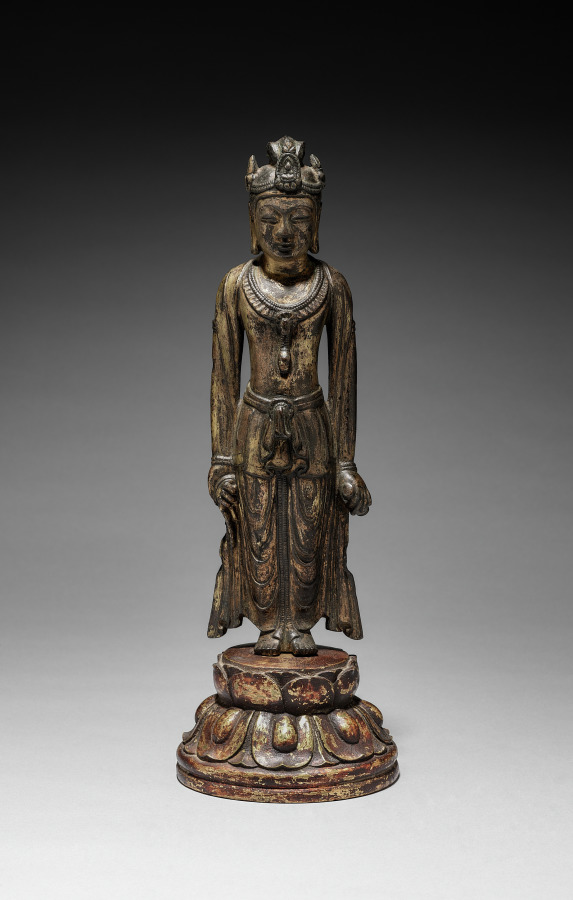
- Title
- Kannon (観音菩薩像)
- Period
- Asuka period (538–710), mid-600s–early 700s
- Region
- Japan
- Medium
- Gilt bronze
- Dimensions
- Overall H. 32 cm (12 5/8 in.); with tang 30.3 cm; figure without tang 25.8 cm; base diameter 11.2 cm; base H. 6.8 cm
- Collection
- Cleveland Museum of Art
- Accession
-
1950.392 - Rights
- CC0 (Cleveland Open Access). John L. Severance Fund.
Cleveland 1950.392, gilt bronze, 32 cm overall (25.8 cm without the tang). Both arms hang at hip level rather than rising into the abhaya gesture commonly assumed for Asuka standing Kannon. The robes flare at the sides and the lower body carries vertical pleat-folds — Tori-school silhouette markers — but the face is rounder and the base a tiered lotus rather than the Tori plinth. The reading sits on the late side of the Asuka–Hakuhō boundary.
Cleveland 1950.392 is a 32-centimetre gilt-bronze standing Kannon dated by the museum to the mid-600s–early 700s. Both arms hang at hip level; the figure stands on a tiered lotus pedestal; the crown carries a small central figure read as Amida. The robes flare at the sides (the Tori-school’s most legible signature) and the lower body carries vertical pleats; the face is rounder and the base more elaborated than the Tori canon. The figure reads as a workshop-descent product of the Hōryū-ji small-bronze atelier on the Asuka–Hakuhō boundary: Tori silhouette with Hakuhō-direction softening.
At hand-scale, both arms hanging
The Cleveland catalog gives the figure a height of 32 centimetres overall, 25.8 centimetres without the tang at the underside that would have fixed it into a wooden pedestal or zushi (tabernacle) base.1 At that scale the figure is portable, hand-cradleable, made for an aristocratic household altar or a small temple cabinet rather than for a hall installation.
The working life of an object of this size is at adult-eye-level when the viewer is seated cross-legged on the floor in front of it, with a single oil-lamp or candle for light. The Cleveland gallery presentation (a vitrine at standing-museum-visitor height under diffused lighting) is the wrong viewing geometry. The figure was made to be looked down at, slightly, by a single seated person in a small space.
What that single seated viewer would have seen, and what the Cleveland published photograph preserves, is a frontal standing figure with both arms hanging straight along the body, hands at hip level. Palms are turned slightly forward, fingers loosely held; one hand may carry a small attribute close to the body but the resolution does not reliably distinguish whether anything is in either palm.2 This is not the raised-right-hand abhaya gesture often assumed for Asuka-period standing Kannon.
The figure’s face is round, with a soft jaw and downcast eyes, and a small mouth that does not carry the sharply upturned archaic-smile corners of the Tori-school canon. A tiered necklace crosses the chest with a central pendant; a sash crosses the waist and trails a long pendant down the front of the lower body.
The crown is a three-pointed openwork form with a small central figure at the apex, visible in the published photograph and read as the small Amida-in-crown that is Kannon’s iconographic identifier. The robes flare outward at the hips on both sides, and the lower body carries vertical pleat-folds that read down to the hem.
What the silhouette keeps and what the face lets go
The figure is a hybrid object, and the surfaces declare themselves separately. The silhouette is Tori-school. The robes flare outward at the hips on both sides (paired hip-flares, the stylized scarf-end side-extensions that are the Asuka period’s most legible visual signature in its Tori-school codification), and the Cleveland record’s own descriptive line, “flowing robes flared at the sides,” registers the convention plainly.1
The lower body carries vertical pleat-folds running down to the hem, the convention preserved from the dated 623 Hōryū-ji Kondō Shaka triad attendants. A central pendant sash falls from the waist down the front of the lower body. The frontal symmetry is unbroken from crown to base. On the diagnostic surfaces where the Tori-school is most legible (silhouette, hip-flares, lower-body drapery), this figure is workshop-correct.
The face and the base are where the figure leaves the Tori canon. The face is round, with a soft jaw and downcast eyes, and a small mouth that does not carry the sharply upturned archaic-smile corners of the Tori convention. The base is a tiered round lotus pedestal: the Hakuhō and Nara convention for the bodhisattva pedestal, distinct from the square or low-tier plinth on which the Tori-school small bronzes typically stand.3 The proportions are reasonably compact: the head sits in normal relation to the body, not the attenuated head-on-slender-body proportion of the Kudara Kannon mode.
Read as a whole, the figure preserves the Tori-school’s silhouette vocabulary while letting go of the Tori facial register and replacing the Tori plinth with a lotus base. That combination is what a workshop-descent late-Tori or Tori-into-Hakuhō product looks like: the iconographic and silhouette inheritance is intact; the surface treatment has begun to soften.
The gilding survives in patches across the body but has worn through to dark bronze across most of the surface, with traces of red pigment preserved in the recesses where polishing did not reach.1 The base preserves the strongest gilding remains, with the petal-tips catching the warm gold tone visibly even at published-photograph resolution. The wear pattern is consistent with a small kondōbutsu that lived a working devotional life (handled, polished, lit by oil-lamp at close quarters) rather than with a temple-installed image protected from contact.
The demure register of the figure (both hands at the hip, soft round face with downcast eyes, the tiered lotus pedestal) is the reason the catalog dates the work across the Asuka–Hakuhō boundary rather than fixing it at the Tori-school anchor. The figure is workshop-correct for the late seventh century or the very early eighth, after the Tori-busshi atelier’s codification had loosened in the face but had not yet loosened in the silhouette.
Mid-600s into early 700s: the Hakuhō transition window
The catalog dating window (mid-600s to early 700s) straddles the Asuka–Hakuhō boundary that conventionally lands at 645 (the Taika reform) or 672 (the Jinshin disturbance and Tenmu’s accession), depending on which periodisation the reader follows. The substantive point is institutional rather than chronological.
By the mid-600s the Tori-busshi atelier had completed the dated 623 Hōryū-ji Kondō Shaka triad, the documentary anchor of the Tori-school style.4 By the late 600s the founder was a generation gone, the original Hōryū-ji had burned in 670 and was being rebuilt, and the Tang-derived stylistic reorientation that would produce the Hakuhō transition and then the Nara workshop synthesis was already legible in the surviving material.
The Cleveland figure sits inside that loosening: descended from the Tori-busshi sculptural lineage by workshop continuity, preserving the Northern-Wei-derived silhouette and drapery vocabulary the founder had codified, but registering the early-Hakuhō face (the round downcast head with the soft jaw and the small mouth) that begins to leave the archaic-smile convention behind.
For the documentary frame (the 538-or-552 transmission of Buddhism from Paekche, the Soga–Mononobe rivalry, the 587 Battle of Shigisan, the 588 founding of Asuka-dera), the canonical recap is the standard recent treatment in McCallum 2009 and the introductory chapter of Washizuka 2003.5 The Cleveland Kannon’s dating sits a century downstream of those events; the events explain why the small gilt-bronze class exists at all but do not explain anything about this specific figure that is not already in the iconographic and material record.
Reading against the Hōryū-ji poles
The two life-size standing Kannon at Hōryū-ji bracket the Asuka stylistic spread inside the founding temple’s holdings. The Yumedono Kuze Kannon, kept as hibutsu (a secret image) until Ernest Fenollosa and Okakura Tenshin opened the Yumedono shrine in 1884, is the canonical Tori-school gilt-wood standing Kannon: rigid frontal symmetry, stiff parallel drapery, columnar body with pronounced paired hip-flares, openwork crown with the figure’s verticality unbroken from crown to plinth.6
The Kudara Kannon, the alternative pole, is also life-size standing gilt-wood, but with attenuated proportions, a much shallower drapery system, a softer face, a more relaxed stance, and the curving silhouette that suggests a body underneath the robes rather than a column behind them.7
The Cleveland figure does not resolve cleanly toward either pole. Against the Kuze Kannon, the silhouette is the same: paired hip-flares, frontal symmetry, vertical lower-body pleats, columnar core. The Cleveland figure carries the Kuze vocabulary in miniature on the silhouette surfaces.
Against the Kudara Kannon, the proportions are wrong: the Kudara Kannon’s distinctive elongation (the head sitting at the top of an unusually slender body) is not present on the Cleveland figure, whose head-to-body relation reads as compact. What the Cleveland figure shares with the Kudara mode is the softening of the face and the absence of the sharply upturned archaic-smile corners; what it shares with the Kuze mode is everything from the shoulders down.
The figure is not a small-scale Kudara Kannon and is not a small-scale Kuze Kannon; it is a workshop-descent product that has begun to leave the Tori canon at the face while preserving the Tori canon in the silhouette.
The Hōryū-ji Kondō Shaka triad attendants, the dated 623 Tori-school small standing flanking bodhisattvas, are the iconographically and stylistically closest comparanda for the Cleveland figure.8 On the silhouette surfaces (hip-flares, vertical lower-body drapery, frontal pose, scale-relative-to-head) the Cleveland Kannon preserves the Kondō convention. On the face and the base (round downcast face, lotus pedestal) the Cleveland Kannon has begun to soften out of the Kondō convention.
The catalog’s “Asuka period (538–710), mid-600s–early 700s” classification is correct as a stylistic reading: the figure’s silhouette is Tori; the face and base are early Hakuhō; the work sits on the late side of the Tori-school workshop’s productive life and at the early edge of the Hakuhō transition.
The sibling Cleveland Miroku, 1950.86
Cleveland accessioned a Miroku Bosatsu (acc. 1950.86) in the same 1950 acquisition cluster as the Kannon, both purchases under the John L. Severance Fund.9 The Miroku is the closest Cleveland comparandum to 1950.392: a small Asuka-period gilt-bronze of the same class, accessioned in the same year under the same fund. The two were almost certainly bought as a pair or as part of a single dealer-mediated lot, though no provenance documentation linking the two purchases is published in the open catalog record.
Reading them side by side in the public catalog is the closest thing to a workshop-relationship test that the Cleveland record allows. The Miroku is dated by the museum to the late 600s, has overall height 45.8 cm (figure 39.4 cm), slightly larger than the Kannon, and is described as cast bronze, incised, with traces of gilding. Both are small kondōbutsu of the late-seventh-century Asuka-into-Hakuhō window, and both arrived without recoverable temple-of-origin documentation.
If the two figures are products of the same workshop or of related workshops in the Hōryū-ji small-bronze descent, the dealer-pair purchase preserves a workshop relationship that the temple-dispersal pattern in the late nineteenth and early twentieth centuries otherwise scrambled. If they are stylistically unrelated and were combined in the lot only by class, the dealer-pair tells nothing about workshop. The published evidence does not currently distinguish.
What stays unverified
Three questions about the Cleveland Kannon are not currently answered by the published evidence and would tighten the reading if answered.
The first is alloy and casting analysis. The dated Asuka and early Hakuhō bronzes (the 623 Hōryū-ji Kondō triad, the Tachibana shrine triad in the mid-seventh-century range, and the 666 small bronze in the Tokyo National Museum holdings) are the technical reference points against which un-dated small bronzes can in principle be tested.10
A comparative alloy analysis would establish whether Cleveland 1950.392 sits inside the documented Hōryū-ji workshop alloy range or outside it, and a casting-seam survey would reveal whether the figure was cast as a single unit (the Tori-school workshop convention for small bronzes) or in multiple pieces joined.
The second is the crown apex and the lowered-hand attribute identification. The current published photograph confirms the small central figure in the three-prong crown (read as the small Amida that is Kannon’s iconographic identifier), but a higher-resolution image of the crown apex would establish whether the small figure is rendered with the uṣṇīṣa (cranial bump) and other Buddha markers or whether it is iconographically reduced.
The lowered-hand attribute question (whether the figure carries a cintāmaṇi jewel, a hōbyō vase, or no attribute at all) is similarly unresolved at current resolution.
The third is provenance prior to the 1950 Severance Fund purchase. The Cleveland record is silent on dealer source, prior collection history, and the temple holding the figure originated in.
The small kondōbutsu class circulated through the international art market in the first half of the twentieth century, often without recoverable documentation; whether the Cleveland Kannon arrived through Yamanaka and Co. or through another dealer, and whether the dealer-pair with the Miroku 1950.86 was assembled in Japan or in the United States, is not currently published.
These are the questions a careful pass with archival access and a technical examination programme would answer. The present pass has to leave the figure where the catalog leaves it: a workshop-correct Asuka-into-Hakuhō small gilt-bronze Kannon, late Tori-school descent, mid-to-late seventh century, Cleveland holding, J. L. Severance Fund: Tori silhouette in the hip-flares and the lower-body drapery, Hakuhō-direction softening in the round face and the tiered lotus base.
Related
- The Chōmeiji pilgrimage mandala — a temple seen by walking
- Jūichimen Kannon: eleven heads and the canonical stack
- Senju Kannon: reading the thousand arms
Footnotes
-
Cleveland Museum of Art, accession 1950.392, “Kannon,” Japan, Asuka period (538–710), mid-600s–early 700s; gilt bronze; classification Sculpture. Credit line: John L. Severance Fund. CC0 (Cleveland Open Access). Catalog page accessed 2026-05-07. Published dimensions: overall 32 cm (12 5/8 in.); with tang 30.3 cm; without tang 25.8 cm; base height 6.8 cm; base diameter 11.2 cm. Catalog descriptive text: standing Kannon figure wearing a tiered necklace and three-pointed crown with a small central figure; flowing robes flared at the sides; tiered lotus pedestal; both arms hanging downward; downcast eyes; traces of gold and red pigment with original gilding worn away to reveal dark bronze. ↩ ↩2 ↩3
-
For the question of attribute identification on small Asuka and early Hakuhō Kannon (the cintāmaṇi wish-granting jewel or the hōbyō small spouted vase of compassion), see Mizuno Seiichi, Asuka Buddhist Art: Hōryū-ji (Heibonsha / Weatherhill, 1974), and Washizuka, Park, and Kang, Transmitting the Forms of Divinity (Japan Society, 2003). Resolution at the published-photograph level rarely distinguishes between the two; the Cleveland record is silent on attribute identification. ↩
-
For the Hakuhō and Nara tiered-lotus pedestal as a stylistic marker distinct from the Tori-school plinth-and-low-base convention, see Mizuno 1974 chapters 5–6 (where the pedestal evolution is treated as one of several diagnostic features for the Asuka–Hakuhō transition) and Paine and Soper, The Art and Architecture of Japan (Yale, 1981, 3rd ed.) chapter 2. ↩
-
The dedicatory inscription on the mandorla of the Hōryū-ji Kondō Shaka triad names “Shiba no Kuratsukuri-no-obito Tori” (Tori-busshi) as the sculptor and gives a date corresponding to 623. This is the foundational Tori-school documentary anchor; see Mizuno 1974 chapter 3 and the standard treatments in Paine and Soper 1981. Tori-busshi was a third-generation immigrant artisan; the family workshop’s combination of immigrant technical inheritance and Yamato court patronage is what defines the Tori atelier as the formal institutional sculptural workshop of the Asuka court. ↩
-
For the two competing dates (552 from the Nihon Shoki and 538 from the Gangō-ji garan engi), the Soga–Mononobe rivalry, and the institutional landscape into which the small gilt-bronze figures were produced, see McCallum, The Four Great Temples (University of Hawaiʻi Press, 2009), chapters 1–2. The Aston translation of the Nihon Shoki (Nihongi, 1896, rpt. Tuttle 1972) gives the chronicle account of the Paekche embassy and the diplomatic-gift framing. ↩
-
For the Hōryū-ji Yumedono Kuze Kannon (life-size standing gilt-wood, traditionally early 7th century, kept as hibutsu until 1884), see Mizuno 1974 chapter 4 and the Cultural Heritage Online (Bunka Isan Online) entry. The Kuze Kannon is treated as the central Tori-school standing Kannon image and the canonical reference against which the small bronze class is read. ↩
-
For the Hōryū-ji Kudara Kannon (life-size standing gilt-wood, dated variously to the early and mid-7th century, with the elongated proportions and softer drapery system distinct from the Tori-school convention), see Mizuno 1974 chapter 5 and Paine and Soper 1981. The dating is contested in the Japanese-language literature; the figure is currently displayed in the Hōryū-ji Daihōzō-in (Great Treasure House). The name “Kudara” refers to the kingdom of Paekche on the Korean peninsula, encoding the workshop’s perceived continental stylistic descent. ↩
-
For the Hōryū-ji Kondō Shaka triad attendants as the dated 623 Tori-school small standing comparanda, see Mizuno 1974 chapter 3 and the standard treatments in Paine and Soper 1981 and Washizuka 2003. The two attendant figures preserve the Tori vocabulary in its most formal codification; subsequent Asuka small bronzes are read against them as workshop or workshop-descent products. ↩
-
Cleveland Museum of Art, accession 1950.86, “Buddha of the Future (Miroku Bosatsu)” (弥勒菩薩像), Japan, Asuka period (538–710), late 600s; cast bronze, incised, with traces of gilding. Overall height 45.8 cm (18 1/16 in.), figure 39.4 cm (15 1/2 in.). John L. Severance Fund. CC0. Catalog accessed 2026-05-07. ↩
-
For the dated Asuka and early Hakuhō bronze sequence as the technical reference points against which un-dated small bronzes can in principle be tested, see Mizuno 1974 and the technical sections in Washizuka 2003. The published alloy analyses for the Hōryū-ji bronzes are scattered across Japanese-language museum bulletins; a consolidated comparative analysis that included Western-collected bronzes such as Cleveland 1950.392 would tighten the workshop-attribution question for the small gilt-bronze class as a whole. Sherwood Moran’s 1958 close-reading method on the Kōryū-ji Miroku is the methodological reference for what a single careful technical-and-iconographic pass can recover from one figure of this class. ↩
Sources
-
The standard English-language reference for the Korean-Japanese sculptural transmission of the late 6th and 7th centuries; treats the Paekche–Asuka conduit, the Northern Wei stylistic descent, and the small gilt-bronze Kannon and Miroku class as the central Asuka surviving corpus.
-
The recent monograph reconstruction of seventh-century Buddhist Japan: Asuka-dera, Kudara-dera, Kawara-dera, and the early Hōryū-ji. Treats the Soga-patronage context and the Asuka–Hakuhō workshop transition that the Cleveland Kannon's dating window straddles.
-
The standard English-language survey of Asuka sculpture organized around Hōryū-ji holdings. The Tori-busshi attribution criteria, the Kondō triad, the Yumedono Kuze Kannon, and the small gilt-bronze corpus are treated in turn.
-
Third edition. The Pelican-series synthesis treats the Asuka small gilt-bronze class as a workshop product of the Hōryū-ji circle and its descendants, with the Kuze Kannon and Kudara Kannon as the two large stylistic poles.
-
Moran's close-reading method on a single Asuka-period statue (the Kōryū-ji Miroku in pensive pose) is the methodological reference for what a careful technical and iconographic reading of a small Asuka work can recover.
-
Sibling Cleveland Asuka-period gilt-bronze accessioned in the same year (1950) under the same fund (John L. Severance). Late 600s. The two works are the closest Cleveland comparanda to one another and useful for reading the small gilt-bronze class.
-
[8]2026-05-07Hōryū-ji / Cultural Heritage Online (Bunka Isan Online), Agency for Cultural Affairs print referenceReference for the Yumedono Kuze Kannon as the canonical large standing gilt-wood Asuka Kannon (life-size, ca. early 7th century, formerly hibutsu unveiled by Fenollosa and Okakura in 1884). Cited as the principal Tori-school stylistic pole.
-
[9]2026-05-07Hōryū-ji / Cultural Heritage Online (Bunka Isan Online), Agency for Cultural Affairs print referenceReference for the Kudara Kannon (life-size standing gilt-wood Kannon, Hōryū-ji Daihōzō-in, dated variously to the early-to-mid 7th century; the principal alternative stylistic pole to the Tori-school Kuze Kannon, with elongated proportions and a shallower drapery system).
-
[10]— Aston translation, Nihongi: Chronicles of Japan from the Earliest Times to A.D. 697, 1896 (rpt. Tuttle 1972) print referencePrimary documentary source for the introduction of Buddhism to Yamato Japan from the Paekche court. The two competing dates are both read in the secondary literature; bodhi follows the 538 reading per McCallum 2009.