Bato Kannon at Cleveland: a calm-faced figure carrying a wrathful name
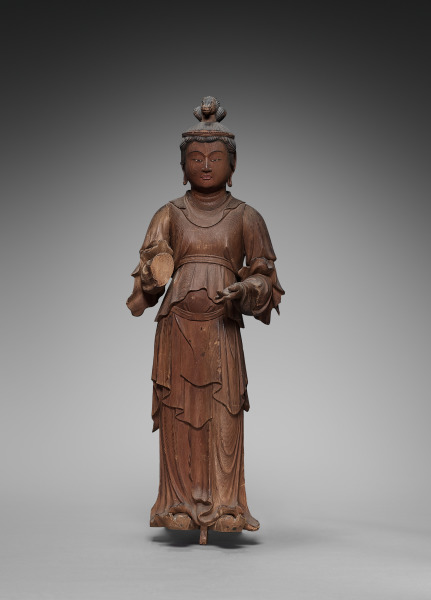
- Title
- Batō (Horse-Headed) Kannon — 馬頭観音像
- Period
- Japan, Kamakura period (1185–1333), early 1300s
- Region
- Japan
- Medium
- Wood with traces of color and gold
- Dimensions
- Figure 82.6 cm (32 1/2 in.); overall mounted with base 110.6 cm (43 9/16 in.)
- Collection
- Cleveland Museum of Art
- Accession
-
1981.1.a - Rights
- CC0 (Cleveland Open Access). John L. Severance Fund 1981.1.a.
The Cleveland figure shows the abbreviated one-face two-arm Bato Kannon variant. The face is calm rather than wrathful; the small horse head at the apex of the hair-knot is the sole iconographic identifier. Right arm broken at the wrist; left hand held palm up. Dark brown wood with traces of black and gold pigment. Kamakura period, early 1300s.
Cleveland’s Bato Kannon (1981.1.a, Kamakura, early 1300s, 82.6 cm) is the abbreviated one-face calm-faced variant of the form. The wrathful three-faced multi-armed Bato of Kanshin-ji and Jōruri-ji is the canonical institutional reading; the Cleveland figure carries the name only through the small horse head atop the hair-knot. The figure is paired across two accession numbers with an Edo lotus pedestal (1981.1.b, 1600s–1700s, 28 cm) made three to four centuries later.
A Bato without the wrath
The Cleveland figure is the form’s quiet exception. The canonical Bato Kannon of the Heian and Kamakura institutional record is wrathful: three faces with bared fangs and furrowed brow, six or eight arms holding the sword and the axe and the vajra-staff, the batō-in horse-mouth mudra at the chest.
The Bato of Kanshin-ji, Jōruri-ji, and Daigo-ji is the canonical reading the Mikkyō literature documents and the Kakuzen-shō records.1 The Cleveland figure does none of that.
Look at the photograph. The face is calm — single, downcast, lips closed. There are two arms, not six. The figure stands quietly on the small platform within its Edo throne. The horse head atop the hair-knot is so small at this resolution that it reads first as a topknot ornament; only on a second look does the equine profile resolve.
The catalog text confirms it: “a horse’s head appears in the hair of this sculpture to identify it.”2 The horse head is the only thing on the figure that says Bato. Without it, the work would be indistinguishable from a generic late-Kamakura calm-faced standing Kannon.
This is the abbreviated one-face two-arm variant, attested in late-Heian and Kamakura institutional records as a minor form alongside the dominant wrathful programme.3 What the canonical scholarship treats as central — the wrath, the multiple faces, the weapons — is precisely what the Cleveland figure leaves out.
The article’s first iconographic move is therefore subtractive: name what is missing, name what remains, and read the remainder as its own rare configuration rather than as a fragment of the canonical form.
What the figure actually shows
The Cleveland figure stands 82.6 cm in dark brown wood. The proportions are the slender late-Kamakura standing-figure type. The face is in light relief: a calm bodhisattva countenance, broad forehead, downcast eyes pulled in toward the centre, full lips closed without expression, no fangs.
The hair is pulled back into a high topknot bound by a cord; the small horse head sits at the apex of the topknot as an ornament rather than as a face — an equine profile in low relief, perhaps two centimetres at scale, easy to miss on first look.
The arms are two. The right arm carries an old break at the wrist; Cleveland’s catalog notes the break and does not document a restoration. The hand is held against the chest in a closed position that may have once held an attribute (a small disc-form is visible at the chest in the museum photograph, but its identification is not recoverable at the published image’s resolution). The left hand extends forward, palm up, in a gesture consistent with the varada-mudra (giving) — a calm-bodhisattva hand-programme rather than a wrathful one.
The robes fall in soft folds from the shoulders to the feet without the columnar parallel-fold convention or the paired hip-flares the wrathful Bato configurations carry. There is no flame-mandorla, no apsara band at the back, no trampling of demons underfoot.
The wood reads the way late-Kamakura unpainted figures usually read: the joinery is invisible at this resolution but the surface preserves traces of black pigment in the hair and at the eyes, and small flakes of gold leaf along the robe-edges that catch the museum lighting. Cleveland’s catalog records “traces of color and gold” as the surviving polychromy programme. The base shown in the museum photograph is the Edo lotus pedestal (1981.1.b), discussed below; in installation the figure stands at the centre of the upper lotus throne, brought to a final 110.6 cm overall.
The honest position on attribute identification is that the figure’s specific iconographic configuration beyond the horse-head identifier is not fully recoverable from the published image. The right hand may have held a small attribute; the left hand reads as varada-mudra; no second pair of hands or additional weapons is present.4 What the figure firmly carries: the calm face, the single head, the two arms, the soft drapery, the small horse head at the topknot’s apex, the wood-with-pigment-traces surface.
The canonical wrathful programme — and what the Cleveland figure does not carry
The Bato Kannon iconographic programme as the Kakuzen-shō records it is more variable than most other Kannon variants. The compendium documents three principal face-configurations and four principal arm-counts, and the surviving Japanese sculptural corpus shows the full combinatorial spread.5
| Face count | Most common arm count | Canonical anchors | Cleveland 1981.1.a |
|---|---|---|---|
| One face, calm or wrathful | Two arms | Smaller temple holdings; painted Bato images; roadside corpus | Match — calm face, two arms |
| Three faces, wrathful (funnu) | Six or eight arms (sanmen-roppi, sanmen-happi) | Kanshin-ji, Jōruri-ji 1241, Daigo-ji 1224 | does not carry |
| Four faces, wrathful | Eight arms | Late-Kamakura Shingon variant sets | does not carry |
The hands at the chest of the canonical wrathful Bato hold the batō-in, the horse-mouth mudra: index and little fingers extended outward, middle and ring fingers pressed inward, thumbs across the inner fingers.6 The mudra is iconographically specific to Bato among the Six Kannon and serves as the diagnostic where the horse head in the crown is small or worn.
The Cleveland figure does not carry the batō-in either: the right hand is closed against the chest (with the wrist break), and the left hand extends forward in varada-mudra. The diagnostic that should resolve the figure’s reading where the horse head is ambiguous is itself absent. The horse head therefore carries the entire iconographic identification on its own.
What this means for reading the work is that the Cleveland figure is not a fragment of the canonical wrathful Bato whose other features have been lost. It is a complete object in the abbreviated variant: a calm-faced bodhisattva whose only Bato-specific feature is the small equine ornament at the topknot. The reading scholarship calls “Bato Kannon” turns out to be a small typology, not a single fixed configuration; the Cleveland figure occupies the typology’s quiet end.
What the Six-Kannon system asks Bato to do
The canonical Six Kannon (Roku Kannon, 六観音) recap is in Van Goethem 2016: the Mikkyō ritual programme assigning each of the six principal Kannon variants to one of the six paths of the rokudō, with Bato assigned to the chikushōdō (animal realm) consistently across the Tendai and Shingon variants.7
What that assignment carries inside the institutional reading is that compassion directed at beings whose minds are dominated by instinct and predation requires a more forceful manifestation than calm bodhisattva form can supply; the wrathful face is the iconographic shorthand for compassion’s protective rather than pacifying register.
The Cleveland figure refuses this shorthand. The work carries Bato’s institutional name and Bato’s institutional realm-assignment without carrying the wrathful manifestation that the institutional reading uses to discharge that assignment.
There are two ways to read the gap. The first is that the figure pre-dates or sits outside the strict-canonical Mikkyō reading and carries the abbreviated form by genuine doctrinal choice — a calm Bato as a deliberate iconographic configuration whose meaning is preserved in the textual lineage even where the institutional Esoteric reading defaults to the wrathful programme.
The second is that the figure is the product of a popular or subsidiary-altar setting where the abbreviated form was the workshop’s pragmatic default and the canonical wrathful programme would have required resources or scholarly anchoring the commissioning context did not supply. The honest position is that the Cleveland record does not commit to either reading; both are open.8
The Edo pedestal that did not match
The pedestal is the figure’s institutional afterlife rather than its iconographic complement. Cleveland accessions the base separately as 1981.1.b and dates it to the Edo period, 1600s–1700s — three to four centuries later than the figure. The mounting is therefore a workshop-of-its-own-moment installation rather than an attempt at archaizing imitation.
The base is 28 cm tall and reads in three tiers from the floor up. The lowest tier is a circular drum of dark wood with a band of gilt cartouches set into an openwork mokoshi-style ring; the cartouches are rectangular, evenly spaced, with low-relief floral or geometric infill at this resolution.
Above the drum is a stepped intermediate band, narrower, with an interlocking key-and-cloud pattern in low relief, lacquered.
The upper element is the lotus throne proper: a stylized open flower of two layered rings of pointed petals, modeled in the round and lacquered in the muted red-purple-and-gold scheme typical of Edo altar pedestals. A reeded upper drum sits at the centre of the open lotus where the figure’s feet land.9
The pedestal carries no Bato-specific iconography of its own. It is altar furniture in the Edo institutional vocabulary: handsome, careful, generic. Its meaning to the Cleveland set is structural — without it, the figure has no plausible installation context, but the iconographic reading of the work runs entirely through the figure. The two-tier accessioning (1981.1.a and 1981.1.b separately) is the museum’s documentary commitment to the materially distinct components and to the dating-and-attribution honesty a single accession would have hidden.
Why a Kamakura figure ends up on an Edo throne
The mounting of a Kamakura wooden figure to an Edo lacquered pedestal is not unusual in the Japanese Buddhist sculpture record. Wooden temple sculptures and their pedestals have different survival profiles. The figure is the iconographic and ritual centre of the altar installation; the pedestal is the support infrastructure, materially less protected and replaced when it fails. Across a working temple’s centuries-long life, an altar figure may sit on three or four successive pedestals, each replacement made in the workshop idiom of its own moment.10
The Edo period (1615–1868) is when much of the surviving altar furniture in Japanese temple holdings was made or re-made. The political stability of the Tokugawa centuries, the patronage structures of the shogunate’s Buddhist temple registration system, and the urban concentration of skilled lacquer and metalwork workshops in Edo, Kyoto, and Osaka produced the most prolific period of altar-furniture production in Japanese institutional history. The Cleveland base reads as one such Edo-workshop replacement: standard mid-to-late Edo altar-pedestal vocabulary, no attempted Kamakura archaism, no Bato-specific iconographic programme.
The folk register would also be available here. Bato means horse-head, and the equestrian reading reads the horse-head as the figure’s domain rather than as the iconographic identifier of an Avalokiteśvara variant.
Across the Edo period particularly, when the post-station network of the Tōkaidō and the Nakasendō carried sustained packhorse traffic, small Bato shrines and stone Bato markers proliferated along travel routes — memorials for horses that died in transit, ritual protection for pack-horse caravans, and practical landmarks at way-stations and mountain passes.11
Whether the Cleveland figure passed through any such roadside or popular-register installation in the centuries between its Kamakura making and its 1981 acquisition is not recoverable from the museum’s published provenance.
To picture the figure in its original context, leave the museum gallery. The likely setting is a small subsidiary altar in a working Mikkyō temple in early-1300s Japan: a covered altar room in a side hall, the figure mounted at adult-eye-level, the room lit by butter-lamps and the smoke of goma rituals, the figure’s face caught in the unsteady light.
The horse head at the apex of the topknot would have been read in passing rather than studied — the kind of iconographic identifier a parishioner would learn by being told it was there, not by inspecting the figure closely. The Cleveland gallery’s even diffused lighting makes the horse head visually findable in a way the original installation did not.12
Where this article is honestly thin
The Bato Kannon at Cleveland is not a heavily studied object in the museum’s Japanese sculpture holdings. Cleveland’s catalog text is one short paragraph for each component. No published technical study, alloy-or-pigment analysis, conservation report, or scholarly catalog entry treating 1981.1 specifically has been located. The work is one of the museum’s quieter Asian holdings, present in the open-access programme and in the Wikidata record (Q79932437), but without the secondary-literature scaffolding that supports the museum’s flagship Buddhist sculptures.13
What this leaves open: the specific provenance prior to 1981, including any Japanese temple-of-origin or Edo-period intermediate installation history; the workshop attribution of the Kamakura figure (Kei-school relationship, regional-workshop assignment, or independent-workshop identification); the Edo workshop and the more granular 1600s–1700s dating for the pedestal; any conservation report on the right-arm break or the surviving polychromy; and the possibility — flagged at the §3 discussion of the batō-in mudra — that a higher-resolution image of the figure’s chest might resolve the chest-level attribute identification.
What the article firmly commits to is what Cleveland’s documentary record supports: a Kamakura wooden Bato Kannon, early 1300s, 82.6 cm, calm face, single head, two arms, the diagnostic horse head at the apex of the hair-knot, mounted on an Edo lacquered lotus pedestal of 1600s–1700s manufacture, the artwork set 110.6 cm overall, acquired in 1981 through the Severance Fund, public-domain, and present in the Cleveland Open Access programme.
The figure is the rare calm-faced Bato that the canonical scholarship treats as the variant rather than the type.
Related
- Tōkannon-ji’s 1271 Batō Kannon kakebotoke — an Adachi commission in gilt bronze
- The Kannon that carries the lotus dais — a Kamakura reading
- Hōitsu’s Willow Kannon — a Rinpa Buddhist scroll
- Senju Kannon: reading the thousand arms
- Jūichimen Kannon: eleven heads and the canonical stack
- An Asuka-period gilt-bronze Kannon at Cleveland
- Bato Kannon
Footnotes
-
For the canonical wrathful three-faced multi-armed Bato Kannon programme, see Ellen Van Goethem, The Six Kannon: Cult and Iconography in the Heian and Kamakura Periods (Brill, 2016), chapter 4. Van Goethem’s reading treats the canonical Heian institutional anchors (Kanshin-ji Bato, Important Cultural Property; Jōruri-ji Bato, 1241; Daigo-ji Bato, 1224) as the institutional reference points for the form. The wrathful three-face six-or-eight-arm configuration with the batō-in mudra and the canonical attribute set (sword, axe, vajra-staff, lotus, bachi trident, rosary) is the form recorded in the Shingon iconographic compendium Kakuzen-shō (Bato section) and in the Tendai parallel compendia Asabashō and Besson zakki. ↩
-
Cleveland Museum of Art, accession 1981.1.a, “Batō (Horse-Headed) Kannon,” Japan, Kamakura period (1185–1333), early 1300s; wood with traces of color and gold; figure 82.6 cm (overall mounted with base 110.6 cm). Catalog text: “Batō Kannon, or Hayagriva Avalokiteshvara in Sanskrit, is the ‘horse-headed’ form of the bodhisattva of compassion, who presides over the realm of animals in the Buddhist Six Realms of Transmigration (rebirth). A horse’s head appears in the hair of this sculpture to identify it.” Condition observations: right arm broken at wrist, left hand held palm up, dark brown wood with visible grain, traces of black and gold pigment. Catalog page accessed 2026-05-07. Credit line: John L. Severance Fund. CC0 (Cleveland Open Access). ↩
-
Van Goethem 2016 chapter 4 records the abbreviated one-face two-arm Bato Kannon variant alongside the canonical multi-faced multi-armed forms. The abbreviated form is most often attested in painted Bato images, in smaller temple holdings outside the major Mikkyō ritual centres, and in the roadside-shrine corpus that proliferates in the Edo period. As a wooden sculpture at 82.6 cm, the Cleveland figure sits between the temple-quality canonical anchors and the smaller stone or rough-wood roadside markers; the iconographic abbreviation is consistent with a subsidiary-altar or popular-register provenance rather than with installation as a major-temple honzon. ↩
-
The published image at 431 × 600 px does not resolve the chest-level attribute (if any) the figure’s right hand carries; the broken right wrist further complicates the reading. A higher-resolution Cleveland conservation photograph or IIIF reproduction would settle it; the article commits to what the catalog text supports (Kamakura, early 1300s, 82.6 cm, horse head in the hair, wood with traces of color and gold) and what the published image shows at this resolution (calm face, single head, two arms, broken right wrist with closed hand against chest, left hand palm-up, soft drapery), and leaves the rest open. ↩
-
For the variant face-and-arm spread of the Bato Kannon iconographic programme as recorded in the Kakuzen-shō (Taishō Zuzō, Bato section), see Van Goethem 2016 chapter 4. The combinatorial spread (one, three, or four faces; two, four, six, or eight arms) means the canonical Bato iconography is itself a small typology rather than a single fixed configuration. The most fully developed institutional configuration is the sanmen-happi (three-faced eight-armed) wrathful form, attested at Jōruri-ji 1241 and treated at length in the Kakuzen-shō. The one-face two-arm calm form is the typology’s abbreviated end and is the configuration the Cleveland figure occupies. ↩
-
For the batō-in (馬頭印, horse-mouth mudra) as the diagnostic hand-gesture of the canonical wrathful Bato Kannon, with the index and little fingers extended outward, middle and ring fingers pressed inward, and the thumbs across the inner fingers, see the Kakuzen-shō Bato section and Van Goethem 2016 chapter 4. The mudra is iconographically specific to Bato among the Six Kannon; the calm-faced Kannon variants use gasshō (palms together) or varada-and-abhaya hand-programmes instead. The Cleveland figure’s left-hand varada-mudra and closed right hand are the calm-bodhisattva hand-programme rather than the batō-in; the figure therefore carries no canonical Bato-specific hand-gesture and depends entirely on the topknot horse head for iconographic identification. ↩
-
Van Goethem 2016 is the standard treatment of the Six Kannon programme, the rokudō assignments, and the Tendai vs. Shingon variant readings. The Bato-to-chikushōdō assignment is the most stable across both schools and across the Heian-into-Kamakura institutional record. Faure 2016 treats the wrathful-Kannon framing inside the broader medieval Japanese pantheon of protective deities. For the institutional canonical recap, the article points at these two volumes rather than rehearsing it. ↩
-
The deliberate-iconographic-choice reading would treat the Cleveland figure as a documented variant within the institutional Bato programme; the popular-or-subsidiary-altar reading would treat it as a workshop-default abbreviated form whose canonical anchoring is loose. Cleveland’s catalog text commits to neither. The patient-observer position: name both options, name the evidence each would require to confirm (a documented temple provenance with surviving Mikkyō ritual records would support the first; a documented subsidiary-altar or roadside-shrine provenance would support the second), and let the reading remain open until the provenance gap closes. ↩
-
The reading of the pedestal as Edo (1600s–1700s) follows Cleveland’s catalog dating for 1981.1.b. The lotus-throne-on-tiered-base configuration is the standard Japanese Buddhist altar pedestal type from the Heian period onward; the Edo-period examples typically introduce the gilt cartouche bands and the openwork mokoshi-style lower ring the Cleveland base shows. No artist or workshop attribution is recorded for the base; the pedestal is published as a single Edo-period object without finer attribution. ↩
-
The pedestal-replacement pattern in Japanese Buddhist altar sculpture is a standard survival-curve issue: figures, ritually protected and centrally placed, survive on average longer than their pedestals; pedestals at the floor or table level take more wear, more handling damage, and more environmental degradation. Replacement pedestals are typically made in the workshop idiom of their own moment rather than in archaizing imitation of the figure’s date. The Cleveland 1981.1 split-accession pattern is the documentary expression of this survival asymmetry. ↩
-
For the Edo-period proliferation of roadside Bato shrines and stone markers along the post-station network, see Fabio Rambelli, Buddhist Materiality: A Cultural History of Objects in Japanese Buddhism (Stanford University Press, 2007), chapter 3 on the social-and-material life of devotional objects. The shrines and markers cluster particularly densely along the Tōkaidō and Nakasendō trunk routes and at the secondary roads through the mountainous interior. For the methodology of reading institutional and folk-Kannon registers as parallel rather than competing, see Mark W. MacWilliams, “Temple Myths and the Popularization of Kannon Pilgrimage in Japan: A Case Study of Ōya-ji on the Bandō Route,” Japanese Journal of Religious Studies 24:3–4 (1997), pp. 375–411. ↩
-
The original installation context for a calm-faced abbreviated Bato Kannon in early-1300s Japan is more plausibly a subsidiary altar in a Mikkyō temple complex than a major-temple honzon position. Major-temple honzon installations of Bato in the canonical Heian and Kamakura record (Kanshin-ji, Jōruri-ji, Daigo-ji) are without exception the wrathful three-face multi-arm form. The abbreviated one-face two-arm form is consistent with subsidiary-altar use, with parishioner-facing devotional installation in a side hall, and with the smaller-scale ritual programmes that supplement rather than anchor a major temple’s iconographic life. ↩
-
Wikidata records the work at Q79932437 (“Batō (Horse-Headed) Kannon”), with the Cleveland Museum of Art recorded as the holding institution and 1981.1 as the inventory number. The figure-of-Hayagrīva-in-Buddhism Wikidata item is Q17004306. No academic-literature references are linked from the Wikidata item. The bodhi article’s
wikidata_subjectis set to Q79932437. ↩
Sources
-
Cleveland's catalog page describes the figure as 'the horse-headed form of the bodhisattva of compassion, who presides over the realm of animals' and notes the diagnostic 'horse's head appears in the hair of this sculpture to identify it.' Condition observations: right arm broken at wrist, left hand held palm up, dark brown wood with visible grain, traces of black and gold pigment.
-
Cleveland's 'artwork set' page connecting the Kamakura figure 1981.1.a and the Edo base 1981.1.b. The 110.6 cm overall height applies only when the figure is mounted on the base.
-
The standard English-language monograph on the Six Kannon programme. Chapters 4–5 treat the variant face-and-arm configurations of the Bato form and the chikushōdō (animal realm) assignment. The one-face calm-faced abbreviated variant is discussed in chapter 4 alongside the canonical three-faced multi-armed institutional form.
-
The textual transmission of the Hayagrīva-class wrathful-Avalokiteśvara forms from the Indian *Hayagrīva-vidyā-rāja* corpus through Tang Esoteric Avalokiteśvara literature into Heian Japanese ritual practice.
-
The social-and-material life of Buddhist objects in Japan, including the rural-folk and commercial dimensions of figures whose institutional Esoteric reading runs in parallel with a popular protector function. Cited for the Bato-as-horse-protector folk reception and the Edo-period roadside Bato shrine pattern.
-
The wrathful-Kannon framing within the broader medieval Japanese pantheon of protective deities. Cited for the institutional placement of Bato inside the Kannon family even where the iconographic configuration approaches the wisdom-king visual programme.
-
The methodology of reading institutional and folk-Kannon registers as overlapping rather than separate, applicable to the Bato roadside-shrine corpus.
-
The English translation of the *Mahāvairocana Tantra* (大日経, *Dainichi-kyō*), the foundational Esoteric text for the Mikkyō Avalokiteśvara family from which the Bato Kannon iconography descends in the Japanese Shingon and Tendai reception.
-
The Shingon iconographic compendium recording variant face-counts and arm-counts of Bato Kannon, the *batō-in* mudra, and the canonical attribute set. The Bato section is the institutional reference for late-Heian and Kamakura Bato images.