Yakushi and his Twelve Generals: a Kamakura silk reading the full programmatic group (Cleveland 1938.422)
- Title
- Medicine Master Buddha and the Twelve Divine Generals — 薬師如来及び十二神将像
- Period
- Kamakura period (1185–1333), 1200s
- Region
- Japan
- Medium
- Hanging scroll; ink, color, gold, and silver on silk
- Dimensions
- Image 151.2 × 84.1 cm (59 1/2 × 33 1/8 in.); overall mount 261 × 106.6 cm
- Collection
- Cleveland Museum of Art
- Accession
-
1938.422 - Rights
- CC0 (Cleveland Open Access). Edward L. Whittemore Fund 1938.422.
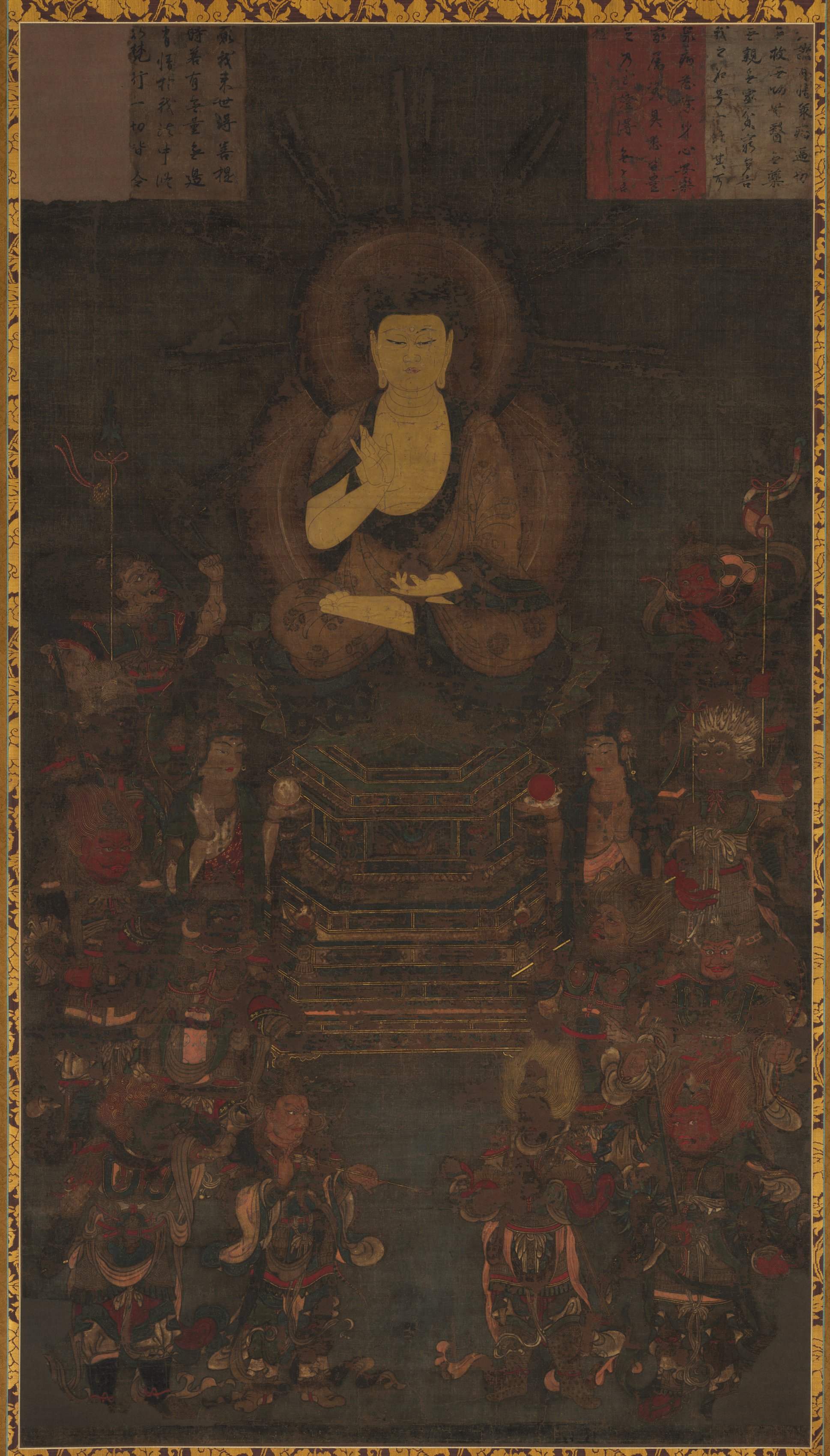
Cleveland 1938.422: Yakushi Nyorai (Bhaiṣajyaguru), the bodhisattvas Nikkō and Gakkō, and the Twelve Heavenly Generals (Jūni Shinshō) — each general identifiable by the zodiacal animal worn in the headdress. Hanging scroll, ink, color, gold, and silver on silk; Kamakura period, 1200s. CC0 (Cleveland Open Access).
Cleveland 1938.422 is a 1200s Kamakura silk hanging scroll, 151.2 by 84.1 cm in the painting field, showing Yakushi Nyorai with the medicine jar in the left hand, flanked by Nikkō and Gakkō, ringed by the Twelve Heavenly Generals (Jūni Shinshō), each with a zodiacal animal in his headdress. The painting compresses into one frame what Shin-Yakushi-ji and Kōfuku-ji distribute across an altar.
What is in front of the viewer
The painting field is taller than wide, 151.2 by 84.1 centimetres, and the composition is read in three horizontal registers. The lower two-thirds carry the figures; the upper third carries a rank of paper-slip cartouches with brushed sutra-text excerpts. The silk has darkened across the centuries, more in the lower passages where altar smoke and incense have done the slow chemistry of darkening, less at the upper edge where the mount has shielded the support. The colour balance now reads as warm brown across the ground, with the figures emerging as patches of preserved pigment: the gold of Yakushi’s body, the kirikane (cut gold leaf) on the bodhisattva and warrior costumes, the surviving silver in the haloes and at the trim of the armour.
Yakushi sits at the upper centre of the figural register in cross-legged meditative posture (full-lotus, padmāsana; both legs folded into the seat with no pendant leg) on a lotus throne raised in turn on a tall, multi-tiered rectangular altar that occupies the picture’s vertical core. The altar (a shumidan / 須弥壇 in form, the architectural type that conceptually positions the principal image atop a representation of Mt. Sumeru, the Buddhist cosmological centre) descends in five or six stepped tiers from the lotus base and frames the seated buddha as the visual apex of a built mountain. Cleveland’s catalog records the figure as in “meditative pose” without specifying the seat type; the article’s earlier identification as lalitāsana (the royal-ease half-folded posture with one pendant leg) was an over-reading of the catalog text that the picture does not support.
The right hand is raised in abhaya-mudrā, the gesture bestowing fearlessness, and the left hand at the lower centre of the chest supports a small lidded jar. The jar is the painting’s iconographic locus. It is the yakuko (薬壺), the medicine jar that distinguishes Yakushi from every other seated buddha-form in the Japanese canon and that names him the Master of Medicines.1 Without the jar he reads as a generic seated buddha; with the jar the painting commits to the Yakushi cult and to the Twelve-Vow doctrinal frame. Cleveland’s catalog reads the gesture programme accurately in this respect.
Nikkō and Gakkō stand on either flank of the throne, smaller than the central buddha and at a slightly lower picture plane. They are the canonical bodhisattva attendants of the Yakushi triad: Nikkō (Sūryaprabha, Sun Bodhisattva) on the proper right, Gakkō (Candraprabha, Moon Bodhisattva) on the proper left, the diurnal-totality bracketing of the cult.2 Both are in princely-form bodhisattva costume with low rounded crowns and softly draped scarves. The disc-attributes that would distinguish the two from each other (sun-disc with three-legged crow for Nikkō; moon-disc with hare or cassia for Gakkō) are not legible at the resolution of the published photograph, and the identification of which is which therefore rests on the conventional left-right placement convention rather than on a visible diagnostic.
The Twelve Generals are arrayed not as a single circular ring but in stepped tiers descending the flanks of the shumidan, with the forward-most figures stationed on a green-tinted ground at the painting’s lower edge. The composition reads from the central altar downward: the smaller mid-register figures cluster against the steps to either side of Yakushi, and the largest, most fully painted general-figures stand on the green foreground at the bottom of the picture, six per side, frontally posed as the army’s vanguard.
They are armoured warrior-figures, life-action posed: one strides with sword raised; one twists at the waist; one grips a polearm at hip-height; one stands frontal in cinched armour, weapon at shoulder. Each face is contorted into a wrathful expression, eyes wide, mouths open, beards and topknots flying. The armour is rendered in detail (lamellar plates, shoulder guards, knee defences, cinched waist-belt), with cut-gold trim picking out the lacing and the edge of the kabuto-style helmets. Above each helmet, in the deep pile of hair or affixed to the headdress, sits a small animal: the diagnostic zodiacal correspondence that turns this generic warrior-retinue into the named Twelve Heavenly Generals.
The upper-register cartouches read as rectangular paper slips painted in alternating cream and pale-blue grounds, each with a column or two of brushed text. Cleveland’s catalog identifies these as excerpts from the Yakushi Sūtra; the legibility at published resolution does not allow per-cartouche transcription, but the pattern is the standard Kamakura device of integrating sutra-text passages into the upper register of a doctrinal painting so that the textual ground for the iconography is present in the same visual field as the figures it describes.3 What the painting offers, then, is the doctrinal package complete: the buddha with his identifying attribute, the bracketing bodhisattvas, the protective retinue with their identifying zodiacal markers, and the textual locus that holds the whole together.
The Twelve Generals as Yakushi’s protective retinue
The retinue is not decorative. The Twelve Heavenly Generals (十二神将, Jūni Shinshō; alt. Jūni Shinnō 十二神王 or Jūni Yakusha Taishō 十二薬叉大将) are the twelve great yakṣa generals (Skt. Dvādaśa Yakṣa-senāpati) named in the Bhaiṣajyaguru-pūrvapraṇidhāna-sūtra (the Yakushi Sūtra) as the warrior-retinue who hear the Medicine Buddha’s vows, take refuge in the Three Jewels, and pledge to protect every devotee who reads the sūtra or holds the buddha’s name. Each general commands seven thousand yakṣa troops; the named twelve are the captains of an army of eighty-four thousand.4
The textual passage is short. It sits near the close of the sūtra, after the Twelve Vows of the Medicine Buddha have been enumerated and after the bodhisattva Mañjuśrī has heard the buddha’s discourse. The twelve generals step forward, declare themselves moved by the buddha’s teaching, and bind themselves and their armies to the protection of those who keep the Yakushi practice. The vow is functional: it converts a doctrinal text about a healing buddha and his twelve aspirations into an institutional programme with a specified protective mechanism. This is why the generals appear so consistently around Yakushi altars from the Nara period forward: they are the iconographic delivery of the sūtra’s protective promise, not a peripheral decorative ring.5
The doctrinal logic produces the visual programme. Yakushi at the centre with the jar; Nikkō and Gakkō bracketing the diurnal totality; the Twelve Generals forming a ring on the periphery, facing outward, weapons drawn against whatever afflictions or external enemies might threaten the devotee. A complete Yakushi altar is thus a small army arrayed around a healer. The Cleveland painting compresses the army into a single picture plane. The sculptural programmes at Shin-Yakushi-ji and Kōfuku-ji distribute it across a hall.
The transmission to Japan is via Xuanzang’s mid-seventh-century Chinese translation. The Japanese version of the sūtra most directly cited in the Heian and Kamakura visual record is the Yakushi-Nyorai-Hongan-Kudoku-kyō (薬師如来本願功徳経), which is Xuanzang’s 650 CE recension as received and copied in Japan from the late seventh century onward.6 By the late Heian period, with the deepening of the Yakushi cult through Tendai and Shingon institutional sponsorship, the Twelve-General iconography had stabilised into the form Cleveland 1938.422 carries: armoured warrior-yakṣas with zodiacal-animal headdresses, ringed around a Yakushi triad, performing the protective function the sūtra-text licenses.
The Shin-Yakushi-ji and Kōfuku-ji canonical comparanda
Two Nara-region sculptural programmes anchor the Japanese visual tradition. The Cleveland painting reads against both.
The first is the Shin-Yakushi-ji Hondō programme at Nara. Shin-Yakushi-ji (“New Yakushi-ji”) was founded in 747 by Empress Kōmyō to invoke Yakushi’s healing for Emperor Shōmu, who had fallen ill; the foundation post-dates the original Yakushi-ji at Nishinokyō by roughly half a century and represents the cult’s intensified imperial sponsorship through the mid-eighth century.
The Hondō houses a seated Yakushi Nyorai on a circular raised dais, encircled by an unbaked-clay (sozō, 塑造) ring of the Twelve Heavenly Generals: life-size standing armoured figures, each on a small lotus, originally polychromed with salmon-toned skin, ink-drawn beards, brightly coloured armour, and gold-leaf detail.7 Eleven of the twelve are designated National Treasure; Haira (Pāyila), the Dragon General, was damaged in an earthquake at the close of the Edo period and was replaced in 1931 by a wooden replacement figure that is not part of the National Treasure designation. The Tenpyō-period (729–749) clay generals at Shin-Yakushi-ji are the oldest surviving Twelve-General set in Japan and the foundational sculptural reference against which all subsequent Twelve-General programmes are read.
The second is the Kōfuku-ji Tōkondō (Eastern Golden Hall) programme at Nara. Kōfuku-ji’s Tōkondō, rebuilt in 726 by Emperor Shōmu and reconstructed several times after fires, holds a seated Yakushi Nyorai surrounded by a Twelve-General ring datable to about 1207, in joined-block (yosegi-zukuri) Japanese cypress (hinoki) with crystal-eye (gyokugan) inlay and cut-gold (kirikane) detail on polychromed armour.8
The set is conventionally attributed to the Kei-school workshop circle around Jōkei (定慶, the Kōfuku-ji-affiliated Kamakura sculptor active in the early thirteenth century), with each of the twelve plausibly carved by a different workshop hand, in the Kei-school division-of-labour pattern that recurs across the larger Kamakura sculptural commissions. The Tōkondō generals are the canonical Kamakura sculptural Twelve-General programme, contemporary with the period (and probably with the workshop generation) that produced Cleveland 1938.422 in painted silk.
The two programmes set the historical envelope. Shin-Yakushi-ji defines the eighth-century Nara sculptural reference; Kōfuku-ji’s Tōkondō defines the early-thirteenth-century Kamakura sculptural reference. Cleveland’s painting sits at the second moment, transposing into silk what the Tōkondō workshop had just done in wood. The transposition is medium-bound: the painted figures cannot carry the volumetric force of the carved generals, but they can carry sutra-text cartouches above the composition, and they can be hung above an altar at portable scale rather than constructed in situ as a permanent ring.
A third comparandum, also Kamakura, is the Standing Twelve Heavenly Generals set conventionally read as originating at Jōruri-ji in Kizugawa, Kyoto Prefecture, now divided between the Tokyo National Museum (five figures) and the Seikadō Bunko Art Museum (seven figures), with Wikidata Q48733892.9 The set is wood with crystal eyes and kirikane and is read by the standard scholarship as Kei-school-adjacent, contemporary with or slightly later than the Tōkondō generals. The Met holds six figures of another dispersed Kamakura Twelve-General set under accession 1975.268.155a–f.10
The dispersal pattern is consistent: the Twelve-General sculptural sets, originally enshrined as integrated rings around their Yakushi altars, have repeatedly been broken up and redistributed across institutional holdings since the Meiji-period temple-system rationalisation. The painted version on a single silk does not face the same dispersal risk; it survives or is lost as one object. Cleveland 1938.422 has survived.
The zodiacal-animal correspondence
Each general carries a small animal in his hair or affixed to the headdress. These twelve animals are the Chinese zodiacal cycle: the twelve Earthly Branches (jūnishi, 十二支), the cycle of Boar, Dog, Rooster, Monkey, Sheep, Horse, Snake, Dragon, Rabbit, Tiger, Ox, and Mouse that organises traditional East Asian time-reckoning. The correspondence locks each general to one animal and, by extension, to one of the twelve months of the year and one of the twelve two-hour intervals of the day.11
The standard correspondence as given in JAANUS, in Schumacher’s photographic dictionary, and in the Wikipedia table compiled from these sources runs as follows:
| # | Japanese name | Sanskrit | Zodiac animal |
|---|---|---|---|
| 1 | Kubira (宮毘羅) | Kiṃbhīra | Boar |
| 2 | Basara (伐折羅) | Vajra | Dog |
| 3 | Mekira (迷企羅) | Mekhila | Rooster |
| 4 | Anchira (安底羅) | Antila | Monkey |
| 5 | Anira (頞儞羅) | Anila | Sheep |
| 6 | Sanchira (珊底羅) | Saṇṭhila | Horse |
| 7 | Indara (因達羅) | Indala | Snake |
| 8 | Haira (波夷羅) | Pāyila | Dragon |
| 9 | Makora (摩虎羅) | Mahāla | Rabbit |
| 10 | Shindara (真達羅) | Cidāla | Tiger |
| 11 | Shōtora (招杜羅) | Caundhula | Ox |
| 12 | Bikara (毘羯羅) | Vikala | Mouse |
The correspondence is a Heian-into-Kamakura Japanese development. The Sanskrit and Chinese textual sources name the twelve yakṣa generals but do not assign zodiacal animals; the assignment is layered on in the East Asian receiving tradition, with the Chinese precedent influencing the Japanese systematisation by the late Heian period.12 Once the assignment is fixed, the animal becomes the diagnostic marker: the way a viewer or a sculptor distinguishes one general from another in the absence of name-cartouches.
The correspondence does iconographic work in two registers. First, it binds the protective ring to time: the twelve generals are the twelve months and the twelve hours, and the protective coverage they offer the devotee is therefore total across the temporal cycle. The ring is not just a guard around the Yakushi altar in space; it is a guard around the devotee in time.
Second, it binds each general to a honji (本地, “original ground”): a Buddha or bodhisattva for whom the general functions as a suijaku (垂迹, “trace manifestation”) in the Heian-Kamakura honji-suijaku scheme. The honji correspondences vary across textual sources; the canonical assignments name Maitreya (Miroku), Avalokiteśvara (Kannon), Amitābha (Amida), and the other principal Mahāyāna figures as the original grounds for the twelve.13 The general is thus a figure in three frames at once: a yakṣa warrior in the sūtra narrative, a calendrical-zodiacal guardian in the East Asian time-system, and a suijaku of a major Buddha or bodhisattva in the medieval Japanese theological synthesis.
On Cleveland 1938.422 the per-general identification is plausibly recoverable through the zodiacal headdress markers, but the resolution of the published photograph does not allow secure per-figure assignment. The figure to Yakushi’s immediate proper-right at the upper register carries what reads as a small mammal, possibly the Tiger (Shindara) or the Sheep (Anira), the two fur-bearing zodiac animals most often confused at small painted scale. A higher-resolution IIIF reproduction would tighten the per-general reading. What can be said firmly is that the diagnostic system is in place across the twelve figures and that the painting therefore preserves the named-general iconography rather than offering twelve generic warriors.
Where the reading commits and where it remains open
Three positions the article commits to and three uncertainties it leaves open.
The article commits to Cleveland’s iconographic reading. The central seated buddha with the medicine jar in the left hand is Yakushi Nyorai. The left-and-right bodhisattva attendants are Nikkō and Gakkō in the canonical Yakushi-triad bracketing. The twelve armoured warrior-figures with zodiacal-animal headdresses are the Twelve Heavenly Generals of the Yakushi Sūtra. The upper-register cartouches carry sutra-text excerpts that ground the figural programme in the textual locus. None of these readings depend on any individual diagnostic that is contestable at the visible state of the painting; the medicine jar is the load-bearing identification, and Cleveland’s catalog reads it precisely.14
The article commits to the comparanda placement. Cleveland 1938.422 is a Kamakura-period (1200s) painted silk transposition of the iconographic programme that the Tenpyō-period clay sculpture at Shin-Yakushi-ji established as the Japanese Twelve-General reference and that the early-Kamakura wooden sculpture at Kōfuku-ji’s Tōkondō (c. 1207) carried into the Kei-school sculptural vocabulary. The painting is contemporary with the Kōfuku-ji set, plausibly produced for a temple or aristocratic-altar context that wanted the full protective programme in a portable hung format rather than a fixed sculptural ring. The dispersal of contemporaneous sculptural sets across institutional holdings (Tokyo NM and Seikadō Bunko; Met; and others) is the institutional context against which the painted format’s single-object survival reads as a structural advantage.15
The article commits to the doctrinal frame. The Twelve Generals are the institutional delivery mechanism for the Yakushi Sūtra’s protective promise: yakṣa warriors who took refuge before the buddha and pledged to protect his devotees, each commanding seven thousand troops, totalling an army of eighty-four thousand. The zodiacal-animal correspondence is a Heian-into-Kamakura Japanese systematisation that binds the twelve to the temporal cycle (months and hours) and, through the honji-suijaku scheme, to the major Mahāyāna Buddhas and bodhisattvas. The painting compresses doctrinal package, calendrical guard, and theological cross-reference into one silk.
Three things remain open.
First, no workshop, sculptor, painter, or temple-of-origin attribution is published for Cleveland 1938.422. The Edward L. Whittemore Fund acquisition in 1938 is recorded; everything before the museum acquisition is not. The painting’s stylistic features (the kirikane patterning, the warrior-figure modelling, the cartouche-and-figural composition) are consistent with Kamakura workshop practice broadly, but no published technical study or curatorial deep-dive has been located that would tighten the reading to a specific workshop, region, or temple lineage. The most likely production context is a Yakushi-cult-affiliated temple commission of the 13th century, somewhere in the Kinai region; finer assignment is not currently available.
Second, the per-general identification by zodiacal headdress is plausibly recoverable but not done. At the published photograph’s resolution, individual headdress animals are not consistently legible. A high-resolution IIIF reproduction or a museum-curated identification key would allow per-general assignment across the twelve figures and would tighten the reading. Until such a survey is published, the identification of any specific figure as Kubira-Boar, Basara-Dog, or any other named general rests on inference rather than on a verifiable diagnostic.
Third, the inscription cartouches in the upper register are identified by Cleveland’s catalog as Yakushi Sūtra excerpts but are not transcribed at published resolution. Per-cartouche transcription would link the painting’s textual ground to specific sūtra passages (the Twelve Vows; the Twelve Generals’ refuge-taking; the seven-thousand-troops detail) and would document which passages the painting’s commission considered most load-bearing. The transcription remains an open task.16
What the painting offers, then, is the iconographic programme complete: the buddha, the bracketing bodhisattvas, the twelve named generals with their zodiacal markers, and the textual ground on the same silk. What the painting cannot offer at the published state is the specifics: who painted it, for whom, in which temple altar context, with which sutra passages selected for the cartouches. Those questions wait on research that has not yet been done.
Related
- Jūniten vs Shitennō vs Jūnishinshō — telling the three guardian sets apart
- Amida, Shaka, Yakushi, Dainichi — reading the four principal honzon
- Nikkō Bosatsu: a c. 800 Yakushi attendant in nutmeg-yew at Cleveland (1961.48)
- An Asuka-period gilt-bronze Kannon at Cleveland
- Kannon Kakebotoke: a Nanbokuchō hanging-Buddha plaque at Cleveland
- Jūichimen Kannon: eleven heads and the canonical stack
Footnotes
-
Cleveland Museum of Art, accession 1938.422, “Medicine Master Buddha and the Twelve Divine Generals” (薬師如来及び十二神将像), Japan, Kamakura period (1185–1333), 1200s; hanging scroll painting; ink, color, gold, and silver on silk; image 151.2 × 84.1 cm; overall 261 × 106.6 cm; with knobs 261 × 113.3 cm. Edward L. Whittemore Fund 1938.422. CC0 (Open Access). Catalog page accessed 2026-04-26. The descriptive text identifies the central Yakushi Nyorai with the right hand in abhaya-mudrā and the left hand holding a medicine jar (yakuko, 薬壺), flanked by Nikkō and Gakkō, ringed by the Twelve Heavenly Generals each with a zodiacal animal in the headdress. The single accession (no .a / .b split) means the entire iconographic programme is on the one scroll. No artist, workshop, or temple-of-origin attribution is published; provenance is not published. Currently not on view. ↩
-
For the Yakushi triad (薬師三尊, Yakushi sanzon) as the canonical Japanese visual format for the Medicine Buddha and his two principal bodhisattva attendants — Nikkō Bosatsu (日光菩薩, Sūryaprabha, “Sunlight”) on the proper right and Gakkō Bosatsu (月光菩薩, Candraprabha, “Moonlight”) on the proper left — see Mizuno Seiichi, Asuka Buddhist Art: Hōryū-ji (Heibonsha / Weatherhill, 1974), the chapters on Hakuhō triadic programmes. The Yakushi-ji Kondō Hakuhō bronze triad (late 7th / early 8th c.) is the institutional Japanese reference for the format; the Cleveland painting carries the same triadic logic into 13th-century silk. ↩
-
For the Kamakura convention of integrating Yakushi-Sūtra text excerpts into the upper register of a doctrinal painting via paper-slip cartouches (shikishigata, 色紙形, “shikishi-shaped”), see the broader discussion of textual integration in Heian and Kamakura Buddhist painting in Nishikawa Kyōtarō and Sano Emily J., The Great Age of Japanese Buddhist Sculpture, AD 600–1300 (Japan House Gallery / Kimbell Art Museum, 1982). The convention compresses doctrinal ground and figural depiction into a single visual field; per-cartouche transcription on Cleveland 1938.422 is not legible at the resolution of the published photograph. ↩
-
For the textual basis of the Twelve Yakṣa-senāpati passage in the Bhaiṣajyaguru-pūrvapraṇidhāna-sūtra (Yakushi Sūtra), the seven-thousand-troops-per-general detail, and the narrative structure of the generals’ refuge-taking and protective vow, see Raoul Birnbaum, The Healing Buddha (Shambhala, 1979; revised 1989), particularly chapter 2 on the sūtra corpus and chapter 4 on the East Asian transmission. Birnbaum’s monograph remains the standard English-language treatment of the cult; the Twelve Generals are positioned in his account as the institutional delivery mechanism for the sūtra’s protective promise rather than as an iconographic ornament added to the doctrinal core. ↩
-
For the Sanskrit Gilgit recension of the sūtra and the Indian textual genealogy of the Twelve Yakṣa-senāpati passage, see Gregory Schopen, The Bhaiṣajyaguru-Sūtra and the Buddhism of Gilgit (Australian National University doctoral dissertation, 1978). The passage that names the twelve generals and their armies appears in both the Gilgit Sanskrit and the Chinese recensions, with minor variations in the spelling of the yakṣa names; the East Asian visual tradition draws principally on the Chinese version transmitted via Xuanzang’s 650 CE translation. ↩
-
For the Japanese transmission of Xuanzang’s Chinese recension as the Yakushi-Nyorai-Hongan-Kudoku-kyō (薬師如来本願功徳経) and the standard iconographic vocabulary that develops from the Nara period forward, see the JAANUS entry “Jūni shinshō 十二神将” by Mary Neighbour Parent (Japanese Architecture and Art Net Users System, accessed 2026-04-26). JAANUS treats the variant Japanese names (Jūni Shinshō / Jūni Shinnō / Jūni Yakusha Taishō) as referring to the same twelve figures with regional and sectarian preferences for one or another. ↩
-
For the Shin-Yakushi-ji Hondō Yakushi triad and Twelve Heavenly Generals — life-size unbaked-clay (sozō) standing armoured figures on a circular dais ringing the seated Yakushi, originally polychromed and partly gilded, dated to the Tenpyō period (729–749), with eleven of the twelve designated National Treasure and Haira (the Dragon General) replaced in 1931 by a wooden figure after Edo-period earthquake damage — see Nishikawa Kyōtarō and Sano Emily J., The Great Age of Japanese Buddhist Sculpture, AD 600–1300 (Japan House Gallery / Kimbell Art Museum, 1982), and the Shin-Yakushi-ji official temple documentation. The set is the foundational Nara sculptural reference for the Twelve-General programme in Japan; every subsequent set, including the Kamakura sculptural sets and painted versions like Cleveland 1938.422, reads against it. ↩
-
For the Kōfuku-ji Tōkondō Twelve Heavenly Generals — joined-block (yosegi-zukuri) Japanese cypress (hinoki) with crystal-eye inlay and cut-gold leaf on polychromed armour, dated to c. 1207, conventionally attributed to the Kei-school workshop circle around the Kōfuku-ji-affiliated Jōkei (defin. fl. early Kamakura) with each figure plausibly carved by a different hand — see the Kōfuku-ji official documentation for the Tōkondō (Eastern Golden Hall) programme and Nishikawa and Sano 1982 for the broader Kei-school technical context. Cleveland 1938.422 is contemporary with the Tōkondō generals and carries the same protective-retinue iconography in painted form rather than carved. ↩
-
For the Tokyo National Museum / Seikadō Bunko set of Standing Twelve Heavenly Generals (Wikidata Q48733892) — wood with polychromy, kirikane, and crystal-eye inlay, dated to the 13th century, conventionally attributed to a Kei-school-adjacent workshop, originally enshrined at Jōruri-ji in Kizugawa, Kyoto Prefecture, with the original twelve now divided between the Tokyo NM (five) and the Seikadō Bunko Art Museum (seven), both portions designated Important Cultural Property — see the Tokyo National Museum public catalog and the corresponding Seikadō Bunko documentation. The dispersal pattern is the standard Meiji-period and twentieth-century one for Japanese Buddhist sculptural retinues separated from their original altar contexts. ↩
-
For the Metropolitan Museum of Art’s Six of the Twelve Divine Generals (Jūni shinshō) — accession 1975.268.155a–f, Japan, Kamakura period — see the Met’s published catalog page (metmuseum.org/art/collection/search/75292). Six surviving figures of an originally twelve-figure set; the central Yakushi and the paired Nikkō and Gakkō from the original altar context have not been located. The Met holding is one of three documented Kamakura Twelve-General dispersal cases referenced here (Tokyo NM / Seikadō; Met; and the implied original-altar separation behind Cleveland 1938.422 itself, which transposes the same iconography into the painted format that the dispersal risk does not threaten in the same way). ↩
-
For the canonical correspondence between the Twelve Heavenly Generals and the twelve Earthly Branches (jūnishi, 十二支) of the Chinese zodiacal cycle — Kubira/Boar, Basara/Dog, Mekira/Rooster, Anchira/Monkey, Anira/Sheep, Sanchira/Horse, Indara/Snake, Haira/Dragon, Makora/Rabbit, Shindara/Tiger, Shōtora/Ox, Bikara/Mouse — see Mary Neighbour Parent, “Jūni shinshō 十二神将,” JAANUS (Japanese Architecture and Art Net Users System), accessed 2026-04-26, and Mark Schumacher, “12 Divine Generals of Yakushi Buddha,” Onmark Productions photographic dictionary (onmarkproductions.com/html/12-generals.shtml). The correspondence is canonical in the Japanese tradition; both sources note variation in some recensions and across regional traditions, but the version given here is the one preserved in the standard reference works. ↩
-
The Sanskrit recension of the Yakushi Sūtra (Schopen 1978) names the twelve yakṣa generals but does not assign zodiacal animals; the zodiacal correspondence is a Chinese-and-Japanese receiving-tradition layer, fixed by the late Heian period in Japan and stabilised in the Kamakura visual record. The mechanism by which the assignment was made (textual, iconographic-pictorial, calendrical-astrological) is not fully resolved in the modern scholarship; Birnbaum 1979 treats it as a syncretic East Asian institutional development rather than as an Indian-textual import. ↩
-
For the honji-suijaku (本地垂迹) doctrinal scheme that pairs each of the Twelve Generals with a Buddha or bodhisattva honji (original ground) for whom the general functions as a suijaku (trace manifestation), see the JAANUS entry on Jūni shinshō and the broader honji-suijaku discussion in the standard Heian-Kamakura institutional histories. The per-general honji assignments vary across textual sources; the canonical Heian-Kamakura version names Maitreya, Avalokiteśvara, Amitābha, Vairocana, and the other principal Mahāyāna figures across the twelve. The scheme is part of the medieval Japanese theological synthesis that integrates the protective-yakṣa retinue into the broader Buddhist cosmography. ↩
-
The medicine jar (yakuko, 薬壺) is the load-bearing iconographic identifier for Yakushi Nyorai across the Japanese Buddhist tradition. Without the jar, a seated buddha in abhaya-and-meditation hand programme reads ambiguously as Shaka, Yakushi, or one of the other principal seated Buddhas; with the jar, the identification commits to Yakushi specifically. The Cleveland painting’s central figure carries the jar in the left hand, which Cleveland’s catalog reads correctly. This is the single iconographic detail on which the entire programmatic identification rests; the bracketing of Nikkō and Gakkō and the twelve-warrior ring follow from the Yakushi-cult institutional vocabulary once the central identification is fixed. ↩
-
The Shin-Yakushi-ji Hondō (Tenpyō clay) and Kōfuku-ji Tōkondō (c. 1207 wood) sets are the two canonical Japanese sculptural Twelve-General programmes; the Tokyo NM / Seikadō Bunko Jōruri-ji-origin set (Kamakura wood, 13th c., Wikidata Q48733892) and the Met 1975.268.155a–f set (Kamakura wood, six surviving figures) are the two principal documented Kamakura sculptural-dispersal cases. Cleveland 1938.422, as a Kamakura painted version on single-object silk, sits against this sculptural corpus as the format that does not face the same dispersal risk: the painting survives or is lost as one piece, where the sculptural sets have been repeatedly broken up across institutional holdings since the Meiji-period temple-system rationalisation. ↩
-
The open research questions behind the article’s uncertainties are: (1) a curatorial or technical study of Cleveland 1938.422 to identify the workshop and probable temple-of-origin; (2) a high-resolution IIIF reproduction of the painting that allows per-general identification by zodiacal-headdress animal; (3) a transcription of the upper-register inscription cartouches to identify the specific Yakushi-Sūtra passages selected; (4) a Wikidata item for the Cleveland-specific work. The relevant umbrella Wikidata items are Q864425 (Bhaiṣajyaguru / Yakushi Nyorai) and Q48733892 (Standing Twelve Heavenly Generals, the Tokyo NM / Seikadō Bunko Kamakura sculptural comparandum). ↩
Sources
-
Cleveland's catalog records the work as 'Medicine Master Buddha and the Twelve Divine Generals' (薬師如来及び十二神将像), Japan, Kamakura period, 1200s; ink, color, gold, and silver on silk. The painting field measures 151.2 × 84.1 cm; mounted overall 261 × 106.6 cm; with knobs 261 × 113.3 cm. Edward L. Whittemore Fund 1938.422. CC0 (Open Access). Catalog text identifies the central figure as Yakushi Nyorai (Bhaiṣajyaguru), seated in meditative pose with the right hand in abhaya-mudrā (gesture bestowing fearlessness) and the left hand holding a medicine jar, flanked by the bodhisattvas Nikkō and Gakkō and surrounded by the Twelve Heavenly Generals, each identifiable by a zodiacal animal worn in the hair or headdress. The upper register contains rectangular cartouches simulating decorative paper inscription slips with excerpts from the Yakushi Sūtra. Currently not on view. The accession is single (no .a / .b component split).
-
Birnbaum's monograph on the Bhaiṣajyaguru (Yakushi Nyorai, Medicine Buddha) cult: the Bhaiṣajyaguru-pūrvapraṇidhāna-sūtra (Yakushi Sūtra) corpus, the Twelve Vows, the Twelve Yakṣa Generals (Skt. Dvādaśa Yakṣa-senāpati), and the institutional history of Yakushi worship in India, China, and Japan. Standard English-language reference; revised Shambhala 1989. Cited for the Twelve Generals' textual basis and for the East Asian transmission via Xuanzang's 650 CE Chinese translation.
-
Schopen's doctoral dissertation on the Bhaiṣajyaguru-pūrvapraṇidhāna-sūtra in its Sanskrit Gilgit recension. Cited for the Indian textual genealogy of the Twelve Yakṣa-senāpati passage that the East Asian sculptural and painted Yakushi corpus inherits.
-
Mizuno's English-language survey of Asuka and early Hakuhō sculpture, with the Yakushi-ji canonical Hakuhō bronze triad treated as the Japanese institutional reference for Yakushi-with-attendants iconography. Cited for the genealogy of the triadic format the Cleveland painting inherits at one remove.
-
Standard English-language reference for the Korean–Japanese sculptural transmission of the late 6th and 7th centuries, with chapters extending into the early Heian transition. Cited for the comparanda-discussion frame within which the Kamakura painting tradition develops.
-
Nishikawa's introductory essays on the Heian and Kamakura sculptural corpus, including the Shin-Yakushi-ji Tenpyō clay generals and the Kōfuku-ji Tōkondō Kamakura wooden generals as the two canonical Japanese sculptural programmes against which any painted Yakushi-with-Twelve-Generals composition is read.
-
Shin-Yakushi-ji was founded in 747 by Empress Kōmyō to invoke Yakushi's healing for Emperor Shōmu. The Hondō (Main Hall) preserves the seated Yakushi Nyorai and an unbaked-clay (sozō) ring of the Twelve Heavenly Generals on a raised circular dais, life-size, originally polychromed and gilded. Eleven of the twelve are designated National Treasure; Haira (Pāyila) was damaged at the close of the Edo period and was replaced in 1931 by a wooden replacement. The Tenpyō-period clay generals at Shin-Yakushi-ji are the foundational Nara sculptural reference for the Twelve-General programme.
-
The Kōfuku-ji Tōkondō (Eastern Golden Hall) Twelve Heavenly Generals are dated to c. 1207 and are conventionally attributed to the Kei-school workshop circle around Jōkei (defin. Kōfuku-ji-affiliated Jōkei, fl. early Kamakura), with each of the twelve possibly carved by a different hand. They are joined-block (yosegi-zukuri) Japanese cypress (hinoki) with crystal-eye inlays and cut-gold leaf (kirikane) on polychromed armour. Treated by the standard scholarship as the canonical Kamakura sculptural Twelve-General programme, against which the Cleveland painting (also Kamakura, also 13th century) is the painted analogue.
-
A 13th-century wooden set with crystal-eye inlay and kirikane, attributed by the standard scholarship to a Kei-school-adjacent workshop and conventionally read as originally enshrined at Jōruri-ji (Kizugawa, Kyoto Prefecture). Designated Important Cultural Property; the original twelve are split between Tokyo NM (five figures) and the Seikadō Bunko Art Museum (seven figures). Wikidata Q48733892. Cited as a documented Kamakura comparandum for the dispersal pattern that has carried Twelve-General sets out of their original temple altars and into divided museum holdings.
-
Met holding of six of an originally twelve-figure Kamakura set, illustrating the same dispersal pattern as the Tokyo NM / Seikadō split: the original set has been broken up across institutional holdings, with the central Yakushi and the paired Nikkō and Gakkō unaccounted for. Cited as a Met comparandum for the Kamakura Twelve-General sculptural corpus to which the Cleveland painting is the painted contemporary.
-
[11]2026-04-26Japanese Architecture and Art Net Users System (JAANUS) aisf.or.jp/~jaanus/deta/j/juunishinshou.htmJAANUS entry for the Twelve Heavenly Generals: Sanskrit Dvādaśa-yakṣa-deva (alt. yakṣa-senāpati), Japanese variant names Jūni Shinshō / Jūni Shinnō / Jūni Yakusha Taishō, the textual location in the Yakushi-Nyorai-Hongan-Kudoku-kyō (Xuanzang's 650 CE recension), and the canonical correspondences to the twelve Earthly Branches (Jp. jūnishi). Standard reference for the iconographic vocabulary.
-
Schumacher's photographic dictionary entry for the Twelve Generals: institutional photographs of the Shin-Yakushi-ji and Kōfuku-ji groups, the per-general zodiac correspondence, the named honji (original-ground) Buddha for each general in the Heian-Kamakura honji-suijaku scheme. Used as a cross-reference for the canonical correspondences.
-
Cleveland's published catalog page for 1938.422, accessed 2026-04-26. The page records title (English and Japanese), period, date, medium, dimensions, classification, credit line, and license; provenance is not published. The accession is a single object (no .a / .b component split). The descriptive text identifies the central Yakushi Nyorai with abhaya-mudrā right and medicine-jar left, the flanking Nikkō and Gakkō, the Twelve Generals each with zodiacal-animal headdress identifier, and the upper-register inscription cartouches with Yakushi Sūtra excerpts.