Nikkō Bosatsu: a c. 800 Yakushi attendant in nutmeg-yew at Cleveland (1961.48)
- Title
- Sun Bodhisattva (Nikkō Bosatsu) — 日光菩薩
- Period
- Heian period (794–1185), c. 800
- Region
- Japan
- Medium
- Japanese nutmeg-yew (kaya) wood with traces of color and gold
- Dimensions
- Height 46.7 cm (18 3/8 in.)
- Collection
- Cleveland Museum of Art
- Accession
-
1961.48 - Rights
- Cleveland Museum of Art, John L. Severance Fund, 1961.48. CC0 (public domain).
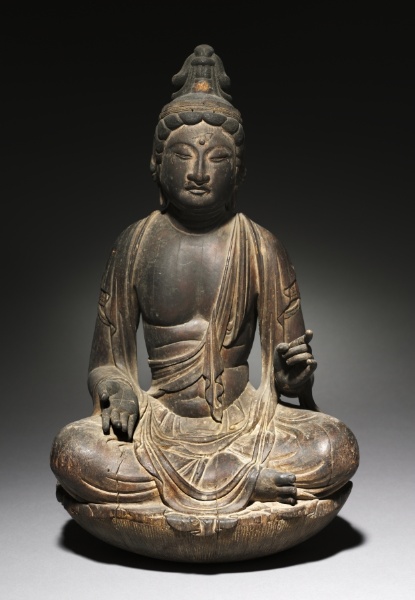
Cleveland 1961.48: a 46.7 cm seated Nikkō Bosatsu in Japanese nutmeg-yew (kaya) wood, c. 800. The proper-left hand is raised at chest level — the position for the now-lost sun-disc attribute. Originally one of two flanking attendants of a Yakushi Nyorai; the central Buddha and the Gakkō Bosatsu twin are not at Cleveland.
Cleveland 1961.48 is a c. 800 seated Nikkō Bosatsu (Sun Bodhisattva) in Japanese nutmeg-yew wood, 46.7 cm tall. The figure was once one of two flanking attendants of a Yakushi Nyorai (the Medicine Buddha); the central Buddha and the paired Gakkō Bosatsu (Moon Bodhisattva) are both lost, and the disc-attribute that names Nikkō is gone too.
What is in front of the viewer
The figure is small and dense. At 46.7 centimetres seated, the Cleveland Nikkō is roughly the size of a folded coat across the lap, and the carving is single-block: head, torso, lap, and the visible portions of the lotus base appear to be worked from one piece of nutmeg-yew (kaya, Torreya nucifera), a hardwood the early Heian workshops favoured for its tight, even grain.1 The block runs vertically. The grain pattern is legible across the front of the chest and the inside surfaces of the lap, where pale parallel striations rise through the surface as fine darker lines. The overall colour reads as a warm honey, slightly cooler at the lap, slightly warmer at the chest and shoulders.
The figure is seated cross-legged in full lotus, the soles turned up, the knees splayed wide enough to make the lap a broad platform. The hand programme is asymmetric: the proper-right hand rests at the lap, the fingers softly closed; the proper-left hand is raised, the elbow bent and the hand held at chest level with the fingers loosely curled. The raised left hand is the iconographically loaded one. Its position is the conventional one for holding a long-stemmed sun-disc attribute (nichirin, sūrya-maṇḍala) at chest height, the stem rising from a closed-fingered grip and the disc presented at face level for the viewer; nothing now survives in or above the hand. Whether the attribute was a separate carved or cast piece pegged into the closed fingers, or an applied painted disc on a stem now lost, is not resolvable from the published photograph alone.
The shoulders are rounded and substantial. The head is small relative to the body, a proportional choice that reads as deliberately compact rather than as workshop error, and the face is broad-cheeked and unsmiling. The eyes are nearly closed, with the lids carved as soft horizontal arcs rather than as the sharper almond shapes of the earlier Asuka-Hakuhō vocabulary. A simple low rounded crown sits high on the head, plain on its outer surface, with no openwork and no surviving jewel at the apex.
The robes are a princely-form bodhisattva costume: a sash crossing the left shoulder and falling diagonally across the chest, a long lower garment gathered at the waist and falling between the knees in low parallel folds, scarves looping at the elbows. The drapery system is carved rather than modelled: the folds are shallow ridges with flat planes between them, a style closer to the Jōgan-period (early Heian, ninth century) hardwood vocabulary than to the more deeply modelled Tang-derived Nara conventions that precede it.2
The diagnostic name for this convention is honpa-shiki (翻波式, “rolling-wave style”), in which the alternation of taller and shallower parallel ridges across the lap reads at distance as a rhythmic patterned surface; the Cleveland Nikkō shows the honpa alternation faintly across the front of the lap, more clearly across the inside of the right thigh.
Two passages of the surface deserve a slow look. First, the wood-grain itself is visibly part of the finished surface. Cleveland’s catalog identifies this as a Japanese workshop innovation: where the Tang-period continental practice was to bury the wood under thick layers of lacquer ground, pigment, and gold leaf, the early Heian ichiboku workshops chose to leave the carved hardwood readable through a thinner finish, so that the grain of the kaya block becomes visual material in the finished icon.3 The traces of colour and gold survive only at sheltered locations: faint pigment in the sash folds, occasional gold-leaf flecks at the recess of the chest sash. The bulk of the figure now reads as exposed dark-toned wood, with visible age-cracking along the lower edge of the lotus base.
Second, the iconographic completion of the figure is incomplete. A Nikkō Bosatsu is conventionally completed by a sun-disc (typically a small red or red-orange disc on a long stem held in or above the open palm, the disc itself often carrying a three-legged crow). On the Cleveland figure the raised proper-left hand is in the position to have held that attribute, and is now empty; whether the disc was a separately carved piece lost in the same dispersal that separated the figure from its central Yakushi and its Gakkō twin, or a painted/applied disc that did not survive, is undocumented. The article’s identification of the surviving figure as Nikkō rather than Gakkō therefore rests on Cleveland’s catalog assignment rather than on a visible diagnostic on the figure.4
What the figure is not is a free-standing bodhisattva on its own iconographic terms. The seated cross-legged pose, the lap-and-raised hand programme with the chest-level attribute position, and the modest scale all read as an attendant configuration: a figure carved to flank a larger seated Buddha at a distance of perhaps a metre or two within a triadic altar programme. Cleveland’s reading that the work originally flanked a Yakushi Nyorai with a paired Gakkō Bosatsu on the opposite side is the iconographic identification that organizes everything else; the body of this article works through what the identification commits to and what it leaves open.
The Yakushi triad and the Bhaiṣajyaguru cult
A Yakushi triad (薬師三尊, Yakushi sanzon) is the canonical Japanese Buddhist visual format for the Medicine Buddha and his two principal bodhisattva attendants. The central figure is Yakushi Nyorai (薬師如来, Skt. Bhaiṣajyaguru, the “Master of Medicines”); the proper-right attendant is Nikkō Bosatsu (日光菩薩, Skt. Sūryaprabha, “Sunlight Bodhisattva”); the proper-left attendant is Gakkō Bosatsu (月光菩薩, Skt. Candraprabha, “Moonlight Bodhisattva”). The triad is one of the four canonical Buddha-and-two-bodhisattvas configurations in Japanese Buddhism, alongside the Shaka triad, the Amida triad, and the Miroku triad in some recensions.5
The doctrinal ground for the cult is the Bhaiṣajyaguru-pūrvapraṇidhāna-sūtra (Yakushi Sūtra), which records the Twelve Vows the Medicine Buddha made before attaining buddhahood: vows to heal the sick, to feed the hungry, to clothe the naked, to release prisoners, to lead the lost. The sūtra exists in multiple Sanskrit and Chinese recensions; the East Asian Yakushi cult develops principally from Xuanzang’s mid-seventh-century Chinese translation, transmitted to Japan in the late seventh century alongside the broader Tang Buddhist canon.6
The Twelve Vows organize the doctrinal content; the visual content is organized around the triadic format and the Twelve Yakṣa Generals (Jūni Shinshō, 十二神将), the protective retinue that the larger Yakushi programmes add as a peripheral guard.
Nikkō and Gakkō are the cosmological brackets of the cult. The Sun Bodhisattva carries the daylit half of the world; the Moon Bodhisattva carries the night. Together they constitute the diurnal totality across which the Medicine Buddha’s healing reaches every being at every hour. The doctrinal logic is older than the Buddhist context: Sūryaprabha and Candraprabha derive from earlier Indian solar and lunar deity types, but the East Asian Buddhist appropriation locates them as the institutional bracketing attendants of the Yakushi cult specifically. There are no significant surviving examples of a paired Nikkō and Gakkō outside that triadic context.7 The Cleveland figure’s iconographic identification therefore commits the museum to a Yakushi-triad reading.
The hand programme on the Cleveland figure is consistent with this reading at the level of the iconographic frame, though the specific configuration deviates from the lap-resting variant. The Cleveland figure carries one hand at the lap and one hand raised at chest level in the disc-bearing position; the Yakushi-ji Kondō Hakuhō bronze pair stands rather than sits and uses a comparable raised-hand-with-disc configuration at monumental scale. What the Cleveland figure does not match is the alternate seated-attendant convention in which both hands rest at the lap with the disc cradled in an open palm — that convention exists across the corpus but is not what the Cleveland piece shows. The figure is the chest-level-attribute variant at portable altar scale.8
The Yakushi-ji canonical programme and its Heian descent
The institutional anchor for any Heian Yakushi triad reading is the Yakushi-ji programme at Nara. Yakushi-ji was founded by Emperor Tenmu in 680 to invoke the Medicine Buddha’s healing for the recovery of his consort Empress Jitō; the temple was consecrated in 698 and moved to its present site in Heijō-kyō (Nara) in 718. The Kondō (Main Hall) houses the seated Yakushi Nyorai with flanking standing Nikkō and Gakkō Bosatsu, all in gilt bronze, traditionally dated to the late seventh or early eighth century, with the dating conventionally undecided in the scholarly literature.9 By consensus the Yakushi-ji Kondō triad is the canonical Hakuhō-period Yakushi-with-attendants programme in Japan and the iconographic reference against which all subsequent Japanese Yakushi triads are read.
The Hakuhō Yakushi-ji bronze attendants are standing, life-size, with the proper hand programme (right hand for the disc-attribute carried palm-up, left hand at the side or hip), and with the Tang-derived naturalistic body-modelling that characterizes the later Hakuhō and early Nara workshops. The drapery is deeply modelled, the proportions are softened away from the rigid frontal symmetry of the earlier Tori-school vocabulary, the faces carry a calm, open countenance rather than the archaic smile.10
The Cleveland figure is roughly a century later than the Yakushi-ji canonical pair and is wood rather than bronze, seated rather than standing, and at altar-portable rather than monumental scale. The transformation is substantial. The naturalistic Tang-derived body-modelling of the Hakuhō bronzes gives way to the denser, more contained, more carved-ridge surface of the Jōgan-period ichiboku idiom. The standing pose collapses to seated. The deep drapery modelling flattens to the parallel-ridge honpa-shiki convention. The bronze production process (wax model, mould, cast, chase, gild) gives way to the single-block carving process in which the iconography is found within the wood rather than built up over a model.11
What survives is the iconographic core: a princely-form bodhisattva attendant in calm hand programme, the disc-attribute identifying as solar or lunar, the triadic configuration around a central Yakushi Buddha. What changes is everything about how the figure is materially produced and stylistically rendered.
The Cleveland Nikkō belongs to the early Heian wood-sculpture moment that the Jingo-ji Yakushi (early ninth century, Kyoto), the Gangō-ji Yakushi (early ninth century, Nara), and the Tō-ji Kōdō Yakushi (839, Kyoto) define institutionally. These named-temple Heian Yakushi triads are larger and more elaborately preserved than the Cleveland piece; they retain documentation of their original temple context. The Cleveland figure is plausibly read as a smaller-altar version of the same iconographic and stylistic moment, produced for a less institutionally documented commission and dispersed from its original context in the centuries since.12
The wood, the workshop, and what kaya makes possible
Cleveland’s medium line is precise. Kaya (榧, Torreya nucifera) is a slow-growing softwood-resembling hardwood native to the Japanese archipelago, with an unusually fine, even, straight grain and a low rate of dimensional change across humidity cycles. The early Heian ichiboku workshops used three principal woods: kaya, hinoki (Japanese cypress), and katsura (Japanese Judas-tree).
Kaya takes the chisel cleanly, holds fine carved detail across small radii, and ages to the warm honey-pale colour the Cleveland figure shows. The choice of kaya for the Cleveland figure is consistent with high-status early Heian wood-sculpture practice: kaya is the more expensive and more difficult to source of the three, and its use signals an above-baseline workshop commission.13
The single-block construction (ichiboku-zukuri, 一木造) is the structural signature of the period. Where the late Heian Jōchō workshop will introduce yosegi-zukuri (寄木造, joined-block construction) in the eleventh century to enable larger figures from multiple smaller blocks, the early Heian convention is to find the figure within a single block of dense hardwood. For a 46.7 cm seated figure the ichiboku method requires a block roughly 50 cm tall by 35 cm wide by 30 cm deep, taken from a kaya trunk of corresponding diameter, and the carving proceeds inward from the four faces of the block toward the locked central form.14
The visible vertical grain on the Cleveland figure (running pale-and-dark across the chest and the inside of the lap) is the trunk’s own growth pattern preserved through the carving, a confirmation that the working method was inward-from-the-block rather than additive-on-a-core.
The visible grain as a finished surface is the reading the Cleveland catalog text foregrounds. The continental Tang-period convention buried the wood: a thick kokuso (lacquer-and-fibre paste) ground over the carved surface, polychrome pigment laid over the ground, gold leaf or kirikane (cut gold leaf) applied over the pigment. The Heian ichiboku workshops thinned this finish programme. A lighter ground, a thinner pigment layer, a more selective gold application: the result is that the carved hardwood remains readable through the finish, and the wood-grain becomes part of the visual material of the icon rather than its hidden substrate.15
Whether the present surface is the original finish state or the consequence of nine centuries of sheltered exposure that has worn away most but not all of a thicker original programme is the question the catalog text does not fully resolve. The Japanese-workshop-innovation reading favours the former; the conventional preservation reading favours the latter; the truth is probably some of both.
The workshop is not recorded. The early Heian wood-sculpture corpus carries very few documented workshop attributions; the Tō-ji Kōdō programme (839) is one of the rare named cases, and even there the named master is inferred from temple records rather than from inscription on the figures themselves. For Cleveland 1961.48 the honest position is silence: a workshop somewhere in the late-eighth or very-early-ninth-century Kinai, plausibly attached to a Nara-derived temple lineage rather than to the more recently founded Heian-kyō (Kyoto) temples, working in the Jōgan-period wood-sculpture vocabulary with high-status kaya material and a thinned-finish surface programme. More specific attribution would require institutional research that has not been done on this piece.16
Provenance, dispersal, and the lost twin
Cleveland’s published provenance for 1961.48 records the John L. Severance Fund acquisition in 1961 and is silent on prior collection history, dealer source, and the temple holding from which the figure originated. The work entered Cleveland during the late Sherman Lee curatorial period, a moment when the museum was building one of the principal U.S. Asian-art collections through a combination of major acquisition funds and active dealer relationships in Tokyo, Kyoto, and New York. The Severance Fund, established by the 1936 bequest of John L. Severance, has been one of Cleveland’s principal vehicles for early Japanese sculpture acquisitions since the late 1940s.17
The dispersal trajectory by which a c. 800 wood Yakushi-triad attendant arrives in a U.S. museum without recorded provenance follows a recognizable pattern. Heian-period wood Buddhist sculpture in private circulation entered the international art market in two principal waves.
The first was the Meiji-period dispersal: the 1868 shinbutsu bunri edicts that separated Shintō shrines from their attached Buddhist temples produced an immense displacement of Buddhist material, but the deeper effect for Heian-period figures came from the early-Meiji rationalization of the Buddhist temple system itself, which closed many smaller temples and dispersed their holdings into the dealer market. The second wave was the early-twentieth-century period, when major Japanese collections passed into international circulation via Yamanaka and Co., Matsuki Bunkyo, and a handful of other dealers connecting the Japanese market to Boston, New York, Chicago, and Cleveland.18
The Cleveland Nikkō almost certainly entered international circulation through one of these two waves and reached Cleveland through a dealer transaction the published catalog page does not document. The triadic dispersal is the more striking story. The central Yakushi Nyorai and the paired Gakkō Bosatsu have not surfaced in the public catalog literature consulted for this article.
They may survive in another collection (temple, museum, or private holding) without their identification as siblings of the Cleveland figure being known; they may have been lost in the Meiji-period or early-twentieth-century displacement; the Yakushi may have been the figure that remained in its original temple while the attendants were dispersed. The honest position is that the original triadic context is iconographically reconstructible (a c. 800 Kinai workshop produced a Yakushi triad of which Cleveland 1961.48 is the surviving Nikkō attendant) but institutionally lost.19
Where the reading is honestly thin
Three substantive uncertainties remain at the close of this article, and the patient-observer voice requires they be named rather than papered over.
First, the iconographic identification as Nikkō rather than Gakkō rests on Cleveland’s catalog assignment. The diagnostic attribute that would distinguish the two (the sun-disc with its red-orange colour and conventional three-legged crow versus the moon-disc with its hare or cassia tree) is not present on the surviving figure. The proper-left hand is raised at chest level in the position consistent with having held a long-stemmed disc-and-stem attribute, but the disc itself is gone, and which side the figure was on within its original triadic configuration cannot be deduced from the hand programme alone (across the corpus, the disc-bearing hand varies between proper-right and proper-left recensions).
Cleveland’s identification may rest on documentary evidence not surfaced in the public catalog text, on stylistic analysis of the figure’s surviving features, or on a curatorial reading at acquisition. Without access to the curatorial documentation behind the catalog identification, the article treats Cleveland’s reading as authoritative without being able to verify it against a visible attribute.20
Second, the workshop and temple of origin are unrecorded. The figure is plausibly assigned to a Kinai-region workshop in the late-eighth or very-early-ninth-century ichiboku tradition working in kaya with a thinned-finish programme; finer assignment is not available from the published record. Whether the work originated in a Nara-region or Kyoto-region temple holding, whether it was commissioned for a major institutional altar or a smaller aristocratic household altar, none of these questions are answerable from the present documentation.
Third, the surface preservation is honest about its losses. The visible wood-grain treatment that Cleveland reads as a Japanese workshop innovation is consistent with the Jōgan-period thinned-finish convention, but the question of how much of the original pigment-and-gold programme has been worn away across the centuries is not fully resolvable from the published photograph. The traces of colour and gold survive only at sheltered locations; whether the original surface was substantially polychromed and gilded with the Heian thinned-finish convention, or substantially closer to the bare-wood reading the present surface suggests, would require pigment analysis and surface examination that have not been published. The Japanese-workshop-innovation reading and the long-wear-loss reading are both consistent with the visible state.21
What can be said firmly is what survives and what the documentary record commits to. A 46.7 cm seated Nikkō Bosatsu in kaya wood, c. 800, of ichiboku-zukuri construction, with traces of original polychrome and gilding, originally one of two attendants of a Yakushi triad in a Kinai-region workshop commission, separated from its central Buddha and its paired Gakkō attendant in an undocumented dispersal, acquired by Cleveland in 1961 through the John L. Severance Fund.
The Yakushi-ji Kondō Hakuhō bronze triad is the canonical reference; the Jingo-ji, Gangō-ji, and Tō-ji Kōdō Heian wood Yakushi triads are the institutional Kinai comparanda; the Yakushi Sūtra corpus is the doctrinal ground; the Twelve Vows, the Twelve Yakṣa Generals, and the diurnal-totality bracketing of Nikkō-and-Gakkō are the cult’s organizing content. The Cleveland figure carries that content forward, in a single block of nutmeg-yew, separated from its programme but legible against it.22
Related
- An Asuka-period gilt-bronze Kannon at Cleveland
- Kannon Kakebotoke: a Nanbokuchō hanging-Buddha plaque at Cleveland
- Jūichimen Kannon: eleven heads and the canonical stack
- Senju Kannon: reading the thousand arms
Footnotes
-
Cleveland Museum of Art, accession 1961.48, “Sun Bodhisattva (Nikkō Bosatsu),” Japan, Heian period (794–1185), c. 800; Japanese nutmeg-yew wood with traces of color and gold; classification Sculpture; height 46.7 cm. Credit line: John L. Severance Fund. Public Domain / CC0 (Cleveland Open Access). Catalog page accessed 2026-04-26. The published record does not include a workshop attribution, a temple-of-origin assignment, or a documented provenance history; the iconographic identification of the figure as Nikkō Bosatsu and the original triadic context (one of two attendants of a Yakushi Nyorai) are Cleveland’s. The accession is single (no .a / .b component split); the central Buddha and the paired Gakkō Bosatsu are not at Cleveland. ↩
-
For the early Heian (Jōgan-period) hardwood-sculpture drapery vocabulary as the carved-ridge honpa-shiki (翻波式, “rolling-wave style”) successor to the more deeply modelled Tang-derived Nara conventions, see Nishikawa Kyōtarō and Sano Emily J., The Great Age of Japanese Buddhist Sculpture, AD 600–1300 (Japan House Gallery / Kimbell Art Museum, 1982), Nishikawa’s introductory essays. The honpa convention (alternation of taller and shallower parallel ridges) is the diagnostic surface marker for ninth-century ichiboku-zukuri sculpture, persisting through the early tenth century before the Heian style softens further toward the Jōchō workshop conventions of the later Heian period. ↩
-
Cleveland’s catalog text for 1961.48 reads the visible wood-grain treatment as a Japanese workshop innovation. The reading aligns with the broader scholarship on the Jōgan-period turn to dense single-block hardwood (kaya, hinoki, katsura) as carrying iconographic and not merely structural significance: the wood is part of the icon, not only its substrate. See Nishikawa and Sano 1982 for the technical and stylistic frame; Mizuno Seiichi, Asuka Buddhist Art: Hōryū-ji (Heibonsha / Weatherhill, 1974), for the longer Asuka-Hakuhō-Nara-Heian sculptural sequence into which the early Heian wood-sculpture turn fits. ↩
-
The iconographic completion for a Nikkō Bosatsu is a sun-disc (Skt. sūrya-maṇḍala; Jp. nichirin, 日輪), conventionally a small red or red-orange disc on a long stem held in or above an open palm, the disc itself frequently inscribed or applied with a three-legged crow (sangaisei, the East Asian solar emblem). The paired Gakkō Bosatsu carries a moon-disc (candra-maṇḍala; gachirin, 月輪) in the corresponding position, conventionally with a hare or a cassia tree. The disc-bearing hand is variable across the surviving Yakushi-triad corpus: in some recensions the proper-right hand carries the attribute (the standing Yakushi-ji Kondō Hakuhō bronze pair is the canonical reference for that arrangement); in others, the raised hand at chest level is the proper-left, with the proper-right resting at the lap. On the Cleveland figure the raised hand is the proper-left, with closed-finger curl at chest height in the position consistent with having held a long-stemmed disc-and-stem attribute now lost. No surviving disc, stem, or visible socket-mortise is documented in the published photograph; high-resolution photography of the closed fingers might reveal the original mounting hardware. The identification of the work as Nikkō rather than Gakkō therefore rests on Cleveland’s catalog assignment rather than on a visible diagnostic on the surviving figure. ↩
-
For the four canonical Japanese Buddhist triadic formats (the Shaka triad with Monju and Fugen; the Yakushi triad with Nikkō and Gakkō; the Amida triad with Kannon and Seishi; the Miroku triad in some recensions), see Mizuno 1974, the early chapters on the Asuka and Hakuhō triadic programmes. The Yakushi triad has the deepest documented institutional history of the four in early Japan, with the Yakushi-ji Kondō Hakuhō-period bronze triad as the canonical Japanese reference and the Hōryū-ji 607 Yakushi (traditionally Tori-busshi) as the earliest documented single Yakushi figure in Japan. ↩
-
For the Bhaiṣajyaguru-pūrvapraṇidhāna-sūtra (Yakushi Sūtra) corpus, the Twelve Vows of the Medicine Buddha, the Twelve Yakṣa Generals (Jūni Shinshō) as protective retinue, and the East Asian transmission via Xuanzang’s mid-seventh-century Chinese translation, see Raoul Birnbaum, The Healing Buddha (Shambhala, 1979; revised Shambhala 1989), particularly chapters 1–3. Birnbaum’s monograph remains the standard English-language treatment of the cult’s doctrinal and devotional content. The Sanskrit Gilgit recension and the Indian textual genealogy are treated in Gregory Schopen, The Bhaiṣajyaguru-Sūtra and the Buddhism of Gilgit (Australian National University doctoral dissertation, 1978), the standard primary-text scholarly reference. ↩
-
For the Indian-religious genealogy of Sūryaprabha and Candraprabha as solar and lunar deity types appropriated into the Buddhist Yakushi cult, see Birnbaum 1979, the introductory chapters on the cult’s pre-Buddhist Indian context. The two figures derive from earlier Vedic and Indian solar / lunar deity types; the Buddhist Yakushi-cult appropriation locates them institutionally as the bracketing attendants of the Medicine Buddha and effectively eliminates their independent cult presence in the East Asian transmission. Surviving East Asian Nikkō and Gakkō figures outside Yakushi-triad contexts are vanishingly rare; the Cleveland figure’s separation from its triad is the dispersal of an attendant from its programme rather than the survival of a free-standing devotional image. ↩
-
For the seated and standing bodhisattva attendant hand-programme variants in the Yakushi-triad corpus (the Yakushi-ji Kondō Hakuhō standing pair with raised disc-bearing hand; the seated-attendant lap-resting variant with disc cradled in an open palm; the seated-attendant chest-level-attribute variant the Cleveland figure exhibits), see Mizuno 1974 chapters on Hakuhō and Nara-period sculpture and Nishikawa and Sano 1982 on the early Heian seated-attendant tradition. The Yakushi-ji bronze attendants stand rather than sit, but the chest-level disc-bearing hand position is comparable to the Cleveland figure’s raised proper-left hand. The variation across the corpus in which hand carries the disc (proper-right in some recensions, proper-left in others) is documented in the Japanese-language scholarship and is not iconographically diagnostic for the Nikkō / Gakkō distinction in the absence of the disc itself. ↩
-
For the Yakushi-ji Kondō Yakushi triad (seated Yakushi Nyorai with flanking standing Nikkō and Gakkō Bosatsu, gilt bronze, traditionally dated to the late seventh or early eighth century), see Mizuno 1974, the chapter on Hakuhō sculpture, and the institutional documentation at Yakushi-ji. The dating question (whether the surviving figures are the original 680s–698 production transferred from the Asuka-period site or the post-718 production at the Heijō-kyō site) is a long-standing technical question in the Japanese-language scholarship; the consensus position treats the figures as Hakuhō-period in either case, with the more specific dating left open. The Yakushi-ji Tōin-dō Shō-Kannon (gilt bronze, late seventh century) is a closely related Hakuhō standing bodhisattva. ↩
-
For the Hakuhō-period turn from the Tori-school rigid frontal symmetry to a Tang-derived softer naturalism, see Mizuno 1974 chapters 4–5 and Washizuka, Park, and Kang, Transmitting the Forms of Divinity (Japan Society, 2003). The Yakushi-ji bronze triad is the canonical Hakuhō reference; the Hōryū-ji Tachibana shrine triad (651) marks the early stages of the same naturalistic turn at small bronze scale. The Cleveland Nikkō inherits the Hakuhō body-modelling and pose vocabulary at one remove, mediated by a century of intervening Nara-period continental-style production and a generation of early Heian wood-sculpture rethinking. ↩
-
For the early Heian (Jōgan-period, ninth-century) turn from Nara-period cast bronze and dry lacquer (dakkanshitsu) production to dense single-block hardwood (ichiboku-zukuri, 一木造) sculpture, see Nishikawa and Sano 1982, particularly Nishikawa’s introductory essays on the Jōgan period. The turn is partly economic (large bronze casting was prohibitively expensive after the Tōdai-ji Daibutsu programme), partly institutional (the early Heian temples favoured smaller and more numerous figures over the Nara-period monumental commissions), and partly stylistic (the kaya and hinoki hardwoods admitted the new dense, compact, carved-ridge surface that defines the Jōgan idiom). The Cleveland Nikkō belongs to this transition. ↩
-
For the early Heian Kinai-region wood-sculpture Yakushi corpus (the Jingo-ji Yakushi, the Gangō-ji Yakushi, and the Tō-ji Kōdō Yakushi with their attendant programmes), see Nishikawa and Sano 1982 and the broader treatment in Mizuno 1974 and Washizuka 2003 as they extend into the early Heian period. These are the institutional comparanda for what a high-status early Heian Yakushi commission looked like in wood; the Cleveland piece reads against them as a smaller-altar variant of the same iconographic moment. ↩
-
For kaya (Japanese nutmeg-yew, Torreya nucifera) as a slow-growing fine-grained hardwood prized by the early Heian ichiboku workshops for its straight even grain, low dimensional change, clean chisel-take, and warm honey-pale ageing colour, see Nishikawa and Sano 1982. The three principal early Heian wood choices (kaya, hinoki, katsura) each carry distinct working and surface properties; kaya is the most expensive and most difficult to source, and its use on a small figure such as the Cleveland Nikkō signals an above-baseline workshop commission. The Tōdai-ji Hokke-dō and the Tō-ji Kōdō programmes use kaya as the principal material for the high-status Jōgan-period figures. ↩
-
For ichiboku-zukuri (一木造, single-block construction) as the structural method of early Heian Buddhist sculpture (the figure carved inward from the four faces of a single hardwood block, before the late-Heian Jōchō workshop introduces yosegi-zukuri in the eleventh century), see Nishikawa and Sano 1982 and the broader technical treatment in Mōri Hisashi’s standard Sculpture of the Kamakura Period (Heibonsha / Weatherhill, 1974), which retrospectively treats the ichiboku-zukuri preceding tradition. The single-block convention constrains the maximum achievable size to the available trunk diameter and creates the dense, compact, contained body silhouette that distinguishes Jōgan-period sculpture. ↩
-
For the early Heian thinning of the continental Tang-period thick-lacquer-and-pigment surface programme (leaving the carved hardwood readable through a lighter ground, thinner pigment, and more selective gold application), see Nishikawa and Sano 1982. The reading that the visible wood-grain becomes part of the iconographic surface rather than its hidden substrate is one of the foregrounded interpretive moves in the Jōgan-period scholarship; it is a Japanese workshop innovation in the Cleveland catalog’s sense (a departure from the continental convention), though the question of whether the visible grain is original intent or post-original wear is rarely fully resolvable on a specific figure without technical analysis. ↩
-
For the documented workshop attribution problem in early Heian wood sculpture (the Tō-ji Kōdō programme of 839 as one of the rare named cases, and the broader silence of the corpus on workshop and named-master identification), see Nishikawa and Sano 1982. The Cleveland Nikkō carries no inscription, no documented dedicatory record, and no published institutional history that would tighten the workshop attribution beyond the period-and-region inference. The honest reading is a Kinai-region workshop in the late-eighth or very-early-ninth-century ichiboku tradition, working in kaya with a thinned-finish programme. ↩
-
The John L. Severance Fund was established by the 1936 bequest of John L. Severance, the Cleveland industrialist and major museum benefactor. The fund has been one of Cleveland’s principal vehicles for early Asian-art acquisitions since the late 1940s; the 1961 acquisition of accession 1961.48 occurred during the late curatorial period of Sherman Lee (Cleveland director from 1958 to 1983), when the museum was assembling one of the principal U.S. Asian-art collections through the major acquisition funds and active dealer relationships in Tokyo, Kyoto, and New York. No further provenance documentation for the work is published on Cleveland’s catalog page; the standard provenance disclaimer applies. ↩
-
For the two principal waves of Heian-period Buddhist sculpture dispersal into the international art market (the Meiji-period temple-system rationalization following the 1868 shinbutsu bunri edicts and the early-twentieth-century circulation through Yamanaka and Co., Matsuki Bunkyo, and other dealers connecting Japan to U.S. and European collections), see the broader institutional histories of the Met, MFA Boston, Cleveland, AIC, and Asian Art Museum (San Francisco) Asian collections. The Cleveland Nikkō’s 1961 acquisition date is consistent with the second-wave dealer-mediated trajectory; the absence of published provenance documentation is the standard documentary condition for Heian wood sculpture acquired through this pattern. ↩
-
The triadic dispersal pattern (central Buddha and paired attendants separated and held in different institutional holdings or lost) is widespread in the early Heian wood corpus. For the Cleveland Nikkō, the central Yakushi Nyorai and the paired Gakkō Bosatsu have not surfaced in the public catalog literature consulted for this article; they may survive in another collection without the sibling identification being known, they may have been lost in the Meiji-period or twentieth-century displacement, or the Yakushi may have remained in its original temple while the attendants were dispersed. More thorough institutional research, particularly through the Japanese-language temple and museum literature, might recover the central Buddha or the paired attendant; the present article leaves the question open. ↩
-
Without the diagnostic disc-attribute (sun-disc with three-legged crow for Nikkō; moon-disc with hare or cassia tree for Gakkō), the iconographic identification of an isolated Yakushi-triad attendant rests on indirect evidence. Cleveland’s catalog identifies 1961.48 as Nikkō; the basis for the identification (documentary evidence not surfaced in the public catalog text, stylistic reading, or curatorial reading at acquisition) is not stated. The article treats Cleveland’s reading as authoritative without being able to independently verify it against a visible diagnostic on the surviving figure. A pigment-residue analysis of the raised proper-left hand might recover trace evidence of an original disc-attribute mounting; a high-resolution photographic survey of the closed-finger curl at chest level might reveal a peg-socket or mortise for a separately carved disc-and-stem piece. Neither pass is currently published. ↩
-
The two readings of the visible bare-wood-with-grain surface (the Cleveland-catalog reading of original Japanese workshop innovation and the conventional preservation reading of originally substantial polychrome and gilding worn down across centuries) are both consistent with the surviving evidence. The truth is almost certainly some of both: the early Heian ichiboku convention does support a thinner original finish than the continental Tang precedent, and the Cleveland figure shows pigment and gold traces only at sheltered locations consistent with normal wear of a thinned but real original surface programme. Pigment analysis and high-resolution surface examination would tighten the reading; neither has been published for this accession. ↩
-
As of 2026-04-26, no Wikidata item specifically identifying the Cleveland 1961.48 Nikkō Bosatsu was located. The Wikidata coverage of the Cleveland Museum of Art’s Japanese sculpture collection is uneven; the major works are well-itemized but the smaller Heian holdings, including this Nikkō, are not. The relevant umbrella Wikidata items are Q864425 (Bhaiṣajyaguru / Yakushi Nyorai) and the Sūryaprabha entries surfaced via Q-search. ↩
Sources
-
Cleveland's catalog records the work as 'Sun Bodhisattva (Nikkō Bosatsu),' Japan, Heian period (794–1185), c. 800; Japanese nutmeg-yew wood with traces of color and gold; classified as sculpture; height 46.7 cm. Credit line: John L. Severance Fund. Public Domain (CC0). The descriptive text notes that the figure was originally paired with a Moon Bodhisattva (Gakkō Bosatsu) and likely flanked a Medicine Master Buddha (Yakushi Nyorai); Cleveland reads the visible wood-grain treatment as a Japanese workshop innovation. The accession is single (no .a / .b component split); the central Buddha and the paired attendant are not at Cleveland.
-
Birnbaum's monograph on the Bhaiṣajyaguru (Yakushi Nyorai, Medicine Buddha) cult: the Bhaiṣajyaguru-pūrvapraṇidhāna-sūtra (Yakushi Sūtra) corpus, the Twelve Vows, the Twelve Yakṣa Generals, and the institutional history of Yakushi worship in India, China, and Japan. Standard English-language reference; revised Shambhala 1989.
-
Mizuno's English-language survey of Asuka and early Hakuhō sculpture, with substantive treatment of the Yakushi-ji canonical programme as the bridge between the Asuka-Hakuhō Tori-school vocabulary and the Nara-period Tang-derived idiom. Cited for the Yakushi-ji bronze triad as the canonical Hakuhō Yakushi-with-Nikkō-and-Gakkō reference.
-
Standard English-language reference for the Korean-Japanese sculptural transmission of the late 6th and 7th centuries, with chapters extending into the early Heian transition. Cited for the comparanda discussion.
-
McCallum's monograph on the Zenkōji Amida triad; treats the broader Asuka-into-Heian transitional iconographic vocabulary and the wood-sculpture turn that follows the Hakuhō and Nara bronze production.
-
Nishikawa's introductory essays on the early Heian ichiboku-zukuri (single-block) idiom and the Jōgan-period transition to dense, single-block hardwood figures are the key technical reference for the period the Cleveland Nikkō belongs to.
-
Schopen's doctoral dissertation on the Bhaiṣajyaguru-pūrvapraṇidhāna-sūtra in its Sanskrit Gilgit recension and the early Indian Buddhist context of the Medicine Buddha cult.
-
Yakushi-ji's Kondō (Main Hall) seated Yakushi Nyorai with flanking Nikkō and Gakkō Bosatsu (gilt bronze, traditionally dated to the late 7th or early 8th century, the foundational Hakuhō-period Yakushi-triad programme in Japan). The Tōin-dō Shō-Kannon (gilt bronze, late 7th century) is a related canonical Hakuhō standing bodhisattva. Cited via Yakushi-ji official documentation and the Cultural Heritage Online (Bunka Isan Online) records.
-
Cleveland's published catalog page for 1961.48, accessed 2026-04-26. The page records title (English and Japanese), period, date, medium, dimensions, classification, credit line, and license; provenance is not published. The accession is a single object (no .a / .b component split). The descriptive text identifies the figure's original triadic context (one of two attendants flanking a Medicine Master Buddha) and notes the visible wood-grain treatment as a Japanese workshop innovation.