The Met's Aizen Myōō, 14th-c. Nanbokuchō: red flames, six arms, the lion-crown
- Title
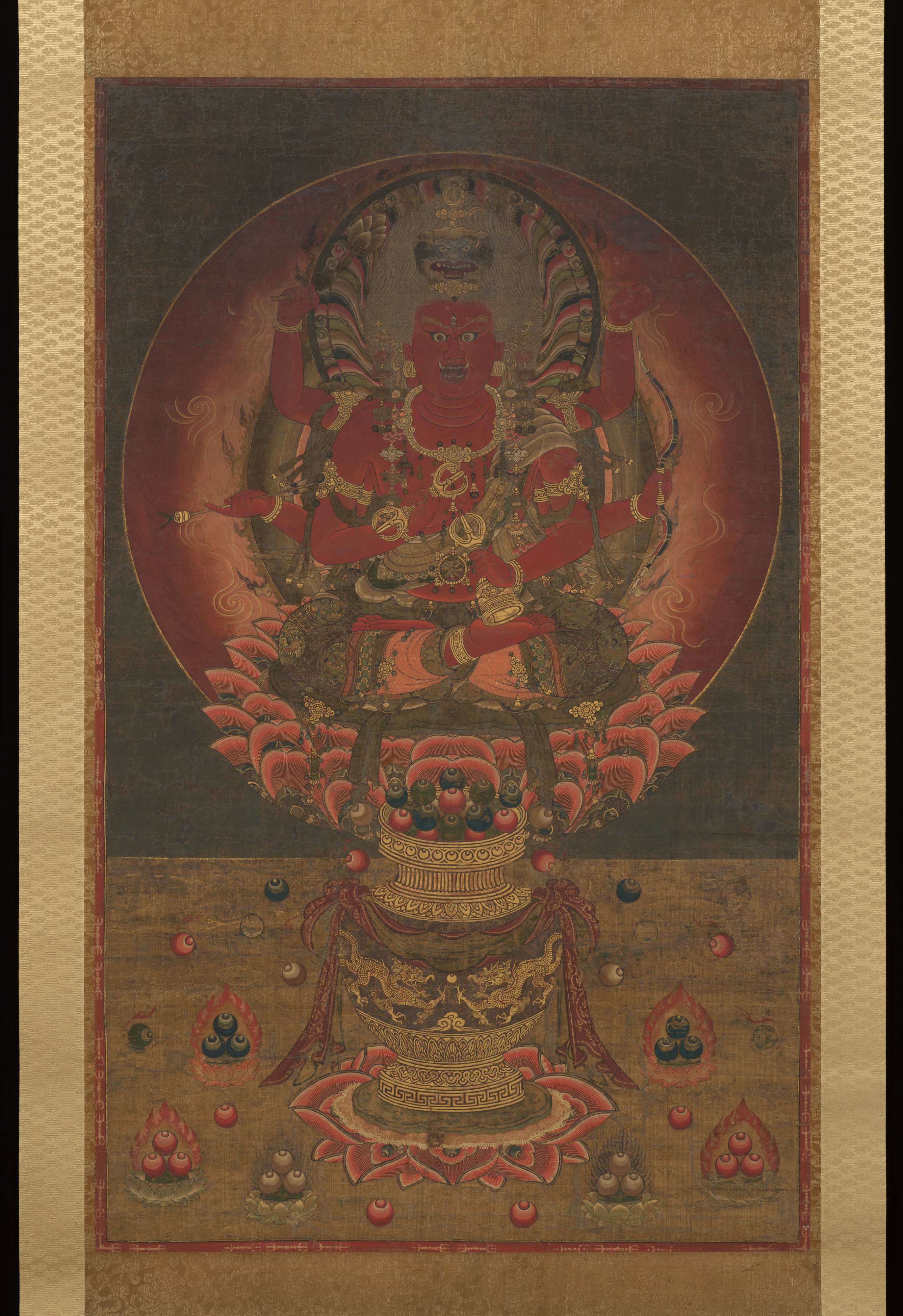
- The Wisdom King Aizen (愛染明王, Aizen Myōō) — Met 66.90, Nanbokuchō, 14th c.
- Period
- Nanbokuchō period (1336–92), 14th century
- Region
- Japan
- Medium
- Hanging scroll; ink, color, gold, and cut gold leaf (*kirikane*) on silk
- Dimensions
- Image: 134.6 × 81.9 cm (53 × 32 1/4 in.). Overall with mounting: 223.5 × 99.7 cm (88 × 39 1/4 in.)
- Collection
- Metropolitan Museum of Art, New York
- Accession
-
66.90 - Rights
- Public Domain. The Metropolitan Museum of Art, Purchase, Mary Griggs Burke Gift, 1966 (acc. 66.90). Met Open Access (OASC).
Met 66.90: Aizen Myōō, Nanbokuchō, 14th c. One of the earliest Mary Griggs Burke gifts to the Met — five decades before the 2015 bequest that completed her transfer of the collection. The work is in the Esoteric-painting register that Sinéad Vilbar's 2013 *Kings of Brightness* essay anchors.
Aizen Myōō (愛染明王, Rāgarāja) is the wisdom king who transmutes passion rather than suppressing it. The name reads literally as “dyed in love”, a Sanskrit-into-Chinese-into-Japanese rendering of Rāgarāja, “the king of rāga,” the king of attachment, desire, the energetic charge of the senses. In the Esoteric programme, the path that the canonical Five Wisdom Kings (Fudō, Gōzanze, Gundari, Daiitoku, Kongōyasha) walk through wrathful protection (defending the Law from external threat), Aizen walks through internal transmutation. The unruly energy of passion, the kleśa that obstructs awakening in the standard Mahāyāna programme, is not extinguished in the Aizen reading. It is dyed.
The Met’s Nanbokuchō hanging scroll of Aizen Myōō (accession 66.90, 14th century, the Mary Griggs Burke Gift of 1966) is one of the major Western-collection holdings of the figure. It is also one of the earliest Burke gifts to the Met, separated from her final bequest by half a century. The work is a fully formed Esoteric-painting specimen: silk hanging scroll with the standard Nanbokuchō kirikane (cut gold leaf) register, the canonical iconographic programme set against the canonical compositional ground.
Red body in red flame
The first visual register is colour and field. The deity is rendered in saturated vermilion against a halo of red flames within an orb of red flames within a variegated outer halo. The body-and-halo system is concentric. The body sits at the centre, the flame-halo immediately surrounds it, and the flame-orb encloses the flame-halo. The painted red of Aizen’s body is the same red family as the painted red of the surrounding flames; the figure and the field do not contrast tonally so much as gradate.
This is a deliberate Esoteric-painting choice. Iconographic-text instruction for Aizen Myōō painting specifies a red body and a red flame field: the deity is meant to read as flame, not as figure-within-flame. The body’s red is the same energetic register as the flame’s red. The figure is of the flame, not merely positioned in it.
The Met curatorial text describes the compositional ground beneath the figure: the deity sits on a multitiered lotus pedestal that hovers above swirling gold clouds, the clouds themselves containing dragons emerging from a rough sea below. Four wish-fulfilling hōju jewels in four colours (red, blue, green, white) fill the four quadrants of the silk field around the deity. This is the canonical Aizen compositional programme: lotus over clouds over dragons over sea, with the four-colour jewel quadrants signalling the four-direction Esoteric mandala framework even on a single-figure hanging scroll.
What the six hands hold
The six-armed Aizen is the most common iconographic variant. Two- and four-armed versions exist, but the six-armed reading is the Japanese Esoteric standard. The Met catalog identifies two of the implements explicitly: the bow and arrow. The full programme, per the standard scholarship (the Smithsonian National Museum of Asian Art teaching reference and the Wikipedia Rāgarāja article summarising the Sanskrit-Tibetan-Japanese tradition), is:
- Bell (ghaṇṭā / kane): the call to awareness, the auditory register that marks ritual attention.
- Vajra (kongō-sho): the diamond-thunderbolt that cuts through illusion. The principal Esoteric implement, present in nearly every wrathful-deity programme.
- Unopened lotus (reni): the bud of unawakened potential, held but not yet opened. The contrast to the bloomed lotus in the standard Buddha programme is deliberate: the lotus in Aizen’s hand is the not-yet-bloomed form, the potential rather than the realisation.
- Bow and arrow (yumiya): the implement of subjugation, shot from the deity toward the worshipper’s obstructing afflictions. Some iconographic traditions show the arrow shot upward into the heavens rather than downward; the Met scroll appears to follow the held-paired register.
- The sixth implement: the iconographic tradition is genuinely undecided here. Some Esoteric texts name a tāmra-kalaśa (copper vessel); others name an indistinct object that the tradition refers to as “sokoraku” (loosely, “that which”) and that advanced Esoteric practitioners are said to see while the uninitiated cannot. The Met scroll’s sixth hand, in the upper-left position above the standard pair, holds an object that is not visually specified, consistent with the tradition’s deliberate iconographic indeterminacy here.
The implement programme is essentially the standard Six-Armed Aizen as it crystallised in Heian Shingon. It is not innovating; it is observing canonical iconographic specification.
Lion-crown, third eye, lotus pedestal
The lion-headed crown rises above the deity’s hair. The lion’s mouth is open, the teeth showing, the wrathful register continuing from the deity’s expression up through the crown ornament. The lion is a Buddhist signifier of regality and ferocity (the lion-throne of the historical Buddha is the canonical use); in Aizen’s iconography the lion specifically encodes royal-wrathful, the deity’s status as a king and as wrath-bearing. The “Rāgarāja” of the Sanskrit name is king-of-rāga; the lion-crown is the visual marker of the king register.
The three eyes (two horizontal in the standard position, one vertical on the forehead) are the wrathful-deity convention shared with Fudō Myōō and the other Wisdom Kings. The vertical third eye, set in the centre of the forehead, sees past the conventional two-eye visual register and into the deeper structures the Esoteric tradition is concerned with. The convention is shared with the Hindu Śiva (whose third eye burns Kāma to ash) and with the Buddhist wrathful programme generally.
The multitiered lotus pedestal is the standard Esoteric throne for the Wisdom Kings. The number of tiers varies (typically three or five, occasionally seven); the Met scroll appears to use the three-tier register. The clouds beneath the lotus, with the dragons emerging from the rough sea, locate the deity in the visionary-cosmic register rather than the temple-floor register. The figure is not sitting in a hall; the figure is sitting in space, above the world of dragons-and-sea, in the canonical Esoteric vision-painting register.
Rāgarāja: passion transmuted, not suppressed
The theological argument the iconography is making is unusually direct. Standard Mahāyāna Buddhism reads rāga (passion, desire, attachment) as one of the three root defilements (kleśa) that obstruct awakening, alongside hatred (dveṣa) and delusion (moha). The standard prescription is to extinguish or transcend passion through monastic discipline, meditative practice, and the cultivation of detachment.
The Esoteric Aizen programme makes a different argument. The same red passion that constitutes rāga is the same red energy that the Esoteric path uses for transmutation. Rāga is not extinguished; it is dyed. The body of the deity is red because passion is red, and the deity is red because the deity is the path that the passion has been transmuted into. The “lust-tainted wisdom king” name (the Sanskrit Rāgarāja translated literally) signals exactly this: the wisdom king is of lust, not opposed to it.
The vow of Aizen, as articulated in the Esoteric texts, is to assist beings, both monastics and lay, in transmuting their unruly passions into spiritual energy. The vow makes the deity accessible to lay practitioners in a way that the more strictly monastic Esoteric programmes are not. Aizen is invoked for matters of attachment and love; the iconographic register’s marriage to the romantic and sensual is not a misreading but the deity’s documented Esoteric purpose. Sinéad Vilbar’s Kings of Brightness in Japanese Esoteric Buddhist Art (Heilbrunn Timeline of Art History, October 2013) articulates the broader Wisdom King logic: wrathful in countenance, staunch protectors of the Buddhist Law, masters of channeling unruly passions toward constructive ends. Aizen is the most direct exemplar of the channeling reading.
The Nanbokuchō kirikane register
Met 66.90 is dated to the 14th century, the Nanbokuchō period (1336–1392) of competing Northern and Southern courts. The Nanbokuchō Esoteric-painting tradition is the natural continuation of the late Kamakura kirikane hanging-scroll register: small geometric cut-gold-leaf passages applied to the silk surface as decorative-and-iconographic ornament on robes, halos, and pedestals.
The Met scroll’s kirikane is most legible in the deity’s robes and the halo edges. The technique is the same as the Kamakura kirikane used on the Kaikei Burke Jizō (Met 2015.300.250, c. 1202, bodhi article), but applied at a different scale and on a different ground (silk rather than lacquered wood). The cut-gold-leaf squares and diagonals on the Aizen scroll’s robes give the surface a fine geometric ornament that the silk-painting alone could not achieve; the gold leaf, applied with animal-glue sizing, sits on top of the silk-painted ground and catches the light at a different angle than the painted passages do.
Nanbokuchō dating for hanging-scroll Esoteric paintings is typically established through three converging methods: stylistic comparison to dated comparanda (the standard art-historical method), the kirikane pattern repertoire (which evolves across the Kamakura → Nanbokuchō → Muromachi periods at a documented pace), and silk and pigment analysis. The Met catalog gives a “14th century” dating with the further “Nanbokuchō” period qualifier; pinning the work to early-Nanbokuchō (1336–1350s) versus late-Nanbokuchō (1370s–1392) would require closer technical examination than the public catalog supports.
The 1966 Burke gift: the long arc
The credit line reads “Purchase, Mary Griggs Burke Gift, 1966.” Mary Griggs Burke (1916–2012) is the same collector whose 2015 bequest gave the Met the major Burke Collection of Japanese and Korean art. The 1966 Aizen Myōō gift falls forty-nine years earlier in her relationship with the Met. It is among her earliest documented gifts to the museum.
The Burke papers at the Met’s Thomas J. Watson Library document the collecting and gifting arc: the 1950s build-out, the 1960s consolidation, the 1970s expansion (the 1970 Kaikei Jizō from Galerie Janette Ostier falls in this phase), the 1980s–1990s deepening, the 2000s curatorial-publication phase, the 2012 death, the 2015 bequest realisation. The 1966 Aizen gift is in the 1960s consolidation phase, early enough that it predates most of the works that would eventually constitute the bequest, late enough that her collecting was clearly serious. The work entered the Met permanent collection via the gift mechanism (the “Mary Griggs Burke Gift, 1966” line) rather than via direct bequest; the technical instrument was a financial gift to the Met that funded the purchase. Burke’s preference for this acquisition mechanism (gift-funded purchase rather than direct donation) is one of the features of her Met relationship that the archive documents.
Reading the 1966 Aizen Myōō and the 2015 Kaikei Jizō (Met 2015.300.250, c. 1202) and the 2013 Senju Kannon embroidery (Met 2013.114, late Muromachi) together: three Burke-circle Esoteric and Buddhist works at the Met, separated by 47 years, covering Kamakura sculpture, late-medieval textile, and Nanbokuchō Esoteric painting. The Burke collecting arc is not concentrated in one medium or period; it spans the major Esoteric-Buddhist-art registers across the medieval and early-modern Japanese period.
What stays open
The work is firm on date, medium, dimensions, public-domain status, and donor mechanism. What is less firm:
- Within-Nanbokuchō dating. Early-Nanbokuchō (1336–1350s) vs. late-Nanbokuchō (1370s–1392) is not settled in the public catalog. Closer technical analysis (kirikane pattern repertoire dating, silk weave analysis, pigment composition) would narrow the window.
- Original temple commission. The hanging scroll was painted for some specific commissioning context: a Shingon or Tendai sub-temple, a private chapel, a court ritual space. The pre-1966 ownership chain (which would name the temple of origin, the deaccession step, and the Burke-acquisition dealer) is not in the public record.
- The sixth implement. The standard six-arm Aizen programme leaves the sixth implement deliberately indeterminate in iconographic-text tradition. The Met scroll observes the indeterminacy; whether the indeterminacy is iconographic intention or pigment loss at this specific point on the scroll is a conservation question the public catalog does not address.
- Workshop attribution. Nanbokuchō Esoteric-painting workshops attached to the Shingon and Tendai monastic institutions are partially documented but not at the granularity of named-painter attribution for unsigned works. The Met scroll is unsigned; workshop attribution is not established.
The work is anchored deeply enough on the iconography, the period, and the acquisition history that a serious reader of Japanese Esoteric painting can use it without these gaps. The gaps are deepening-opportunities, not load-bearing weaknesses.
Related
- Five Wisdom Kings — bodhi disambiguation: Aizen sits outside the canonical Five and is one of the additional Esoteric figures.
- Met 1975.268.6: Godai Myōō handscroll: the canonical Five Wisdom Kings zuzō (iconographic-drawing) handscroll, Packard Collection.
- Daiitoku Myōō: the six-headed Wisdom King: Yama-on-water-buffalo Wisdom King, one of the canonical Five.
- Fudō Myōō iconographic markers: Acala / Immovable Wisdom King, the principal Wisdom King.
- Met 44.842: Heian Fudō Myōō close reading: Heian wood-sculpture Fudō in the Met collection.
- Nyoirin Kannon iconographic markers: wish-granting jewel Kannon, the cintāmaṇi / hōju tradition that the four Aizen scroll jewels invoke.
Sources
-
[1]2026-05-12The Metropolitan Museum of Art, New York collectionapi.metmuseum.org/public/collection/v1/objects/44910Met Open Access API entry. Confirms: accession 66.90; period Nanbokuchō 14th c.; medium hanging scroll ink/color/gold/kirikane on silk; image 134.6 × 81.9 cm; overall 223.5 × 99.7 cm with mounting; classification Paintings; culture Japan; public domain (CC0); credit line 'Purchase, Mary Griggs Burke Gift, 1966'.
-
Met curatorial text (read in a search excerpt; the direct page could not be retrieved): 'Aizen Myōō is a wrathful deity, as suggested by his fearsome expression, his red skin, the bow and arrow he holds in two of his six hands, and the roaring lion's head he wears as a crown.' Names: 'multitiered lotus pedestal that hovers above delicately swirling gold clouds decorated with dragons emerging over a rough sea, surrounded by red, blue, green, and white wish-fulfilling jewels (hōju)' and 'a variegated halo within an orb of red flames.' Names the etymology: 'dyed in love.'
-
Met curatorial essay (October 2013) by Sinéad Vilbar (Department of Asian Art). The scholarly anchor for the Met's Myōō (Wisdom King) holdings, including 66.90. Names the Wisdom Kings (Myōō) as ninth-century imports from China into Japan, channels of wrathful protection and passion-transmutation. The named-scholar reference for any article in the bodhi mikkyō cluster citing Met-curatorial-essay tradition.
-
Encyclopedic synthesis on Rāgarāja / Aizen Myōō: two-, four-, and six-armed variants; the six-armed is the most common; the six implements (bell, vajra, unopened lotus, bow, arrow, and the indistinct sixth that the Esoteric tradition names but does not visually fix); the body's etymology 'lust-tainted wisdom king.'
-
[5]2026-05-12Smithsonian National Museum of Asian Art asia.si.edu/education/educator-resources/encounte…Comparative reference text from the Smithsonian. Reinforces the iconographic programme (red body, lion-crown, three eyes, six arms with bow/arrow/vajra/lotus/bell/indistinct sixth). Useful as a non-Met institutional confirmation of the standard programme.
-
[6]2026-05-12The Metropolitan Museum of Art, Thomas J. Watson Library libmma.org/digital_files/archives/Mary_Griggs_Bu…Met-archive finding aid for the Burke papers. Documents the long arc of Mary Griggs Burke's relationship with the Met from the 1950s onward — the 1966 Aizen Myōō gift falls in the early phase, decades before the 2015 bequest that completed the transfer of the Japanese collection.
-
bodhi disambiguation page distinguishing the canonical Five Wisdom Kings (Fudō, Gōzanze, Gundari, Daiitoku, Kongōyasha) from the related Esoteric figures (Aizen, Ususama, etc.). Aizen sits outside the canonical Five and is one of the additional Wisdom Kings observed in the Shingon and Tendai traditions.