Fudō Myō-ō: sword, lasso, and the asymmetric face
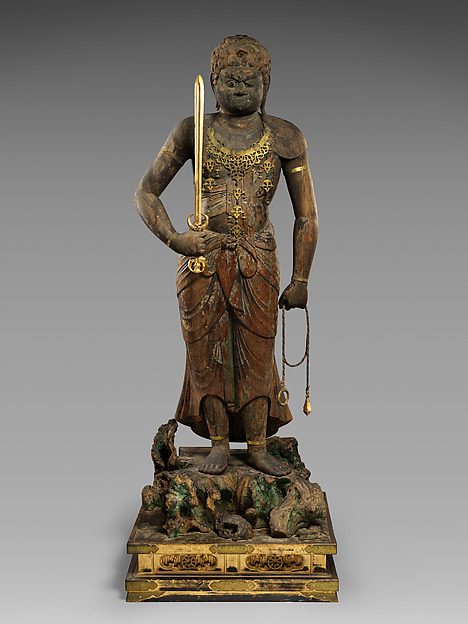
- Title
- Fudō Myōō (Achala Vidyaraja) — 不動明王
- Period
- Heian period (794–1185), 12th century
- Region
- Japan — originally Kuhonji Gomadō, Funasaka
- Medium
- Wood with lacquer, gold leaf, and colour; six-block *yosegi-zukuri* construction
- Dimensions
- H. 162 cm (63 3/4 in.)
- Collection
- The Metropolitan Museum of Art
- Accession
-
1975.268.163 - Rights
- The Metropolitan Museum of Art (Public Domain / OASC). The Harry G. C. Packard Collection of Asian Art, Gift of Harry G. C. Packard, and Purchase, Fletcher, Rogers, Harris Brisbane Dick, and Louis V. Bell Funds, Joseph Pulitzer Bequest, and The Annenberg Fund Inc. Gift, 1975 (1975.268.163).
Met 1975.268.163 (acc. 44842): a 162 cm late-Heian Fudō Myōō, originally the central icon of the Kuhonji Gomadō (Funasaka, twenty miles northwest of Kyoto). The full late-Heian face programme — *tenchigan* eyes, opposed fangs, *henpatsu* braid — and the standard wrathful implements: *kongō-ken* in the right hand, *kenjaku* lasso in the left.
Fudō Myō-ō is the immobile Mikkyō Wisdom King. The Mahāvairocana Sūtra (Taishō 848, Śubhakarasiṃha 725) sets the scriptural baseline: the rock seat, the sword and noose, the henpatsu braid over the left shoulder. The late-9th-century Japanese codification (Annen’s Nineteen Visualizations, the tenchigan asymmetric eye programme, the paired fang asymmetry) is what locks the canonical iconography that runs through the late Heian and Kamakura record.
The most reliable way to read a Japanese Fudō Myō-ō is to know which of the iconographic markers come from the 8th-century Indic-Chinese scripture and which come from the 9th- and 10th-century Japanese ritual codification. The scriptural baseline and the period accretion answer to different sources, and conflating them flattens the iconographic record into a checklist that obscures how the form actually develops.
The scriptural baseline: Mahāvairocana T.848 fascicle 1
The textual anchor for Acala / Fudō iconography is the Mahāvairocana Sūtra (大日経, Dainichi-kyō), preserved in the Taishō Tripiṭaka as number 848, volume 18. The Chinese translation is the work of Śubhakarasiṃha (善無畏, 637–735) and his Chinese disciple Yixing (一行, 683–727), completed in 725 CE. Yixing’s commentary on the same text (Taishō 1796) is where the title Vidyārāja (明王, “Wisdom King”) is first attached as a class designation rather than as one figure’s epithet.
Mahāvairocana fascicle 1 specifies the iconography of Acala / Fudō directly. The figure is described as:
- Seated on a rock seat (banjakuza, 盤石座), not a lotus throne. The rock is iconographically continuous with the figure’s immobility: rooted, unmoving.
- Holding a sword in the right hand and a noose (pāśa, the kenjaku) in the left.
- With hair from the top of the head hanging down on the left shoulder: the henpatsu (弁髪) braid that becomes one of the figure’s secondary diagnostics.
- With one eye fixed: a single-eye-fixity reading, not yet the full asymmetric programme.
- With the mouth biting the upper lip: the early stratum of the wrathful-mouth handling, which the late-Heian codification develops further into the paired-fang asymmetry.
This is the inherited stratum. Anything in the surviving Heian or Kamakura Fudō that traces back to this list is scriptural.
The boy attendants (Kongara and Seitaka) appear in the same scriptural corpus; the early Heian Fudō at the Tō-ji Lecture Hall, completed before the 839 CE eye-opening ceremony, sits squarely in this register: wide-eyed, symmetrical, the wrathful aspect read at the level of the mouth and the sword rather than through the elaborated face programme.
The Japanese codification: Annen and the Nineteen Visualizations
What anchors the canonical Japanese Fudō, in the form most readers will recognise from the late Heian and Kamakura sculptural record, is the late-9th-century ritual codification. The principal scholar is Annen (安然, 841–915), the Tendai monk whose Womb Realm Prescriptional Rites of Fudō (and related ritual texts) systematises the Nineteen Visualizations (十九観) of Fudō, the canonical iconographic checklist used by Japanese Mikkyō practice from his lifetime forward.
Annen is the underweighted name in English-language popular treatments, where the iconographic checklist is presented as if it were timelessly canonical rather than the late-9th-century synthesis it actually is.
Faure, The Fluid Pantheon Volume 1 (Hawai’i 2015), chapter 3, traces the Japanese codification of the Acala / Fudō programme in detail. Two of Annen’s nineteen visualizations matter most for the iconographic reading:
- The asymmetric eye programme, the tenchigan (天地眼, “heaven-and-earth eyes”). The right eye looks up (toward heaven), the left eye looks down (toward earth), sometimes also rendered as right-eye-wide-and-open versus left-eye-narrow-and-half-closed. Faure dates this convention to the late 9th century; Wikipedia’s recently improved Acala article preserves the periodisation explicitly. Earlier Heian Fudō (the Tō-ji programme) is the wide-eyed symmetrical type; the tenchigan is the late-Heian-and-after development. The asymmetry has an iconographic meaning: two visual fields bound into one face, the heaven-realm and the earth-realm read simultaneously, the figure surveying both at once.
- The paired-fang asymmetry. One fang projects upward, the other downward. The Mahāvairocana scriptural baseline only specifies the biting-upper-lip handling; the formal opposed-fang programme is the late-9th-century formalisation. The handedness (which fang up, which down) varies in the surviving record. There is no canonical left/right orientation; the diagnostic is that the two fangs face opposite directions, not the specific direction.
The other Annen visualizations elaborate the figure’s halo, the colour programme, the youthfulness or aged register of the body, the relationship between the boy attendants and the central figure: collectively the iconographic checklist that runs through the late Heian and Kamakura sculptural record without substantive modification.
The sword: kongō-ken vs kurikara-ken
Popular English-language treatments often call any Fudō sword a “kurikara.” The iconographic record makes a precise distinction that is worth preserving:
- The default Fudō sword is the kongō-ken (金剛剣, “vajra sword”) or simply hōken (宝剣, “jewelled sword”). The pommel is in the form of a kongō-sho (vajra), and the blade is straight and double-edged. This is the sword described in the Mahāvairocana baseline; this is the sword Fudō holds in the Met 44842 Heian standing figure (per the Met catalog’s specific terminology); this is the sword in the great majority of surviving institutional Fudō.
- The kurikara-ken (倶利伽羅剣, “Kurikara sword”) is the same sword type with the dragon king Kurikara (Kulika nāgarāja) coiled around the blade. The dragon is itself an iconographic emanation of Fudō, the kurikara-ryūō (倶利伽羅竜王), and the sword-and-dragon together is the diagnostic programme of the Aka-Fudō (赤不動, “Red Fudō”) painted variant. The Tokyo National Museum’s Sword with the Dragon King Kurikara and Two Child Acolytes is the canonical disambiguator: that work is iconographically the kurikara-ken; most other Fudō swords are not.
The distinction matters because the kurikara-ken is iconographically marked: the dragon-around-blade signals a specific visualisation lineage tied to the Aka-Fudō and to the broader Mikkyō relationship between Fudō and the kurikara-ryūō dragon king. Calling the Met 44842 figure’s kongō-ken a “kurikara sword” misreads the figure’s iconographic register. It is the standard Mikkyō Fudō, not the dragon-coiled variant.
The two boy attendants: Kongara and Seitaka
The two dōji (童子, boy attendants) who flank Fudō in nearly all institutional images are Kongara (矜羯羅, Skt. Kiṃkara) and Seitaka (制吒迦, Skt. Ceṭaka). Both are textually grounded in the Mahāvairocana corpus and in the Amoghavajra-tradition Esoteric ritual literature.
Their iconographic differentiation (Kongara as the gentle, white-skinned, respectful attendant, Seitaka as the active, red-skinned, vajra-bearing wrathful attendant) is the Japanese Shingon codification (especially Annen-era), developing an earlier scriptural seed into the binary that the surviving sculptural record carries.
The gentle/wrathful binary is iconographically functional. Kongara, the passive attendant, faces the viewer with the figure’s right side; Seitaka, the active attendant, faces with the figure’s left side. The two-attendant programme is the standard institutional convention: nearly all surviving Heian and Kamakura Fudō halls preserve the two-attendant grouping where the iconography is intact.
The eight: Hachidai Dōji at Kongōbu-ji
The Eight Great Boy Attendants (hachidai dōji, 八大童子) are an expanded attendant programme that elaborates the iconographic core. The eight are not in the Mahāvairocana baseline: they derive from later Shingon ritual texts (Annen-era and the Hachidai-Dōji-Hihō, the secret ritual text of the Eight Great Boy Attendants). The standard set is Eko, Eki, Anokuda, Shitoku, Ukubaga, Shōjōhi, Kongara, and Seitaka. Kongara and Seitaka therefore appear in both the two-attendant and the eight-attendant sets.
The canonical surviving Japanese institutional installation of the Eight Great Boy Attendants is at Kongōbu-ji (金剛峯寺), Mount Kōya, dated 1197: the Unkei workshop production for the temple’s Fudōdō programme, and a designated National Treasure. The set is the reference image for the elaborated attendant programme; Mōri’s Japanese Sculpture survey treats the Kongōbu-ji set as the workshop anchor.
The Tō-ji Lecture Hall preserves the Five Great Wisdom Kings programme (Fudō at the centre with Gōzanze, Gundari, Daiitoku, Kongōyasha at the cardinal points) but not the Eight Great Boy Attendants; the hachidai dōji set is a separate iconographic register, deployed in dedicated Fudō halls rather than in the Five Great Wisdom Kings group.
Reading the Met holdings
The Metropolitan Museum’s two principal Fudō works span roughly a century and a half of stylistic development with iconographic continuity:
- Met 1975.268.163 (objectID 44842): Heian, 12th century. Originally the central icon of the Kuhonji Gomadō in Funasaka, twenty miles northwest of Kyoto. The hall has not survived. The figure is standing, not seated: the standing convention emerges in the late tenth century and matures in the twelfth. Constructed of six joined blocks of wood (an early example of yosegi-zukuri at scale). The face programme is fully late-Heian: the tenchigan eye asymmetry is present; the opposed fangs are present; the henpatsu braid runs along the proper-left side. The right hand holds the kongō-ken (per the Met catalog’s specific terminology), the left holds the kenjaku lasso. The full iconographic close reading (the catalog body, the institutional context, the comparanda) sits in the Met 44842 single-work close reading on bodhi; this article carries the markers, that article carries the work.
- Met 2015.300.252a, b (objectID 53176): Kamakura, early 13th century. The Burke Collection gift to the Met (2015), with Shōren’in (Kyoto) provenance. (The “53176” handle is the Met’s online objectID, not the accession.) The Met catalog credits the work to Kaikei (快慶, active 1183–1223) in the artist field; the descriptive paragraph names Shinkai (a Kaikei disciple, also documented at the Daigo-ji Sanbōin) as a workshop alternative, with the Burke catalog Bridge of Dreams drawing the comparison to the Daigo-ji Sanbōin Fudō (softer modeling) against the Burke Fudō (harder modeling). The figure is Japanese cypress (hinoki) with lacquer, colour, gold, cut gold leaf (kirikane, 切金), and inlaid crystal eyes (gyokugan, 玉眼): the Kei-school inset-crystal-eye innovation. The face programme preserves the late-Heian tenchigan and opposed fangs; Kaikei’s documented stylistic markers (the lower-lip bite, the bound-hair handling) are present.
The two together also read across a difference in function the iconography is silent about. Met 1975.268.163 is a 162 cm standing figure — a hall’s central icon, the Kuhonji Gomadō honzon. Met 2015.300.252a, b is a 53.3 cm seated figure (its rock pedestal now lost) — Kamakura work at devotional, near-portable scale. The same markers (rock seat, kongō-ken, tenchigan, opposed fangs) carry from a six-foot standing ritual centrepiece to a seated object that fits on a private altar. The iconographic core is stable across the late Heian / Kamakura transition; the principal shift is in technique (six-block yosegi → finer Kei-school joinery with crystal eyes and kirikane) and in the elaboration of the wrathful countenance, not in the markers themselves.
How to identify Fudō in the field
A working diagnostic for the reader looking at a Japanese Buddhist sculpture or painting:
- A standing or seated figure on a rock pedestal, not a lotus throne. The banjakuza is scripturally specified.
- A sword in the right hand, blade upright. The default sword is the kongō-ken; if the blade has a dragon coiled around it, the work is in the kurikara-ken / Aka-Fudō register, iconographically marked.
- A coiled rope (kenjaku lasso) in the left hand.
- A single braid of hair (henpatsu) along the figure’s left side. Scripturally specified.
- The asymmetric face programme: tenchigan eyes (right up, left down) and opposed fangs (one up, one down). If both face features are present, the work is post-Annen (late 9th century forward). If the eyes are wide-open symmetrical and the mouth is biting-upper-lip without the formal fang opposition, the work is in the early Heian register (Tō-ji 839 type).
- A flame mandorla (kayō-kōhai, 火焔光背) behind the figure.
- Two boy attendants (Kongara and Seitaka) flanking the central figure.
The face programme combined with the rock pedestal and the sword-and-noose pair are together the most reliable single diagnostic. No other Japanese Buddhist figure carries this combination as canonical.
Where the iconography is commonly misread
Three readings recur in popular sources that the iconographic record does not support:
- The “spiritual warrior” framing. Reading Fudō as a personal-energy figure available to the viewer, the wrath as channeled into the practitioner’s life, is the popular Western register. The iconographic Fudō is a specific Mikkyō honzon whose wrath is directed at kleśa (defilements that obstruct awakening), not at obstacles in the viewer’s life. The immobility (fudō) is the principal theological reading; the wrath is what serves the immobility, not a transferable register of force. Bogel 2009 reads the Mikkyō wrathful iconography carefully and is the principal anchor for the iconographically grounded reading; Faure 2015 chapter 3 reinforces the same reading at the broader pantheon level.
- The flat-checklist iconography that misses the periodisation. Treating tenchigan and the paired-fang asymmetry as if they were timelessly scriptural, present from the figure’s earliest Japanese arrival, flattens the late-9th-century Annen codification into the 8th-century Mahāvairocana baseline. Early Heian Fudō (the Tō-ji 839 programme) does not yet have the formal asymmetric face programme; the tenchigan convention is a Japanese-period development with a specific date.
- The kurikara / kongō-ken conflation. Calling every Fudō sword a “kurikara” is a popular-source elision. The kurikara-ken is the dragon-coiled variant; the default sword is the kongō-ken. Met 44842’s catalog terminology is precise (kongō-ken), and that precision is worth preserving. The conflation matters because the dragon-coiled variant is iconographically marked (the kurikara-ryūō lineage, the Aka-Fudō painted programme); reducing all Fudō swords to “kurikara” loses the distinction.
In all three cases the correction is the same: the iconographic record is more periodised, more scripturally grounded, and more terminologically precise than popular sources tend to render it. The figure can be read iconographically, what the record shows, without the reader being asked to take a position on the practice and without the Japanese-period accretion being mistaken for the inherited scriptural baseline.
Related
Sources
-
Taishō Tripiṭaka 848, vol. 18; trans. Śubhakarasiṃha + Yixing, 725 CE; the scriptural anchor for Acala / Fudō Myō-ō iconography. Fascicle 1 specifies the rock seat, sword and noose, hair-to-left-shoulder braid, single-eye fixity, and the biting-upper-lip handling of the mouth
-
Taishō 1796; the commentary in which the title *Vidyārāja* / *Myōō* is first attached as a class designation
-
The textual source that systematises the Nineteen Visualizations of Fudō (十九観) — the canonical iconographic checklist used by Japanese Mikkyō practice from the late 9th century forward. Annen is the underweighted scholar in English-language popular treatments
-
Chapter 3 traces the Acala / Fudō programme; cited at chapter level; specific pages not verified. The standing-Japanese vs South-Asian-striding posture distinction and the periodisation of the asymmetric face programme as late-9th-c. Japanese codification rather than scriptural inheritance both anchor here
-
Heian Mikkyō visual culture; Fudō within the broader Esoteric programme. Specific pages not verified
-
Anchors the Tō-ji 21-figure programme as completed before the 839 CE eye-opening ceremony, with the central Godai Myōō group surviving as Heian originals
-
Pinned for the 839 CE eye-opening ceremony of the 21-figure Tō-ji Lecture Hall sculpture mandala
-
Heian Esoteric icons in the Powers Collection context; cited without page numbers
-
Workshop-attribution anchor for the Kei-school Fudō (Met 53176) and the broader Heian sculptural context
-
objectID 44842; accession 1975.268.163. Standing figure, joined-woodblock (yosegi-zukuri) construction, H. 162 cm. Structured catalog facts re-confirmed 2026-06-05 via Met Open Access API (title, 12th c. Heian, yosegi medium, dimensions, credit line, culture Japan, 'Swords' tag); curatorial-paragraph items (six-block count, kongō-ken term, standing posture, Kuhonji Gomadō provenance) taken from the Met catalogue text as previously consulted; the catalogue page could not be re-checked. The single Western institutional anchor for late-Heian Fudō at scale
-
objectID 53176; actual accession 2015.300.252a, b (the '53176' is the online objectID, not the accession — corrected 2026-06-05 via Met Open Access API). Burke gift to the Met, 2015. Provenance: Shōren'in (Kyoto). Japanese cypress with lacquer, colour, gold, kirikane, and inlaid crystal eyes; H. 53.3 cm. Catalog credits Kaikei in the artist field while naming Shinkai (Kaikei disciple, also documented at Daigo-ji Sanbōin) as a workshop alternative. Compared in the *Bridge of Dreams* Burke catalog to the Daigo-ji Sanbōin Fudō
-
National Treasure. The canonical surviving institutional set of the Eight Great Boy Attendants of Fudō; Unkei workshop production for the Kongōbu-ji Fudōdō programme. The reference image for the elaborated attendant programme
-
The disambiguation source for *kurikara-ken* — sword with the dragon king Kurikara coiled around the blade — as distinct from the generic *kongō-ken*