The goma fire ritual in the surviving record
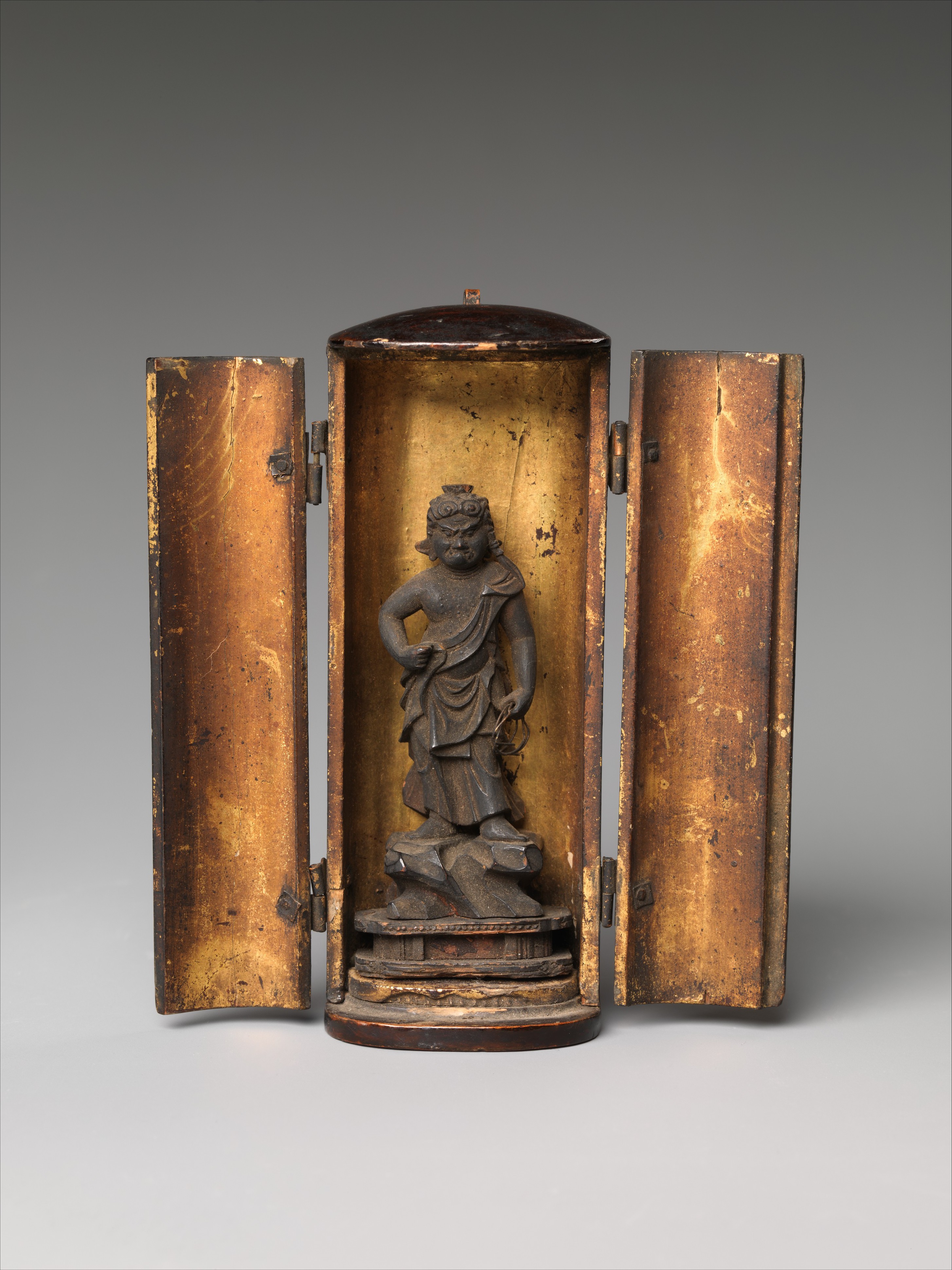
- Title
- Portable Shrine (zushi) with Fudō Myōō, the Immovable Wisdom King
- Period
- Edo period (1615–1868), 18th century
- Region
- Japan
- Medium
- Wood with lacquer, gold, metal fittings
- Dimensions
- H. 4.8 cm (figure); H. 10.1 cm (portable shrine)
- Collection
- The Metropolitan Museum of Art
- Accession
-
08.74 - Rights
- Portable Shrine (zushi) with Fudō Myōō, Japan, Edo period, 18th c. The Metropolitan Museum of Art, New York, accession 08.74. CC0 (public domain).
Met acc. 08.74: an 18th-century portable zushi about 10 cm tall housing a Fudō Myōō figure under 4 cm. Not temple goma furniture — a private devotional shrine — but the icon-over-fire relationship of the goma reduced to its irreducible minimum.
The goma (護摩, Skt. homa) esoteric fire ritual leaves almost no trace of the rite itself. It survives as an evidentiary chain: the Fudō icon over the hearth, the implement sets, the goma-dō halls, and the Heian–Kamakura ritual manuals. This is a transmission-history read through that chain.
A rite that destroys its own evidence
The goma is a rite designed to consume its materials. Wood, oils, grains, and consecrated tokens are fed into a hearth fire and burned to nothing; the offerings are the message and the message is ash. What this means for the historian is blunt: the central event of one of the most continuously performed rituals in Japanese Buddhism is, by construction, unrecoverable. There is no surviving Heian goma. There are only the things that stood around it.
The Met holds one of those things. Accession 08.74 is a portable shrine, a zushi, about ten centimeters tall, with a Fudō Myōō figure inside it under four centimeters high.1 It is late, an eighteenth-century Edo object in lacquered and gilded wood with metal fittings, and it was never altar furniture for a temple goma; it is a private devotional shrine. Held in the hand with the doors swung open, it sits below normal reading distance. The figure is too small to look down on the way a temple Fudō pedestaled in a goma-dō looks down on its officiant, so the spatial hierarchy of the rite is inverted by sheer scale: the worshipper looms over a deity built to loom over a fire. The carved mandorla behind the figure is the giveaway. It is flame-shaped, and on an object this size it does the work that a real fire did at full scale, the shrine having internalized the hearth into a few millimeters of gilded wood. That is the one element of the goma the rite does not burn: the presiding deity, fixed in place, with the fire already abstracted into the icon. Read backward through the scholarship, this small object is a legible terminus of a transmission that runs from Vedic India through Tang China to a hearth in a Heian temple hall. The rite is gone. The chain that produced it is not.
This article reads that chain. It is not a description of how to perform the goma, and it is not a study of the Met shrine as an object. It is a transmission-history that asks what the surviving material and pictorial record (icon, implements, halls, manuals) can and cannot tell us about a rite that erases itself every time it is performed.
What was transmitted, and from where
The goma is the Japanese inheritance of the Sanskrit homa, the fire oblation whose root hu means to pour into fire, to offer. Its genealogy is the longest of any rite in the Japanese Esoteric repertoire: Payne’s argument in The Tantric Ritual of Japan is that the Shingon goma is a living contemporary ritual whose structure descends, by traceable stages, from Vedic Indo-Iranian antiquity through the Tantric Buddhist absorption of the Vedic fire cult into Indian esoteric practice.2 The descent is not a vague resemblance. It is the persistence of a specific ritual syntax (build a hearth, invoke the fire god, feed the fire on behalf of a patron deity) across roughly three millennia and several languages.
The Buddhist transmitters are named and dated. The eighth-century Chinese masters who carried the Esoteric corpus into Tang practice, Śubhakarasiṃha and Amoghavajra, worked with the texts that fixed the goma’s Buddhist form: the Mahāvairocana Sūtra, the Vajraśekhara corpus, and the Susiddhikara.3 The Tang commentator Yi Xing, writing in the early eighth century, did not disguise the rite’s ancestry; he acknowledged outright that the Buddhist homa derived from the older Vedic fire sacrifice.4 That candor matters for what follows, because the most durable modern misreading of the goma inverts exactly this point.
What reached Japan came through one bottleneck. Kūkai (774–835) received the Esoteric transmission from Huiguo at Chang’an in 805 and returned in 806; Saichō (767–822) received a more rudimentary Esoteric initiation on the same Tang embassy and built it into the Lotus-centered Tendai system.5 Both schools carried the goma. The doctrinal split between them, with Kūkai treating Mikkyō as the supreme and self-sufficient teaching and Saichō folding it into a Lotus framework, produced two ritual lineages performing recognizably the same fire rite with different liturgical emphases, Tendai leaning harder on the Susiddhikara and its devotional register.5 By the late Heian period the goma was not an occasional rite. In Shingon practice it became a daily obligation and a competence required of every ācārya, which is why the surviving record is dense at the level of implements and manuals even though no single performance survives.
The receiving context: doctrine that hides the rite from the historian
The goma arrived into a system that had already doubled it. Yamasaki, in Shingon, sets out the distinction the Japanese tradition draws between the gegoma (外護摩), the outer goma of the literal hearth, the real fire, and the burned offerings, and the naigoma (内護摩), the inner goma, in which no fire is lit at all: the practitioner internalizes the entire structure, the hearth becoming the body, the fire becoming wisdom, the offering becoming defilement consumed in meditative identification with Dainichi Nyorai.6 The stated goal of the outer rite is the inner one; the burned sesame and wood are read, doctrinally, as the outward double of an interior operation.
This is the single most consequential fact for anyone reading the goma through its material remains, and it cuts in a direction the objects alone cannot show. The doctrinally primary goma leaves no evidence at all, because it has no hearth, no implements, no ash. The entire surviving record, every ladle, every hearth, every manual, documents the gegoma, the form the tradition itself treats as the support and not the substance. The historian who reconstructs the goma from its implements is reconstructing the half the tradition considered provisional. This is not a reason to distrust the material record; it is a reason to read it for what it is, the externalized scaffolding of a rite whose claimed center is interior and therefore mute.
It also names the misreading. The popular framing, goma as “an ancient fire-worship ritual,” a Vedic survival, Hindu fire sacrifice in Buddhist dress, takes the part the tradition designed to be visible and mistakes it for the whole. The genealogical descent from the Vedic homa is real, and Yi Xing said so in the eighth century; the error is not in the genealogy but in stopping there, as if the goma were the gegoma and nothing else.
There is a real scholarly tension underneath the popular one, and it has to be stated precisely. Payne’s project in The Tantric Ritual of Japan and again in Homa Variations is genealogical: it follows ritual syntax across the longue durée and treats the goma as a node in a three-thousand-year structural lineage, the continuity being the point. Yamasaki’s account in Shingon is doctrinal: it treats the rite from inside the tradition, where the genealogy is almost beside the point and the naigoma identification with Dainichi is the whole content. These are not contradictory, but they answer different questions, and a reader who takes only Payne will overweight the Vedic descent while a reader who takes only Yamasaki will underweight it. bodhi’s reading holds both. The goma is genealogically a fire rite, where Payne’s chain is sound, and doctrinally an interior one, where Yamasaki’s reading is what the tradition means by it, and the surviving material record, by its nature, documents only the first of the two.
Surviving works: the chain the rite did not burn
Strip away the rite and four classes of evidence remain, each documenting a different segment of the transmission.
The icon. Fudō Myōō (Acala) is the goma’s presiding deity, the wrathful form whose flame mandorla and sword make him the iconographic patron of a rite conducted in fire. Agni, called Katen in the Japanese pantheon and carried intact through the whole transmission as the Vedic fire god, is almost invariably the first deity invoked into the hearth, which is itself a fossil of the rite’s Vedic ancestry sitting in plain sight inside a Buddhist liturgy.7 The Met zushi (acc. 08.74) is the icon class in its most portable, latest form: a Fudō under four centimeters, housed so it can travel and still face a fire. It is the wrong scale and the wrong century to be temple goma furniture, and that is exactly what makes it useful, since it shows the icon-over-hearth relationship reduced to its irreducible minimum, the figure and the implied fire and nothing else.1 The temple-scale version of the same relationship is read at single-work depth in bodhi’s study of the Met 44842 Heian Fudō, formerly the central icon of the Kuhonji Gomadō at Funasaka, a goma-hall icon read out of its lost hall.
The implements. The goma altar is built around an iron hearth-kettle, the goma-gama (護摩釜), set at the center of a square altar roughly 105 to 135 cm on a side, the altar itself read as a mandala; the kettle’s lid carries a petal-like projection to hold the ghee that fuels the fire.8 Around it sit the offering ladles, the triangular array of water vessels, the five-pronged vajra and the bell, and the bundled gomagi, the inscribed prayer-sticks of sandalwood and cedar, cut to fixed lengths, that carry a petitioner’s request into the flame.8 The vajra and bell of this set are not generic altar fittings; they are the specific Esoteric implements bodhi treats at object depth in the studies of the five-pronged vajra and the five-pronged vajra-bell. The implement record is the densest surviving segment of the chain precisely because implements are durable and the rite is not.
One liturgical detail in the practice tradition does the article’s argument for it: during the rite the hearth is visualized as the mouth of the invoked deity, the offerings poured in as if fed to it.9 That is the gegoma apparatus already reaching toward the naigoma reading from inside the outer rite. The physical kettle is thought as a body part; the literal fire is on its way to becoming the figurative one.
The halls. The goma is performed in a goma-dō (護摩堂), a hall built around the hearth and the central Fudō. Daigo-ji, the Kyoto center of the Ono branch of Shingon, is the model case: the Suntory Museum’s 2018 exhibition documented how icons, ritual implements, and procedural manuals accumulated there in great numbers as the working archive of a ritual lineage, the hall and its contents forming a single material deposit of continuous practice.10 The architecture is the largest-scale surviving evidence and the least mobile; it fixes the rite to a place even though the rite itself fixes nothing.
The manuals. The Heian and Kamakura ritual manuals and zuzō (iconographic compendia) are the segment that records procedure rather than apparatus. They preserve the five classified types of goma, sokusai (息災, Skt. śāntika, for protection and the averting of calamity), zōyaku (増益, pauṣṭika, for increase), chōbuku (調伏, ābhicāruka, for subjugation), keiai (敬愛, vaśīkaraṇa), and kōchō (鉤召, ankuśa), each keyed to a hearth of a different shape: round, square, triangular, and lotus forms recur across the manual tradition.11 This is the part of the chain where the rite’s logic, not just its hardware, is written down; it is also the part that lets Payne, in his chapter “Fire on the Mountain: The Shugendō Saitō Goma” in Homa Variations, run a syntactic analysis of a saitō goma ritual text and demonstrate its genealogical relation to the Shingon goma, manual against manual, the transmission visible as shared structure.12 Lisa Kochinski’s review of the volume for the American Academy of Religion’s Reading Religion states the method plainly: Payne “applies syntactic analysis to a saitō goma ritual text to reveal its genealogical relation to Shingon,” with fire and its identification with Agni broadly retained while other elements transform across time and place.13 That the method is legible to a reviewer at the claim level, not only to Payne, is part of why the manual segment of the chain is the one that carries the genealogical argument rather than merely illustrating it.
No one of these four classes recovers the rite. Together they triangulate it: the icon names the patron deity, the implements show the apparatus, the halls fix the place, the manuals record the procedure and the typology. The center, the burning and behind it the inner goma, stays empty, as it was built to.
What the chain proves and what it cannot
The surviving record carries one argument cleanly and refuses another. It carries the transmission: the Vedic descent that Yi Xing acknowledged in the eighth century, the Tang systematization under Śubhakarasiṃha and Amoghavajra, the bottleneck through Huiguo to Kūkai in 806, the bifurcation into Shingon and Tendai lineages, and, by Payne’s syntactic method, the onward descent into the Shugendō saitō goma. Every link in that chain has a material or textual witness: an implement, a hall, a manual, an icon. The genealogy is not inferred from resemblance; it is read off objects.
What the chain cannot prove is the goma’s doctrinal claim about itself. The inner goma leaves no implement, no hearth, no ash. The material record documents only the gegoma, the form the tradition itself treats as the provisional outer double. A historian working purely from objects would reconstruct a fire rite and would have no way, from the objects alone, to recover the interior operation that Shingon doctrine treats as the rite’s actual content. The Met zushi is the limit case of this: a complete goma icon, ten centimeters tall, in front of which the fire was never the point and never recoverable either way.
The residual uncertainty is honest and specific. The syntactic-descent link, Payne’s argument that the Shugendō saitō goma derives genealogically from the Shingon goma, is now carried by two named witnesses: Payne’s own chapter and Kochinski’s independent review of it. Payne has since restated the genealogical reading for the Yoshida goma at the Shintō–Shingon interface.14 What the present article still does not pin to a physical page is the chapter-level argument in Payne 1991 and Yamasaki 1988 for the specific hearth-shape-to-type mappings and the gegoma/naigoma pages, which are stated consistently across the secondary literature but are sourced here at work-and-claim level rather than from the physical volumes. The chain is solid. Two of its links still want a page number from the books themselves; none of them wants a different argument.
Sources
| Source | Type | Citation |
|---|---|---|
| Richard K. Payne, The Tantric Ritual of Japan | book | Aditya Prakashan / IAIC, 1991 |
| Yamasaki Taikō, Shingon: Japanese Esoteric Buddhism | book | Shambhala, 1988 |
| Payne, “Fire on the Mountain,” in Homa Variations | book chapter | Oxford University Press, 2015 |
| Kochinski, review of Homa Variations | review | Reading Religion (AAR); accessed 2026-05-18 |
| Payne, “A Pragmatics of Ritual: The Yoshida Goma” | journal article | Religions 12(10):884, 2021 |
| The Metropolitan Museum of Art, acc. 08.74 (objectID 49114) | museum record | CC0; public-domain status verified via the Met API 2026-05-16 |
| Suntory Museum of Art, Daigoji Temple exhibition | exhibition catalog | 2018 |
| Shikoku Tours, Purifying Fire: the Goma Offering Ritual | reference | practice-tradition; accessed 2026-05-18 |
| ”Shingon Buddhism,” Wikipedia | reference | accessed 2026-05-16 |
| Homa (Q2561131) | reference | Wikidata; subject QID, alias “goma”, jawiki 護摩 |
Related
- Met 44842: the Heian Fudō from the Kuhonji Gomadō (single-work study)
- Fudō Myōō: iconographic markers
- Gokosho: the five-pronged vajra
- Gokorei: the five-pronged vajra-bell
- Godai Myōō: the sculpted goma-dō altar program
- Goma (entity)
- Fudō Myōō (entity)
- Kūkai (entity)
- Shingon (entity)
Footnotes
-
Met acc. 08.74, Portable Shrine (zushi) with Fudō Myōō, the Immovable Wisdom King, Japan, Edo period, 18th century; wood with lacquer, gold, metal fittings; H. 4.8 cm (figure), 10.1 cm (shrine); Gift of T. Hitachiyama, 1908. Public domain (CC0); objectID 49114 verified via the Met Collection API, 2026-05-16. The article reads this object as the icon-class terminus of the goma transmission, not as a single-work subject. ↩ ↩2
-
Payne 1991, The Tantric Ritual of Japan, the book’s central argument: the Shingon goma is a continuously performed rite whose structure descends by traceable stages from Vedic and Indo-Iranian fire oblation through Tantric Buddhist absorption. Cited here at work-and-claim level; chapter page numbers not verified against the print volume. ↩
-
Textual basis of the Buddhist goma in the Mahāvairocana Sūtra, the Vajraśekhara corpus, and the Susiddhikara; eighth-century Tang transmission via Śubhakarasiṃha and Amoghavajra. “Shingon Buddhism,” Wikipedia, accessed 2026-05-16, corroborated by Payne 1991 at the structural level. ↩
-
Yi Xing (early 8th c.) acknowledged the Buddhist homa’s derivation from the Vedic fire sacrifice. “Shingon Buddhism,” Wikipedia, accessed 2026-05-16; the point is standard in Payne 1991 and is load-bearing here as the basis for naming the popular misreading. ↩
-
Kūkai received the Esoteric transmission from Huiguo at Chang’an in 805 and returned to Japan in 806; Saichō received a more rudimentary Esoteric initiation on the same embassy and built it into Tendai. Doctrinal split: Kūkai treated Mikkyō as supreme and self-sufficient, Saichō folded it into a Lotus framework, Tendai weighting the Susiddhikara. “Shingon Buddhism,” Wikipedia, accessed 2026-05-16; consistent with Yamasaki 1988. ↩ ↩2
-
Yamasaki 1988, Shingon: the gegoma (outer, literal-fire) / naigoma (inner, fireless meditative) distinction, the inner goma identifying hearth, fire, and offering with body, wisdom, and defilement in identification with Dainichi Nyorai. Cited at work-and-claim level; page numbers not verified. ↩
-
Fudō Myōō (Acala, Wikidata Q337624) as the goma’s presiding deity; Agni / Katen, the Vedic fire god, almost invariably the first deity invoked into the hearth. Payne 1991, structural account; “Shingon Buddhism,” Wikipedia, accessed 2026-05-16. The Agni-first invocation is the clearest single survival of the rite’s Vedic ancestry inside the Buddhist liturgy. ↩
-
Goma altar built around an iron hearth-kettle (goma-gama, 護摩釜) on a square altar c. 105–135 cm, the altar read as a mandala; offering ladles, triangular water-vessel array, five-pronged vajra and bell, and inscribed gomagi prayer-sticks of sandalwood and cedar cut to fixed lengths. Drawn from the implement description corroborated against Payne 1991’s account of the altar and the five-pronged vajra/bell studied at object level elsewhere on bodhi. ↩ ↩2
-
The visualization of the hearth as the mouth of the invoked deity, into which the offerings are poured, is standard in the Shingon practice tradition and is described across the practice literature and temple sources (e.g., Shikoku Tours, Purifying Fire: the Goma Offering Ritual, accessed 2026-05-18). It is load-bearing here only as the point at which the outer apparatus already encodes the inner-goma logic; it is not a doctrinal claim sourced to a primary text and is presented at that level. ↩
-
Suntory Museum of Art, Daigoji Temple: A Shingon Esoteric Buddhist Universe in Kyoto (2018 exhibition): Daigo-ji as the Ono-branch center where icons, ritual implements, and procedural manuals accumulated as the working archive of a continuous ritual lineage. Accessed 2026-05-16. ↩
-
The five classified goma types, sokusai (息災, śāntika), zōyaku (増益, pauṣṭika), chōbuku (調伏, ābhicāruka), keiai (敬愛, vaśīkaraṇa), kōchō (鉤召, ankuśa), each keyed to a differently shaped hearth (round, square, triangular, lotus recurring across the manual tradition). Payne 1991 enumerates the five types; the type-to-hearth-shape mapping is stated consistently across the secondary literature and is sourced here at work-and-claim level; page numbers not verified. ↩
-
Richard K. Payne, “Fire on the Mountain: The Shugendō Saitō Goma,” in Richard K. Payne and Michael Witzel (eds.), Homa Variations: The Study of Ritual Change across the Longue Durée (Oxford University Press, 2015): syntactic analysis of a saitō goma ritual text demonstrating its genealogical relation to the Shingon goma. Chapter title verified via Oxford Academic, 2026-05-18; cited at chapter-and-claim level; page numbers not verified. ↩
-
Lisa Kochinski, review of Homa Variations (Payne & Witzel, eds.), Reading Religion (American Academy of Religion), accessed 2026-05-18 via the Institute of Buddhist Studies mirror (shin-ibs.edu). Quoted: Payne “applies syntactic analysis to a saitō goma ritual text to reveal its genealogical relation to Shingon”; “fire and its identification with the ancient Vedic fire-god Agni have been broadly retained” while other elements transform across time and space. Used as an independent named witness to the syntactic-genealogical method. ↩
-
Richard K. Payne, “A Pragmatics of Ritual: The Yoshida Goma at the Interface of Shintō and Shingon,” Religions 12, no. 10 (2021): 884. Bibliographic identity verified 2026-05-18; full text not consulted at the page level (gated). Cited only for the fact that Payne has extended the genealogical reading of the Shingon goma to a further descendant rite; no page-level claim is borrowed. ↩
Sources
-
First book-length English study of the Shingon goma; structure of the rite, hearth, implements, the five classified types, and the Vedic descent argument.
-
Shingon ritual system; the inner-goma (naigoma) / outer-goma (gegoma) doctrine and the Dainichi identification.
-
Comparative homa across the longue durée; Payne's syntactic-genealogical analysis of the Shugendō saitō goma's descent from the Shingon goma.
-
objectID 49114; public-domain status verified via the Met Collection API 2026-05-16; H. 4.8 cm (figure) / 10.1 cm (shrine); Gift of T. Hitachiyama, 1908.
-
Ono-tradition center; the documented accumulation of icons, ritual implements, and procedural manuals as a single ritual archive.
-
[6]2026-05-18Reading Religion (American Academy of Religion) shin-ibs.edu/review-of-homa-variations-edited-by-p…Independent named witness to Payne's syntactic-genealogical method: quoted that Payne 'applies syntactic analysis to a saitō goma ritual text to reveal its genealogical relation to Shingon'; Agni retained while other elements transform.
-
Religions 12(10):884. Bibliographic identity verified 2026-05-18; full text gated, not consulted at page level. Cited only that Payne has extended the genealogical reading to a further descendant rite.
-
Practice-tradition / temple-adjacent source for the standard visualization of the hearth as the mouth of the invoked deity; used at practice-tradition level only, not as a doctrinal primary text.
-
Yi Xing's 8th-c. acknowledgement of the Vedic homa root; daily goma performance; textual basis. Robert Sharf cited there for the Shidokegyō goma-as-training-segment point.
-
Subject QID; alias 'goma', jawiki sitelink 護摩. Object-level QID for Met 49114 does not exist (objectWikidata_URL empty in Met API).