A close reading of the Heian Fudō Myōō
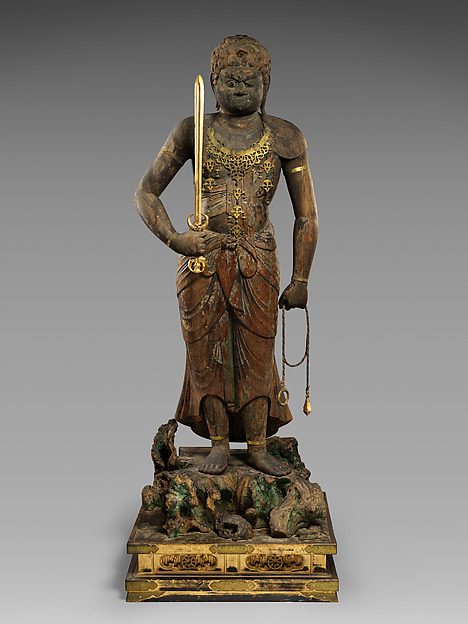
- Title
- Fudō Myōō (Achala Vidyaraja) — 不動明王
- Period
- Heian period (794–1185), 12th century
- Region
- Japan
- Medium
- Wood with lacquer, gold leaf, and color; joined-woodblock construction (yosegi-zukuri)
- Dimensions
- H. 162 cm (63 3/4 in.)
- Collection
- The Metropolitan Museum of Art
- Accession
-
1975.268.163 - Rights
- The Metropolitan Museum of Art (Public Domain / OASC). The Harry G. C. Packard Collection of Asian Art, Gift of Harry G. C. Packard, and Purchase, Fletcher, Rogers, Harris Brisbane Dick, and Louis V. Bell Funds, Joseph Pulitzer Bequest, and The Annenberg Fund Inc. Gift, 1975 (1975.268.163).
Met 1975.268.163: a 162 cm Heian-period wood Fudō Myōō with surviving lacquer, gold leaf, and pigment. Yosegi-zukuri joined-block construction. The standard wrathful programme (sword in the right hand, lasso in the left, long braid falling along the proper-left side) read here in 12th-century iconographic form. The flame mandorla and boy attendants of the elaborated Goma programme are not present in the Met installation.
Met 44842 (accession 1975.268.163) is a 12th-century standing Fudō Myōō built from six hollowed-out blocks of hinoki, formerly the central icon of the Kuhonji Gomadō at Funasaka, northwest of Kyoto. Reading the work means reading what yosegi-zukuri made possible at the moment the technique reached a wrathful Esoteric figure at temple-icon scale.
The hall it no longer inhabits
The Met catalog records the work’s provenance in one sentence: the figure was formerly the central icon at Kuhonji Temple, northwest of Kyoto, and the Met provenance line records the original installation specifically as the Kuhonji Gomadō at Funasaka. The Gomadō was the goma-fire-ritual hall: the architectural setting for the goma-e, the Mikkyō rite in which offerings of wood, oils, and consecrated objects are burned to ritually destroy defilements.
Fudō Myōō is the iconographic patron of the goma rite. A Heian temple of any seriousness with a goma practice would have built a Gomadō around a central Fudō image; the practice predates Kūkai’s 806 return from Tang China and runs continuously through the Heian and Kamakura periods.
The figure is therefore reading itself out of context. Whatever the spatial geometry was inside the Kuhonji Gomadō (whatever the lighting, the proportions of the hall to the figure, the angle from which a goma-officiant would have seen the central icon during a fire ritual) is no longer recoverable through the figure’s installation, because the figure no longer occupies the hall it was made for. The figure preserves the iconography. It does not preserve the installation.
This is one of the harder things about reading 44842. The work was not made to be seen the way it is now seen, in a Met gallery vitrine at adult-eye-level with diffused museum lighting. It was made to be read in the firelight, smoke, and chant of a Mikkyō ritual hall, by a small number of officiants standing relatively close to it.
The information the figure encoded for that audience and the information it encodes for the museum visitor are not the same information. The first is partly recoverable from the iconography and the technical construction; the second is what the museum lighting and gallery context produces.
Six blocks, hollowed
The Met catalog’s other load-bearing technical sentence: “This statue, composed of six hollowed-out pieces of wood.” Six blocks of hinoki (Japanese cypress), hollowed from the inside, joined to assemble a standing figure of Fudō Myōō at temple-icon scale.
This is yosegi-zukuri (寄木造), the joined-block construction method that came to dominate Japanese Buddhist sculpture from the late Heian period onward. Two things about applying the technique to this figure are not obvious from the gallery view.
The first is that yosegi-zukuri is not a single invention. It is a graduated extension of the warihagi (split-and-rejoin) technique, in which a single-block figure is split, hollowed from the inside to relieve the stress of the wood seasoning, and rejoined. Warihagi is the predecessor; yosegi is the extension to multiple blocks not originally part of a single piece.
The Met 44842 figure sits at the late-Heian moment when the technique had matured enough to assemble a standing wrathful figure at scale, but the term yosegi itself is most reliably applied where the blocks are independently sourced rather than rejoined from a split. The historical-technical literature treats the boundary as soft.
The second is the iconographic consequence of the hollow core. A six-block hollowed figure has an internal cavity. The cavity allowed Heian sculptors to deposit ritual contents (sutras, relics, the gobutsu cosmological set, inscriptions naming the donor and the workshop) inside the figure during the kaigen (“eye-opening”) consecration.
The Buddha or Wisdom King constructed by yosegi is not merely a representation of the deity. It is a locus where the consecration deposits make the image ritually live, with the deposits sealed inside a body the figure itself has been built to carry.
The Met 44842 figure has not, to bodhi’s knowledge, been internally examined in detail; whether deposits remain sealed inside the joined blocks or have been removed during the figure’s transit out of Kuhonji is undocumented in the Western institutional record.
The unembellished joinery of yosegi is therefore not an aesthetic choice. It is a precondition for the ritual practice the figure was made to host.
Standing late, asymmetric face
Met 44842 is a standing figure, not seated. The point matters because the standing Fudō convention is itself late. The Met catalog records the chronology in one sentence: “the first sculptures of Fudō Myōō made in Japan showed the figure seated, but standing examples like this one began to appear in the eleventh century.”
The earliest Japanese Fudō sculptures (at Tō-ji and Jingo-ji in the early ninth century) are seated on a rock pedestal, in the Mikkyō foundation iconography that Kūkai brought back from China. Standing Fudō figures emerge from the late tenth and eleventh centuries, with rigid heavily-set shoulders and a ground-rooted lower body that adapts the seated rock-pedestal-rooted convention to the upright posture. Met 44842, dated to the 12th century, sits within this standing-Fudō tradition at roughly its first century and a half of currency.
The figure preserves the canonical Fudō iconography in its hand-and-implement set. The Met catalog gives the iconographic burden in one sentence: “Fudō uses his sword to cut through ignorance and his lasso to reign in those who would block the path to enlightenment.”
The sword sits in the right hand, blade upright. The lasso (kenjaku / kensaku) sits in the left, coiled, the rope-end visible. The Heian standing-Fudō convention reads the sword as the plain vajra-blade rather than the dragon-coiled kurikara form that becomes more common in later Kamakura readings of the figure.
What the late-Heian register reads into the canonical iconography is in the face and the body weight. The face carries the asymmetric programme that distinguishes the wrathful figure. The eyes are the tenchigan (天地眼): the “heaven-and-earth eyes” convention, the right eye looking up, the left looking down, the two readings of the visual field bound into one face.
The fangs follow the same asymmetry: one projects upward, one downward, in the canonical Fudō opposed-fang convention. Both tenchigan and the opposed-fang programme become the dominant standing-Fudō register from the late Heian period onward.
Faure (The Fluid Pantheon, Hawai’i, 2015, ch. 3) reads the asymmetry as iconographically consequential rather than ornamental: the doctrinal claim that the wrathful king takes in what is above and what is below in a single regard, distinguishing the Japanese standing Fudō from the South Asian striding Acala that does not stabilise the asymmetric-face convention. The bodhi iconographic-markers reading guide for Fudō Myōō treats both programmes at marker length. The hair is flame-drawn into a topknot above the principal head, with the henpatsu single braid falling along the proper-left side.
The body weight is the Met catalog’s load-bearing line on the figure: “the heavy weight of the shoulders and back is planted firmly on the stiffened legs, appropriate for a deity whose name means ‘the Immovable One.’” That ground-rooted weight is the late-Heian standing-Fudō register, before the Kei-school taut musculature of the thirteenth century took the wrathful figure in a different direction.
The flame mandorla and the boy attendants Kongara and Seitaka (both standard parts of the elaborated Fudō iconographic programme) are not present in the Met installation. Whether the Kuhonji Gomadō original installation included these is undocumented; the Goma hall would have provided real flames around the figure during ritual, which makes the absence of a sculpted flame mandorla less surprising than it would be in a non-Goma installation. The surviving central figure preserves the iconographic core but not the elaborated complement.
The Kuhon-ji pair at the Met
The Met holds a second sculpture from the same Kuhonji provenance: acc. 44893, the Jūichimen Kannon, Nanbokuchō (1336–1392), 199.1 cm wood with lacquer, gold leaf, and metal decoration. The two figures bracket the Kuhonji material at the Met across roughly two centuries: 44842 is the late-Heian central icon of the Gomadō; 44893 is a later addition, post-dating the original Heian foundation by several generations and showing Kei-school stylistic influence in its carved drapery, with the Met catalog reading the more decorative robe treatment and heavy, solemn face as a fourteenth-century date rather than Kamakura proper.
Both works entered the Met in 1975 from the Harry G. C. Packard Collection of Asian Art, with the same composite credit line: the temple’s holdings dispersed in the late nineteenth and early twentieth centuries into Western institutional collections, and the two Kuhonji works travelled together through the Packard collection before joining the Met as a related Kuhonji pair.
The two Kuhonji sculptures together do not preserve the temple’s full iconographic programme as it would have stood in the goma-hall installation, but they do preserve the temple’s wrathful-and-Esoteric iconographic register across a Heian-Nanbokuchō span. Reading them as a pair (the late-Heian central icon with the standing wrathful asymmetric face, and the Nanbokuchō Kannon with the eleven-head stack) is the kind of cross-period institutional reading the Met collection enables. The companion bodhi article on Met 44893 treats the Jūichimen at section length and pursues the head-programme specifically; the Kuhon-ji pairing is the reason both works repay the second visit.
Comparanda
The principal Fudō comparanda for the Met 44842 work bracket the form across three centuries:
- Tō-ji Lecture Hall Fudō, the central Mikkyō foundation Fudō at Kūkai’s Kyoto institution. The hall’s three-dimensional sculpture mandala (twenty-one figures around a central Dainichi) was completed before the 839 CE eye-opening ceremony held in front of the Heian court (Tokyo National Museum, National Treasures of Tō-ji: Kūkai and the Sculpture Mandala, 2019, exhibition catalog). The Tō-ji Fudō is the iconographic anchor for the entire Japanese Heian Fudō tradition; the Met 44842 is downstream of this iconographic programme by roughly three centuries.
- Daigo-ji Fudō, Heian period, Important Cultural Property. The Daigo-ji holding is the principal Shingon-tradition Heian Fudō reference image and is documented across the temple’s published catalogs. Reading the Daigo-ji and Met 44842 figures against each other tracks the standing Heian-Fudō convention’s stabilization across the eleventh and twelfth centuries.
- Met acc. 2015.300.252a, b (object 53176) — a Kamakura early-13th-century Fudō Myōō, 53.3 cm seated figure in hinoki with lacquer, color, gold, kirikane, and inlaid crystal eyes. The Met catalog credits the work to Kaikei, the leading Kei-school sculptor, while flagging the workshop question in its descriptive paragraph: Kaikei was unusually prolific, with a large group of able assistants, and the catalog names Shinkai (a Kaikei disciple documented as workshop hand on the Sanbōin Fudō) as a plausible alternative attribution for the Burke piece. The figure is “nearly identical” (per the Met catalog, search snippet 2026-05-07) to a Kaikei-signed Fudō dated 1203 at Sanbōin, the sub-temple of Daigo-ji. The autograph claim is to Kaikei; the workshop alternative is named in the same catalog text: the kind of honest hedge that closes the Kaikei autograph corpus around the signed and dated Sanbōin original. The rock-shaped pedestal on which the figure originally sat has been lost. The pairing with 44842 enables the most informative Met comparison for the form’s late-Heian-to-Kamakura stylistic development: 44842 is the standing Heian central icon at temple-honzon scale, ground-rooted and unembellished in joinery; the Kaikei (or Kaikei-workshop) seated Fudō is the Kamakura Kei-school register at private-devotional scale, with crystal eyes and the taut wrathful musculature the Kei sculptors developed.
The Tō-ji and Daigo-ji holdings remain in temple installation in Japan and are documented through the temples’ own publications and through the ColBase records of the National Institutes for Cultural Heritage. The Met 44842 and 53176 holdings are openly licensed (CC0) and can be reproduced in detail in the Western institutional context.
Where this work sits
The Met 44842 Fudō is one of the most important late-Heian Fudō figures in Western institutional collections, and its principal art-historical interest sits at the intersection of three threads.
The first is the standing-Fudō convention at its mature Heian phase: Met 44842 is downstream of the early ninth-century Tō-ji seated foundation by three centuries and is upstream of the Kamakura Kei-school standing Fudō by another century. The figure is in the middle of the form’s century-and-a-half-long Heian standing-Fudō stabilization, with the late-Heian register’s small centralised facial features fully developed.
The second is the technical innovation of yosegi-zukuri as it extended from the seated Amida iconography (Jōchō and the In-school, mid-eleventh century) to the wrathful Wisdom King iconography (this work and its institutional kin, late eleventh and twelfth centuries). The six-block hollowed construction is not a workshop convenience. It is the technical precondition for a ritual practice that requires the figure to be ritually inhabited. The Met 44842 work is one of the earliest documented examples of the technique applied to a wrathful Esoteric figure at temple-icon scale.
The third is the broader pattern of Heian temple-installation dispersal in the late nineteenth and early twentieth century. The Kuhonji Gomadō has not survived; the figure has.
The figure’s survival is not separable from the dispersal that brought it to the Met in 1975 (via the Harry G. C. Packard Collection), and the dispersal’s ethical and historiographical complications are not separable from any reading of the figure now. The Met catalog records the institutional facts. The hall it came from, and the goma practice it presided over, are no longer there to be read against.
What remains is the figure: standing, asymmetric, six blocks, hinoki, twelve hundred years old, the central icon of a hall that did not survive. Reading it is reading what is left when the ritual context is gone; the work’s argument is that the iconography survives the loss, in part because the technique that built the figure was iconography itself.
Related
- Aka, Ao and Ki Fudō — reading the colour-type recensions of the same wisdom king
- The goma fire ritual — Fudō’s rite in the surviving pictorial record
- Jūichimen Kannon: eleven heads and the canonical stack, the Kuhon-ji companion piece at the Met (acc. 44893)
Sources
-
Chapter 3 — Acala / Fudō Myōō; the standing Japanese Fudō contrasted against the South Asian striding Acala
-
Tō-ji Lecture Hall sculpture mandala — twenty-one figures completed before the 839 CE eye-opening ceremony
-
[6]2026-04-25Department of Asian Art, Heilbrunn Timeline of Art History metmuseum.org/toah/hd/king/hd_king.htm -
objectID 44842; accession 1975.268.163 (source field previously held the objectID — corrected 2026-06-05). Structured facts re-verified via Met Open Access API: 12th-c. Heian, joined-woodblock (yosegi-zukuri), H. 162 cm, Packard 1975 credit line
-
objectID 53176; accession 2015.300.252a, b. Met Open Access API (2026-06-05) confirms Kaikei artist field, early-13th-c. Kamakura, Japanese cypress with lacquer/colour/gold/kirikane/inlaid crystal eyes, H. 53.3 cm, Burke 2015