Dainichi as the Cosmic Buddha: the Heian Mahāvairocana at the Met, with halo intact
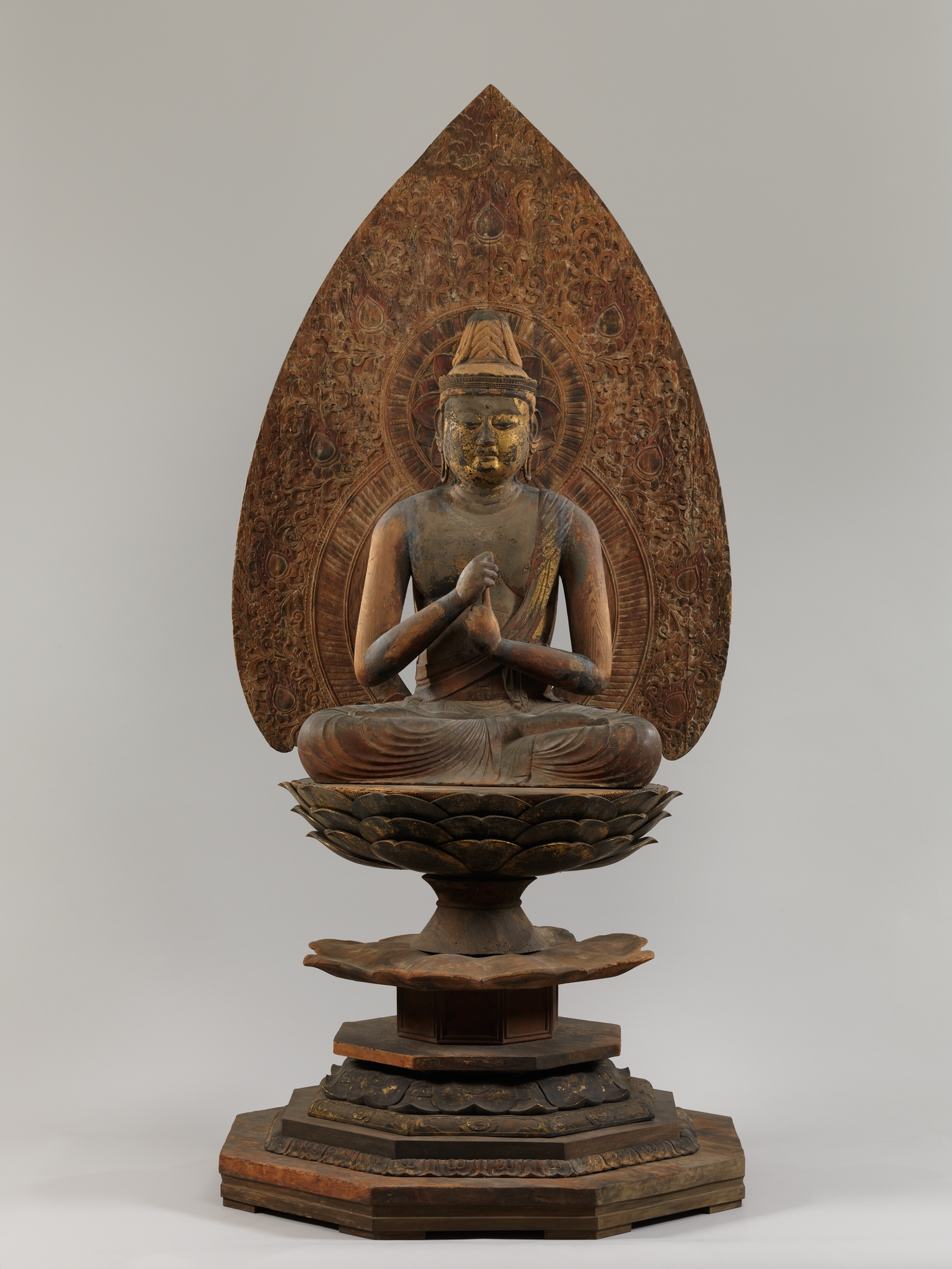
- Title
- Dainichi, the Cosmic Buddha (Mahavairocana) — Met 26.118a,b, Heian 12th c.
- Period
- Heian period (794–1185), 12th century
- Region
- Japan
- Medium
- Wood with lacquer and gold leaf
- Dimensions
- Figure: H. 92.4 × W. 69.9 × D. 49.8 cm (36 3/8 × 27 1/2 × 19 5/8 in.). Figure with base: 161.9 × 98.4 × 99.4 cm. Figure with base and halo: 218.4 cm (86 in.) total height.
- Collection
- The Metropolitan Museum of Art, New York
- Accession
-
26.118a, b - Rights
- Public domain (CC0 / OASC). Rogers Fund, 1926. The Metropolitan Museum of Art.
Met 26.118a,b — Heian 12th-century Dainichi Nyorai (Mahāvairocana) in painted-and-lacquered wood. The *chiken-in* mudra identifies the figure as the Kongōkai (Diamond World) Dainichi; the original carved-wood mandorla and multi-tier lotus pedestal raise the total assembly to 86 inches (218.4 cm). One of the rare Heian Dainichi survivals with its halo intact.
The figure and the gesture
The Metropolitan Museum’s Heian Dainichi (acc. 26.118a,b, Rogers Fund 1926) is one of the great twelfth-century Japanese Buddhist sculptures in any Western collection. A seated figure of painted-and-lacquered wood, 92.4 cm in height; on its original multi-tier lotus pedestal, 161.9 cm; with its original carved-wood mandorla, 218.4 cm — 86 inches, almost the height of a doorframe. That the figure, the pedestal, and the halo survive together as a single complete assembly is the rare case. Most Heian wood Buddhas reach us with their lotus pedestals replaced by Edo-period substitutes and their carved haloes lost; Met 26.118 is the exception.
Read the gesture first. The hands at chest level form chiken-in (智拳印, the wisdom-fist mudra): the right fist closes around the upraised index finger of the left hand. The Met catalogue is precise on the meaning, and worth quoting in full:
In Esoteric Buddhism, the entire universe is believed to emanate from Dainichi Nyorai, the supreme Buddha of the cosmos. Dainichi’s mudra, with the left index finger surrounded by the fingers of the right hand, is known as the “wisdom fist.” This powerful gesture expresses the union of the spiritual and material realms and is thought to restrain passions hindering the practitioner’s enlightenment. In paintings and sculptures, Dainichi often assumes this pose while surrounded by the other four Wisdom Buddhas, representing the metaphysical world of complete enlightenment — known as the Diamond Realm in Esoteric doctrines.
The chiken-in mudra is the diagnostic. There is one Buddha in the entire Mahāyāna iconographic vocabulary who holds this gesture: Dainichi Nyorai (大日如来) in his Kongōkai (Diamond Realm) form. Take that mudra away and the figure is unreadable. Take any other Buddha’s mudra and the figure is no longer Dainichi.
What you are looking at, iconographically
Dainichi Nyorai — Mahāvairocana, the cosmic Buddha
Dainichi Nyorai (大日如来, literally “Great Sun Tathāgata”) is the Japanese name for Mahāvairocana, the supreme cosmic Buddha of esoteric Buddhism — the dharmakāya itself made knowable as a Buddha-figure. The doctrinal logic is the centrepiece of Shingon. There is one ultimate reality (dharmakāya), and that reality is itself a Buddha; that Buddha is named Mahāvairocana / Dainichi; every other Buddha, every bodhisattva, every dharma in the universe is an emanation of Dainichi.
The figure has two principal iconographic forms — and only two — that derive from the two foundational esoteric texts:
- Kongōkai Dainichi (金剛界大日, Diamond World), source = Vajraśekhara Sūtra (T.865). Mudra = chiken-in (wisdom-fist). This is Met 26.118.
- Taizōkai Dainichi (胎蔵界大日, Womb World), source = Mahāvairocana Sūtra (T.848). Mudra = hokkai-jōin (法界定印, dharmadhātu-meditation, hands resting in the lap with thumbs touching).
The two Dainichis are the same Buddha, conceived as two complementary aspects: the Diamond Buddha is the knowledge that sees reality; the Womb Buddha is the reality that is seen. The Two Worlds Mandala is the visible statement of this complementarity across two paired hanging scrolls; Met 26.118 is the same statement compressed into the single sculptural figure of the Diamond half.
A piece of useful disambiguation: in painted and sculptural Buddhist iconography in Japan, the chiken-in is almost the only way to read a figure as Dainichi. The bodhisattva-regalia visual code is shared with several other figures (Vairocana, certain forms of Hōshō, some crowned-Amida images); the chiken-in is unique to Dainichi. The Met catalogue identifies the figure on this basis alone, and that identification is sufficient.
The carved halo — what survives
The mandorla preserved with Met 26.118 is the rare survival, and it is worth a paragraph of its own. The carved-wood halo, tall and vine-leaf-shaped, almost the height of the seated figure on its pedestal, carries three distinct iconographic programmes layered into one carved field.
First, the karakusa — the Chinese-vine pattern that fills the body of the halo. This is the standard Heian-Kamakura halo-decoration: a continuous scrolling vine with stylised flowers and tendrils, descending from Tang Chinese Buddhist halo tradition.
Second, the ke-butsu — the small Buddha or bodhisattva figures embedded within the scrollwork. These are the emanation Buddhas: figures that radiate outward from the central Dainichi, each one a particular nirmāṇakāya manifestation. The Met figure’s halo preserves a programme of these emanations, individually carved within the wood field. Their identification in detail would require a close inspection at the figure’s installation; the published Met catalogue does not enumerate them, and the photographic record on the OA system reads them as a generalised programme rather than as individually named figures.
Third, the flame-tongue outer edge. The mandorla’s perimeter is shaped as a continuous tongue-of-flame — the wisdom-fire (智火, chika) that surrounds the Buddha. The same flame-edge appears on the haloes of Fudō Myōō and the other Wisdom Kings, but the function is different: on a Wisdom King the flame is wrathful subjugation; on Dainichi the same flame is wisdom-radiance.
The reason this halo matters is that almost no other Heian Dainichi figure in any Western collection preserves its original mandorla. Tō-ji’s Kongōkai Dainichi (the great mid-Heian Lecture Hall figure attributed to Kūkai’s design) preserves its halo; Murō-ji’s seated Dainichi preserves a later replacement halo; Kongōbu-ji on Kōya-san preserves figures whose haloes have been re-carved or substituted. Met 26.118 is unusual outside Japan in retaining the original carved-wood programme.
Wood, joined-block construction, and the Jōchō legacy
The technical history matters. Met 26.118 is a twelfth-century sculpture executed in yosegi-zukuri (joined-block construction), the workshop technique that the eleventh-century master Jōchō (d. 1057) refined into a workshop standard. Before yosegi-zukuri — that is, before the late tenth and early eleventh centuries — Japanese Buddhist wood sculpture was made by the ichiboku-zukuri (single-block) method: a single trunk of wood was hollowed and carved, with limbs added separately. The single-block method limited figures to the diameter of an available cedar or cypress trunk, and the unhollowed core was prone to splitting as the wood aged.
Jōchō’s joined-block revolution did three things. It decoupled figure-size from log-diameter — the figure could be any size the workshop could carve and join. It reduced shrinkage warping — the hollowed-out interior released seasonal moisture stress instead of cracking the exterior. And it enabled workshop division of labour — one carver could rough-out the body block while another carved the head, while another carved the arms, with assembly happening at the final stage. This last consequence is the one that made the Heian sculptural workshop a workshop in the modern industrial sense — capable of producing large figures at moderate cost in moderate time, which is in turn what made the late-Heian boom in Pure Land and Mikkyō sculpture economically possible.
Met 26.118, at 92.4 cm seated height with original halo, is a workshop product of this Jōchō tradition. It is not a Jōchō-school signed piece — there is no documentary record placing it inside a specific master’s workshop — but it is a piece that could not exist without the workshop technique Jōchō codified. Samuel C. Morse’s research on Heian sculptural workshops (Amherst College, multiple articles and the catalogue Object as Insight co-edited with Anne Nishimura Morse, 1995) is the principal English-language reference for reading individual figures like this one back into the workshop system that produced them.
What stays open
The piece is undated. Met catalogues it as “Heian period, 12th century” — appropriately conservative for an unsigned, undocumented commission. A finer dating into early, middle, or late twelfth century would require comparison with closely dated benchmarks (the dated 1053 Byōdō-in Amida by Jōchō, the dated 1156 figures at Sanjūsangen-dō pre-fire, the dated 1191 Kōfuku-ji figures by Unkei, etc.) and a style-analysis of the figure’s facial features, drapery treatment, and proportional system.
The original temple location is not recorded. Met provenance starts at the 1926 acquisition via the Rogers Fund; whether the figure was a private chapel commission, a small temple’s central icon, or a sub-temple figure in a larger esoteric programme is not documented in publicly available Met records.
The four Wisdom Buddhas that originally surrounded this central Dainichi (Akṣobhya east, Ratnasaṃbhava south, Amitābha west, Amoghasiddhi north) — if they existed — are lost. A complete Kongōkai Five Buddhas programme in sculptural form would have placed our Dainichi at the centre with four smaller seated Buddhas around it in a cross arrangement. Met 26.118 survives alone. Whether the four secondary figures were ever made and have been lost, or whether the central Dainichi was conceived from the beginning as a standalone devotional figure, is not knowable from the surviving record.
Sources
-
[1]2026-05-14The Metropolitan Museum of Art collectionapi.metmuseum.org/public/collection/v1/objects/44838Met OA API (CC0). Confirms: 大日如来坐像; Heian period, 12th century; wood with lacquer and gold leaf; figure 92.4 × 69.9 × 49.8 cm; full assembly 218.4 cm; classification sculpture; Rogers Fund 1926; objectID 44838; primaryImage DP233932.jpg.
-
Met catalogue text, verbatim: 'In Esoteric Buddhism, the entire universe is believed to emanate from Dainichi Nyorai, the supreme Buddha of the cosmos. Dainichi's mudra, with the left index finger surrounded by the fingers of the right hand, is known as the "wisdom fist." This powerful gesture expresses the union of the spiritual and material realms and is thought to restrain passions hindering the practitioner's enlightenment. In paintings and sculptures, Dainichi often assumes this pose while surrounded by the other four Wisdom Buddhas, representing the metaphysical world of complete enlightenment—known as the Diamond Realm in Esoteric doctrines.' Retrieved 2026-05-14.
-
Samuel C. Morse (Amherst College) is the principal English-language scholar on Heian wood-construction technique and the workshop history of Japanese Buddhist sculpture. *Object as Insight* (1995) reads Buddhist sculpture as ritual object — not as art-historical specimen — and is the methodological reference behind any sculptural close-read in this register. Morse's work on joined-block (*yosegi-zukuri*) construction is the textbook account of the technical revolution that made figures like Met 26.118 producible at workshop scale during the 11th–12th centuries.
-
Bogel's reading of esoteric icon as ritually visible — the figure exists to be seen, in a specific ritual context, by a specific initiate. Foundational to understanding why a Kongōkai Dainichi in chiken-in is *more than* a representation of a Buddha — it is the icon at the centre of the Diamond Mandala made three-dimensional. Same reference frame as the Two Worlds Mandala (Ryōkai mandara) reading.
-
Chapter 2 reads the Kongōkai Dainichi as the central figure of the Vajraśekhara Sūtra's Diamond Mandala — surrounded in the Genzu Kongōkai by the four other Wisdom Buddhas (Akṣobhya east, Ratnasaṃbhava south, Amitābha west, Amoghasiddhi north). The Met catalogue line — 'Dainichi often assumes this pose while surrounded by the other four Wisdom Buddhas' — is precisely this iconographic system.
-
The doctrinal source for the *Taizōkai* Dainichi (with hands in dharmadhātu-meditation mudra). Translated by Śubhakarasiṃha and Yixing 724–725. The Met 26.118 sculpture is the *Kongōkai* counterpart — its doctrinal source is the *Vajraśekhara Sūtra* (T.865), not the *Dainichikyō*. Both texts and both Dainichis are required for the complete esoteric programme; sculptures and paintings frequently focus on the Kongōkai Dainichi alone because the chiken-in mudra is iconographically the more distinctive of the two.
-
The doctrinal source for the Kongōkai (Diamond World) Dainichi. The *chiken-in* mudra is articulated in this text as the seal of the Diamond Realm — the visible token of unity between phenomenal and absolute. Amoghavajra (705–774) translated the sutra at Chang'an; Kūkai brought the lineage materials to Japan in 806. Every later Japanese Kongōkai Dainichi, including Met 26.118, descends from this textual-and-iconographic transmission.
-
The Heian-period sculptural technique in which a figure is assembled from multiple separately-carved wood blocks joined along the figure's central axis. The technique replaced the older *ichiboku-zukuri* (single-block) method around the mid-Heian period and is credited canonically to the eleventh-century master Jōchō (d. 1057). *Yosegi-zukuri* reduces wood-shrinkage warping, enables larger and more anatomically complex figures, and supports workshop division of labour. Met 26.118 is a 12th-century *yosegi-zukuri* figure in the late-Heian Jōchō-derived workshop tradition. See the yosegi-zukuri construction-method article for detail.
-
The standard Heian-Kamakura wood-sculpture finish: black lacquer (urushi) ground laid over a textile-reinforced base, with gold leaf (*haku*) applied over the lacquer where the figure is meant to read as gilt. Over centuries the gold abrades; what survives is the dark lacquer ground with scattered gold-leaf traces — the typical mature patina visible on Met 26.118. The Met record's 'wood with lacquer and gold leaf' is the catalogue shorthand for this technique.
-
In the Genzu Kongōkai layout — the canonical nine-assembly pictorial Diamond Mandala that Kūkai brought to Japan in 806 — Dainichi sits at the centre of the *Jōjin-e* (Perfected Body Assembly), surrounded by the four other Wisdom Buddhas (Akṣobhya, Ratnasaṃbhava, Amitābha, Amoghasiddhi) at the four corners of the central court. The Met 26.118 sculpture makes that pictorial centre three-dimensional. The same iconographic relationship is read across the Ryōkai mandara (Two Worlds Mandala) pair as a 2D field.
-
Wikidata reference identifier.