Five Wisdom Kings as workshop reference: a Heian iconographic handscroll
- Title
- Iconographic Drawings of the Five Kings of Wisdom (Myōō-bu shoson) — 明王部諸尊
- Period
- Heian period (794–1185), 12th century
- Region
- Japan
- Medium
- Handscroll; ink and color on paper
- Dimensions
- 33.7 × 1285.7 cm (13 1/4 in. × 42 ft. 2 3/16 in.)
- Collection
- The Metropolitan Museum of Art
- Accession
-
1975.268.6 - Rights
- Metropolitan Museum of Art, 1975.268.6 — Public Domain (Met Open Access). The Harry G. C. Packard Collection of Asian Art.
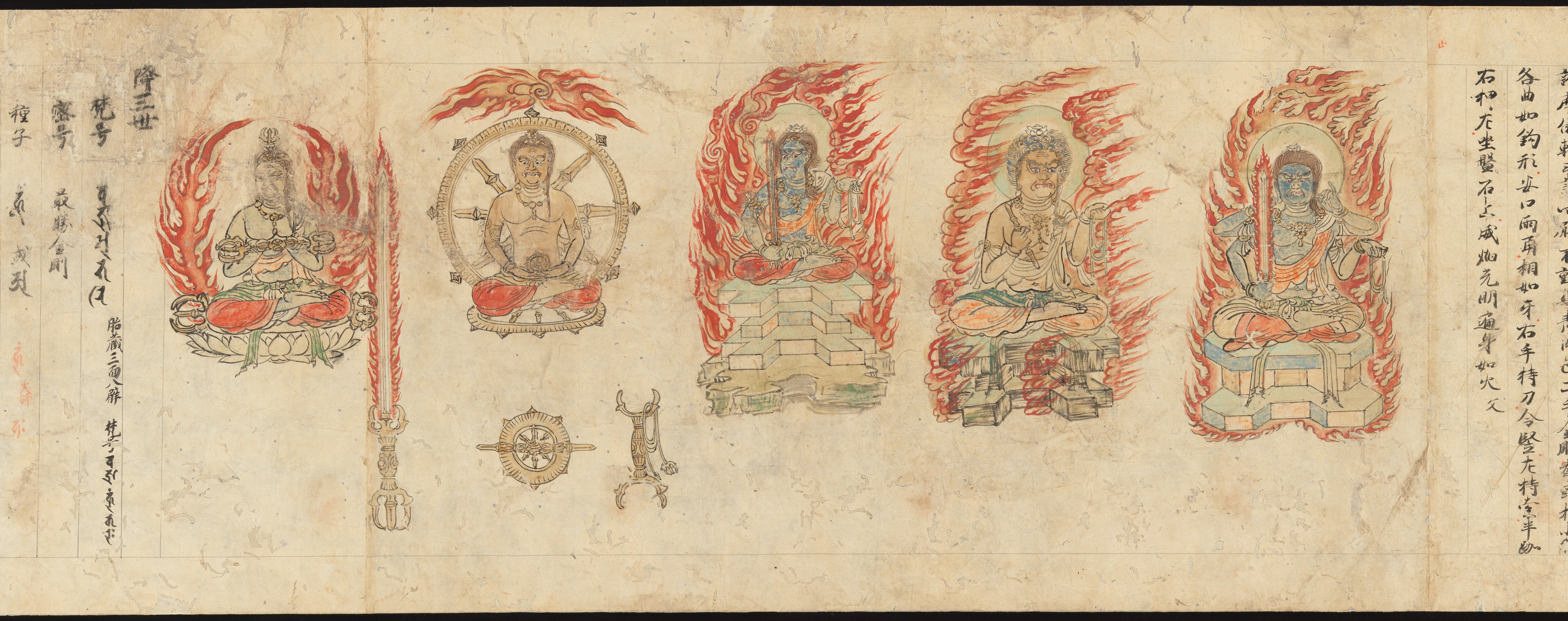
One section of Met 1975.268.6 — *Myōō-bu shoson*, 33.7 × 1285.7 cm. Heian iconographic-drawing convention: five figures in red flame mandorlas with their canonical attributes drawn separately below, each accompanied by long vertical Japanese ritual-text cartouches. The leftmost figure's cartouche includes 三世 ('three worlds'), supporting identification as Gōzanze Myōō, the King who subdues the three worlds and one of the canonical Five Wisdom Kings.
Iconographic-drawing handscrolls are not devotional images. They are workshop reference: line drawings of canonical figures with their attributes inventoried separately, designed to be unrolled on a flat workshop table while a painter, sculptor, or ritual specialist consulted the correct iconography. Met 1975.268.6 is 12.86 metres of this kind of reference. The visible section shows five wrathful Wisdom Kings in red flame mandorlas with their attributes drawn separately below: a sample of the canonical Heian Mikkyō visual programme.
What you’re looking at
One section of a long handscroll. The Met catalog gives the scroll’s full dimensions as 33.7 × 1285.7 cm, twelve metres eighty-six. The image available at the metmuseum.org primary-image position shows one segment, with the scroll fully unrolled and photographed at high resolution; nineteen additional photographs in the Met’s catalog cover further sections.
The visible segment reads left to right across the unrolled scroll. The leftmost figure is a standing wrathful deity in a red flame mandorla, hands clasped at chest, on a small lotus pedestal. The vertical Japanese ritual-text cartouche immediately to his left is dense: the legible characters include 三世 (“three worlds”), supporting identification as Gōzanze Myōō (降三世明王), the King who subdues the three worlds, one of the canonical Five Wisdom Kings (Godai Myōō). Below him on the scroll a single upright sword is drawn separately: the convention of the iconographic compendium, where the figure’s attributes are inventoried beside or below the figure for unambiguous reference.
The second figure (proceeding rightward) is seated, with multiple arms holding a large chakra (wheel) at chest level. Below him on the scroll a small wheel and a small implement are drawn separately. The third figure is seated on a rocky outcrop in a red flame mandorla, blue-skinned, two-armed. The fourth is another seated wrathful figure with red and blue robes and brown-red hair, hands clasped at chest. The fifth is rightmost, seated, holding an upright trident-like implement in his right hand.
The drawing convention throughout is fine ink line with selective red, blue, and ochre colour washes, on aged paper. Long dense vertical Japanese ritual-text columns flank both edges and the inter-figure spaces. This is the canonical Heian iconographic-handscroll appearance — line-led, lightly coloured, dense in text, with the attributes inventoried separately for reference.
What an iconographic handscroll is for
The visual genre Met 1975.268.6 belongs to is zuzō (図像, “iconographic drawing”). Zuzō are not devotional images. They are not hung at altars. They are not the focus of ritual practice. They are the reference against which ritual practice, image production, and sculptural commissions were checked.
Heian Mikkyō (the Esoteric Buddhist tradition transmitted by Kūkai (774–835) at Shingon and contemporaneously by Saichō (767–822) and his successors at Tendai) placed exceptional weight on the iconographic correctness of visual programmes. The Mikkyō system maps a vast pantheon of figures across two principal mandalas (the Kongōkai, Diamond Realm, and the Taizōkai, Womb Realm), arrayed in formal compositional relationships, with each figure carrying canonical attributes, mudrās, robes, complexions, and seats. The ritual implementation of Mikkyō (the goma fire ceremony, the empowerment rites [kanjō], the visualisation practices [kannō]) depends on each figure being represented correctly. A miscoloured robe, a substituted attribute, an incorrect mudrā: each can collapse the ritual’s validity.
The iconographic-drawing tradition emerged from this exacting demand. By the late Heian period, Mikkyō priests had compiled major iconographic compendia: among them the Zuzōshō 図像抄 (Compendium of Iconographic Drawings), associated with the mid-twelfth-century Shingon priest Ejū, and the Kakuzen-shō 覚禅鈔, compiled by Kakuzen (1143–c. 1213). These compendia were copied, recopied, and circulated in handscroll form as reference, and Met 1975.268.6 (the Myōō-bu shoson, “the section on Wisdom Kings, the various honourable ones”) is one section of one such reference programme.
Cynthea J. Bogel’s With a Single Glance: Buddhist Icon and Early Mikkyō Vision (2009) is the standard English-language treatment of how Heian Mikkyō visualisation practice and iconographic systematisation are linked. The iconographic drawings are the textual programme made visible, and they are the visual programme made citable.
The Five Wisdom Kings programme
The Godai Myōō (the Five Wisdom Kings) are the canonical wrathful protectors of the central Mikkyō programme. The traditional arrangement places Fudō Myōō (不動明王, the Immovable Wisdom King) at the centre, surrounded by four kings at the cardinal points:
| Position | Wisdom King | Function |
|---|---|---|
| Centre | Fudō Myōō (不動明王) | Immovable, wrathful aspect of Mahāvairocana |
| East | Gōzanze Myōō (降三世明王) | Subdues the three worlds |
| South | Gundari Myōō (軍荼利明王) | Wrathful protector, multi-armed |
| West | Daiitoku Myōō (大威徳明王) | Six-faced, six-armed, on water buffalo |
| North | Kongōyasha Myōō (金剛夜叉明王) | Vajra-yakṣa, wrathful protector |
Each is a wrathful manifestation of one of the Five Wisdom Buddhas (Godai Nyorai), the central programme of the Diamond Realm Mandala. The arrangement is canonical from at least the mid-Heian period and stable across the Kamakura, Muromachi, and Edo periods. Aizen Myōō (愛染明王) is the related sixth king (iconographically separate, but often grouped with the Five) and is the subject of one of the Met’s other Public Domain Heian iconographic holdings (2015.300.3, dated 1107 Kashō 2).
The visible section of Met 1975.268.6 shows five figures consistent with the Godai Myōō programme. The leftmost figure’s “三世” cartouche supports Gōzanze identification. Specific identifications of the other four figures in this segment depend on cartouche legibility at higher resolution than the available primary image allows; bodhi does not commit to identifications of the figures whose cartouche text is not yet legibly readable.
The Packard Collection
Harry G. C. Packard (1914–1991) assembled the most important postwar private American collection of Japanese Buddhist art. His holdings were transferred to the Metropolitan Museum of Art in 1975 in a complex acquisition combining gift and purchase, the credit line on Met 1975.268.6 captures the structure: “Gift of Harry G. C. Packard, and Purchase, Fletcher, Rogers, Harris Brisbane Dick, and Louis V. Bell Funds, Joseph Pulitzer Bequest, and The Annenberg Fund Inc. Gift, 1975.” Twelve discrete sources of acquisition funding, plus the Packard gift portion, plus the Packard expertise: this was one of the largest single transfers of Japanese Buddhist material into a Western museum in the second half of the twentieth century.
The Packard Mikkyō holdings at the Met include Met 1975.268.6 (the Myōō-bu shoson handscroll, this article’s subject), Met 1975.268.5 (a related Zuzōshō scroll, 30.2 × 781 cm), Met 1975.268.12 (an individual Kongōyasha Myōō hanging scroll on paper), and Met 1975.268.13 (an individual Daiitoku Myōō hanging scroll on paper). Together with the later Mary Griggs Burke Collection acquisition (Met 2015.300.3, the dated 1107 Aizen mandala drawing), the Packard transfer makes the Met one of the densest single-institution holdings of Heian Mikkyō iconographic drawings outside Japan.
The acquisitional context matters because iconographic-drawing handscrolls of this length and condition rarely come to market. Most surviving Heian-Kamakura examples are in temple holdings (Daigo-ji, Kōzan-ji, Tō-ji, Daikaku-ji, and other Shingon and Tendai temple archives), where they have remained since their original deposit. The handful that left Japan in the late nineteenth and early twentieth century moved through specific dealer chains: Yamanaka, Setsu Gatōdō, Tanaka, and the named individual collectors who built private holdings between c. 1900 and the postwar period. Packard’s holdings came largely through these chains.
Where the reading commits and where it varies
The reading commits to: the scroll as a Heian-period iconographic-drawing handscroll in the zuzō genre; the function as workshop reference rather than devotional image; the iconographic programme as Mikkyō with the Five Wisdom Kings (Godai Myōō) as the canonical central set; the visible section’s leftmost figure as Gōzanze Myōō on cartouche-text evidence (三世); the scroll’s institutional provenance via the 1975 Packard Collection transfer.
The reading defers on: specific identifications of figures 2–5 in the visible section beyond the Gōzanze identification (the cartouche text is not legibly readable at the available primary-image resolution, and bodhi does not commit to identifications that the visible attribute set alone cannot fix unambiguously; the wheel and multi-arm figure could plausibly be Daiitoku in his multi-armed form, but Daiitoku is canonically six-headed and the visible figure does not clearly show that, so the identification is not closed); whether the scroll is the complete Myōō-bu shoson or one constituent section of a larger compendium-set (the catalog title implies completeness; the broader generic context of Zuzōshō-style compendia would suggest one section of a larger original programme); whether the scroll’s twelfth-century dating is firmly anchored by inscription or based on stylistic comparison alone (the catalog does not address this directly).
The reading also defers on the specific transmission chain by which the scroll left Japan. The Packard-collection acquisition record names the 1975 Met transfer but the pre-Packard chain is not published in the Met catalog text.
What the reading does not defer on is the genre claim. Met 1975.268.6 is a Heian iconographic-drawing handscroll, the Myōō-bu shoson, in the canonical reference-document tradition of medieval Japanese Mikkyō, and it is one of the most accessible English-language entry points into the visual programme of the Five Wisdom Kings.
Related
Sources
-
Met OA API record verified Public Domain 2026-05-12. The Met's Heian-period Myōō-bu shoson handscroll — 12.86 metres of iconographic drawings on paper, with figures arranged in sequence and their canonical attributes drawn separately, each accompanied by long ritual-text cartouches. Acquired 1975 as part of the Harry G. C. Packard Collection of Asian Art, one of the major postwar transfers of Heian-Kamakura Buddhist material from a private American collection into a major museum. The primary image at metmuseum.org shows one section; the catalog provides 19 additional images covering further sections of the scroll.
-
Met OA API record verified Public Domain 2026-05-12. A companion scroll in the Packard Collection: a Heian-to-Kamakura transitional scroll from the *Zuzōshō* — the *Compendium of Iconographic Drawings* compiled in the mid-twelfth century by the Shingon priest Ejū. The Zuzōshō is the canonical Mikkyō iconographic-compendium tradition that the Myōō-bu shoson scroll (1975.268.6) sits within. Used here as the institutional and generic comparandum within the same Met holding.
-
Met OA API record verified Public Domain 2026-05-12. An individual Heian iconographic-drawing hanging scroll of Kongōyasha Myōō — one of the canonical Five Wisdom Kings — drawn in pure ink on paper, the same Heian iconographic-line convention as the handscroll 1975.268.6 but in single-figure hanging-scroll format. Useful as the per-figure comparandum within the Met's Packard holdings.
-
Met OA API record verified Public Domain 2026-05-12. An individual Heian iconographic-drawing hanging scroll of Daiitoku Myōō — the Wisdom King of Great Awe, traditionally depicted with multiple heads, multiple arms, multiple legs, and riding a water buffalo. The pure-ink-on-paper convention matches 1975.268.12 (Kongōyasha) and the handscroll 1975.268.6. Used as the per-figure Daiitoku comparandum.
-
Met OA API record verified Public Domain 2026-05-12. A dated Heian iconographic drawing of the Aizen Myōō mandala — Kashō 2 (1107). The inscribed date makes this one of the firmly dated anchors of the Heian iconographic-drawing tradition. Used here as a dated-by-inscription comparandum within the Met's broader Mikkyō iconographic-drawing holdings; the Burke-collection acquisition (2015) is later than the Packard-collection acquisition (1975) but the two Met holdings together constitute the strongest English-language access to the Heian iconographic-drawing genre.
-
Standard English-language treatment of Heian Mikkyō visual culture, including the systematisation of iconographic drawings as ritual and workshop reference. Cited at the framework level for the iconographic-handscroll genre's relationship to Mikkyō visualisation practice; cited without page numbers.
-
Standard English-language treatment of Japanese Buddhist iconographic systematisation; cited for the framework of Mikkyō visual programmes including the canonical Five Wisdom Kings (Godai Myōō) arrangement at the centre of the Mandala of the Diamond Realm and the Womb Realm.
-
The standard Japanese-language history of Mikkyō art. Cited here at the framework level for the genre history of the iconographic-handscroll tradition within the wider Mikkyō visual programme; the citation is made at one remove, via the standard English-language Mikkyō visual-studies literature.
-
[9]2026-05-12Kakuzen-shō 覚禅鈔 — Heian iconographic compendium compiled by the Shingon priest Kakuzen (1143–c.1213) print referenceThe Kakuzen-shō is the canonical Heian-Kamakura Mikkyō iconographic compendium. Compiled by the Shingon priest Kakuzen (1143–c.1213), it became the most-cited iconographic-reference text for ritual implementation and image-production in the medieval Japanese Mikkyō tradition. The Myōō section of the Kakuzen-shō is the canonical textual programme to which iconographic-drawing handscrolls like Met 1975.268.6 functioned as the visual counterpart.