Two worlds, one gesture apart: the Freer Ryōkai Mandara pair in gold on purple silk
- Title
- Ryōkai Mandara — Taizōkai (Womb World), one of a pair with F1966.5
- Period
- Heian (794–1185) or Kamakura (1185–1333) period, 12th century
- Region
- Japan
- Medium
- Hanging scroll; gold on purple-dyed silk
- Dimensions
- 166.3 × 81.8 cm (65 1/2 × 32 3/16 in.)
- Collection
- Smithsonian National Museum of Asian Art (Freer Gallery of Art), Washington, DC
- Accession
-
F1966.4 - Rights
- CC0 — Creative Commons Zero. Purchase, Charles Lang Freer Endowment. Smithsonian National Museum of Asian Art.
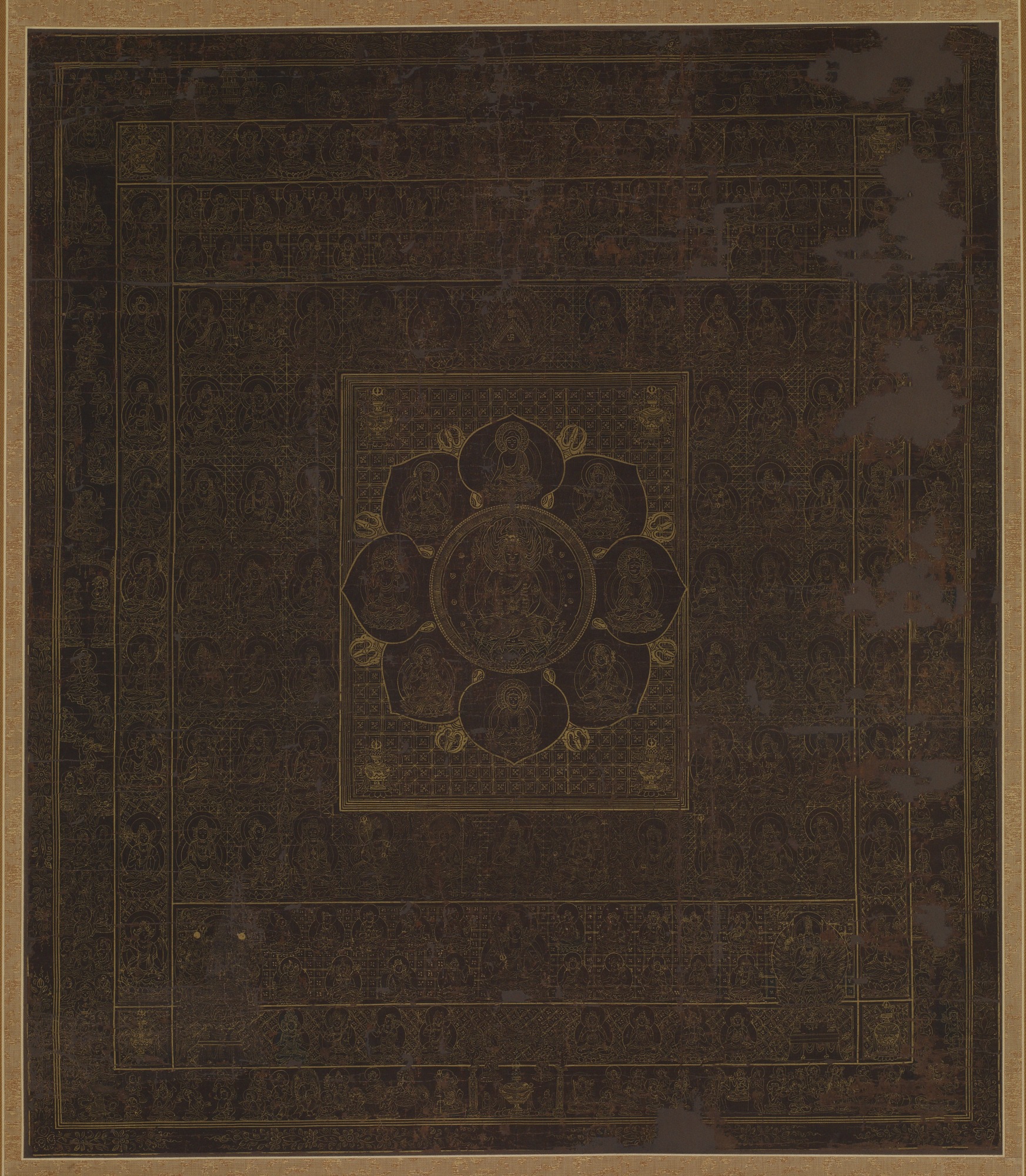
F1966.4 — the Womb World (Taizōkai) of the Freer Ryōkai Mandara pair. Twelfth century, gold on purple-dyed silk. The eight-petalled lotus court (Chūdai-hachiyō-in) sits at the centre: Dainichi Nyorai at the heart of the lotus, four Buddhas and four bodhisattvas seated on the surrounding petals. The surrounding registers stand in for the Genzu Taizōkai's twelve outer courts, compressed into rectangular bands appropriate to the hanging-scroll format.
Two scrolls, one cosmos
The Freer Gallery owns a paired Ryōkai Mandara (両界曼荼羅, Two Worlds Mandala) — F1966.4 and F1966.5 — that survives as a pair, in original mounts, in gold line on purple-dyed silk, from the twelfth century. Two scrolls of nearly identical dimensions (166 × 82 cm), one purpose: to make Shingon esoteric Buddhism visible as a single iconographic programme.
The pair is the doctrinal spine of Mikkyō. The Womb World (胎蔵界, Taizōkai, F1966.4) represents ri (理 — principle): the dharmakāya Mahāvairocana’s compassionate manifestation in the phenomenal world, organised around the eight-petalled lotus court. The Diamond World (金剛界, Kongōkai, F1966.5) represents chi (智 — wisdom): the unobstructed knowledge that perceives all phenomena as expressions of the dharmakāya, organised across nine assemblies in a three-by-three grid. Two scrolls. One cosmos. Read together they are how Shingon teaches that the world and the wisdom that knows the world are not two.
What you are looking at, in iconographic terms
Reading the Diamond World (F1966.5)
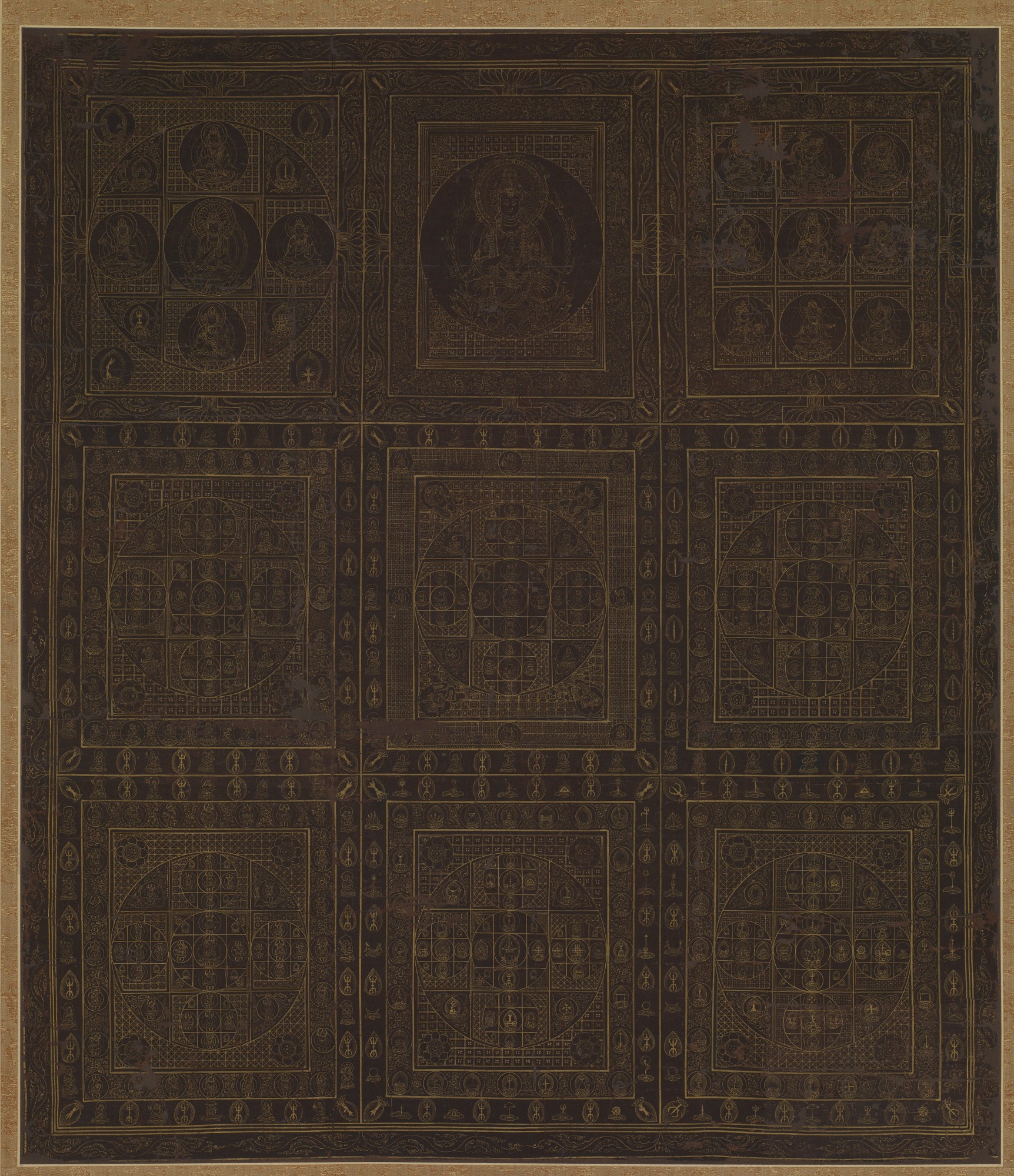
F1966.5 is the Diamond World scroll. The format is unmistakable: nine framed assemblies in a three-by-three grid, the canonical Genzu Kongōkai layout that Kūkai brought to Japan in 806 and that has anchored the iconographic standard ever since.
Read the grid from the top centre. The top-centre frame in F1966.5 is taller than the others and contains a single seated deity inside a circular halo, set against an otherwise spare field — the Ichi-in-e (一印会, Single Seal Assembly). Vairocana alone, in dharmadhātu meditation, the wisdom-cycle closing on itself. The other eight assemblies are densely populated: rows of small seated figures around a central Buddha, ritual implements at the frame corners, the whole structured around the central Jōjin-e (成身会, Perfected Body Assembly) — the assembly that contains the thousand Buddhas and is read as the iconographic summa of the Diamond cycle.
The nine assemblies of the standard Genzu Kongōkai run, in their textual sequence: Jōjin-e (centre), Sanmaya-e, Misai-e, Kuyō-e, Shi-in-e, Ichi-in-e, Rishu-e, Gōzanze-e, and Gōzanze-sanmaya-e. Different surviving Heian-Kamakura pairs sequence the nine slightly differently in the visual grid — the Tō-ji Saiin pair has a different reading order from the later imperial commissions — and the Freer scroll’s specific sequence rewards close inspection at high resolution. But the structural fact is invariant: nine assemblies, three by three, Dainichi at the centre of the central assembly, the Single Seal Assembly closing the cycle.
Reading the Womb World (F1966.4)
F1966.4 is the Womb World scroll. The diagnostic is at the centre: an eight-petalled lotus, with a small seated deity at the heart of the lotus and eight figures on the eight surrounding petals — the Chūdai-hachiyō-in (中台八葉院), the Central Eight-Petalled Lotus Court.
The central deity is Dainichi Nyorai. On the four cardinal-direction petals sit four Buddhas: Hōdō (south), Kaifuke-ō (east), Muryōju / Amida (west), and Tenkuraion (north). On the four intermediate petals sit four bodhisattvas: Fugen, Monju, Kannon, and Miroku. The eight-petalled court is the iconographic kernel of the Taizōkai — the visual statement that Dainichi’s compassion manifests through the four Buddha-emanations and the four bodhisattva-emanations into the four quarters of the universe.
In a complete Genzu Taizōkai there are twelve outer courts arranged around this central court — the Henchi-in (universal-knowledge), Renge-bu-in (lotus-section), Kongō-shu-in (vajra-bearer), Jimyō-in (knowledge-holders), and seven more. In the Freer scroll’s hanging-scroll format these twelve courts are compressed and reorganised as concentric rectangular registers of figures around the central panel. The visual hierarchy is preserved — the deities closer to the centre are larger and more important; the deities at the outermost register are the protector classes and the historical figures (Indian rishis, deva kings). The compression is a typical Heian-Kamakura simplification appropriate to the hanging-scroll format; a full-scale Genzu Taizōkai of the kind installed at Tō-ji would be considerably wider and would preserve all twelve courts as discrete framed fields.
Why gold on purple silk
The Freer pair’s material — shihai-kondei, gold ink on purple-dyed silk — places it inside a specific Heian-Kamakura tradition of high-status devotional production. The purple ground was achieved with murasaki dye (from the root of Lithospermum erythrorhizon, gromwell), which carried imperial and aristocratic associations going back to the Nara period; the gold line was kindei, finely ground gold leaf suspended in animal-glue medium and applied with a fine brush.
The same combination was used for the most prestigious sutra-copying commissions of the late Heian and early Kamakura — the konkōmyō saishōōkyō (Golden Light Sutra) and konsenshikyō (Compendium of the Four Garbha Sutras) survive in multiple purple-and-gold copies from this period. The technique was not used for everyday painting; it was used when the patron wanted to communicate maximal devotional weight and maximal social prestige in one material gesture.
This places the Freer pair in a specific patronage register. It was almost certainly commissioned by an aristocratic patron — possibly an imperial or regental family — for use at a private chapel or memorial hall, almost certainly for esoteric initiation rites (kanjō, 灌頂) or for the funerary cycle that followed the death of a high-ranking patron. The 166-cm scale is too small for a major Shingon temple’s main mandala installation (those are typically two-to-three metres tall) but exactly the right scale for a private aristocratic chapel: large enough to function as the actual ritual field, small enough to be hung indoors.
The Genzu lineage — from Kūkai’s 806 import to Heian production
The canonical pictorial form of the Two Worlds Mandala is the Genzu Mandara (現図曼荼羅), the version brought to Japan from Tang China by Kūkai in 806. Kūkai studied at the Qinglong-si monastery in Chang’an from 804 under Huiguo (惠果, 746–805), the seventh Shingon patriarch. When he returned to Japan in 806 he brought back what he later catalogued in the Shōrai mokuroku (請来目録, Catalogue of Imported Items): texts, ritual implements, and a pair of pictorial mandalas that served as the source originals for everything that followed in Japanese Mikkyō visual production.
Cynthea Bogel’s reading in With a Single Glance (Washington 2009) is the corrective to a text-first reading of Shingon transmission. What Kūkai imported was not primarily doctrinal — Amoghavajra’s translations of the Dainichikyō and Kongōchōkyō had been available in China for nearly a century — but visual. The Genzu pair was the iconographic-installation through which esoteric vision was transmitted; the doctrinal texts described what the visual installation was. Without the imported pair (and Kūkai’s training in how to read it ritually) the texts alone would not have constituted a transmission lineage.
The ninth-century originals at Tō-ji’s Saiin — the direct first-generation copies of Kūkai’s imports — survive as the canonical reference for the Genzu format and are designated Important Cultural Property. Every later Japanese Ryōkai Mandara pair, including the Freer twelfth-century pair, descends from that visual line. Elizabeth ten Grotenhuis’s Japanese Mandalas: Representations of Sacred Geography (Hawai’i 1999) traces the descent through the major surviving examples: Tō-ji Saiin (9th c.) → Daigo-ji Genzu Mandara (11th c.) → various 12th-century aristocratic-commission pairs of the Freer type → the great Kamakura imperial-commission pairs (Jingo-ji etc.). The Freer pair is mid-stream in that lineage — late Heian or early Kamakura, in an aristocratic-private register rather than a major-temple register.
What the Freer pair tells us about twelfth-century practice
What we can say with confidence about F1966.4 and F1966.5:
The pair was made for ritual use, not display. The 166 × 82 cm dimensions are functional — the height of a hanging space in a private chapel, the width of the mandala-stand on which the initiate kneels during kanjō. The gold-on-purple finish is high-status but lamp-readable; this is not a daylight-viewing painting but a ritual-lamplight painting.
The pair was an aristocratic commission. The shihai-kondei material register is unambiguous on this point. The patron expected the mandala to be read as a religious object and as a status object simultaneously.
The pair survives complete — both halves preserved, both in original mount, both legible. This is unusual. Many surviving Ryōkai Mandara pairs are now split — one half at one institution, the other lost or in a different collection. The Freer’s possession of both F1966.4 and F1966.5 makes this one of the most readable complete twelfth-century pairs outside Japan.
What stays open
The Smithsonian record gives the date range as Heian (794–1185) or Kamakura (1185–1333), twelfth century. That is appropriately conservative for an unsigned, undocumented commission. A finer dating — pre-1185 versus post-1185, late Heian versus early Kamakura — would require comparison with closely dated Genzu-format mandalas (the dated 1191 Jingo-ji pair, for instance, or the dated 1216 Saimyō-ji pair) and a closer comparative reading of the figure-style and the iconographic sequencing of the Kongōkai assemblies.
The original patron and the original chapel are not recorded. The provenance starts at Charles Lang Freer’s pre-1919 acquisition (Freer died in 1919; his collection became the founding bequest of the Freer Gallery). What aristocratic family commissioned the pair, for what chapel, on what occasion — that record is lost.
The full inventory of figures in each scroll has not been published in English. Snodgrass’s two-volume Matrix and Diamond World Mandalas gives the canonical Genzu identifications court-by-court and assembly-by-assembly, but a piece-specific identification of every deity in the Freer pair — particularly in the compressed outer registers of F1966.4 — would require a high-resolution comparison with the Tō-ji Saiin reference and would be a significant scholarly contribution in its own right.
Further works cited
- Title
- Ryōkai Mandara — Kongōkai (Diamond World), one of a pair with F1966.4
- Period
- Heian (794–1185) or Kamakura (1185–1333) period, 12th century
- Region
- Japan
- Medium
- Hanging scroll; gold on purple-dyed silk
- Dimensions
- 166.8 × 82 cm (65 11/16 × 32 5/16 in.)
- Collection
- Smithsonian National Museum of Asian Art (Freer Gallery of Art), Washington, DC
- Accession
-
F1966.5 - Rights
- CC0 — Creative Commons Zero. Purchase, Charles Lang Freer Endowment. Smithsonian National Museum of Asian Art.
F1966.5 — the Diamond World (Kongōkai) of the Freer Ryōkai Mandara pair. Twelfth century, gold on purple-dyed silk. The canonical Genzu nine-assembly layout — nine framed *e* (assemblies / chapters) in a three-by-three grid. The top-centre Single Seal Assembly (Ichi-in-e) shows Dainichi alone in the dharmadhātu meditation, the iconographic resting-point that closes the Diamond cycle.
Sources
-
[1]2026-05-14Smithsonian National Museum of Asian Art (Freer Gallery of Art) asia.si.edu/object/F1966.4Smithsonian Open Access (CC0 1.0). Confirms: hanging scroll (kakemono), 166.3 × 81.8 cm, gold on purple-dyed silk, Heian or Kamakura period 12th century, Japan, Purchase — Charles Lang Freer Endowment. Object currently not on view. Title verbatim: 'Ryokai Mandara (one of a pair with F1966.5)'.
-
[2]2026-05-14Smithsonian National Museum of Asian Art (Freer Gallery of Art) asia.si.edu/object/F1966.5Smithsonian Open Access (CC0 1.0). Confirms: hanging scroll (kakemono), 166.8 × 82 cm, gold on purple-dyed silk, Heian or Kamakura period 12th century, Japan, Purchase — Charles Lang Freer Endowment. Object currently not on view. Title verbatim: 'Ryokai Mandara (one of a pair with F1966.4)'.
-
Chapter 2 (*The Two Worlds Mandalas*) is the canonical English-language reading of the Ryōkai Mandara. ten Grotenhuis works through the textual sources — the *Mahāvairocana Sūtra* (大日経, Dainichikyō, T.848) for the Womb and the *Vajraśekhara Sūtra* / *Sarvatathāgata-tattva-saṃgraha* (金剛頂経, Kongōchōkyō, T.865 in its Amoghavajra recension) for the Diamond — and then the canonical pictorial form (the *Genzu Mandara*) that Kūkai brought to Japan in 806. The book is the structural reference for any close-reading of a single Ryōkai Mandara piece.
-
Bogel reads Kūkai's 806 import not as a private text-transmission but as an *iconographic-visual installation* — the imported paintings, sketches, and ritual implements were the vehicle through which esoteric vision was transmitted. The Genzu pair brought back by Kūkai (the lost ninth-century originals at Tō-ji's Lecture Hall) is the foundational pictorial moment for everything later, including the Freer 12th-century pair. Bogel is the corrective to a text-first reading of Shingon transmission.
-
The most comprehensive structural reading in English of both mandalas — court-by-court, assembly-by-assembly, with full identification of every figure in the canonical Genzu programme. The reference text for unpacking the iconographic content of any Ryōkai Mandara pair at the level of individual deity identification.
-
The primary doctrinal source for the Womb World (Taizōkai) mandala. Translated into Chinese by Śubhakarasiṃha (善無畏, Zenmui, 637–735) and Yixing (一行, 683–727) in 724–725. The text supplies the doctrinal programme that the eight-petalled-lotus court at the centre of F1966.4 visualises — the dharmakāya Mahāvairocana's compassionate manifestation in the phenomenal world (*ri*, 理 — principle).
-
The primary doctrinal source for the Diamond World (Kongōkai) mandala. The Amoghavajra (不空, Bukong, 705–774) translation is the version Kūkai studied at Chang'an under Huiguo and brought to Japan in 806. The nine-assembly Genzu Kongōkai programme that F1966.5 reproduces in compressed hanging-scroll form derives from this text.
-
Kūkai studied at the Qinglong-si monastery in Chang'an 804–806 under Huiguo (惠果, 746–805), the seventh Shingon patriarch. He returned to Japan in 806 with what he later catalogued in the *Shōrai mokuroku* (請来目録, *Catalogue of Imported Items*): texts, ritual implements, and a pair of canonical pictorial mandalas (the *Genzu Mandara*, 現図曼荼羅) that became the source from which every later Japanese Ryōkai Mandara pair — including F1966.4/5 — descends. The earliest direct copy of those originals at Tō-ji is the *Tō-ji saiin* mandala pair (9th century).
-
A material tradition for high-status devotional manuscripts and paintings in Heian-period Japan. The purple ground (achieved with murasaki / gromwell-root or aniline dyes) carried aristocratic and imperial associations; the gold line was made with *kindei*, finely ground gold suspended in glue. The combination was used for sutra-copying (most famously the *konkōmyō* and *konsen sūtras*) and for paired Ryōkai Mandara at private chapels and aristocratic memorial halls. The Freer pair's gold-on-purple-silk technique places it inside this tradition.
-
The canonical pictorial form of the Two Worlds Mandala, named after the version installed at Tō-ji's Saiin in the 9th century. The Tō-ji originals (now Important Cultural Property) are the iconographic *standard* against which the Freer pair's layout reads as a 12th-century Heian-Kamakura recension. The Tō-ji Lecture Hall sculptural programme installed by Kūkai in 839 makes the same mandala scheme three-dimensional — the Five Buddhas and Five Wisdom Kings of the central courts as wooden statues.
-
The ritual context in which a Ryōkai Mandara pair was used. *Kanjō* ('sprinkling the crown') is the Shingon initiation in which the initiate is placed before the spread-out pair, asked to throw a flower onto one of the mandalas blindfolded, and assigned a tutelary deity based on where the flower lands. The rite is descended from Indian *abhiṣeka* via Tang China. Both the Tō-ji *Genzu* pair and 12th-century recensions like the Freer pair were used for this rite in private chapels — small enough at 166cm tall to be hung indoors but large enough to function as the actual initiation field.
-
Wikidata reference identifier for the Freer Taizōkai scroll.