Daiitoku Myō-ō: six heads, six arms, water buffalo
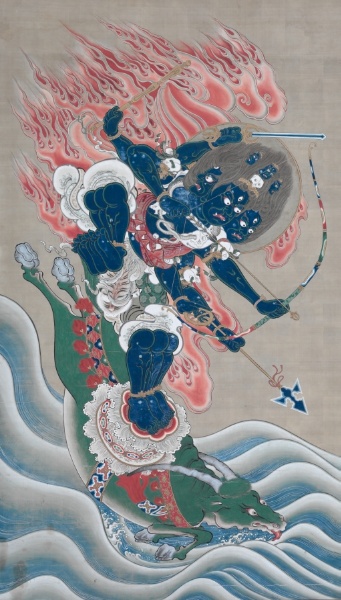
- Title
- Wisdom King of Great Awe-inspiring Power (Daiitoku Myōō)
- Period
- Edo period (1615–1868), mid-1800s
- Region
- Japan
- Medium
- Hanging scroll; ink, color, and gold on silk
- Dimensions
- Overall: 250 × 143 cm (98 7/16 × 56 5/16 in.)
- Collection
- Cleveland Museum of Art
- Accession
-
1976.72 - Rights
- Cleveland Museum of Art (CC0). John L. Severance Fund.
Cleveland 1976.72. Mid-19th-century Edo recension of an iconography fixed at Tō-ji in the 830s. The wrathful body is Amida; the six heads are the six realms of rebirth; the buffalo is Yama-as-death-lord, subdued and ridden. The painter is working a thousand-year-old canon at speed: the bow is already drawn, the buffalo is already moving.
What the scroll shows
Stand far enough back to see the whole 250-cm scroll at once. The figure is in motion. The buffalo is moving, its body angled diagonally across the lower third of the silk, head turned back toward the viewer’s left, red caparison flying.
Out of the buffalo’s back rises the deity: a dark-blue body, multiple stacked heads under a flaring corona of grey-white hair, six arms working at six things at once. Behind the head, a gold-yellow disc dotted with darker round marks reads as a moon-and-stars halo. Behind the body, a wall of vermillion flame.
What you can read off the silk:
- The body is dark blue, almost blue-black, the standard Mikkyō wisdom- of-emptiness colour for Yamāntaka. Lighter blue highlights articulate the muscle-folds.
- The hair flares outward from each head as a wrathful crown: pale grey- white, drawn as separate flame-shaped locks.
- One pair of right hands has just drawn a bow: the long curve of the bow swings up and right, the bowstring taut.
- A long staff descends in the lower-left field; a small triangular banner is fixed near its base. The banner reads as a sankoshō-style mark (three-pronged vajra).
- The buffalo is green: not a workshop slip, a deliberate choice. Its caparison is red with white-and-blue rosette ornament.
- The buffalo stands or wades through stylized blue waves, drawn in the Edo workshop convention of breaking white-cap curls over a flat blue ground.
- The flame wreath fills the upper field behind the figure. It is red shading to pink at the tips, not the gold-orange of earlier flame- halo conventions.
What you cannot reliably read at this resolution: the exact disposition of all six legs (the deity’s lower body is partially behind the buffalo’s red caparison and the flame field), the small attributes in the two lower hands, and any inscription that may exist on the painting’s mounting fabric.
The Five Wisdom Kings, in brief
Daiitoku is one of five. The Godai Myō-ō (五大明王, Five Great Wisdom Kings) are the wrathful manifestations of the Five Wisdom Buddhas of Mikkyō Esoteric Buddhism. Each occupies a cardinal point and pairs with one of the central Buddhas:
| Direction | Wisdom King | Original Buddha |
|---|---|---|
| Centre | Fudō (Acala) | Mahāvairocana (Dainichi) |
| East | Gōzanze (Trailokyavijaya) | Akṣobhya (Ashuku) |
| South | Gundari (Kuṇḍali) | Ratnasambhava (Hōshō) |
| West | Daiitoku (Yamāntaka) | Amida (Amitābha) |
| North | Kongō-yasha (Vajrayakṣa) | Amoghasiddhi (Fukūjōju) |
The five appear together in the Five Wisdom King mandala (Godai-Son Mandara) used in court-sponsored Mikkyō ritual through both Tendai and Shingon lineages. Each also has an independent cult, an independent painting tradition, and an independent ritual programme. What you are looking at on the Cleveland scroll is the western pillar of that five-figure system, removed from the mandala and read at full height.
The Heian canon: Tō-ji, Kūkai, the Benevolent Kings rite
The iconography on Cleveland 1976.72 is mid-19th century. The form it follows is over a thousand years older.
Kūkai (空海, 774–835), founder of the Shingon school, returned from Tang China in 806 with the iconographic-drawing (zuzō) tradition and the texts of the Mahāvairocana and Vajraśekhara cycles.
By the 830s, he had set up a sculptural programme in the Lecture Hall (Kōdō) of Tō-ji in Kyoto: a three-dimensional Five Wisdom Kings group flanking a central Mahāvairocana, the whole arrangement keyed to the Ninnō-gyō (仁王経, Sutra of the Benevolent Kings) ritual for protecting the nation. The Tō-ji Daiitoku (six-headed, six-armed, six-legged on a buffalo) fixes the canonical form in Japan.
Cynthea Bogel reads Kūkai’s Tō-ji programme as the moment Mikkyō visual theology becomes a state-sanctioned visual order: not a private iconography but a civic one (Bogel 2009).
What survived from that fixing is a stable bundle: six heads to see each of the six realms of rebirth, six arms holding the standard wrathful armament (the canonical lists in the Asabashō and related compendia name a sword, a bow and arrow, a staff or trident, a vajra, a wheel or club, in varying arrangements).
Six legs distribute as two crossed in front and four pendant when the deity is shown seated on the buffalo; dark blue or black body, flaming halo, the buffalo mount.
The painted-scroll tradition departs from the seated-Tō-ji-statue arrangement in one important way: when the figure is shown moving (as on the Cleveland scroll) the leg distribution shifts. The deity is not seated; the deity is riding. The buffalo carries the body; the six legs grip the buffalo’s flanks or kick out into the flame field. The Edo painter on Cleveland 1976.72 has chosen the dynamic mode.
The ritual context survived too. In the Heian period, paintings and sculptures of the Wisdom Kings were used in court-sponsored Benevolent Kings rites at moments of political crisis: military threat, drought, plague, succession dispute. The Daiitoku-hō (the rite specifically focused on Daiitoku) was performed by warriors preparing for battle (Linrothe 1999). The deity that subdues the death-lord is the deity you want on your side when other men are trying to kill you.
Yama, the buffalo, the Slayer of Death
The buffalo is the iconographic puzzle.
In the strict Indian Buddhist version of the story, Yamāntaka kills Yama, the death-king who rules the underworld. Yamāntaka itself parses as Yama-anta-ka, “Yama-ender”, the bodhisattva who terminates the power of death, the one (per the Met essay’s gloss) who stops the power of the King of Hell. The Tibetan and East Indian traditions preserve this conquest pattern most directly: Yamāntaka is bull-headed or buffalo-headed, having taken on the death-lord’s own form to defeat him.
The Japanese tradition reads the same iconography differently. In Japanese Mikkyō painting and sculpture, Daiitoku is rarely bull-headed; he is anthropomorphic but rides a buffalo; the buffalo is the death-lord, subdued. The six heads remain; they are read as the six realms of rebirth that the deity sees and rules, not as the multiple faces of a bull.
Linrothe traces this East Asian recension to the Tang Mikkyō tradition that Kūkai inherited; the buffalo-mount form is the form Kūkai brought back to Tō-ji and the form the Asabashō and later compendia recorded.
The Cleveland scroll preserves both halves of the story. The buffalo is not a generic mount in the way the lion of Mañjuśrī or the elephant of Samantabhadra is a mount. It is, doctrinally, the death-lord himself, brought under the wisdom-king’s control.
That the buffalo is green on this scroll (not the standard ox-grey or earth-tone) is worth noting. The colour is canonical for water-bull / underworld-bull imagery in some Mikkyō recensions and is one of the features by which later workshops signalled they were working from a zuzō lineage and not improvising.
Edo workshop fluency
The Cleveland scroll is mid-19th century. By then Mikkyō painting workshops had been copying the Heian iconographic canon for nearly a thousand years. Most provincial-temple Five Wisdom King hanging-scroll sets from the late Edo period are slack: the heads are stacked but not articulated, the weapons are flat-listed in the hands, the buffalo is a cartoon, the flame is filler.
This scroll is not slack. The painter is fluent.
What fluency looks like, on the silk:
- The bow has weight. The string is drawn (not posed-drawn but pulling-against-the-arm drawn) so the arm muscles, painted in lighter blue over the blue-black ground, register the load.
- The buffalo is in motion at the head and the rear-quarters simultaneously. The head turn is reactive (the buffalo is responding to the rider, not posed for the viewer) and the rear hooves break through the wave-pattern.
- The flame wreath has internal current. The flames at the upper edge of the halo lick rightward; the flames at the lower edge lick leftward; the body of the wreath visibly rotates around the figure. This is a painter who has watched fire.
- The moon-and-stars halo behind the central head is quiet against this kinetic field. The painter has read the iconographic distinction (the wrathful body is moving, the wisdom-mind behind it is still) and has rendered it as a contrast in surface activity.
This is not a fabricated reading. It is what a curator notices on inspection: the difference between a workshop copying a zuzō and a workshop using a zuzō as the basis for a moving picture. Cleveland’s own catalog text is restrained: the museum identifies the deity and the directional pairing and stops. The argument that the scroll is a competent example of late-Edo Mikkyō painting (rather than just a correct one) is bodhi’s, not the museum’s.
What stays unverified
The Cleveland catalog is brief: title, accession, dating, medium, dimensions, credit line (John L. Severance Fund), one short curatorial sentence. It records nothing about:
- Pre-acquisition provenance: which temple, which workshop, which collector before Severance Fund 1976
- Workshop attribution: no painter name, no school identification (Tosa? Kanō? a Mikkyō-affiliated atelier?)
- Companion scrolls: whether this Daiitoku was once part of a Five Wisdom King set or was painted as a single
- Conservation history: what restoration the silk has received
The mid-19th century dating is institutional. No published rationale is given.
Reading the scroll next time
Three things to look at, in order:
- The buffalo’s eye. In a slack workshop scroll the buffalo is passive. In a fluent one (like Cleveland 1976.72) the buffalo is reading the rider, the situation, the viewer. The eye is where you see the painter’s hand.
- The bow. Drawn or undrawn tells you whether the workshop has thought about what the deity is doing, or only about what the deity holds. A drawn bow with visible string-tension is the signature of a workshop that knows the difference.
- The flame current. Pick a point on the halo and trace which way the flames are moving. If the upper and lower edges move in opposite directions, the painter has rendered the canonical wrathful-deity “wheel of fire” rather than a flat halo of static tongues.
If those three reads come up positive (moving eye, drawn bow, rotating flame) you are looking at a workshop that handled the iconography as a living image, not as a diagram. The Cleveland scroll clears all three.
Sources
-
Catalog identifies Daiitoku as 'an avatar of the Buddha Amida' who 'manages the west'; period mid-1800s; John L. Severance Fund acquisition
-
[2]— Robert N. Linrothe, Ruthless Compassion: Wrathful Deities in Early Indo-Tibetan Esoteric Buddhist Art (London: Serindia, 1999) print referenceThe standard study of wrathful-deity iconography across the Mikkyō transmission; treats Yamāntaka's bull/buffalo associations and the Indo-Tibetan vs. East Asian recensions
-
[3]— Cynthea J. Bogel, With a Single Glance: Buddhist Icon and Early Mikkyō Vision (Honolulu: University of Hawai'i Press, 2009) print referenceOn Kūkai's Tō-ji programme, the *zuzō* (iconographic-drawing) tradition, and the visual-theological function of the Five Wisdom Kings in Heian court Buddhism
-
[4]— Pamela D. Winfield, Icons and Iconoclasm in Japanese Buddhism: Kūkai and Dōgen on the Art of Enlightenment (New York: Oxford University Press, 2013) print referenceMikkyō visual theology in the Kūkai lineage; the doctrinal frame for the Five Wisdom Buddhas / Five Wisdom Kings pairing
-
[5]— Roger Goepper, Aizen-Myōō: The Esoteric King of Lust (Zürich: Artibus Asiae, 1993) print referenceComparative Mikkyō wrathful-deity iconography; structural model for reading a single Wisdom King against the canonical-text basis
-
[6]— Asabashō (阿娑縛抄), Tendai Mikkyō iconographic compendium compiled by Shōchō (1205–1281) print referenceCited at compendium level for the Heian-canonical iconographic descriptions of Daiitoku that survived into the workshop tradition