Yosegi-zukuri: the multi-block construction that scales
- Title
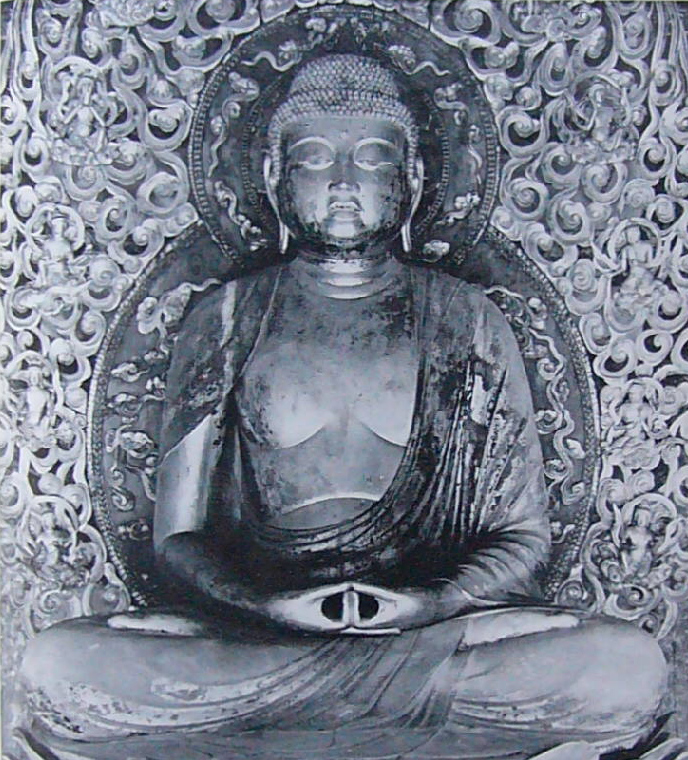
- Amida Nyorai zazō (阿弥陀如来坐像) — Byōdō-in Hōō-dō, the canonical *yosegi-zukuri* anchor
- Period
- Heian period, 1053
- Region
- Yamashiro / Kyoto
- Medium
- Wood with gold leaf and lacquer; *yosegi-zukuri* (joined-block construction) — the earliest surviving large-scale instance, attributed to Jōchō
- Dimensions
- 277.2 cm seated
- Collection
- Byōdō-in (平等院), Uji, Kyoto — Japanese National Treasure (国宝)
- Accession
-
Hōō-dō (Phoenix Hall) principal honzon - Rights
- Public domain (PD-Japan-oldphoto). Photograph from *Illustrated Byōdōin (Byōdōin Zukan)*, ed. Fukuyama Tsuneo and Mōri Tōru, published January 22, 1947 — pre-1957 PD-Japan-oldphoto eligible. Source: Wikimedia Commons.
The canonical *yosegi-zukuri* anchor: Byōdō-in Hōō-dō Amida by Jōchō (1053), 277.2 cm. The earliest surviving large-scale joined-block figure — the technical innovation that resolves the cypress-drying-cracks problem and enables every Heian and Kamakura monumental wooden sculpture downstream. The 1947 *Byōdōin Zukan* plate.
Yosegi-zukuri (寄木造, “joined-block construction”) is the Heian-period workshop innovation (anchored at Jōchō’s Byōdō-in Amida, 1053) that replaced single-block (ichiboku-zukuri) with joined-from-hollowed-blocks technique. Three downstream effects: drying-crack resolution, workshop division of labour, scale to monumentality. The 8.4 m Tōdai-ji Niō (1203) is the architectural ceiling the technique enables.
The cypress problem
The technical problem yosegi-zukuri solves is the cypress problem.
Japanese cypress (hinoki, ヒノキ) is the canonical wood for Buddhist sculpture: straight grain, low resin, takes lacquer and gilding cleanly, ages predictably over centuries. The cultural-religious preference for cypress is documented from the Asuka period onward.
But cypress, like all wood, dries unevenly. The outer rings dry faster than the inner heartwood. This causes the wood to shrink across the grain as it loses moisture; a sealed-in heartwood that cannot release moisture will crack as the outer rings contract around it. For a single-block carving, this means an inevitable structural fault running from the surface inward.
For figures up to roughly 100–150 cm, the problem is manageable. The block is small enough that drying-cracks can be controlled by aged wood, careful seasoning, and post-carving repairs. Asuka and Tenpyō (Nara) sculpture is dominated by ichiboku-zukuri (一木造, “single-block construction”) at this scale. The 32 cm Cleveland Asuka Kannon (1950.392) and the 60 cm Tōdai-ji Hokke-dō Fukūkenjaku Kannon-attendant figures are at the comfortable end of single-block work.
Above ~150 cm, the cypress problem becomes governing. A 250-300 cm seated figure cannot be carved from a single block without major drying-faults. A 8.4 m standing figure is impossible.
The yosegi solution
Yosegi-zukuri solves the cypress problem by hollowing the figure.
The mechanics:
- The figure is divided into multiple blocks before carving: typically the head, the torso (sometimes split front/back), the legs, and the arms as separate units.
- Each block is hollowed from inside before final carving: the bulk of the heartwood is removed, leaving a relatively thin (~5-10 cm) outer wall.
- The blocks are joined with mortise-and-tenon and wooden pegs at the seams.
- The final external carving is then completed across the joined surfaces, with the joins concealed under lacquer-gesso ground (kokuso urushi) and gilding.
The hollowing is the load-bearing technical move. Drying-cracks come from sealed-in heartwood; remove the heartwood, and the wood can release moisture from both inside and outside surfaces. The remaining ~5-10 cm wall section dries at a rate the wood can accommodate without cracking.
Three downstream consequences
The technique has three downstream consequences that reshape Japanese Buddhist sculpture.
Workshop division of labour. Once the figure is conceived as joinable blocks, the workshop can split the carving across multiple hands. The head-master carves the principal expressive surfaces (the face, the hands, the central drapery); junior carvers handle the limbs, the secondary drapery, the lotus base. The Jōchō-school workshops at Heian-period palace and temple commissions could deliver figures faster and at greater scale. The Kei-school workshops a century and a half later operationalise this further: the documented 1203 Tōdai-ji Niō are produced by Unkei, Kaikei, Tankei, Jōkaku, and 16 other named artisans across 69 days on-site, a workshop scale impossible without yosegi-zukuri’s joinable-block conception.
Scaling to monumentality. Above the ~150 cm cypress-problem threshold, yosegi-zukuri is the only viable technique. The Byōdō-in Amida at ~295 cm seated (1053) sits at the early-deployment scale. The Tōdai-ji Niō at 8.4 m standing (1203) sit at the architectural ceiling: the technique’s outermost demonstration. Without yosegi-zukuri, the Niō at that scale do not exist. The Heian and Kamakura monumental wooden sculpture corpus is, in this sense, a downstream phenomenon of the 11th-century Jōchō-school technical innovation.
Internal cavities and dedications. The hollow interior creates an unforeseen institutional space: a cavity into which the workshop or commissioning patron can place dedications: relics, sutras, sculptors’ inscriptions, donor lists. The 1988 restoration of the Tōdai-ji Agyō Niō recovered a Hōkyōin darani-kyō sutra naming Chōgen, Unkei, Kaikei, Tankei, Jōkaku, and the 16 busshi shōnin: the documentary record that anchors the entire 1203 Niō attribution. Internal-cavity dedications become a Kamakura-period documentation convention; many of the major attribution claims of the period rest on internal-cavity recoveries during 20th-century restoration work.
Ichiboku, warihagi, yosegi
The technique-progression is best read as three stages.
Ichiboku-zukuri (一木造): single-block construction. The Asuka and Tenpyō dominant technique. Workable up to ~100-150 cm; faults appear above that scale. Most surviving Asuka and Nara sculpture is ichiboku.
Warihagi-zukuri (割矧造): split-and-rejoin construction. An intermediate. The figure is roughed out in single-block, then split (typically along the front-back axis), the heartwood is removed from inside, and the two halves are rejoined and finish-carved. The Heian early-and-mid period dominant technique for medium-scale figures (~150-220 cm). Distinct from yosegi-zukuri in that the figure is conceived as one block then split, rather than designed as joinable blocks from the start.
Yosegi-zukuri (寄木造): joined-block construction. The Heian late-period innovation, anchored at Byōdō-in 1053 by Jōchō. The figure is designed from the start as joinable blocks. The Kei-school Kamakura workshops continue and refine the technique through the 12th-13th century.
The progression is not strict: warihagi and yosegi coexist in the late Heian, and some late works are hybrids (joinable-block torso with single-block head, for instance). But the broad direction is from single-block toward increasingly modular construction across the Heian-Kamakura transition.
The Jōchō anchor
Jōchō (定朝, d. 1057) is the named foundational figure. The Byōdō-in Amida (1053) is the earliest large-scale documented yosegi-zukuri work that survives. Whether Jōchō invented the technique or standardised it from earlier workshop experiments is a substantive scholarly question: Mason 2005 and Mōri 1974 read the Byōdō-in Amida as the first canonical deployment, with the technique itself developing through the late-10c and early-11c Heian workshops in fragmentary form.
What is documented: by the time the Byōdō-in Amida is commissioned, the technique is sufficiently mature that a single workshop under Jōchō’s direction can deliver a 295 cm seated figure with the structural integrity to survive nine and a half centuries to the present, including the 1336 Sōji-in fire, multiple temple-precinct fires, and the 19th-20th century Cultural Properties restoration regimens. The technique works.
The Kei-school descent
The Kei-school (慶派) workshops of late Heian and Kamakura inherit the yosegi-zukuri technique directly from Jōchō through three generations:
- Kōkei (康慶, fl. late-12c): the Kei-school founder. Kōfuku-ji holdings.
- Unkei (運慶, c.1150-1223): Kōkei’s son. Tōdai-ji Niō 1203 (with Kaikei), Kōfuku-ji Hokuendō Miroku 1212, multiple commissioned works.
- Kaikei (快慶, fl. 1185-1223): independent practitioner with documented Pure Land institutional connection (the An’amibutsu signature pattern). Tōdai-ji Niō 1203 (with Unkei).
- Tankei (湛慶, 1173-1256): Unkei’s eldest son. Sanjūsangen-dō Senju Kannon programme 1251-1266.
The Kei-school technical refinements:
- Gyokugan (玉眼, “jewel eyes”): rock-crystal eyes inserted from inside the hollow head cavity, secured behind a paper or cloth backing. The lifelike-eye effect that distinguishes Kamakura sculpture from Heian-period painted-eye work. Possible only because yosegi-zukuri’s hollow head allows insertion from behind.
- More aggressive hollowing: the Kei-school workshops hollow more aggressively than Jōchō-period workshops, reducing weight further and allowing larger figures (Tōdai-ji Niō at 8.4 m, Sanjūsangen-dō programme of 1,001 figures).
- Internal-cavity dedications standardised: the practice of placing sutras, relics, and inscribed records inside the hollow body becomes a Kei-school workshop convention, providing the documentary anchors that modern attribution scholarship rests on.
Where this technique sits
Yosegi-zukuri is the most consequential single technical innovation in Japanese Buddhist sculpture. The Asuka transmission imported the iconographic and stylistic vocabulary; yosegi-zukuri provided the construction-technical infrastructure that allowed Japanese workshops to scale beyond the cypress-problem ceiling and produce the monumental Heian-Kamakura corpus.
A reader walking through Tōdai-ji’s Nandaimon, Sanjūsangen-dō’s hall of 1,001 figures, the Kōfuku-ji Hokuendō, or any Heian-Kamakura temple with monumental wooden sculpture is, in technical-genealogical terms, walking through downstream consequences of an 11th-century Jōchō-workshop innovation. Without yosegi-zukuri, the visible institutional Buddhism of late Heian and Kamakura (the workshop scale, the monumental figures, the gyokugan-eye realism) does not exist.
Related
- Byōdō-in Amida: Jōchō, the canonical Heian image: the foundational yosegi-zukuri work.
- Tōdai-ji Niō, 1203: the Unkei-Kaikei collaboration: the 8.4 m architectural ceiling that yosegi-zukuri enables.
- Asuka transmission: Tang precedent into Yamato: the institutional-historical foundation that the Heian technical infrastructure builds on.
Sources
-
The foundational yosegi-zukuri reference work. Built 1053 by Jōchō (定朝, d. 1057). Approximately 295 cm seated. The earliest large-scale documented use of the joined-block technique. Bodhi covers this work in its dedicated single-work-study
-
The 8.4 m Niō pair. Demonstrates the architectural ceiling that yosegi-zukuri enables. The 1988 *Hōkyōin darani-kyō* recovery from inside the Agyō body cavity is the documentary record of an internal-cavity dedication that yosegi-zukuri's hollow construction enables. Bodhi covers this work in its dedicated single-work-study
-
Standard English-language survey. Heian and Kamakura sculpture chapters cover Jōchō's yosegi-zukuri innovation, the Kei-school technical descent, and the construction-technique mechanics. Cited at work level.
-
The English-language Kamakura sculpture reference. Reads the Kei-school technique as direct yosegi-zukuri descent from Jōchō workshop with refinements (gyokugan glass eyes, more aggressive hollowing for weight reduction). Cited at work level.
-
Foundational mid-20c Japanese-language scholarship on Japanese sculpture techniques. The technical-mechanical analysis of *ichiboku-zukuri*, *warihagi*, and *yosegi-zukuri* progression. English-language reception via Mason
-
Modern restoration documentation describes the Amida's internal hollow-block construction in technical detail. Cross-referenced via published Cultural Properties summaries
-
The 1988 dismantling of the Agyō Niō revealed the internal cavity construction and recovered the *Hōkyōin darani-kyō* sutra naming Chōgen, Unkei, Kaikei, and the workshop. Documentary record of the internal-cavity dedication practice
-
Cross-checked for the Heian-period dating, the Jōchō attribution, the *ichiboku* / *warihagi* / *yosegi* progression, the Kamakura technique-descent
-
Cross-checked for the late-10c origin, the multiple-block hollow-and-join mechanism, the gilding/painting finishing
-
Cross-checked for the Kōkei → Unkei → Tankei + Kaikei lineage and the workshop-technical descent from Jōchō through three generations of Buddhist sculptors