Jizō Bosatsu: reading the saviour of the six realms
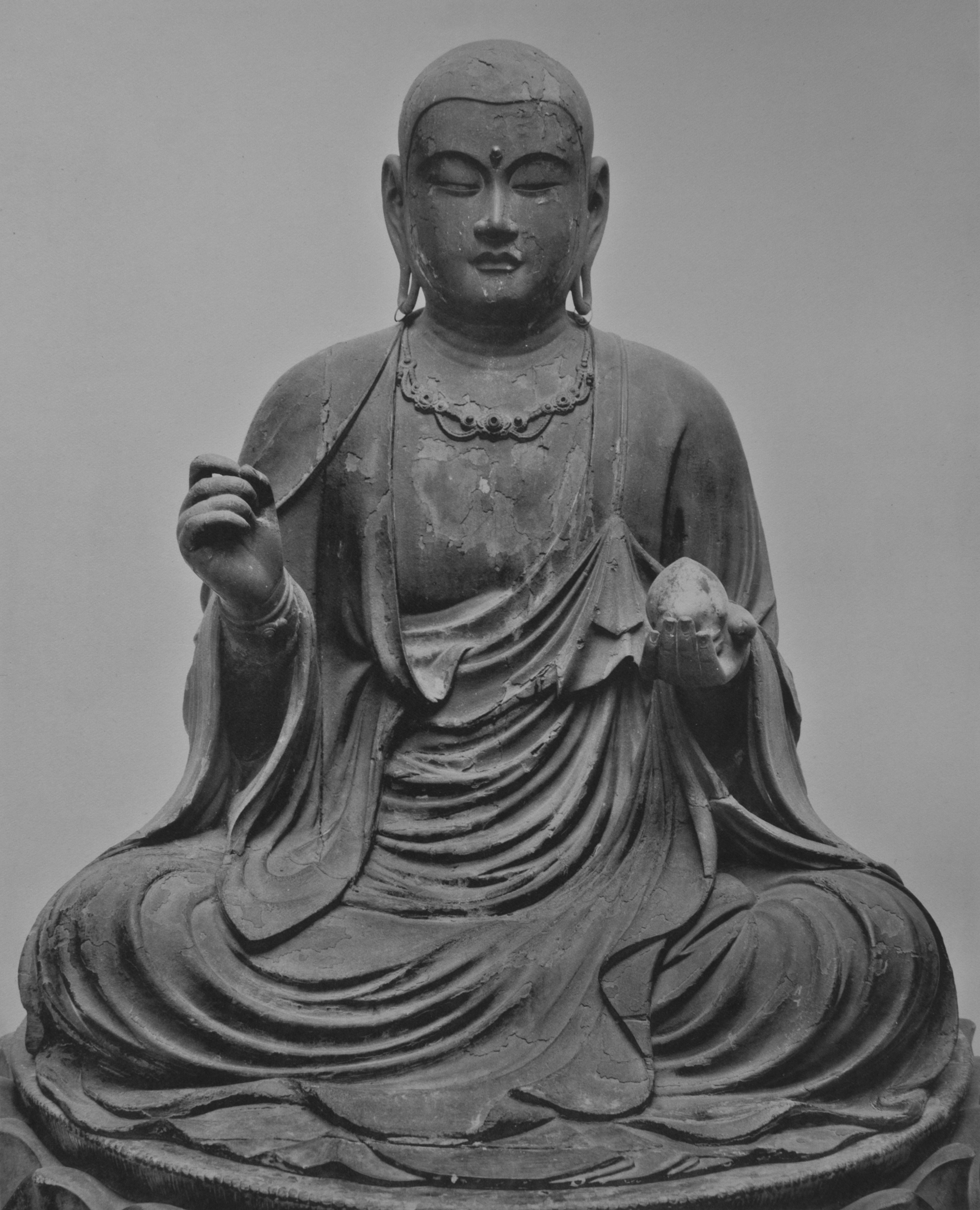
- Title
- Jizō Bosatsu (地蔵菩薩立像) — Rokuharamitsuji
- Period
- Kamakura period, early 13c
- Region
- Yamashiro / Kyoto
- Medium
- Wood with polychromy and gold-leaf passages; *yosegi-zukuri*; *gyokugan* (rock-crystal eyes)
- Dimensions
- Standing figure approximately 90 cm
- Collection
- Rokuharamitsuji, Kyoto
- Accession
-
Treasure Hall principal Jizō - Rights
- Public domain (PD-Japan-oldphoto). Photograph from the 1933 *Nara Imperial Museum* sculpture catalogue. Source: Wikimedia Commons.
Jizō Bosatsu, Rokuharamitsuji (Kyoto), early 13c — attributed to Unkei (contested). The 1933 photographic catalogue plate. The canonical Kamakura-period Jizō: monk-form, *shakujō* in raised right hand, *cintāmaṇi* in left.
Jizō Bosatsu (地蔵菩薩, Skt. Kṣitigarbha) is the bodhisattva who vowed to remain in the six realms of rebirth (including hell) until all beings are saved. Iconographically: shaven-headed monk-form, shakujō (六環杖) ringed staff, cintāmaṇi (如意宝珠) wish-granting jewel. The Heian-Kamakura sculptural canon includes the Rokuharamitsuji Jizō (Unkei attributed, contested) and the Tōdai-ji Hokke-dō / Saidai-ji Jizō programmes. The Edo-period child-saviour reading is doctrinally late.
The vow that defines the figure
Jizō Bosatsu is iconographically and doctrinally distinguished by a single substantive claim: he vowed to remain in the six realms of rebirth (including the hell-realms) until all beings are saved.
The vow comes from the Jizō Bosatsu Hongan-kyō (地蔵菩薩本願経, “Earth Store Bodhisattva’s Original Vow Sūtra”), Taishō Tripiṭaka 412 (T.412). The text develops in the Indian-to-Chinese Buddhist transmission and arrives in Japan via the Chinese Buddhist canon. The vow’s doctrinal weight: while other bodhisattvas vow to attain enlightenment for all beings, Jizō specifically vows to operate within the realms of suffering rather than from above them.
This is the load-bearing iconographic difference. Other bodhisattvas (Kannon, Monju, Fugen) appear in their celestial-bodhisattva form: jewelled crown, ornaments, princely silks, the lotus-throne register. Jizō appears in monk-form: shaven head, plain monastic robes, walking-staff. The visual register is itself the doctrinal claim: this is a bodhisattva who walks the realms of suffering as a monk on the road, not as a celestial figure descended.
The iconographic markers
Three markers in standard combination:
Shaven head. No crown, no jewelled ornaments, no ushnisha (the Buddha’s cranial protuberance). The head is plain monk-form; and this is, on its own, the strongest disambiguator: no other major bodhisattva is rendered without a crown.
Plain monastic robes (kasaya, 袈裟). Standard Buddhist monk’s robes (the tied-shoulder undergarment with the outer-shoulder draped kāṣāya) without the long crown-streamers, scarves, and princely silks of bodhisattva-clad figures. The robe-treatment is naturalistic-monastic rather than ceremonial-celestial.
Shakujō (錫杖): the ringed monk’s staff. The most diagnostic single attribute. Six rings on the upper end (sometimes more in elaborated programmes), held in the right hand or, less frequently, both hands. The staff’s ringing announces the monk’s approach (in the original Indian Buddhist convention, allowing small creatures to clear the path before the monk’s footstep). The six rings are sometimes read as corresponding to the six realms, though the more conventional reading is six pāramitās.
Cintāmaṇi (如意宝珠): the wish-granting jewel. Spherical jewel held in the left hand at chest height, sometimes resting on the palm or partly enclosed by the fingers. The jewel signals the bodhisattva’s compassionate-aid function; in some Esoteric programmes the jewel is read as containing the relics of all Buddhas, or as the source of all blessings.
The combination shakujō + cintāmaṇi + shaven head + monastic robes fixes the identification. Variant works may show the staff in the left hand and the jewel in the right (mirror reversal, common in painted vs sculpted contexts), or one attribute alone, or no attributes at all (the most reduced monk-form figures, particularly in Kamakura roadside-Jizō contexts). The shaven head and monk’s robes together are the floor; the staff and jewel together are the ceiling of the iconographic specification.
The six-realms reading
The Jizō Bosatsu Hongan-kyō describes Jizō manifesting in each of the six realms of rebirth:
- Hell-beings: Jizō in the hell-realms is the figure that anchors the medieval Japanese hell-paintings and the Jigoku Zōshi tradition.
- Pretas (hungry ghosts): Jizō providing nourishment.
- Animals: Jizō providing protection.
- Asuras: Jizō providing peace.
- Humans: Jizō providing instruction.
- Devas: Jizō providing reminders of impermanence.
The Six-Jizō (六地蔵, Roku-Jizō) programmatic codification places one Jizō manifestation in each realm, parallel in structure to the Six Kannon programme that bodhi treats in the Six Kannon disambiguation. Each manifestation bears a slightly modified attribute set; the central monk-form remains constant.
In sculptural context, the Six-Jizō programme appears as paired sets at temple gates, roadside cluster shrines, and within hall-programmes. The most iconic deployment is the roadside Roku-Jizō-do (six small Jizō figures at the entrance to a graveyard or a village boundary) which becomes the popular-devotional setting in the Edo period.
The Rokuharamitsuji anchor
The single most-cited Kamakura-period Jizō sculpture is the Rokuharamitsuji Jizō (Kyoto, early 13th century). The figure is approximately 90 cm tall, standing, in yosegi-zukuri construction with gyokugan (rock-crystal) eyes and polychrome / gold-leaf finishing. The principal attributes are the shakujō in the raised right hand and the cintāmaṇi in the left hand at chest height.
The figure is traditionally attributed to Unkei. The attribution is contested in modern scholarship: Mōri 1974 reads the figure as Kei-school workshop production rather than securely Unkei-solo. The yosegi-zukuri construction and gyokugan refinement are securely Kei-school workshop output; the carving register is consistent with Unkei-circle work; whether the figure is Unkei’s hand specifically remains an open question.
This places the Rokuharamitsuji Jizō in a similar attribution-evidentiary register to the Tōdai-ji Niō (1203): secure Kei-school workshop attribution, contested specific-hand attribution. The honest reading: this is a Kei-school Kamakura Jizō with credible (but unconfirmed) Unkei involvement, of the highest quality the workshop produced for non-monumental commissions.
The temple’s broader Treasure Hall collection, which also includes the Kūya Shōnin standing portrait (an itinerant-monk realist portrait, Kei-school) and the Taira no Kiyomori portrait, anchors Rokuharamitsuji as a Kei-school Kamakura-realist programme more broadly. The Jizō sits within this institutional and stylistic context, not as an isolated work.
What the popular reading flattens
A note on the modern Jizō devotional culture, because the popular framing tends to flatten the doctrinal-historical thread.
In contemporary Japan, Jizō is most visibly associated with child-saviour roles: the mizuko-Jizō (水子地蔵) for stillborn and miscarried children, the protector of dead children at the river Sai-no-kawara, the guardian of travellers and roadside-shrine watcher. The small stone Jizō figures with red bibs, found at temple precincts and roadside shrines across Japan, anchor this devotional register.
This reading is historically late. It develops in the Edo period (17th-19th c.) and post-Edo as the Buddhist devotional culture popularises and as the Jizō-as-children’s-saviour narrative gains institutional support. The classical Heian-Kamakura iconographic and doctrinal reading is the six-realms saviour vow, with hell-realm operation as the doctrinally-weighted manifestation. The child-saviour reading is downstream and supplementary, not the primary classical claim.
This is worth naming because the popular Anglophone framing of Jizō (“the protector of dead children and travellers”) often takes the late-Edo and modern devotional reading as if it were the classical doctrinal claim. The classical reading is closer to: “the bodhisattva who descends into hell-realms in monk-form to teach beings out of suffering.” Both readings have institutional and devotional reality in Japan today; reading them as the same is the popular over-reach.
Where this figure sits
Jizō Bosatsu is the principal monk-form bodhisattva in Japanese Buddhism. The Heian-Kamakura sculptural canon (Rokuharamitsuji, Tōdai-ji Hokke-dō subsidiary figures, Saidai-ji Jizō programme) establishes the iconographic vocabulary that subsequent Japanese Jizō devotional culture builds on. The Six-Jizō programmatic codification parallels the Six Kannon programme as the principal Esoteric realm-saviour codification of the Heian period.
A reader encountering Jizō imagery (sculptural, painted, or roadside-stone) can apply the iconographic-marker hierarchy: shaven head and monk’s robes (floor), shakujō and cintāmaṇi (ceiling), six-realm programmatic context (institutional anchor). The doctrinal reading via the Jizō Bosatsu Hongan-kyō (T.412) provides the textual ground that the iconography renders pictorially.
Related
- The Havemeyer Jizō raigō — a solitary descent of the same bodhisattva
- Datsueba — the old woman of the Sanzu River, met on the road through the six realms
- The six Jizō of Edo — one bodhisattva programmed across the six realms
- Kōfuku-ji Hokuendō Miroku, 1212: Unkei working alone: Unkei’s solo-attributed late masterpiece; useful comparandum for the contested Rokuharamitsuji Jizō attribution debate.
- Tōdai-ji Niō, 1203: the Unkei-Kaikei collaboration: the workshop-coordinated commission that grounds the Kei-school production model the Rokuharamitsuji Jizō descends from.
- The Six Kannon disambiguation: parallel realm-saviour programmatic codification in the Esoteric programme.
- Yosegi-zukuri: the multi-block construction that scales: the technique deployed at the Rokuharamitsuji Jizō and across the Kei-school Jizō corpus.
- The Thirteen Buddhas: Jizō in the memorial-rite sequence
Sources
-
The principal textual source for Jizō devotion. Translates as 'Earth Store Bodhisattva's Original Vow Sūtra.' Establishes Jizō's vow to remain in the six realms — including hell — until all beings are saved. Foundational text for East Asian Jizō devotional culture
-
The canonical Kamakura-period Jizō. Wood, *yosegi-zukuri*, *gyokugan*, polychromed. Approximately 90 cm standing. Traditionally attributed to Unkei; the attribution is contested in modern scholarship — Mōri 1974 and others read the figure as Kei-school workshop production rather than securely Unkei-solo. National Treasure
-
Both temples hold significant Jizō imagery from Heian and Kamakura periods. Tōdai-ji's Hokke-dō and Daibutsuden contexts include subsidiary Jizō figures; Saidai-ji's Jizō programme is the temple's principal devotional anchor in the Eison-revival period (13c)
-
Reads Rokuharamitsuji Jizō within Kei-school workshop context; treats Unkei attribution as Kei-school-coordinated rather than securely Unkei-solo. The substantive scholarly position the article commits to. Cited at chapter level, without page numbers
-
Covers Heian-Kamakura Jizō iconography in the broader bodhisattva-cult chapters. Cited at chapter level, without page numbers
-
Frank's research on Japanese Buddhist popular devotion. Anchors the historiographical reading of Jizō from doctrinal-canonical six-realms-saviour role to popular-devotional child-saviour role. The shift is Edo-period and post-Edo, not classical
-
The Esoteric programmatic placement of six Jizō manifestations, one per realm of rebirth (hell-beings, *pretas*, animals, *asuras*, humans, devas). Each manifestation bears a distinct attribute combination. The programme is parallel to the Six Kannon (cf. /disambiguations/six-kannon) and emerges in the same Heian Esoteric institutional context
-
Cross-checked Sanskrit Kṣitigarbha origin, Chinese Dìzàng (地藏) reception, Japanese Jizō devotional development, the *Jizō Bosatsu Hongan-kyō* T.412 textual source, the six-realms vow
-
The temple's records on its principal Jizō figure, the Unkei-attribution tradition, and the broader Treasure Hall holdings (which also include the Kūya Shōnin standing portrait and the Taira no Kiyomori portrait — both Kamakura-period realist sculptures)