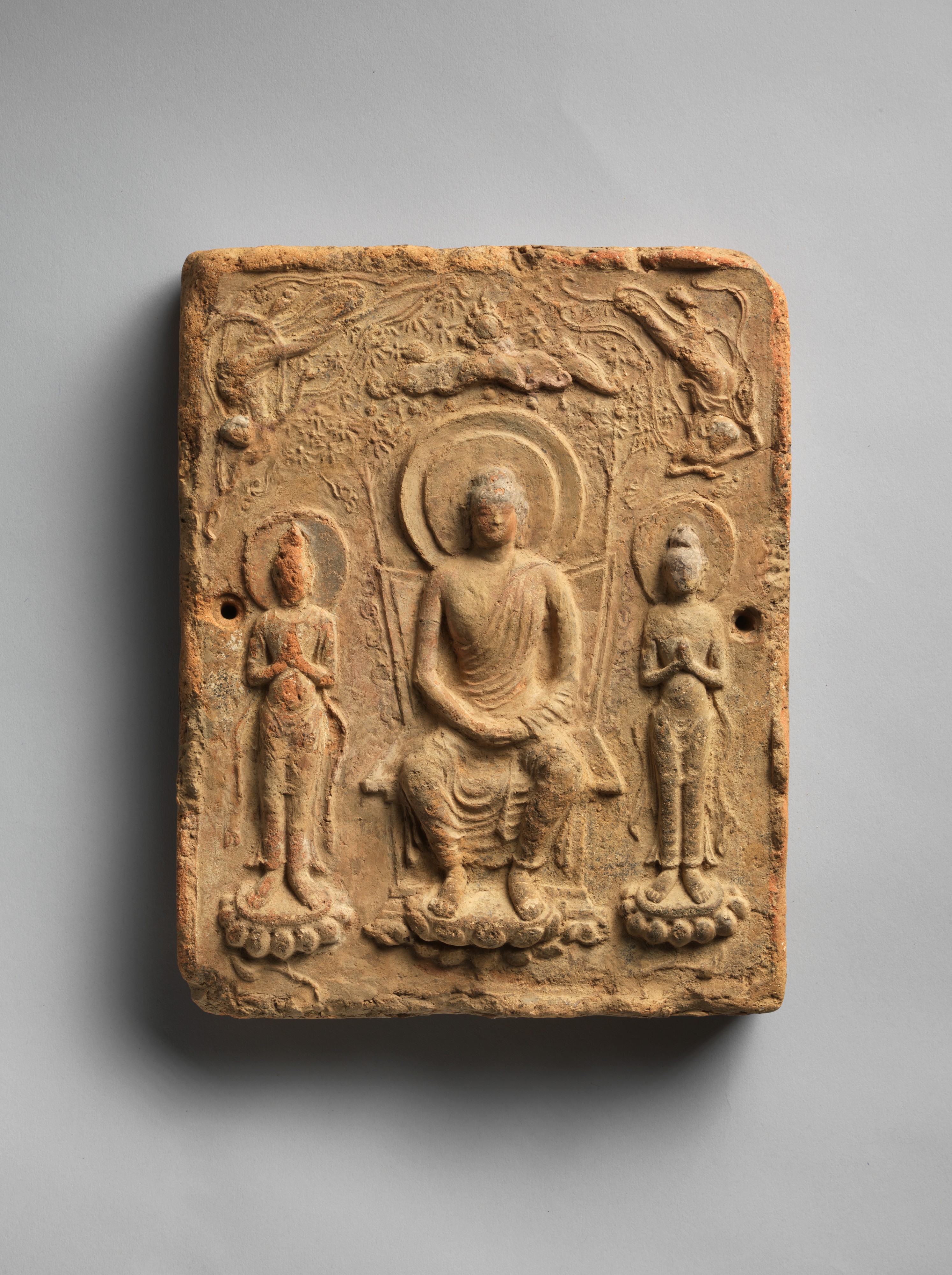
An Asuka senbutsu tile, Buddha triad, c. 670s
- Title
- Tile with Buddha Triad (Sanzon Senbutsu, 三尊塼仏) — Met 2015.300.249, Asuka c. 650–699
- Period
- Asuka period (538–710), second half of the 7th century (650–699)
- Region
- Japan
- Medium
- Earthenware with traces of color
- Dimensions
- Height: 24.5 cm (9 5/8 in.). Width: 19.7 cm (7 3/4 in.). Depth: 3.8 cm (1 1/2 in.)
- Collection
- Metropolitan Museum of Art, New York
- Accession
-
2015.300.249 - Rights
- Public Domain. The Metropolitan Museum of Art, New York, Mary Griggs Burke Collection, Gift of the Mary and Jackson Burke Foundation, 2015 (acc. 2015.300.249). Met Open Access (OASC).
Met 2015.300.249: a *senbutsu* tile, c. 650–699. Probably from the interior wall decoration of Tachibana-dera in Asuka. The Buddha-triad composition is a press-mould reproduction of a Tang-derived sculptural composition translated into clay tile via technology that arrived from Baekje in 588 CE.
A tile, 24.5 by 19.7 centimetres, fired clay 3.8 centimetres thick. Smaller than a sheet of A4 paper, heavier than a smartphone, and at one time fixed flush against an interior temple wall in Asuka. The relief is shallow but the composition is fully legible: a seated Buddha at the centre, two standing bodhisattvas flanking, a tiered canopy above the Buddha’s head, the upper branches of a bodhi tree rising behind. Traces of polychrome survive in the recesses.
This is a senbutsu (塼仏): a clay press-mould Buddha-relief tile. Sen means “tile,” in particular a tile pressed from a mould; butsu is “Buddha.” Senbutsu are one of the most diagnostic and least-discussed survivors of Japan’s earliest Buddhist art — and they exist for only about sixty years.
A tile from a temple wall
The Met’s Tile with Buddha Triad sits on the early-Hakuhō side of the late-Asuka transition. The catalog dates it to the second half of the seventh century (650–699). The Met record locates its likely provenance: this tile is believed to come from Tachibana-dera (橘寺), the temple in the Asuka basin traditionally associated with Prince Shōtoku Taishi’s mother and one of the major Buddhist establishments of the late-Asuka period. Tachibana-dera’s archaeological record has yielded substantial quantities of senbutsu fragments — enough that any senbutsu tile of this period and iconographic type has a non-trivial probability of being from there.
The work is not a sculpture in the round, not a hanging painting, not a bronze cast. It is a wall decoration. Senbutsu tiles were installed flush against the interior walls of Asuka-period temple halls, usually arrayed in horizontal registers, sometimes with the Buddha-triad composition repeating along the wall like a stamped band of iconography. The medium presupposes the wall.
That is a different aesthetic register from the great bronze and clay sculptures that share the period. The Hōryū-ji Shaka Triad (Tori-busshi, 623), the Yakushi-ji bronze Yakushi (early 8th c.), the Kōfuku-ji kanshitsu Hachibushū (734) are all stand-alone three-dimensional objects. The senbutsu tile is two-and-a-half-dimensional and exists only as part of an array. The single 24.5 cm survivor in New York is one fragment of what was originally a multi-tile composition.
Buddha, canopy, bodhi tree, two bodhisattvas
The iconography is a textbook seated Buddha triad. The central Buddha sits on a small lotus pedestal, hands held in front of the body in a dhyāna (meditation) or abhaya (fearlessness) variant — the relief depth makes precise mudra identification difficult, and the polychrome that would have clarified it has largely worn away. The body is rounded, the shoulders square, the face round in the late-Asuka / early-Hakuhō manner.
Above the Buddha’s head, a tiered canopy: a layered umbrella-form rendered in low relief, the draped fabric stylised into folds. Behind the canopy, a stylised tree extends upward to the tile’s upper edge — the bodhi tree under which Śākyamuni attained enlightenment, used here generically to mark the cosmological location of any seated Buddha as the place of awakening.
Flanking the Buddha at left and right, two standing bodhisattva attendants on smaller lotus pedestals, each turned slightly toward the central figure, hands held in attendant gestures (one raised, one lower). Their identities are conventional rather than fixed: in a generic Buddha-triad, the attendants might be Kannon and Seishi (the Amida attendants), Monju and Fugen (the Shaka attendants), or simply unspecified bodhisattvas as iconographic markers of Buddha-presence. The senbutsu composition does not specify and probably did not need to: the wall it was installed on would have given it iconographic context that the tile alone no longer carries.
The triad-with-canopy-and-bodhi-tree composition is canonical Tang-Chinese — versions of it appear in Tang-period painted murals at Dunhuang and Longmen, in Tang clay tiles from Chinese temple contexts, and in Korean transmissions of the same type. The Japanese senbutsu form translates the Tang composition into clay press-mould production. The translation is faithful: the canopy, the bodhi tree, the seated central figure, the two flanking attendants are all present in the Tang source.
Senbutsu — clay relief Buddha tiles
The senbutsu medium has a sharp historical window. Tiles of this kind appear in Japan in the second half of the 7th century and disappear by the early 8th century — roughly a sixty-year span. The reasons for the medium’s short life are clear in retrospect: senbutsu sit at the technological intersection of two changing capacities. They require both the established clay-tile production infrastructure (which arrived in Japan from Baekje in 588) and the new Buddhist-image iconographic vocabulary (which arrived from continental sources through the 7th century). Once full bronze casting and large-scale dry-lacquer (kanshitsu) and clay sculpture were established in the 8th century, senbutsu’s relative simplicity could not compete with the new monumental sculptural forms.
What remains is roughly a few hundred senbutsu fragments distributed across museum collections (Tokyo National Museum, Nara National Museum, Kōfuku-ji, Tachibana-dera, and Western collections including the Met) — most fragmentary, a smaller number complete or near-complete. Met 2015.300.249 is one of the better-preserved examples in Western collections.
588 CE: when the Baekje potters arrived
The senbutsu medium presupposes a sophisticated clay-tile infrastructure. That infrastructure arrived in Japan on a specific date and via a specific delegation.
The Nihon Shoki records that on the 14th day of the 3rd month of 588 CE (according to the lunar calendar), King Wideok of Baekje dispatched a delegation of Buddhist artisans as a diplomatic gift to the Soga clan of the Yamato court. The delegation is named: four temple-architecture specialists, one bronze-statue caster, and two roof-tile doctors (瓦博士, kawara-hakase). Subsequent missions across the 590s and 600s added more specialists, including additional potters specifically trained in roof-tile making.
This is the foundational technology-transfer moment for Japanese Buddhist architecture and Buddhist clay-art production. The Soga clan, then in the process of building Asuka-dera (Japan’s first major Buddhist temple, founded 588 and substantially complete by 596), needed exactly this set of skills: how to build a Tang-style temple with stone foundations, how to cast a bronze Buddha image, and — critically for our tile — how to fire roof tiles and clay relief work to a temperature and density appropriate to East Asian temple construction.
The 588 delegation does not make senbutsu directly. But the kawara-hakase tradition it founded supplies the clay-firing competence that, two and three generations later, can produce a Buddha-triad press-mould tile fine enough that the canopy, bodhi tree, and bodhisattva attendants are all legible in shallow relief on a 24.5 cm fired ceramic surface.
The Tang composition behind the press-mould
The senbutsu mould itself is a Japanese workshop product. The composition stamped into it is not.
Tang-Chinese Buddha-triad compositions of the 7th and early 8th centuries — surviving in Dunhuang cave murals, in Longmen and Yungang stone reliefs, and in small bronze and stone Buddhist works that travelled along the Silk Road — supply the iconographic source for the Asuka-Hakuhō senbutsu corpus. The canopy-bodhi-tree-attendant configuration on Met 2015.300.249 is a small-scale clay reproduction of a Tang sculptural composition that the Japanese workshop knew through any of several possible transmission paths: a continental original imported as a model, a continental painting copied from, or a Korean intermediary version of the Tang prototype.
The Tang-precedent argument is not about specific one-to-one source identification (which is rarely possible for senbutsu given the scale and the loss-rate of Tang originals) but about iconographic register: the senbutsu tiles read as continental and Tang-derived, not as the more austere mid-Asuka Tori-school workshop. The transition from Tori register to Tang register inside the late-7th-century Hakuhō transition is one of the major art-historical events of the period, and the senbutsu corpus is one of its diagnostic markers.
The Burke bequest and the Met’s Asuka holdings
The Met’s senbutsu tile entered the collection in 2015 through the Mary Griggs Burke Bequest — the same 300-plus-work gift that included the Kaikei Jizō (2015.300.250, the consecutive accession), and which constituted one of the largest single transformations of an American Japanese-art collection in the early 21st century.
Mary Griggs Burke (1916–2012) collected Japanese art across a long life, building a corpus of approximately 1,000 works that on her death was divided between the Met (around 300 Japanese works plus Korean and Chinese pieces) and the Minneapolis Institute of Art (the remainder, plus separate ongoing relationships with both institutions). The 2015 Burke Bequest extended the original 1966 Burke Gift — which had brought the Met its Nanbokuchō Aizen Myōō (66.90) — into a complete generational arc.
The .300.249 senbutsu and the .300.250 Kaikei Jizō are not just consecutive accession numbers. They are two of the most diagnostically rare objects in the bequest: the senbutsu is one of perhaps a handful of well-preserved early-Asuka clay tiles in a Western collection; the Jizō is a signed Kaikei zenshin phase work with the An Amida Butsu inscription inside the head. The Met curator who assigned the consecutive numbers almost certainly knew what they were doing — these are the bequest’s Asuka and Kamakura sculptural anchor pieces.
Across the Met’s Japanese Buddhist sculpture holdings, the senbutsu is the earliest. Met 2015.300.249 dates to c. 650–699; the next-earliest substantial Buddhist sculpture in the collection is from the 8th century. The work therefore anchors the start of the Met’s Asuka-to-Edo Japanese Buddhist sculpture chronology.
What stays open
The Tachibana-dera identification is presented in the Met catalog as “believed to have been” rather than firmly attributed. Tachibana-dera is the most probable source given the temple’s known senbutsu output, but the Met does not assert a documented provenance chain. The tile’s pre-Burke ownership history is therefore not surfaced.
The mould-relationship of Met 2015.300.249 to other surviving senbutsu of the same composition is an open scholarly question. Senbutsu were produced from re-usable moulds, so any given composition exists in multiple tile-copies; the relationship of Met 2015.300.249 to the other surviving copies of the same Buddha-triad composition would identify which specific mould this tile came from, and (via mould-wear analysis) where in the mould’s production sequence the tile sits.
The specific Tang source-composition for this Buddha-triad has not been identified in published scholarship that surfaces in standard searches. A comparison with Tang painted Buddha-triads at Dunhuang and with surviving Tang stone-relief Buddha-triads at Longmen would be the natural starting point for that identification.
The senbutsu’s original installation context at Tachibana-dera — which hall, which wall, with what other tile compositions — is in principle reconstructable from the archaeological record but has not been published in English-language scholarship in a form that is easily searchable.
Related
For the broader Asuka-Hakuhō transmission narrative (Tang precedent into Yamato), see Asuka transmission: Tang precedent into Yamato. For the gilt-bronze Asuka-Hakuhō Kannon at Cleveland that pairs with this tile across media (bronze vs. clay), see Cleveland 1950.392 Asuka gilt-bronze Kannon. For the Burke-Met arc continuing through the Kamakura period, see Met 2015.300.250 Kaikei Burke Jizō (1202) and Met 66.90 Aizen Myōō (Nanbokuchō). For the Cleveland Tenpyō fragment that anchors the next-period Nara-Buddhist sculptural tradition (8th century, after the senbutsu medium’s end), see Cleveland 1982.264 Tenpyō Bodhisattva head. For Shōtoku Taishi as the dynastic figure associated with the Asuka Buddhist transmission, see Shōtoku Taishi at age two.
Sources
-
[1]2026-05-12The Metropolitan Museum of Art, New York collectionapi.metmuseum.org/public/collection/v1/objects/53158Met Open Access API entry. Confirms: accession 2015.300.249; second half 7th century (650–699 CE); medium earthenware with traces of color; dimensions 24.5 × 19.7 × 3.8 cm; classification sculpture/relief; public domain (CC0); credit line 'Mary Griggs Burke Collection, Gift of the Mary and Jackson Burke Foundation, 2015'.
-
Met curatorial-text and search-excerpt context 2026-05-12: 'Clay relief tiles with figures of the Buddha, known as senbutsu, were made for only a short period of time, between the second half of the seventh and the early eighth century. The Buddha sits beneath a canopy with two attendant bodhisattvas in front of the sacred bodhi tree, and this example is believed to have been an interior wall decoration at Tachibanadera Temple in Asuka, near the ancient capital of Nara.'
-
Met institutional account of the 2015 Burke Bequest. Confirms: Mary Griggs Burke (1916–2012); collection of approximately 1,000 works (more than 850 Japanese, ~90 Korean, ~65 Chinese); 300+ Japanese masterworks bequeathed to the Met (the remainder to Minneapolis Institute of Art); landmark bequest celebrated in the exhibition *Celebrating the Arts of Japan: The Mary Griggs Burke Collection* opening October 20, 2015; the .300.249 senbutsu and .300.250 Kaikei Jizō are in the same Burke acquisition lot.
-
*The Influence of Baekje on Ancient Japan*. Historical record confirms: Baekje-Korean Buddhist artisans sent as a diplomatic gift from King Wideok of Baekje to the Soga clan of the Yamato court on 14 March 588 CE — four temple-architecture specialists, one bronze-statue caster, two roof-tile doctors (*kawara-hakase*), with subsequent dispatch of additional potters specialising in roof-tile making. This is the foundational technology transfer that enables senbutsu production a generation later.
-
General Asuka-period iconographic and historical context. Confirms: the Tachibana-dera (橘寺) temple in Asuka was a major early Buddhist site associated with Prince Shōtoku's mother; the late-Asuka / early-Hakuhō transition is marked by the entry of Tang-Chinese influences alongside the continuing Baekje-derived workshop tradition.
-
bodhi's canonical transmission-history article. The Met 2015.300.249 article does not re-cover the full transmission narrative; the cross-link is the primary reference for the 538–710 transmission sequence.
-
bodhi's companion Asuka anchor article. Cleveland 1950.392 (32 cm gilt-bronze Kannon) and Met 2015.300.249 (24.5 cm clay tile) are the two principal Asuka-period anchors in bodhi's corpus, working different media — bronze casting vs. clay press-mould.
-
Tachibana-dera is one of the major late-Asuka temples, traditionally associated with Prince Shōtoku Taishi. The archaeological site has yielded substantial numbers of *senbutsu* tile fragments, identifying it as one of the principal known sources of the surviving senbutsu corpus.