Gilt bronze: how a ritual implement was made
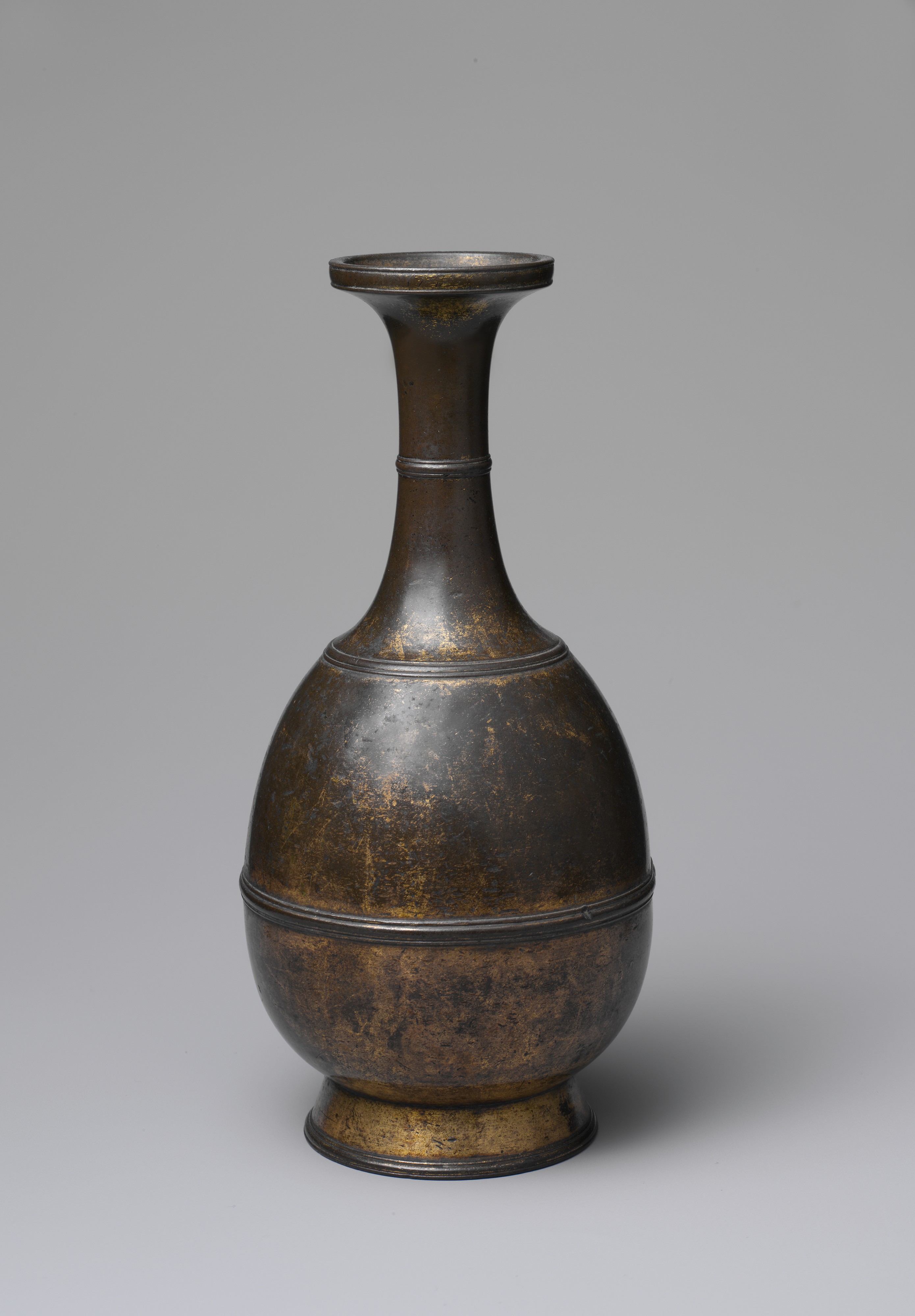
- Title
- Flower Vessel
- Period
- Japan, Kamakura period (1185–1333), 13th century
- Region
- Japan
- Medium
- Gilt bronze
- Dimensions
- H. 19.4 cm (7 5/8 in.); Diam. 9.2 cm (3 5/8 in.)
- Collection
- The Metropolitan Museum of Art
- Accession
-
2006.180 - Rights
- Flower Vessel, Japan, Kamakura period, 13th century, gilt bronze, The Metropolitan Museum of Art, New York, accession 2006.180, Purchase, Barbara and William Karatz Gift, 2006. CC0 (public domain).
The Met flower vessel (2006.180), 19.4 cm high, gilt bronze, Kamakura 13th century. A turned-profile butsugu whose worn gilding records the amalgam-survival pattern. CC0.
A Japanese Buddhist altar implement is a short list of metalworking decisions before it is an object of devotion: cast, raised, chased, pierced, then gilded by burning mercury off a gold amalgam. The Met’s 13th-century gilt-bronze flower vessel (2006.180) wears its gilding back to the exact pattern that says which method put it on.
One object, one short list of operations
A flower vase, an incense burner, a candlestick, a hanging garland-pendant, a handled bell, a vajra: these are butsugu, the equipment of the rite rather than its object. They differ in form and almost not at all in métier. The same kind of workshop made them, out of the same material, by running one short list of operations in different orders. Learn to read the list off one piece and you are reading the others.
The Met holds a piece at the plain end of that list: accession 2006.180, a flower vessel, gilt bronze, dated by the museum to the 13th century and 19.4 cm high, catalogued simply as “Flower Vessel” and classified as Metalwork.1 It is a bottle. A flaring dish-mouth, a long neck crossed by one raised collar-ring, a swelling ovoid body cut by a girdle, a low splayed foot. No figure, no inscription, almost no ornament.
That is why it is the right place to start. An undecorated vessel is the metalwork with nothing to look at except the metalwork, and on this one the gilding has worn back far enough to show how it was put on.
On the altar this object does not stand alone or at eye height. The flower vase belongs to the three-piece set, the mitsugusoku (vase, burner, candlestick), set low on the offering table at the foot of the dais, often doubled to flank the burner, read from above by a worshipper standing back, against the dark of the table, in lamplight that never holds still.
The museum vitrine reverses every one of those conditions. The vessel is lit flat, isolated, raised to standing-eye level, turned so the worn front faces out. That reversal happens to serve a technique reading, which wants exactly the conditions the altar denies.
The object is ordinary in the one sense that matters here: a competent instance of a type made in quantity, not a masterwork carrying a famous program. The operations that made it are the operations that made the class.
Casting: the blank and its mould
Before any decoration there is a decision about how the body exists at all. An implement with mass and a closed three-dimensional profile (a bell, a vajra, the body of a burner, a turned bottle like this one) is cast. The Japan Tourism Agency’s craft-taxonomy reference divides Japanese casting, chūkin, into three mould types, and the distinction is not academic for this vessel.2
Rōgata is lost-wax: a model in a beeswax-and-resin compound, packed in investment, fired so the wax drains and bronze fills the void. Komegata is sectioned piece-moulding off a clay model. Sōgata is the sweep-mould, a board rotated around the basin’s central axis to form the cavity, and the same source names its products precisely: “circular, bowl-shaped objects like bells and tea ceremony kettles.”
That third type is the one the Met bottle argues for. Its strict rotational symmetry and the crisp encircling mouldings at mouth, neck, girdle and foot are what a swept profile produces, not what a freehand wax model leaves. The rings sit at the heights a rotated template would reach, and they are too even for anything but rotation.
This is a sharper claim than the older reading of the piece as a freehand casting later trued on a lathe, and it is still an inference: it is read from the symmetry of the surface, not from a section or a radiograph, and no published technical examination of 2006.180 is cited here because none was found. The lost-wax-versus-sweep-mould question for this particular bottle stays open at the level of proof. What the profile supports, it supports strongly; it does not close the file.
Raising is the other route, and it is for sheet. A thin bronze sheet hammered up into a hollow shape is a structurally different object: lighter, thinner-walled, capable of relief a casting would need a far more elaborate mould to carry. The relief route has a Buddhist history of its own. Oshidashibutsu are repoussé Buddhist images, made by laying a thin bronze sheet over a carved relief matrix and hammering the sheet down into it.
The Tokyo National Museum, describing the Hōryūji Treasures, states the technique plainly. The images “could be mass-produced by placing a thin sheet of bronze over a relief image of a Buddhist divinity and hammering it into shape,” and the museum dates the flowering “from the second half of the 7th to the early 8th century.”3 That is the consequential fact about repoussé in Japanese Buddhist metal: one matrix yielded many near-identical images, the way one block yields many prints.
The dating phrase carries a quiet disagreement worth surfacing, because the competitor pages that mention oshidashibutsu give a date and stop. The “second half of the 7th to early 8th century” straddles a contested period boundary. Sekino Tadasu ended the Asuka period at the Taika Reform of 646 and called the successor era Hakuhō; Okakura Kakuzō ended Asuka only at the 710 move to Nara.4
Art and architecture historians generally follow Sekino, which is why oshidashibutsu are usually labelled Hakuhō rather than late Asuka, while general historians follow Okakura and the objects land inside a long Asuka. The objects do not move; the period label does, depending on whose scheme the catalog uses. bodhi follows the art-historical convention and calls the type Hakuhō, while noting the residual point: the boundary is a modern periodisation argument, not a fact the bronzes settle.
Repoussé and chasing: the front-and-back pair
Repoussé proper, Japanese uchidashi, drives relief out of sheet by working it from the reverse against a yielding bed of pitch, so the front rises into forms the front was never touched to make. It is hammering done by looking at the back of what you want to see from the front. The relief that comes off the hammer is soft and approximate, so a repoussé object is always finished from the other side as well.
That finishing is chasing, and its fine-line form is kebori. JAANUS defines kebori as hairline engraving cut as a sequence of fine lines with a shibutagane graver leaving a V- or U-section groove.5 The same source puts kebori on Buddhist statues and implements from the Asuka period and, in the Nara period, on the lotus petals of the Tōdai-ji Daibutsu pedestal: the technique working at the largest scale Japanese Buddhist bronze ever reached and at hand-implement scale in the same centuries.
Repoussé makes the form; chasing draws on it. On a worked keman the cut feather of a karyōbinga and the curl of a flower-scroll are chased line over raised relief. The two operations are a pair, front and back, and a fully decorated implement carries both.
The Met vessel carries almost none of this, and the absence is the point rather than a disappointment. No chased line on the body, no raised figure. What it has instead is the structural skeleton with the decoration stripped off: the turned rings sit where chasing and inlay would go on a richer piece, the smooth fields between them where a scroll or figure would be raised or cut.
Read against an ornamented implement, the plain bottle is the same object one step before the chaser reached it. An undecorated piece lays the operations out one band at a time, with nothing competing for the eye.
Piercing: when the design needs air
A fourth operation removes metal instead of moving or marking it. Sukashibori is pierced openwork: the design cut clean through so the figure survives as a lattice in air, the ground gone. It is the operation behind the flame-scroll halo, the pierced bodhisattva crown, and above all the keman, the fan-shaped altar pendant that is a halo with no statue, hung on its own as the offering.
bodhi’s reading of the keman as a single object is kept separate and not re-argued here. What matters for the class is that piercing is the same workshop’s fourth tool, used when the design needs light through it rather than gold on it.
Piercing also changes what the gilding then has to do. On a solid cast vessel the gold lies on a continuous surface and wears where hands and cloths reach it. On a pierced keman the gold follows a web of edges and the object is read backlit, so the gilding does optical work the vessel’s never does. Holding the pierced and the solid members of the class together makes one thing visible: the final operation is the same chemistry on both and a different problem on each.
Gilding: the gold goes on by being burned
The gilding is the operation this vessel shows best, because it is failing in the way that reveals it. Japanese gilt bronze was, as a rule, mercury-amalgam fire-gilded. Gold is dissolved into mercury to make a soft amalgam; the amalgam is spread onto the metal; the object is heated until the mercury volatilises and leaves the gold bonded to the surface as a thin, matte film, afterward burnished bright.
Alessandra Giumlia-Mair, Yasunosuke Morimoto IV and Ken’ichi Ota documented the surviving practice at the Morimoto Kazari workshop in Kyoto, which has run since 1877.6 Their account is specific enough to pin. The object is heated in a brazier “over 352°C (the boiling point of mercury) to drive off the mercury in the form of vapor” (p. 1109). That figure is worth flagging: the textbook boiling point of mercury is 356.7°C and the paper rounds it down, and the article reports the number as the source gives it rather than silently correcting it.
The surviving gold is then “polished first by rubbing it with dried rice seedlings, then processing it in ash lye,” cleaned in “a plum vinegar bath,” washed and rinsed (p. 1109). The paper also records a metallurgical constraint with a visible consequence: the pieces gilded this way “are made of unalloyed copper, because the presence of other elements such as tin, lead or zinc would produce ugly spots on the gilding” (p. 1109).
The technique is placed in time as well: used in Japan “since the Nara period,” widely in the Edo period (p. 1106), and on through the Meiji period (p. 1107). The mercury is acutely toxic in the burn-off, which is why the technique all but vanished from working shops in the twentieth century and why the Morimoto workshop is studied as a survival rather than a norm.
The Met vessel is the argument for why this matters to looking. Its gold has not flaked the way leaf flakes. It has thinned and worn. Gilding survives down in the hollows (inside the dish-mouth, in the angle below the girdle ring, around the foot) and is gone from the high ground, the front of the shoulder and the swell of the belly, worn through to dark brown-black bronze.
That is the signature of an amalgam film: a coating chemically bonded to the metal, thin enough to abrade off the surfaces a handler’s fingers and a cleaning cloth reach, surviving where they do not. Gold leaf lifts in sheets and leaves a clean torn edge. Amalgam gold wears like a worn coin, brightest where it sat sheltered.
The wear is patient and legible rather than ruinous. The bottle is, in effect, a diagram of its own gilding, drawn over centuries by being picked up and wiped.
Reading the worn vessel
Set the bottle back where it cannot quite be seen, low on the offering table, behind the burner, in moving lamplight, and the technique reading inverts into what the object was for. None of the operations was done to be admired up close.
The sweep-mould trued the profile so the vase would read as a clean silhouette from the worship floor. The gilding was burned on so it would catch an unsteady flame, not a vitrine light. The wear that now exposes the method is the record of the object doing its job: handled, set out, wiped, set out again, for the better part of five centuries.
What the bottle settles, it settles by being plain. The casting and the gilding are read off this object directly; the repoussé and oshidashibutsu evidence is the Hōryūji Treasures tradition reported by the Tokyo National Museum; the chasing terminology is JAANUS; the gilding chemistry is the Giumlia-Mair study of a workshop that still does it. The composite is stated, not hidden.
The honest open edges are narrow and specific: the sweep-mould reading is strongly supported by the profile but unconfirmed by section or radiograph; the “13th century” is a museum catalogue attribution on an uninscribed type-object; the gilding inference is read from the surface, not from analysis of the film. None of those gaps is the kind a more confident sentence would close — only a Met conservation report on 2006.180 would, and there is none to cite.
That is the honest limit of what one worn bottle, read closely, can be made to say about how a whole class of ritual metal was made. The next thing to do is not to read more about it. It is to find the file that would close the casting question, or another plain butsugu worn the same way, and check the pattern again.
Sources
| Source | Type | Citation |
|---|---|---|
| The Metropolitan Museum of Art acc. 2006.180 | museum record | Flower Vessel, Japan, Kamakura 13th c., gilt bronze, CC0; object facts re-verified via Met Open Access API 2026-05-18 |
| Giumlia-Mair, Morimoto & Ota, “Mercury Gilding in Today’s Japan” | article | ISIJ International 54(5), 2014; p. 1109 (352°C heating, burnish sequence, unalloyed-copper constraint), p. 1106 (Nara onset, Edo use, Morimoto workshop 1877), p. 1107 (until Meiji) |
| Japan Tourism Agency (MLIT): Metal Casting (Chūkin) | reference | rōgata / komegata / sōgata mould taxonomy; sōgata is the sweep-mould for circular bowl-shaped objects (bells, kettles) |
| JAANUS: kebori (毛彫) | reference | hairline engraving, shibutagane graver, Asuka Buddhist application, Tōdai-ji pedestal |
| Tokyo National Museum: Hōryūji Treasures, repoussé Buddhist images | museum record | oshidashibutsu over a relief matrix, 7th–8th c., mass production, 48 small gilt-bronze statues |
| Asuka period-boundary scholarship (Sekino vs Okakura) | reference | named historiographical disagreement on the Asuka/Hakuhō boundary that governs how oshidashibutsu are period-labelled |
Related
- Keman, the openwork gilt-bronze altar pendant
- Kyōzō, the incised Buddhist mirror
- Gokorei, the five-pronged vajra bell
- Gokosho, the five-pronged vajra pestle
- Kanshitsu, the Tenpyō dry-lacquer technique
- Butsugu, Buddhist altar furniture (entity)
- Sukashibori, pierced openwork (entity)
Footnotes
Sources
-
Object facts (date 13th c. / objectBeginDate 1200, objectEndDate 1299; medium gilt bronze; H. 19.4 cm Diam. 9.2 cm; classification Metalwork; public domain) re-verified live via the Met Collection Open Access API 2026-05-18; catalogue HTML 429'd again, expected, no curatorial or provenance text retrieved.
-
[2]2026-05-18ISIJ International (Iron and Steel Institute of Japan) jstage.jst.go.jp/article/isijinternational/54/5/54_110…Vol. 54, no. 5, pp. 1106–1110. Internal pages now pinned: p. 1109 (heating over 352°C; rice-seedling/ash-lye/plum-vinegar burnish; unalloyed-copper requirement, tin/lead/zinc cause spots); p. 1106 (Nara-period onset, Edo-wide use, Morimoto Kazari workshop since 1877); p. 1107 abstract (used until the Meiji period). The paper states 352°C as the boiling point of mercury; the textbook value is 356.7°C — divergence noted in-body, not silently corrected.
-
Hairline engraving with a shibutagane graver cutting V- or U-section grooves; Yayoi onward, Asuka use on Buddhist statues and implements, Nara use on the Tōdai-ji Daibutsu pedestal lotus petals. Entry-level, page legitimately N/A.
-
Verbatim re-verified 2026-05-18: 'Repoussé Buddhist images could be mass-produced by placing a thin sheet of bronze over a relief image of a Buddhist divinity and hammering it into shape'; flourished 'from the second half of the 7th to the early 8th century'; 48 small gilt-bronze statues 'no more than 30–40 cm in height', Asuka-period private worship for local rulers.
-
[5]2026-05-18Japan Tourism Agency, Ministry of Land, Infrastructure, Transport and Tourism mlit.go.jp/tagengo-db/en/R4-00037,htmlGovernment craft-taxonomy reference. Chūkin divides into three mould types: rōgata (lost-wax, beeswax-and-resin model), komegata (sectioned / piece-mould from a clay model), sōgata (sweep-mould, a board rotated around the basin's central axis; used for 'circular, bowl-shaped objects like bells and tea ceremony kettles'). Replaces the prior commercial-blog rōgata reference.
-
[6]2026-05-18Wikipedia, citing Sekino Tadasu and Okakura Kakuzō period schemes en.wikipedia.org/wiki/Asuka_periodSekino dated the Asuka period as ending at the Taika Reform (646), treating the successive era as 'Hakuhō'; Okakura ended Asuka at the 710 move to Nara. Art and architecture historians generally prefer Sekino's scheme. Cited only for the named historiographical disagreement that bears on how oshidashibutsu are period-labelled; not for object attribution.