Dry lacquer against the single block: a Tenpyō-to-Heian construction shift
- Title
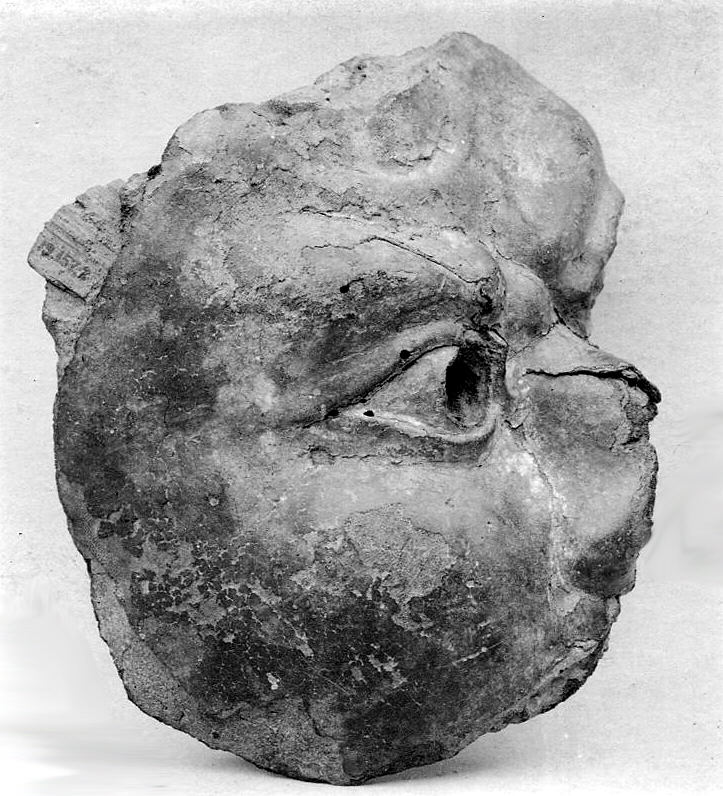
- Fragment: Head of Buddhist Image (菩薩頭部断片) — Met 19.157.2
- Period
- Japan, Nara period (710–794), 8th century
- Region
- Japan / Yamato
- Medium
- Dry painted lacquer (*kanshitsu*) — hemp cloth layered in *urushi* over a removed clay core; *kokuso-urushi* surface paste
- Dimensions
- H. 15.2 cm (6 in.)
- Collection
- The Metropolitan Museum of Art, New York
- Accession
-
19.157.2 - Rights
- Public domain (CC0, Met Open Access). The Metropolitan Museum of Art, Rogers Fund, 1919; accession 19.157.2; object 49126. Public-domain status confirmed via the Met Collection API 2026-05-16.
Met 19.157.2, an 8th-century Japanese head in dry painted lacquer (*kanshitsu*), 15.2 cm, broken at the crown and across the right side. The break is the reason to use it: it shows the construction in section — a thin cloth-and-lacquer shell with no solid wood body. Met Open Access (CC0), archival negative.
Met 19.157.2 is a broken 8th-century Japanese head in dry painted lacquer (kanshitsu). The fracture is the point: it shows a hollow cloth-and-lacquer shell with no solid body inside. Read against single-block wood (ichiboku), its early-Heian successor, the fragment makes the Tenpyō shift legible: an additive lacquer skin against a subtractive carved core, and what each does to surface and weight.
A head that shows its own section
The Met records 19.157.2 plainly: a fragment, the head of a Buddhist image, Japan, Nara period (710–794), 8th century, dry painted lacquer (kanshitsu), 15.2 cm high, Rogers Fund 1919.1 The photograph is an old archival negative, the paper accession label still pinned at the upper left. It is not a flattering picture, and that is its use here.
The face is broken. The right side and the crown are sheared away, the right eye-socket gouged into a dark hollow, the surface gone granular where the finish has lifted and the cloth-and-paste body beneath has begun to crumble. What survives reads as a face only by inference: a left brow ridge, the long shallow curve of a cheek, the set of a mouth that has lost its lip. Most museum heads of this period are shown intact, lit to flatter the modelling. This one is shown the way a section drawing is drawn, opened, so the inside can be seen.
That is what makes it the right object for a construction argument rather than an iconographic one. An intact Tenpyō head presents a continuous surface and conceals exactly the thing under discussion. A broken one cannot. Along the fracture the wall is thin and shell-like; behind it is not solid material but a cavity. The fragment is the technique caught with its skin off. The reading that follows is built outward from that one observation, and it is honest to say at the start that the surviving image is a study negative and a Met API tombstone, not an object handled in the gallery. The in-section reading is what the photograph and the recorded medium together license, no more.
What dakkatsu-kanshitsu actually is
The medium line, “dry painted lacquer (kanshitsu),” names a family with two members, and the family matters more than the individual here.1
Hollow dry lacquer, dakkatsu-kanshitsu (脱活乾漆), is the Tenpyō workshop method. A rough core is modelled in clay at full scale. Hemp cloth soaked in urushi lacquer is wound around it, layer on layer, the hemp wall built to roughly a centimetre, each one left to harden before the next.23 The cloth is not bonded with raw lacquer but with mugi-urushi, lacquer cut with wheat flour into a paste that grips; that paste is the structural glue of the whole shell.3 When the shell is rigid the clay core is taken out, scraped through an opening, or the figure cut into segments, the core removed, the segments rejoined. A light wooden frame, the shingi, is then set inside the empty shell to keep it from warping, and the surface is brought up in a coarser filler paste worked to whatever fineness the modeller can hold: makko-urushi in the Nara period, kokuso-urushi (lacquer, flour and wood-powder) in the Heian period and after.23 What comes out is a lightweight hollow statue: a skin with a brace inside it and nothing else.
The canonical survivor to set beside the Met fragment is the Ashura at Kōfuku-ji in Nara, 153.4 cm, made in dakkatsu in Tenpyō 6 (734), one of the Eight Legions (Hachibushū) commissioned by Empress Kōmyō for the first-anniversary memorial of her mother.4 It is what 19.157.2 was before it broke: a full hollow figure, the three faces and six arms carried on a shell light enough that the set weighs between ten and fifteen kilograms apiece. That number is not a curiosity. The Kōfuku-ji Western Golden Hall burned to the ground four times, most recently in 1717, and the Hachibushū survive because monks could pick the figures up and carry them out. The construction is the reason the object still exists to be looked at.4
The second member, mokushin-kanshitsu (木心乾漆, wood-core dry lacquer), keeps a roughly carved wooden body in place and lays the lacquer skin only over it, mostly across the expressive surfaces. It is the cheaper, faster variant, and it is the bridge: wood begins to do the structural work while lacquer still does the face.
Met 19.157.2 cannot be assigned to one variant from a photograph; whether a wooden core was ever inside it is precisely what the catalog does not say and what the public image cannot settle. But the broken wall in the negative reads as a layered shell rather than as cut grain, and that is enough to make the general point the fragment is here to make: in this family the body of the image is not carved away from a mass. It is wound up out of cloth and resin around a void.
The single block does the opposite
Set against it the technique that displaced it. Ichiboku-zukuri (一木造), single-block construction, takes the head and torso from one piece of wood; projecting limbs may be pieced on, but the core of the figure is one mass.5 The image is not built up. It is found inside the log and the rest is cut away. JAANUS notes the practical fix that came with it: a cavity, uchiguri, chiselled out from the base or the back, partly to lighten the figure and partly to slow the splitting that a solid block suffers as its moisture changes. It is the same instinct toward a hollow interior, reached from the opposite side, by removal rather than by winding.5
The two methods are mirror operations. One is additive: a surface accreted in soft layers, the interior emptied on purpose. The other is subtractive: a surface arrived at by stopping the chisel, the interior emptied as a remedy. The finest single-block work is dated to the later 8th and 9th centuries, exactly the decades on the far side of the Tenpyō dry-lacquer peak, and JAANUS connects it to the imported danzō sandalwood-image ideal and to a domestic reverence for the spirit thought to live in a large tree.5 That last point is not decoration. It changes what the finished object is held to be: not a modelled likeness applied over a void but a presence taken whole out of one living thing.
Why the shift happened
The standard account is economic before it is doctrinal, and the sources are consistent on it. Kanshitsu reached Japan from Tang China in the Nara period and was used heavily for Buddhist images from the late 7th into the 8th century; in the Heian period it falls away because the urushi is costly and the process is slow.6 Wood was abundant; the wood-core variant already pointed the way; solid carving finished the move. Britannica puts the trade-off in one clause worth keeping: kanshitsu lends itself to soft contour and flowing drapery better than wood or stone does.6 The Heian period did not abandon the better surface because it had forgotten how to make it. It abandoned the surface because the surface had become unaffordable at scale, and then it found that the cheaper material could be made to mean something the expensive one could not.
That second half is the part the economic account underdescribes, and it is where the Morse dissertation matters, though it has to be cited for exactly what it demonstrably argues, not for the tidy thesis it is convenient to hang on it. Morse’s The Formation of the Plain-Wood Style (Harvard PhD, 1985; 694 pp.) names and tracks a coherent 9th-century idiom (brooding facial mass, heavy rounded bodies, deeply cut concentric drapery) and frames its emergence around new carving practice routed through Tōshōdai-ji rather than around a lacquer shortage.7 What it does not do, at the level its abstract states the case, is settle the question this article wants settled: whether the bare 9th-century block is best read as forced by cost or chosen for what unconcealed wood was held to be. That reading-difference is live, and naming it honestly is more useful than resolving it by assertion. The economic account (Britannica, and the survey literature generally) makes cost the prime mover; the religious-aesthetic reading makes the single tree the point. bodhi takes them as sequential rather than rival (cost cleared the dry-lacquer option from general use, and the period then built an idiom out of what was left) but that ordering is bodhi’s synthesis of the two literatures, not a finding either side has proven, and the surviving evidence does not pin how much of the plain-wood taste was forced and how much was willed. Nishikawa and Sano’s survey reads the deep rolling-wave drapery of those decades as the idiom native to single-block wood: what a chisel in a hard block produces well and what a lacquer skin would never naturally take.8 The drapery is the tell that the change was not only in cost but in what the surface was now for.
What each method does to the finished image
This is the part the fragment is best at, because it can be reasoned from the construction rather than asserted.
Surface. Dakkatsu builds outward in kokuso-urushi, a paste under the modeller’s thumb that holds any fineness it is given; the Tenpyō face-type (full cheek-volume, the soft eyelid curve, drapery that flows rather than breaks) is what that paste does easily.2 Single-block wood arrives at its surface by removal, and its fineness is capped by the grain and the blade; its native expression is the cut channel, the hard repeated fold, the plane that stops. The Tenpyō surface is modelled; the Heian surface is faceted. Even crumbling, the Met fragment shows the modelled register: the cheek is a continuous swell, not a sequence of cuts.
Weight. Hold the scale of this thing first. At 15.2 cm the fragment is a head you could close one hand around, and a hand-sized head says its parent figure was roughly life-size; the Kōfuku-ji Ashura, a complete dakkatsu figure at 153.4 cm, weighs in the ten-to-fifteen-kilogram band, a standing adult-scale image two people lift without strain.42 A single block at the same scale is the heaviest object in the hall, and the uchiguri cavity is the carver’s admission of it, an attempt to take back some of the mass and some of the cracking at once.5 Stand in a Tenpyō hall and the figures around you are, structurally, hollow shells on light internal frames. Stand in a 9th-century hall and they are worked timber, each one planted where it was set down because moving it is the problem the construction did not solve. The difference is felt in the room before it is analysed on paper, and it is not abstract: it is the literal reason the Hachibushū outlived four fires that took the hall around them, and the reason a comparably scaled single-block figure, when the hall burns, burns with it.
Presence. This is the least measurable and the most consequential, and it deserves the hedge that it is an inference about reception, not a property the API records. The dry-lacquer image is a perfected outer surface with a deliberate emptiness behind it; the single-block image is a mass from which a figure has been released, its origin in one tree part of why it was venerated. The fragment makes the first half of that contrast physical. The broken wall says, in section, that nothing was ever meant to be inside; the void is the design, not the damage. Three centuries later the Heian carver’s whole claim is the opposite: the body is continuous to the core, taken whole. The two halls ask the worshipper to credit two different things, a flawless skin and a presence drawn out of solid wood. The fragment is one honest end of that span.
Where this sits, and what it does not settle
The end-state is worth naming so the span is complete. Single-block construction does not last either: by the 11th century the joined-block method, yosegi-zukuri, takes over for the same kind of reason kanshitsu fell, solving the cracking, the weight and the scale of solid wood at workshop volume. That story is its own article and is not re-argued here; it is the next link, named and left.
What this fragment can carry is bounded and should be stated as such. It establishes, from the broken wall and the recorded medium, that the Tenpyō image was a hollow lacquer skin, and it lets that fact be set against single-block wood as the mirror operation, with surface, weight and presence reasoned from the two constructions. It cannot say which kanshitsu variant it is, whether a wooden core was ever inside it, which figure it belonged to, or which workshop made it; the catalog is a tombstone and the image is a study negative, and a Met technical report could change the variant question in either direction. The Morse dissertation is cited for its bibliographic record and for the claim it demonstrably makes (the plain-wood idiom and its Tōshōdai-ji-routed carving practice), while Nishikawa and Sano 1982 and Mōri 1974 are cited at chapter and argument level, without page references checked against the physical volumes. The reading-difference recorded above is the genuine one, and it stays open by design: bodhi’s sequential synthesis (cost cleared the field, the period then made an idiom of what remained) is a reconciliation of the survey and Morse literatures, not a result either proves, and a single broken head, however legible in section, settles none of it.
Sources
| Source | Type | Citation |
|---|---|---|
| Met Collection API: object 49126 (acc. 19.157.2) | museum API | public domain (CC0); medium, date, dimensions, credit verified live 2026-05-16 |
| JAANUS: dakkatsu-kanshitsu | reference | construction sequence, shingi, kokuso, “lightweight hollow statue,” accessed 2026-05-16 |
| JAANUS: ichiboku-zukuri | reference | single-block head+torso, uchiguri cavity, warihagi/yosegi, danzō, accessed 2026-05-16 |
| Encyclopædia Britannica: Kanshitsu / Dakkatsu / Ichiboku / Tempyō | reference | Tang import; Heian decline on cost and time; soft-contour trade-off; survey-level |
| Samuel Crowell Morse, The Formation of the Plain-Wood Style | thesis | Harvard PhD, 1985, 694 pp.; record + abstract verified 2026-05-18; cited for the plain-wood idiom only; cited at work level |
| Nishikawa Kyōtarō and Emily J. Sano, The Great Age of Japanese Buddhist Sculpture | book | Kimbell / Japan Society, 1982; rolling-wave idiom native to single-block; pages not verified |
| Mōri Hisashi, Sculpture of the Kamakura Period | book | Weatherhill, 1974; Tenpyō kanshitsu as the inherited technical ground; pages not verified |
| Japanese Wiki Corpus: Kanshitsuzo | reference | mugi-urushi bond paste, ~1 cm hemp, shingi core, makko→kokuso chronology; accessed 2026-05-18 |
| Kōfuku-ji: Ashura of the Eight Legions | museum | H. 153.4 cm, dakkatsu, 734, Kōmyō commission, 10–15 kg, survived the 1717 fire; web-verified 2026-05-18 |
Related
- How the Tang Buddha image reached Nara — the transmission behind the technique
- Kanshitsu: the Tenpyō dry-lacquer technique, the mechanics-and-decline survey this piece reads an object against
- Cleveland 1982.264: an intact Tenpyō dry-lacquer head, the collecting-history companion
- An early-Heian single-block Shakyamuni, c. 900: the single-block end of this span at single-work depth
- A Nara Buddha hand at Cleveland: a companion survival fragment in wood
- Yosegi-zukuri: the joined-block construction that displaced the single block in turn
- Dakkatsu-kanshitsu: hollow dry lacquer (entity)
- Ichiboku-zukuri: single-block construction (entity)
Footnotes
-
The Metropolitan Museum of Art, accession 19.157.2, objectID 49126, “Fragment: Head of Buddhist Image,” Japan, Nara period (710–794), 8th century; dry painted lacquer (kanshitsu); H. 15.2 cm; Rogers Fund, 1919; classification Sculpture; public domain (CC0). Verified live via the Met Collection API 2026-05-16; all object data is API-level, and the in-section reading rests on the CC0 archival negative plus the recorded medium, not on in-person examination. ↩ ↩2
-
JAANUS, “dakkatsu-kanshitsu” (脱活乾漆), accessed 2026-05-16: clay core; successive hardened layers of lacquer-soaked hemp cloth; clay core removed by scraping or by cut-and-rejoin; an internal wooden framework (shingi) added after de-coring to prevent warping; kokuso-urushi surface paste of lacquer, flour and wood-powder; result a lightweight hollow statue; Hakuhō and Nara periods. Entry-level reference; pages not applicable. ↩ ↩2 ↩3 ↩4
-
Japanese Wiki Corpus, “Kanshitsuzo,” accessed 2026-05-18: “Mugi-urushi is a paste mixture of urushi (lacquer) and wheat flour, which creates a strong bond”; the hemp layer “is typically made into roughly about 1-cm thickness”; “the framework of the statue is made using shingi (a wooden core)”; and “during the Nara period, makko-urushi, and during the Heian period and later, kokuso-urushi were mainly used.” Used for the bond-paste-versus-surface-paste distinction and the makko→kokuso chronology that JAANUS compresses. Reference-level corroboration; pages not applicable. ↩ ↩2 ↩3
-
Kōfuku-ji (Hossō-shū head temple, Nara), National Treasure Hall, on the Ashura of the Eight Legions (Hachibushū): H. 153.4 cm, hollow-core dry lacquer (dakkatsu), Tenpyō 6 (734), commissioned by Empress Kōmyō for the first-anniversary memorial of her mother; the eight figures weigh between ten and fifteen kilograms each, and survived the four destructions of the Western Golden Hall (most recently the fire of 1717) because the hollow-lacquer construction kept them light enough to be carried clear. Temple statement and corroborating dimension (H. 153.4 cm) verified via web search 2026-05-18; the Kōfuku-ji English catalog page itself returned a TLS certificate error on direct fetch 2026-05-18, so the figures are taken from the temple’s published statement as surfaced in search, not from a fetched catalog HTML. Named comparandum only; not handled in person. ↩ ↩2 ↩3
-
JAANUS, “ichiboku-zukuri” (一木造), accessed 2026-05-16: head and torso from a single block, projecting limbs optionally pieced; an interior cavity (uchiguri) chiselled from base or back to reduce cracking and weight; warihagi the splitting variant; yosegi-zukuri the joined-block successor that became dominant by the 11th century; finest examples late 8th–9th century; influenced by the danzō sandalwood-image tradition and by reverence for the spirit of a large tree. Entry-level reference; pages not applicable. ↩ ↩2 ↩3 ↩4
-
Encyclopædia Britannica, “Kanshitsu,” “Dakkatsu,” “Ichiboku,” “Tempyō style,” accessed 2026-05-16: kanshitsu imported from Tang China in the Nara period; the hollow dakkatsu variant; very few kanshitsu statues made in the Heian period and after because of the large amount of costly urushi and the time-consuming process; kanshitsu better suited than wood or stone to soft contour and flowing drapery. Survey-level corroboration of JAANUS and the named scholarship; pages not applicable. ↩ ↩2
-
Samuel Crowell Morse, “The Formation of the Plain-Wood Style and the Development of Japanese Buddhist Sculpture: 760–840” (PhD dissertation, Harvard University, 1985), 694 pp. Bibliographic record verified via the Digital Library & Museum of Buddhist Studies catalog (NTU), accessed 2026-05-18. The dissertation names and tracks the 9th-century plain-wood idiom (“brooding facial features, rounded corpulent bodies, and deeply carved concentric drapery folds,” dissertation abstract) and frames its emergence around new carving practice introduced from China at Tōshōdai-ji. It is cited here for that demonstrable argument only; the abstract does not itself adjudicate economic-necessity versus deliberate-programme, and this article does not put that adjudication in Morse’s mouth. Page references within the 694-page text have not been verified; the bibliographic and abstract-level facts are verified. ↩
-
Nishikawa Kyōtarō and Emily J. Sano, The Great Age of Japanese Buddhist Sculpture, AD 600–1300 (Kimbell Art Museum / Japan Society, 1982), survey treatment of the Nara dry-lacquer corpus and the early-Heian single-block turn, reading the deep rolling-wave drapery system as the idiom native to single-block wood. Chapter-level citation; specific pages not verified. ↩
Sources
-
[1]2026-05-16The Metropolitan Museum of Art collectionapi.metmuseum.org/public/collection/v1/objects/49126Authoritative for accession 19.157.2, objectID 49126, title, culture Japan, Nara period 710–794, 8th century, medium 'Dry painted lacquer (Kanshitsu)', H. 15.2 cm, Rogers Fund 1919, classification Sculpture, public domain (CC0). API record used for all object data.
-
[2]2026-05-16Japanese Architecture and Art Net Users System aisf.or.jp/~jaanus/deta/d/dakkatsukanshitsu.htmConstruction sequence: clay core; hemp cloth soaked in lacquer wound in successive hardened layers; clay core removed by scraping or by cutting and rejoining; an internal wooden framework (shingi) added after de-coring to prevent warping; kokuso-urushi surface paste. Result: a lightweight hollow statue. Hakuhō–Nara periods.
-
[3]2026-05-16Japanese Architecture and Art Net Users System aisf.or.jp/~jaanus/deta/i/ichibokuzukuri.htmHead and torso from a single block; an internal cavity (uchiguri) chiselled from base or back to reduce cracking and weight; warihagi the splitting variant; yosegi the joined-block successor (11th c.); finest examples late 8th–9th c.; danzō sandalwood-image ideal and tree-spirit reverence as background.
-
Kanshitsu imported from Tang China in the Nara period; dakkatsu hollow variant; kanshitsu lends itself to soft contour and flowing drapery better than wood or stone; decline in the Heian period as the costly urushi and time-consuming process gave way to wood. Survey-level corroboration.
-
[5]2026-05-18Harvard University (PhD dissertation) buddhism.lib.ntu.edu.tw/DLMBS/en/search/search_detail.jspNames and tracks the 9th-c. plain-wood idiom (brooding face, rounded body, deep concentric drapery) and routes its emergence through new carving practice at Tōshōdai-ji; abstract does not adjudicate economic-necessity vs deliberate-programme. Cited for the demonstrable argument only; that adjudication is bodhi's own synthesis, not attributed to Morse.
-
Mugi-urushi (lacquer + wheat flour, 'creates a strong bond') as the structural bond layer; hemp layer ~1 cm; shingi internal wooden core; makko-urushi the Nara surface paste, kokuso-urushi the Heian-and-later one. Construction-sequence precision the JAANUS entry compresses.
-
H. 153.4 cm, hollow-core dry lacquer (dakkatsu), Tenpyō 6 (734), Empress Kōmyō commission; set weighs 10–15 kg each; survived four Western Golden Hall fires (last 1717) because the hollow-lacquer build kept the figures portable. Temple statement + dimension web-verified 2026-05-18; direct catalog fetch returned a TLS cert error, figures taken from the published temple statement via search. Named intact-dakkatsu comparandum to the Met fragment.
-
Standard English survey of the Nara dry-lacquer corpus and the early-Heian single-block turn; the rolling-wave drapery as the idiom native to single-block wood. Chapter-level citation; specific pages not verified.
-
The Tenpyō kanshitsu foundation as the technical ground that the later wood-construction trajectory inherits and replaces. Argument-level citation; specific pages not verified.