Asuka transmission: Tang precedent into Yamato
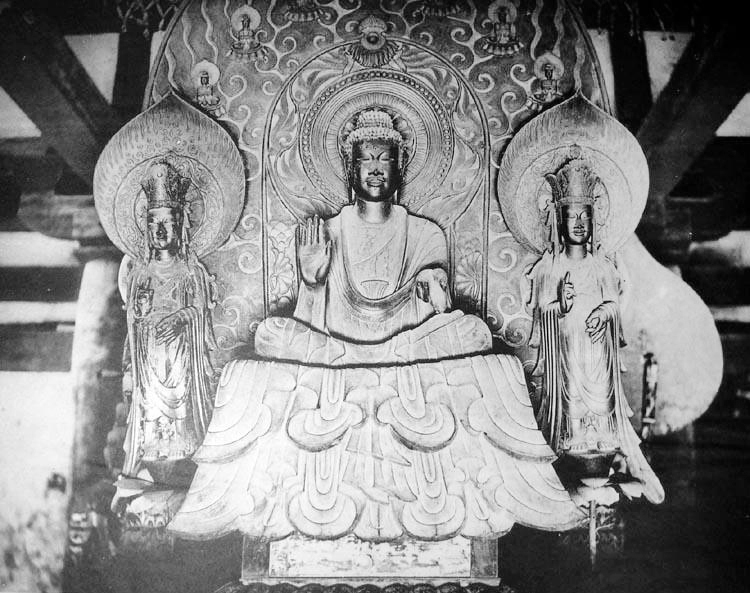
- Title
- Shaka Triad (釈迦三尊像)
- Period
- Asuka period, 623
- Region
- Yamato (Japan)
- Medium
- Gilt bronze
- Dimensions
- Central Shakyamuni: H. 87.5 cm; complete altar group with halo and base
- Collection
- Hōryū-ji, Nara
- Accession
-
Kondō main image - Rights
- Public domain (PD-Japan-oldphoto). Photograph 1899–1908; converted to black-and-white reproduction. Source: baxleystamps.com via Wikimedia Commons.
Shaka Triad, Hōryūji kondō, 623 — Kuratsukuri Tori workshop. The single most-cited Asuka-period bronze and the foundational anchor of Yamato Buddhist sculpture.
The earliest Japanese Buddhist sculpture is imported transmission, not native invention. The official date is disputed (538 per Gangō-ji Engi; 552 per Nihon Shoki); the line of transmission runs Paekche → Soga clan → Shiba Tachito’s workshop → Kuratsukuri Tori. The surviving anchor works are the Asuka Daibutsu (606), Hōryūji Shaka Triad (Tori, 623), and the Hōryūji small bronzes. Hakuhō (mid-late 7c) softens the Tori silhouette toward Tang continental fashion.
The two dates
The first thing to know about Buddhist sculpture in Japan is that there is no native pre-history. Buddhism arrives, with its image-making, as a fully-formed continental import in the 6th century. Sculpture in Yamato before this transmission consists of haniwa terracotta tomb figures and ritual bronze mirrors, not figural devotional images.
The transmission date is disputed. The two principal traditions:
- 538 CE. The Gangō-ji Engi, the temple-origin chronicle of Gangō-ji (the Nara relocation of Asuka-dera), records 538 as the year Paekche king Seong sent the Buddhist image and texts to Yamato.
- 552 CE. The Nihon Shoki (compiled c.720) records 552 as the year of the same transmission. The Aston (1896) English translation is the standard reference.
Modern scholarship tends to read 538 as the more historically defensible date: Inoue Mitsusada and Hayami Tasuku argue that the Nihon Shoki compilers used a 14-year liturgical adjustment that retrojected the event. But the Nihon Shoki date persists in many introductory accounts, so a reader will encounter both.
What both dates name is the official transmission: the moment a Korean kingdom formally sent images and sutras to the Yamato court as a diplomatic gesture. The actual artisan-and-image traffic predates this.
The Fusōryakki records that Shiba Tachito (司馬達等) arrived in Yamato in 522, sixteen years before the Gangō-ji date, reportedly as a Buddhist craftsman from Liang China (or Korea, depending on the chronicle). He is the documented grandfather of Kuratsukuri Tori, the foundational sculptor of the Asuka period. The workshop-genealogy infrastructure existed in Yamato before the imperial-court transmission.
The Soga clan as patrons
The political context matters. When the Paekche image arrived (in 538 or 552, the chronicles disagree), the Yamato court split. The pro-foreign-religion faction was led by the Soga clan; the resistance was led by the Mononobe and Nakatomi clans. The Nihon Shoki records that Soga no Iname (?-570) accepted the image privately when the broader court refused.
The Soga clan won. By 587 they had defeated the Mononobe in open conflict, and Buddhism became the institutional religion of the Yamato court. Soga no Umako (?-626), Iname’s son, founded Asuka-dera (also known as Hōkō-ji) in 588, completed in 596, the first major Buddhist temple in Yamato. The 605–606 Nihon Shoki entry that commissions the Asuka Daibutsu (the Shakyamuni for the Asuka-dera kondō) names Tori as sculptor and Umako as patron.
Empress Suiko (r. 593–628) and her regent Prince Shōtoku (574–622) consolidate the Soga programme into imperial policy. The Hōryūji Shaka Triad halo inscription names Suiko, Shōtoku’s consort, and other court members as the patrons of that work. The 623 completion is months after Shōtoku’s 622 death; the work is, in part, a memorial commission.
The Tori workshop
Kuratsukuri Tori (鞍作止利), also known as Tori Busshi, is the named sculptor of the foundational Asuka bronzes. His workshop was descended from Shiba Tachito (the 522 arrival). The lineage runs Tachito → Tasuna (his son) → Tori (his grandson). Three generations of artisan-immigrant workshop in Yamato before the Tori bronzes are commissioned.
The two surviving Tori works are the Asuka Daibutsu (Asuka-dera kondō, 606) and the Hōryūji Shaka Triad (623). The Yakushi at Hōryūji’s east altar carries a 607 inscription that may also indicate Tori workshop, but the inscription is contested.
The Tori-workshop style is identifiable. The markers:
- Almond-shaped eyes, downcast, with the upper lid forming a smooth arc.
- The “archaic smile”, slightly upturned corners of a small closed mouth.
- Frontal stance: the figure is conceived for face-on viewing, with the body oriented strictly forward.
- Vertical pleat-treatment in the lower robe: the cloth falls in stylised parallel folds rather than naturalistic drapery.
- High forehead, elongated ears, three-fold neck creases (the sansen-tsū marks).
- Triangular silhouette: the figure tapers from the broad robe-base to the narrower upper body.
These markers descend from Northern Wei (北魏) Chinese sculpture (386–534), transmitted via Paekche. The Northern Wei stylistic register itself was passing out of fashion in China by Tori’s lifetime. The Tang court was already moving toward fuller, more naturalistic figures. Tori’s workshop in Yamato is therefore a trailing-edge reception of a Chinese style that was already historical at the moment of transmission.
Korean intermediation
The standard popular framing, “Buddhism came to Japan from China,” flattens an essential mediating step. The Asuka transmission runs through Korea, and specifically through Paekche (백제 / 百済), the southwestern Korean kingdom.
The Nihon Shoki records repeated waves of artisan transmission from Paekche, Koguryŏ, and Silla:
- 522: Shiba Tachito arrives (per Fusōryakki; chronicle disputes whether from Liang China or Korea).
- 538/552: the official Paekche image and sutras.
- 577: Paekche sends Buddhist artisans, monks, and architects.
- 584: additional Korean artisan transmissions.
- 588: Paekche sends architects and sculptors specifically for the Asuka-dera construction project.
- 595: the Korean monk Hyeja arrives from Koguryŏ to teach Prince Shōtoku.
The Korean kingdoms were themselves Buddhist for less than two centuries before this transmission (Koguryŏ adopted Buddhism in 372, Paekche in 384, Silla in 527/535). The transmission to Yamato is therefore Tang-precedent-via-Paekche-recension: Tang continental sculpture passing through the southwestern Korean kingdom and arriving in Yamato in a form already mediated by Paekche workshop conventions.
The Kōryū-ji Hanka-shiyui Maitreya (中宮寺・広隆寺の半跏思惟像), a wooden seated Maitreya in pensive pose, is sometimes dated to early-7c and shows particularly direct Korean Paekche stylistic affinity; some scholars argue it was carved in Paekche and gifted to Yamato. The disagreement is genuine and unresolved. The figure is one of the strongest evidences of the Korean intermediation.
The Hōryūji anchors
Hōryū-ji is the surviving anchor. Founded by Prince Shōtoku in 607 (per the temple’s traditional founding date), it burned in 670 (per Nihon Shoki) and was rebuilt c.690–710. The current kondō and pagoda are the rebuild, making them, depending on dating, the world’s oldest surviving wooden buildings (the rebuild itself is now over 1,300 years old).
The principal Asuka works at Hōryū-ji:
- Shaka Triad (623, kondō main altar): the Tori bronze. Foundational anchor.
- Yakushi (607 inscription, kondō east altar): date contested; the figure may be original or rebuild-period.
- Yumedono Guze Kannon (early 7c, Yumedono octagonal hall): wooden, gilded, hidden image; uncovered by Ernest Fenollosa in 1884.
- Kudara Kannon (early-mid 7c): wooden, tall slender figure with paired side-flares; Korean Paekche stylistic affinity.
- Tamamushi shrine (mid-7c): miniature lacquered wood reliquary with painted narrative panels; the surviving Asuka painting reference.
- The small-bronze atelier output: the Tori-workshop-descent of the Hōryūji 48-bodhisattva collection (now Tokyo National Museum, Hōryū-ji Treasure Gallery).
Whether some of these are pre-fire originals saved or reproduced post-fire is the substantive Asuka-studies dating question. Mason 2005 reads the Tori bronzes (Shaka Triad, possibly Yakushi) as pre-fire originals; the Tamamushi shrine and Yumedono Kannon are also generally read as pre-fire. The Kudara Kannon’s dating is more debated.
The Hakuhō transition
By the late 7th century, the Tori-workshop frontal-archaic register was giving way. The Hakuhō period (white phoenix; conventional dates 645–710, though some scholars compress to 672–710) marks the transition. The visible markers:
- Round face replaces the elongated-rectangular Tori face.
- Softer drapery replaces the vertical-pleat treatment: the cloth begins to fall in modelled folds.
- Three-quarter and side viewing positions become workable; the strict frontality relaxes.
- Tang continental fashion, the contemporary Chinese Sui-Tang sculpture register, becomes the new reference rather than the trailing-edge Northern Wei.
The Yakushi-ji Yakushi Triad (the Yakushi-ji main altar, conventionally Hakuhō, c.700) is the canonical Hakuhō reference. The Yakushi-ji Tōindō Shō Kannon, the standing single-figure bronze that bodhi treats in a separate single-work-study, is the Hakuhō register at its most refined, with the round face, modelled drapery, and the contrapposto-ready three-quarter viewability that Tori bronzes do not offer.
The transition is not sharp. Some Hōryūji works that are conventionally dated to the late-Asuka or early-Hakuhō (the Cleveland 1950.392 small bronze, for instance) carry mixed markers: Tori-silhouette in the hip-flares and the vertical lower-body pleats, Hakuhō-direction softening in the round face and lotus-base. These transitional works are the most informative for reading the stylistic-mechanical mechanism of the transition.
What the transmission means
A point worth naming, because it is sometimes elided in popular framings:
The Asuka-Hakuhō moment is not a “Japanese style emerging.” It is a Yamato-court importation of a Tang/Northern-Wei continental Buddhist register, mediated through Paekche workshops and crystallised in the Tori-workshop output. The “Japaneseness” of these works is in their patron-context (Soga clan, Suiko, Shōtoku) and their institutional-religious framing, not in their visual register.
The first authentically Japanese sculptural register, distinguishable from continental Sui-Tang work, does not arrive until the Tenpyō period (mid-8c, Nara), with the kanshitsu (dry-lacquer) workshop tradition that produces works like the Tōdai-ji Hokke-dō Fukūkenjaku Kannon (c.747). And even Tenpyō is a regional adaptation, not an invention from scratch.
This matters for reading the early sculpture honestly. The Hōryūji Shaka Triad is a Yamato Northern-Wei recension via Paekche. Calling it “the foundational work of Japanese Buddhist sculpture” is true in the institutional-historical sense and misleading in the stylistic-genealogical sense. Both readings have to coexist.
Where this transmission sits
The Asuka-Hakuhō transmission is the institutional ground for everything that follows in Japanese Buddhist art. The Tenpyō workshops at Tōdai-ji descend institutionally from the Soga commissions.
The Heian-period Jōchō-school workshops at Byōdō-in descend technically from the Hakuhō-period bronze and woodwork. The Kamakura Kei-school workshops at Tōdai-ji and Kōfuku-ji descend through the Tenpyō and Heian generations to a continental-influenced Sōgen reformulation under Chōgen.
Every later workshop is, in this sense, a downstream branch of the Asuka transmission. Reading the early importation honestly is therefore reading the institutional-and-technical foundation of the entire tradition.
Related
- An Asuka senbutsu tile — a Buddha triad, c. 670s
- An Asuka-period gilt-bronze Kannon at Cleveland: Cleveland 1950.392 as the transitional small-bronze that carries Tori silhouette markers and Hakuhō softening together.
- Shōtoku Taishi at age two, namu-busshi: Shōtoku as the imperial patron-actor whose memorial-context grounds the Hōryūji Shaka Triad commission.
- Byōdō-in Amida: Jōchō, the canonical Heian image: the downstream Heian Buddhist sculpture that the Asuka transmission eventually produces.
Sources
-
The orthodox-imperial-court chronicle. Records Paekche king Seong sending a gilt-bronze Shakyamuni image and sutras to Yamato in 552. The Aston (1896) translation is the standard English reference. The 552 date is the *Nihon Shoki* tradition
-
The Gangō-ji (formerly Asuka-dera) temple-origin chronicle records 538 as the transmission date. The two principal date traditions (538 vs 552) reflect different chronicle lineages; modern scholarship (Inoue Mitsusada, Hayami Tasuku) tends to read 538 as the more historically defensible date
-
Records the commission of the Asuka-dera Shakyamuni (the Asuka Daibutsu) to Kuratsukuri Tori in 605, with completion in 606. Hard chronicle anchor for the Tori workshop
-
The inscription on the back of the central halo records the patron context: Empress Suiko, the consort of Prince Shōtoku, and other court members commissioned the work after the deaths of two court ladies in 621 and Shōtoku's own illness in 622. Tori is named as the sculptor. Workshop completion 623 — months after Shōtoku's death (622). The bedrock epigraphic anchor of Asuka sculpture
-
The Yakushi halo inscription records 607 as the commission year. Modern scholarship is divided — some scholars (e.g., Ōno Genmyō) read the inscription as a later (post-rebuild) addition that retrojects the date. The Yakushi figure itself is sometimes dated to the rebuild period (c.690–710) on stylistic grounds. Substantive open question in Asuka studies
-
The standard English-language survey. Asuka-Hakuhō chapter covers the Soga commissions, Tori workshop, Korean intermediation, and the Hōryūji anchor sequence. Cited at chapter level; page numbers not verified.
-
Rosenfield's broader transmission scholarship anchors the East Asian context — the Northern Wei stylistic precedent, the Paekche intermediation, the workshop-genealogy tracking. Cited at work level; page numbers not verified.
-
Foundational mid-20c Japanese-language scholarship on Asuka-Hakuhō sculpture. The technical-stylistic analyses of the Tori workshop and the Hakuhō transition. English-language reception via Mason
-
The chronicle records that Soga no Iname accepted the Paekche-sent Buddhist image into his private hall when other court factions opposed the foreign religion. The Soga clan's role as the principal Buddhist patrons of the early period is the documented institutional ground
-
Records Shiba Tachito (司馬達等) arriving in Yamato 522 from Liang China (or Korea, depending on the chronicle), reportedly as a Buddhist craftsman. He is the documented grandfather of Kuratsukuri Tori. The 522 date predates the official 538/552 transmission — the workshop-genealogy infrastructure existed in Yamato before the official imperial transmission
-
Records that Hōryūji burned in 670. The current kondō and pagoda are the rebuild (c.690–710). Stylistic dating of surviving works at Hōryūji therefore distinguishes pre-fire originals (Tori bronzes saved or reproduced) from rebuild-period works
-
Confirms the kondō main-altar identification of the Shaka Triad, the Yakushi figure on the east altar, the rebuild dating. Cross-verification anchor
-
The Asuka-dera Daibutsu (Asuka Daibutsu) is the surviving Tori work commissioned 605, completed 606 per *Nihon Shoki*. The figure has been heavily restored; some scholars (Mason 2005) treat parts as Edo-period restoration. The face and right hand are generally considered Asuka-original
-
Cross-checked for the Shiba Tachito → Tasuna → Tori workshop genealogy, the 605/606 Asuka Daibutsu commission, the 623 Shaka Triad, the workshop-style markers (almond eyes, archaic smile, frontal stance, vertical pleat-treatment)
-
Cross-checked for the political-institutional context (Soga clan supremacy, Shōtoku regency, Taika reforms 645), the Korean intermediation, the surviving artefact list