The Dunhuang ban: a banner the Met labels one way and its own journal another
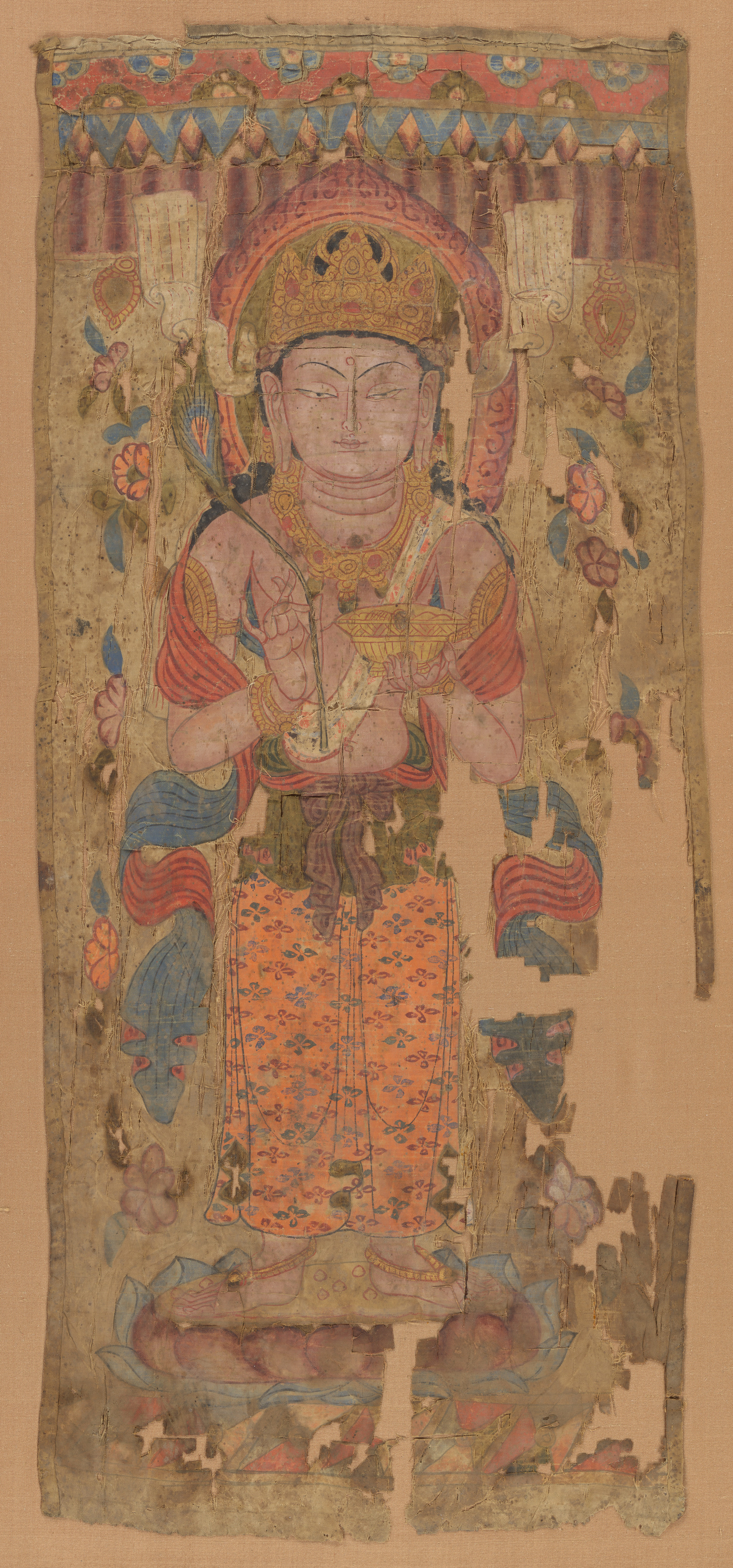
- Title
- Banner with Bodhisattva, possibly Mahamayuri
- Period
- China (Dunhuang area, Gansu Province), Tang dynasty (618–907) or Five Dynasties period (907–960), 9th–10th century
- Region
- China (Dunhuang area, Gansu Province)
- Medium
- Ink and pigment on silk
- Dimensions
- 22 1/2 x 11 in. (57 x 28 cm)
- Collection
- The Metropolitan Museum of Art
- Accession
-
2007.294a, b - Rights
- Banner with Bodhisattva, possibly Mahamayuri, China (Dunhuang area, Gansu Province), 9th–10th century, ink and pigment on silk, The Metropolitan Museum of Art, New York, accession 2007.294a, b, Purchase, The Vincent Astor Foundation Gift, 2007. CC0 (public domain).
The Met Dunhuang banner (2007.294a, b), 57 × 28 cm, ink and pigment on silk. Head and body of a hung ritual banner; the streamer legs are lost. The Met labels the figure 'possibly Mahamayuri'; the museum's own 2020 journal identifies it firmly. CC0.
A ban (幡) is a hung textile with a triangular head, a body panel, and weighted streamer legs, not a painting on a wall. The Met dates banner 2007.294 to the 9th–10th century and labels it “possibly Mahamayuri”; the museum’s own 2020 journal study identifies the figure firmly, reads a Khotanese donor’s inscription on its back, and dates it to the Guiyijun period. It is the continental form the Japanese Nara ban descends from.
What the label says, and what the museum’s own journal says
The Met’s public catalogue calls accession 2007.294a, b Banner with Bodhisattva, possibly Mahamayuri, China (Dunhuang area, Gansu Province), 9th–10th century, ink and pigment on silk, 57 by 28 cm.1 That title was checked live against the museum’s open-data record on 2026-05-18 and still carries the “possibly,” still gives the loose two-century date. Set against it is a study the same museum published. In Metropolitan Museum Journal 55 (2020), Michelle C. Wang, Xin Wen, and Susan Whitfield reassessed this exact object and identified the figure without the hedge, named the period more tightly, and read an inscription on the back of the silk that the catalogue does not mention.2
So the most useful first fact about this banner is not its size or its date. It is that its holding institution describes it in two voices. The gallery label is cautious to the point of withholding; the journal is specific. The gap between them is where the object actually becomes legible, and closing it is what this reading is for.
Two attributes the silk did keep
Begin where the doubt comes from, because it is real and it is physical. The banner is torn and lost down its right side and along the foot; large passages of the figure’s lower body are gone. A label written to the surviving silk has reason to hedge. But two attributes did survive, one in each hand, and they are the two that settle the name. The figure holds a single peacock feather in the right hand and a bowl in the left. Wang, Wen, and Whitfield read those two together as decisive: the feather and the bowl identify the deity as Mahāmāyūrī, the Great Peacock Wisdom King, the bowl being a bowl of medicine, the deity canonically invoked against snakebite and for healing through the recitation of the Mahāmāyūrī dhāraṇī.2
This corrects a detail bodhi’s own earlier reading got wrong by deferring too far to the cautious label. The object in the left hand is not a “small lobed offering” of indeterminate kind. It is a medicine bowl, and naming it is not a guess against the gap; it is reading what is still there. The point is narrow but it matters: the hedge belongs to the lost lower zone, not to the hands. The silk did keep enough to finish this particular sentence. What it did not keep is the part that would say who the bowl was for, and that turns out to be answered not on the front of the banner but on its back.
An object with two faces
The banner came to the Met in 2007 mounted on a textile-covered panel, which let only one side be seen. In spring 2019 Minsun Hwang and the Department of Textile Conservation removed it from the panel, and the object turned out to have two faces.2 Mahāmāyūrī is painted on both sides, the two images near mirrors of each other, differing only in minor passages: the flowers, the fall of the cloth at the waist. This is a property of the support, not a flourish. The journal sets out the sequence the conservation exposed: a black underpainting laid on one side only (the recto, where it shows through most in the bare skin of the arms and the upturned hand), filled with colour, then closed with a deep red outline; on the other side, no black underpainting at all, only the red outline, because the silk is sheer enough that the front drawing read through it to guide the back.2
That is why a banner is not a wall and not a scroll. A scroll has a front. This object was painted to be true from both sides because it was made to hang free in the air, lit from behind as much as in front, turning slightly, read by people on either side of it as they passed. The translucency that makes the silk a poor wall is exactly the property the maker worked with.
A Khotanese minister’s gift
On the verso, along the left edge, runs a line of text the gallery label is silent about. It is not Chinese. It is Khotanese, a Middle Iranian language, written in Brāhmī script, and Wen’s reading of it changes what the object is. The legible portion transcribes and translates as: the āmāca-official named, tentatively, Yaraiṣa “donated, in love of bodhi of the Four Assemblies.”2 The end is torn away, so the donor’s specific petition and any date are lost with the streamers. But the spine of it is intact. An āmāca (from Sanskrit āmātya, “minister,” one of the highest civil titles in the Khotanese state in the ninth and tenth centuries) paid for this, and dedicated it not for himself alone but for the four assemblies of monks, nuns, laymen, laywomen.2
This is the fact that re-dates the object. Khotan and Dunhuang, about a thousand miles apart, ran an unusually close relationship across the ninth and tenth centuries: exchanged envoys from at least 901, intermarriage between the Khotanese royal house and the Cao family that governed Dunhuang, Khotanese officials and monks resident in the oasis as Buddhist patrons.2 A banner commissioned by a Khotanese minister belongs in that window, the Guiyijun period (848–1036), not loosely to “the 9th–10th century” as the catalogue still has it. The journal’s reconstruction is concrete to the institution: a banner like this was most plausibly given to the Sanjie monastery at Dunhuang, the original repository of much of what was later sealed into the Library Cave. That is how a Khotanese official’s offering came to be found, a millennium on, in a walled chamber at Mogao.2 The donor inscription is not a footnote to the iconography. It is the reason the object exists and the evidence that fixes its date.
The anatomy, and the parts that did not travel
Hold the whole form in view, because what survives only reads against what is missing. The Met’s two-part accession encodes the structure: 2007.294a is the triangular head, painted with a small seated Buddha; 2007.294b is the rectangular body with the standing Mahāmāyūrī.1 The journal gives the full anatomy in four named parts: a triangular head, decorative silk or a small painting, usually a seated Buddha; the rectangular body carrying the principal image, one panel or several stitched; side streamers attached to the wide border of the head; and bottom streamers attached to a wooden weighting board, with a loop at the apex to hang the whole from a pole, a temple beam, or a stūpa.2
The Met object is the head and the body and nothing else. The head’s border is gone; the side and bottom streamers are gone; the weighting board is gone. To see what did not travel, look at the Victoria and Albert Museum’s Stein banner from the same Mogao cache (LOAN:STEIN.619, site mark Ch.00342): a banner that kept everything: a silk-bordered head with its white suspension loop, three body panels, two patterned side arms, three legs, and at the foot the painted wooden board, which, in the museum’s plain words, “prevented the streamers becoming tangled and helped to keep it in place.”3 That board is the most prosaic part of the object and the first to be lost, because it hung lowest, took the handling, and was the least worth keeping when a banner came down. The Met banner is a banner read from its top two parts; the V&A banner is the sentence finished. Stein alone took 230 banners out of Mogao (179 of silk, the rest hemp and paper), so the comparison is not a lucky single survival but a corpus.2
What it became: from a Khotan donor’s merit to the Japanese ban
Why a banner at all, rather than a panel or a scroll. Because the banner is an act, and the act is named in the canon. The Lotus Sutra, chapter 2, “Skillful Means,” places among those who “have certainly attained the path of the buddhas” the ones who honoured stūpas and images “with flowers, perfumes, banners, and canopies.”4 The banner is listed beside the flower and the canopy as a thing one offers; the offering is what generates merit. The Khotanese inscription is that doctrine made specific: an āmāca converted rank and silk into a dedicated offering for the four assemblies. The Dunhuang material, as Hwang’s study of the Mogao long banners shows, turns the transaction personal across the corpus: banners as materialised petitions for longevity, healing, repentance, in the extreme cases stretched to the forty-nine-chi length that makes the wish itself physical.5
This is where the Chinese object earns its place in a corpus about Japanese Buddhist art, and the framing has to stay honest. This banner is not Japanese. It is a Khotanese-sponsored, Dunhuang-context object of the Guiyijun period, and saying so is the point, not an apology. It is the continental form the Japanese ban descends from: the structure, the four-part vocabulary, and the merit logic that Japan received through the Nara transmission alongside the sūtra and the bronze image.6 The genealogy is documented at the Japanese end, not inferred. The Tokyo National Museum’s Gallery of Hōryūji Treasures holds Nara-period banners dated to 757 (Tenpyō-shōhō 9), made for the first-anniversary memorial rite of Emperor Shōmu: figured-twill body sections joined on the diagonal, appliqué flower cutouts, and, surviving among the fragments, pieces the museum labels 幡足, ban-soku, the banner’s foot, the exact streamer-and-weight part the Dunhuang banner lost.7 The Japanese banners of 757 do what the Dunhuang banner did a century or so earlier: hang as a dedicated offering, here for a named emperor’s memorial, the Lotus Sutra’s merit logic executed in silk for a death.
The two ends diverge in execution and hold in function. The Dunhuang banner is painted, fast, thin, double-faced for the air. The Nara and later Japanese banners run more to figured weave, embroidery, dyed gauze, and, at the high end, gilt-bronze openwork, the kondō-ban that turns the textile into metal. The image migrates from brushed silk to woven cloth to pierced bronze. The object stays a head, a body, streaming legs, a weighted foot, hung as a dedicated offering. That stability across a continent, a language barrier, and several centuries is the single most useful thing this fragment teaches. It is visible only once the Khotanese inscription has told you the Met object is itself a transmission, Khotan to Dunhuang, before it is anything to do with Japan.
What is settled and what the silk still withholds
Three things the catalogue leaves open are, on the journal’s evidence, closed. The figure is Mahāmāyūrī, not “possibly” a bodhisattva: the surviving peacock feather and medicine bowl name it, and the hedge belongs only to the lost zone.2 The donor is identified in kind if not securely in name: a Khotanese āmāca, the offering dedicated for the four assemblies, the object’s existence accounted for.2 And the date is tighter than the public record: the Khotan–Dunhuang context places it in the Guiyijun period, not loosely across two centuries.2 Where bodhi’s earlier reading rested on the cautious label and called the figure unnameable, it followed the weaker of the museum’s two voices; the journal is the better-grounded one and this reading now follows it.
Two things remain genuinely open, and naming them flatly is the discipline. The head and the body are no longer attached, and whether 294a and 294b began as one object is not provable from the silk; the journal finds the style, technique, and palette consistent enough to suggest a single origin but states it as a suggestion, not a fact.2 And the place of making is undecided: a Khotanese minister could have had the banner made in Khotan and carried to Dunhuang, or commissioned it at Dunhuang from an artist working in the Khotanese idiom, and the painting alone cannot say which.2 Those are not failures of the reading. They are the residue a torn, transported, thousand-year-buried textile leaves after the evidence has been spent: the head two parts of a hung offering, painted thin and double for motion and light, given by a foreign official for the merit of all, and the continental original of a form Japan would keep almost unchanged for a thousand years.
Sources
| Source | Type | Citation |
|---|---|---|
| The Metropolitan Museum of Art, acc. 2007.294a, b | museum record | Banner with Bodhisattva, possibly Mahamayuri, 9th–10th c., CC0; object facts re-verified via Met OA API 2026-05-18 |
| Wang, Wen & Whitfield, “Buddhism and Silk: Reassessing a Painted Banner from Medieval Central Asia” | article | Metropolitan Museum Journal 55 (2020): 8–25; cited by manuscript page, UEA open-access accepted manuscript |
| Yoon Ah Hwang, “Materialized Wishes: Long Banner Paintings from the Mogao Caves of Dunhuang” | article | Religions 14(1):58, 2023 (open access; MDPI host 403 on full text, cited at article level) |
| Victoria and Albert Museum, Stein banner LOAN:STEIN.619 (Ch.00342) | museum record | near-complete Dunhuang banner; head, body, side arms, legs, painted weighting board; description verified 2026-05-18 |
| The Lotus Sutra, ch. 2 “Skillful Means” | primary text | trans. Kubo & Yuyama, BDK / Numata, 2007 (cited at chapter level) |
| Tokyo National Museum, Gallery of Hōryūji Treasures: Nara-period banners (757) | museum record | TNM exhibition record, accessed 2026-05-18 |
| JAANUS, “ban 幡” | reference | JAANUS entry, accessed 2026-05-18 |
Related
- Nehan-zu: the parinirvāṇa painting the banner was raised before
- Silk versus paper ground: why a banner is painted on thin, translucent silk
- Tang to Nara: the transmission this banner sits at the head of
- Sutra mounds: the other Heian merit-deposit practice
- Ban (ritual banner): concept
- Merit offering: concept
- Dunhuang / Mogao caves
Footnotes
-
The Metropolitan Museum of Art, Banner with Bodhisattva, possibly Mahamayuri, accession 2007.294a, b, China (Dunhuang area, Gansu Province), Tang dynasty (618–907) or Five Dynasties period (907–960), 9th–10th century, ink and pigment on silk, 57 × 28 cm. Object facts (title with “possibly,” accession, objectDate “9th–10th century” / objectBeginDate 800 / objectEndDate 999, culture, medium, dimensions, classification Paintings, department Asian Art, credit line, public domain) re-verified live via the Met Collection Open Access API, 2026-05-18. The public catalogue retains the hedged title and the loose two-century date; the contrast with the museum’s own Metropolitan Museum Journal 55 (2020) study is this article’s hinge. The two-part accession (
athe triangular head,bthe rectangular body) is the structural datum. ↩ ↩2 -
Michelle C. Wang, Xin Wen, and Susan Whitfield, “Buddhism and Silk: Reassessing a Painted Banner from Medieval Central Asia in The Met,” Metropolitan Museum Journal 55 (2020): 8–25. Read in full via the open-access accepted manuscript (University of East Anglia ePrints, 27-pp. typescript), 2026-05-18; claims cited by manuscript page. Identification of the figure as Mahāmāyūrī from the surviving peacock feather (right hand) and medicine bowl (left hand), the deity invoked against snakebite and for healing via the Mahāmāyūrī dhāraṇī (MS p. 2). Four-part banner construction: triangular head (usually a seated Buddha), rectangular body, side streamers on the head border, bottom streamers on a wooden weighting board, suspension loop at the apex (MS p. 3). Double-sided painting, the two Mahāmāyūrī images near mirrors; black underpainting on the recto only, most visible in the arms and upturned hand, then colour, then a deep red outline; verso red outline only, the silk sheer enough to read through; removed from its 2007 mounting panel and conserved spring 2019 by Minsun Hwang, Met Department of Textile Conservation (MS pp. 5–6). The Khotanese verso inscription, Brāhmī script, transcription yaraiṣä nāmai āmācä haiṣṭe tcahauryāṃ parṣāṃ ba’ysuśte brrī[ye …, translated “The āmāca-official named Yaraiṣa donated, in love of bodhi of the Four Assemblies, …”; āmāca from Sanskrit āmātya, a top-rank Khotanese civil title (MS pp. 9–10). Khotan–Dunhuang exchange (envoys from 901, Cao-family intermarriage, resident Khotanese patrons), the probable Sanjie-monastery deposit feeding the Library Cave (MS pp. 11–13). Provenance: Library Cave → Stein (1907, or 1913–16, in an unrecognized unconserved state) → accidentally retained by Stein’s assistant Frederick Henry Andrews → Andrews family → Christie’s London, 15 May 2007, lot 171 → the Met, 2007 (MS pp. 14–17); the head/body single-origin and the Khotan-vs-Dunhuang place of making both stated by the authors as probable, not settled. Published page range 8–25 per the Met Journal v. 55 record; claims are cited by manuscript page because the accepted manuscript is the open-access form consulted; these have not been converted to the printed journal’s pagination. ↩ ↩2 ↩3 ↩4 ↩5 ↩6 ↩7 ↩8 ↩9 ↩10 ↩11 ↩12 ↩13 ↩14 ↩15
-
Victoria and Albert Museum, Stein Collection banner, museum number LOAN:STEIN.619, Stein site mark Ch.00342, Dunhuang, Mogao Cave 17, 7th–10th century, plain and patterned woven silk with painted wood, L 131 cm × W 34 cm. Description verified verbatim 2026-05-18: a head with red silk border and white-silk suspension loop carrying a painted Chinese character; three plain-weave body panels (blue, white, red); two side arms in lozenge-and-quatrefoil patterned silk; three blue silk legs; a wooden weighting board at the foot painted with a red floral scroll. Curatorial text: “A painted wooden board across the bottom of the banner prevented the streamers becoming tangled and helped to keep it in place.” Cited as the intact-anatomy comparandum; supersedes the prior work-level Whitfield citation as the pinnable structural authority. ↩
-
The Lotus Sutra, chapter 2, “Skillful Means,” trans. Tsugunari Kubo and Akira Yuyama (Berkeley: Bukkyō Dendō Kyōkai / Numata Center for Buddhist Translation and Research, BDK English Tripiṭaka, 2007), Taishō vol. 9, no. 262. The chapter lists those who honoured stūpas and images “with flowers, perfumes, banners, and canopies … have certainly attained the path of the buddhas”: the canonical Mahāyāna basis for the banner as a merit-generating offering. Cited at chapter level (chapter 2); the BDK PDF is not paginated to a fixed page for this clause in the consulted form, so no page number is given. ↩
-
Yoon Ah Hwang, “Materialized Wishes: Long Banner Paintings from the Mogao Caves of Dunhuang,” Religions 14, no. 1 (2023): 58. Hwang reads the Mogao long banners as donors’ materialised petitions for longevity, healing, and repentance, the extreme forty-nine-chi length enacting the life-lengthening wish; the article also sets out the standard banner configuration (optional triangular headpiece, single or paired body strip of standing bodhisattvas, streamers). Cited at article level; the MDPI host returns HTTP 403 on full-text fetch (re-confirmed 2026-05-18), the argument corroborated via the published abstract and the ResearchGate record; internal page numbers not verified. ↩
-
JAANUS (Japanese Architecture and Art Net Users System), entry “ban 幡”: the Buddhist hanging banner, etymology from Sanskrit patākā through Chinese into Japanese (ban / hata), hung as temple ornament and at services, including the dōban (幢幡) hung-banner class. Reference-tier, entry-level; accessed 2026-05-18. ↩
-
Tokyo National Museum, Gallery of Hōryūji Treasures, Nara-period banners (ban), dated Tenpyō-shōhō 9 (757), made for the first-anniversary memorial rite of Emperor Shōmu: figured-twill body sections joined along diagonal seams, appliqué flower cutouts, and surviving 幡足 (ban-soku, banner-foot / streamer-leg) fragments. TNM exhibition item record, accessed 2026-05-18; the
r_exhibitioncontroller is a rotating-display endpoint, the cited 757 / Shōmu-memorial / ban-soku facts are stable Hōryūji-Treasures catalogue facts independent of the URL. ↩
Sources
-
Object facts re-verified live via the Met Collection Open Access API 2026-05-18: title 'Banner with Bodhisattva, possibly Mahamayuri'; accession 2007.294a, b; objectDate '9th–10th century' (objectBeginDate 800 / objectEndDate 999); culture China (Dunhuang area, Gansu Province); medium ink and pigment on silk; dimensions 57 × 28 cm; classification Paintings; department Asian Art; credit Purchase, The Vincent Astor Foundation Gift, 2007; public domain (CC0). The public catalogue record retains the hedged title and the 9th–10th-century dating; the contrast with the museum's own MMJ 55 (2020) study is the article's hinge.
-
[2]2026-05-18Metropolitan Museum Journal, vol. 55 ueaeprints.uea.ac.uk/id/eprint/76988/1/Accepted_Manuscript…Metropolitan Museum Journal 55 (2020): 8–25. The definitive study of this exact object (Met 2007.294a, b). Accepted manuscript (UEA ePrints, 27 pp.) read in full 2026-05-18 and pinned by manuscript page: Mahamayuri identification from the peacock feather + medicine bowl (MS p. 2); four-part banner construction with wooden weighting board (MS p. 3); double-sided painting, recto/verso underpainting, conserved spring 2019 by Minsun Hwang, Met Textile Conservation (MS pp. 5–6); the Khotanese verso inscription, transcription and translation, donor an amaca official *Yaraisa (MS pp. 9–10); Khotan–Dunhuang exchange, Sanjie monastery deposit (MS pp. 11–13); provenance library cave → Stein → F. H. Andrews → Christie's London 15 May 2007 lot 171 → Met 2007 (MS pp. 14–17). Published page range 8–25 from the Met Journal v. 55 record; claims are cited by manuscript page because the accepted manuscript is the open-access form consulted.
-
Religions 14(1):58. Banner physical configuration (optional triangular headpiece, single/paired body strip of standing bodhisattvas, streamers), the votive donor-wish function, longevity/healing/repentance scriptural background, the forty-nine-chi long-banner type. Article-level citation; MDPI host returns 403 on full-text fetch (re-confirmed 2026-05-18), corroborated via the published abstract and the ResearchGate record — cited at article level; internal page numbers not verified.
-
[4]2026-05-18Victoria and Albert Museum collections.vam.ac.uk/item/O92254/the-stein-collection-bann…A near-complete Stein Dunhuang banner: 7th–10th c., L 131 cm × W 34 cm, plain and patterned woven silk with painted wood. V&A description (verified verbatim 2026-05-18): a head with red silk border and white-silk suspension loop; three plain-weave body panels; two patterned-silk side arms; three silk legs; a painted wooden weighting board at the foot. 'A painted wooden board across the bottom of the banner prevented the streamers becoming tangled and helped to keep it in place.' The intact comparandum for the parts the Met fragment has lost; replaces the unpinned Whitfield work-level citation as the anatomy authority.
-
[5]2026-05-18Bukkyō Dendō Kyōkai / Numata Center (BDK English Tripiṭaka) bdk.or.jp/document/dgtl-dl/dBET_T0262_LotusSutr…Chapter 2 'Skillful Means': those who honoured stūpas and images 'with flowers, perfumes, banners, and canopies … have certainly attained the path of the buddhas' — the canonical Mahāyāna basis for the banner as a merit offering. Quoted at chapter level (chapter 2); the BDK PDF is unpaginated to a fixed page for this clause in the consulted form, so no page number is given.
-
Nara-period (Tenpyō-shōhō 9 / 757) Hōryūji banners used at the first-anniversary memorial rite for Emperor Shōmu; figured-twill body sections joined diagonally, appliqué flower cutouts, surviving 幡足 (ban-soku, banner-foot/leg) fragments. The Japanese end of the genealogy this Dunhuang banner sits at the head of. The r_exhibition controller is a rotating-display endpoint; the cited facts are stable Hōryūji-Treasures catalogue facts independent of the URL.
-
Terminology for the Japanese ban: the etymology from Sanskrit patākā, the cloth banner hung as temple ornament and at services, the dōban (幢幡) hung-banner class. Reference-tier; entry-level, no page.