Fugen Bosatsu on the elephant: reading a stand-in
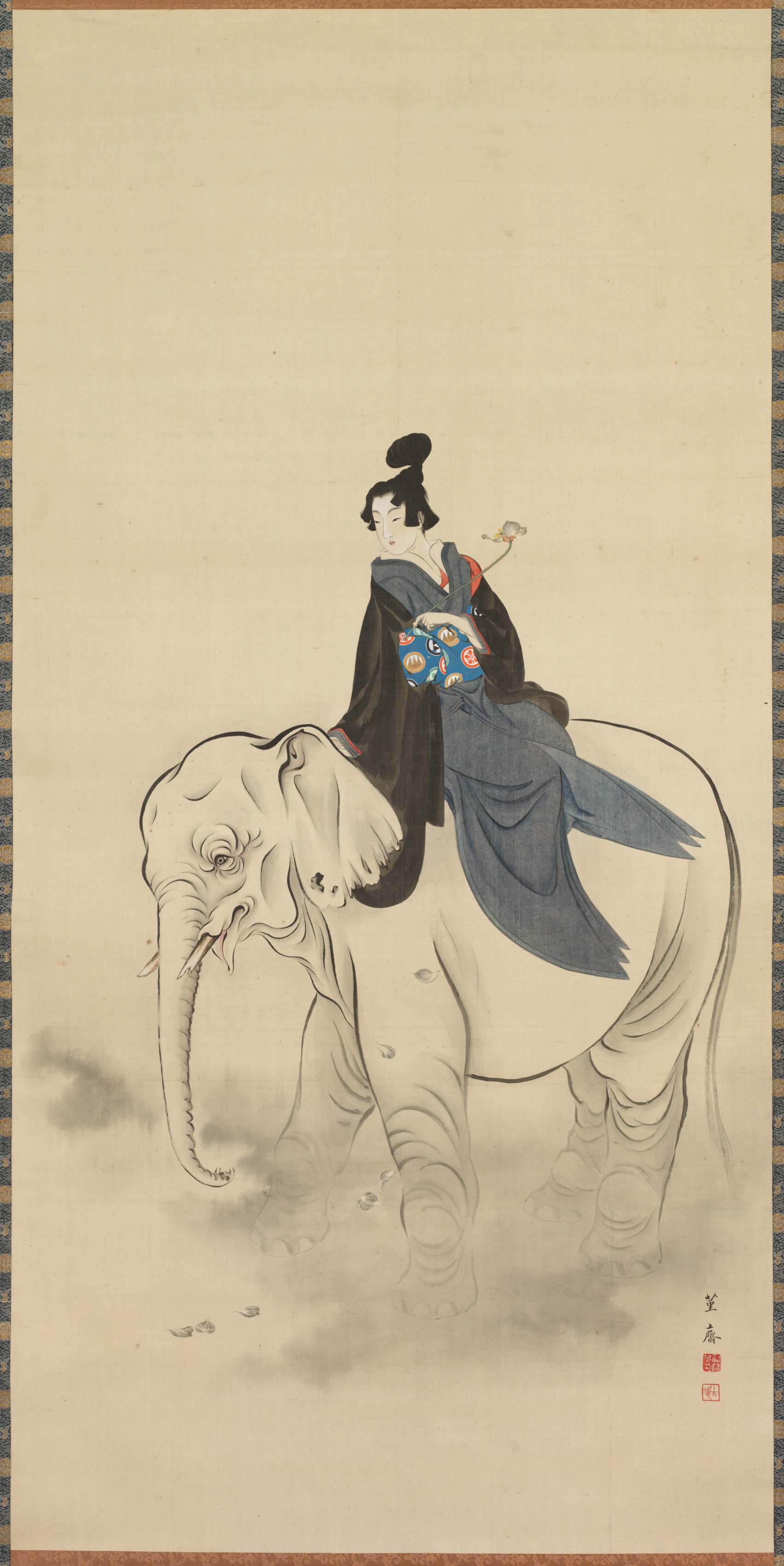
- Title
- Stand-in Fugen (見立普賢菩薩図)
- Period
- Edo period, late 1700s–early 1800s
- Region
- Japan
- Medium
- hanging scroll; ink and color on silk
- Dimensions
- painting only 114.3 × 56.2 cm; with mounting 186.7 × 76.2 cm
- Collection
- Cleveland Museum of Art
- Accession
-
1985.277 - Rights
- Cleveland Museum of Art, The Kelvin Smith Collection, given by Mrs. Kelvin Smith, 1985.277. CC0.
Kitao Masayoshi, Stand-in Fugen, late 1700s–early 1800s. A mitate-e: the courtesan stands where Fugen Bosatsu would sit, the six-tusked white elephant withheld.
Cleveland’s Stand-in Fugen (Kitao Masayoshi, late 1700s–early 1800s) is a mitate-e, not a devotional icon. Where Fugen Bosatsu would sit on the six-tusked white elephant, the museum’s own label reads a woman dressed as a man, one lotus shedding petals over bare silk. The elephant — the mount the Lotus Sutra names — is the one thing withheld. The parody works only because the canonical Fugen is fixed enough to be quoted by leaving its central animal off the silk.
The figure who is not there
Start with what the Cleveland catalogue actually says it sees. The museum reads the standing figure in Stand-in Fugen (見立普賢菩薩図, acc. 1985.277) not as a courtesan in women’s dress but as “a woman dressed as a man” who “replaces Fugen.”1 That detail is easy to skim past and it is the whole of the picture’s wit. The substitute is not simply a beauty standing in for a bodhisattva; it is a gender already in disguise, standing in for a sexless deity, on a hanging scroll that withholds the one attribute that would fix the identification. The disguise is doubled before the iconographic joke even begins.
The scroll is a hanging scroll in ink and color on silk, the painting alone 114.3 by 56.2 cm, by Kitao Masayoshi (1761–1824), dated by Cleveland to the late 1700s or early 1800s; it entered the collection from the Kelvin Smith Collection, the gift of Mrs. Kelvin Smith.1 What is in it is quickly listed: the cross-dressed figure, one lotus stem, a few petals coming away from the flower, and a great deal of bare silk. What is not in it is the longer list. No elephant. No triad, no Shaka at the center, no Monju opposite. No halo, no jewelled crown, no lotus throne stepped up in tiers. The ground above and behind the figure is left empty.
The emptiness is the argument. A devotional Fugen is a crowded thing: the bodhisattva, the platform, the six-tusked animal under it, the descending blossoms, the gold. Masayoshi has cleared all of it and kept one held flower. The viewer supplies the rest. The scroll is not a picture of Fugen. It is a picture of the place a Fugen would occupy, made for people who know the shape of what is missing.
The iconography being quoted
To read the absence, the canonical form has to be in front of you. The fixed Japanese type is best seen in the Heian National Treasure Fugen Bosatsu in the Tokyo National Museum (絹本著色普賢菩薩像, A-1), a twelfth-century work, color on silk, 159.1 by 74.5 cm.2 The museum’s own description is spare and exact: the bodhisattva “sits upon a lotus dais placed on the back of a white elephant, whose trunk is wrapped around a pink lotus flower,” the hands “pressed together,” the “gaze directed downward,” with “a canopy of flowers above the figure” and blossoms trailing “down on both sides.” The robes carry kirikane, “thinly cut gold leaf” in the catalogue’s phrase, laid in patterns the museum calls the most delicate the technique allows. The Cleveland label glosses Fugen as the bodhisattva who “symbolizes learning as a path to awakening”; the TNM description fixes the function the picture-type serves, since Fugen “appears before those who chant the Lotus Sutra.” Praxis on one label, the Lotus reciter’s protector on the other: the painted type holds both at once.
Every element is doctrinally placed. The mount is specified in the Lotus Sutra itself. Chapter 28, the Fugen-bosatsu-kanpotsu-bon, “Encouragement of the Bodhisattva Samantabhadra,” has Fugen vow that when a person reads and recites the sutra, “I will mount my six-tusked kingly white elephant and with my multitude of great bodhisattvas will proceed to where he is.”3 The elephant is not a vehicle of convenience. It is the figure’s pledge of protection to the Lotus reciter, and the six tusks are read as the six pāramitās, the perfections of the bodhisattva path. The companion text, the Kan Fugen-kyō (観普賢菩薩行法経, the Sutra of Meditation on the Bodhisattva Universal Virtue), is treated as the closing third of the so-called Threefold Lotus Sutra and prescribes the visualization directly: the practitioner is to see Fugen descending on the lotus-platform borne by the six-tusked elephant, the tusks now glossed as the purified six sense-organs.3 The gasshō hands, the lowered eyes, the descent through falling flowers: these are not a painter’s choices. They are the visualization text rendered.
This is why the form is so stable across five centuries of Japanese painting. Fugen-on-the-elephant is the icon of a meditation, and the meditation has a script. The Heian court Fugen, the Fugen-kan scrolls hung for the Lotus rite, the Fugen-Jūrasetsunyo variant that adds the ten rākṣasī protectresses below: they vary the surround but hold the core, namely bodhisattva, gasshō, lotus seat, six-tusked white elephant, descending blossoms. The type is rigid enough that a single quoted fragment of it can stand for the whole.
How the parody works
A mitate-e, a “seeing-as” or analogue picture, substitutes a contemporary figure for a classical one and lets the gap between them carry the meaning. The Eguchi-as-Fugen subject was one of its set pieces. Ikumi Kaminishi, writing on Maruyama Ōkyo’s Lady Eguchi, reads the substitution not as irreverence but as a visual argument from upāya, skillful means: the courtesan-in-place-of-the-bodhisattva stages the Mahāyāna claim that sanctity and its apparent opposite are not two different things, and that the holy may appear in the lowest social form precisely to teach that the distinction is provisional.4
Masayoshi’s scroll runs that argument with a near-total economy of means. He keeps three things from the canonical Fugen and discards everything else. He keeps the lotus, held the way the bodhisattva holds an attribute. He keeps the falling blossoms, which in the devotional type rain down around the descending figure and here come off the held flower instead, the same motif relocated from the sky to the hand. And he keeps the frontal, still, vertical poise of an icon, so that the standing courtesan occupies the picture the way a hung devotional scroll occupies an altar. What he removes is the load-bearing element—the elephant. The animal that the Lotus Sutra names, that fixes the identification beyond doubt, is the one thing not painted. The viewer is made to notice its absence and to name it, which is the whole mechanism. You cannot register that the elephant is missing unless you already know it should be there.
The unexpected economy here is how little it takes. A lesser parody would crowd the joke: a courtesan perched on a comic elephant, the gag spelled out. Masayoshi trusts the iconography to do the work from off the page. The scroll is legible only to a viewer carrying the canonical image, and it is built on the bet that an Edo audience carried it.
The Eguchi legend, and why a courtesan
The substitution is not arbitrary. It runs through a specific medieval tradition that had already identified a courtesan with Fugen before any Edo painter touched it. The Noh play Eguchi (江口), Zeami working from a fragment by Kan’ami and classed as a third-category katsura mono, braids two strands.5 In one, the wandering monk-poet Saigyō, refused shelter at the Eguchi quarter on a rainy night, reproaches the courtesan in verse: she is stingy “even with the night I ask of you, a place in your soon-left inn.” Her answer turns his own renunciation back on him. It is because she has heard he is no longer bound to the householder’s life, she says, that she is “loath to let you get attached to this inn of brief, bought stays”; then she admits him. In the other strand, the holy man Shōkū, longing to worship a living Fugen, is directed in a dream to the Lady of Eguchi. The play fuses the women. At its close a moonlit boat appears bearing her; she reminds the monk that “all things are a moment’s refuge,” reveals herself as Fugen Bosatsu, and ascends, the boat becoming the white elephant, the cloud carrying her westward.
That transformation is the hinge. The Noh stages the canonical iconography as a revelation: the courtesan does not resemble Fugen, she is Fugen, and the proof is that the boat turns into the six-tusked elephant. Every later painted Stand-in Fugen inherits this. The courtesan is the right substitute because the medieval legend already made the substitution and supplied the doctrine for it: impermanence, non-duality, the holy disclosed in the worldly. Masayoshi’s falling petals are not decoration. They are the courtesan’s own teaching to Saigyō, the impermanence she preached, made into the one event the still scroll permits.
The Cleveland catalogue itself reads the petals this way and names the Eguchi-Saigyō legend as the painting’s reference.1 The reading is not a modern art-historical overlay imposed on a genre scene; it is the subject the picture was made to carry, and it descends in an unbroken line from the Lotus Sutra through the Kan Fugen-kyō visualization to the Noh stage to the silk.
The same conceit in other hands
Masayoshi did not invent the subject and was not its boldest practitioner. The set is wide enough to show what his economy costs and buys. The Metropolitan Museum’s Katsukawa Shunshō Courtesan of Eguchi (acc. 2018.853.26), a hanging scroll in ink and color on paper, keeps the figure standing and the ground spare, close to Masayoshi’s restraint.6 Harvard Art Museums’ Courtesan Eguchi as the Bodhisattva Fugen with a White Elephant and the Smithsonian National Museum of Asian Art’s Meiji-era Kobayashi Kiyochika Mitate-e of Courtesan Eguchi … seated astride an elephant (acc. F2004.10) go the other way: they paint the elephant in, seat the courtesan on it, and let the title carry the joke rather than the absence.78 A Courtesan of Eguchi as the Bodhisattva Fugen at the Museum of Fine Arts, Boston shows the standing-versus-mounted split runs across the whole tradition, not between two artists.9
That spread is what makes Masayoshi’s choice legible as a choice. The default Eguchi-as-Fugen picture mounts her on the animal; reading the parody then takes only the title. Masayoshi withholds the animal and makes the title do nothing; the reading has to come from the viewer’s memory of the devotional type or it does not come at all. The Kiyochika and the mounted versions are parodies you can solve from the wall label. The Cleveland scroll is one you can solve only from the canon.
Where the scroll hung
A devotional Fugen and a Stand-in Fugen were not seen in the same place or for the same reason, and the difference is physical. The Heian type was a hibutsu-adjacent rite image: hung for the Lotus ceremony, read close, the kirikane catching lamplight, the scroll rolled and stored between observances. It was made to be venerated at devotional height in a dim hall.
Masayoshi’s scroll hangs in a different room. A mitate-e of this kind belonged in the tokonoma of a secular interior (a connoisseur’s alcove, a teahouse, a pleasure-quarter reception space), viewed at seated eye-level by an audience that read the joke as connoisseurship, not worship. The bare silk that reads as doctrinal economy in iconographic terms also reads, in the room, as the spare aesthetic of the literati alcove: a single figure, much empty ground, the eye allowed to rest. The same emptiness does two jobs at once. It quotes the absent icon, and it furnishes the secular room in the idiom that room expected. The scroll only fully resolves when both are held together: the devotional image it points at, and the alcove it actually hung in.
What the reading commits to, and what it leaves to the volume
The serious reading and the witty one are not idle alternatives; they are a real divergence in how the Eguchi-Fugen subject is taken. Kaminishi argues the substitution as a religious argument from skillful means, sanctity disclosed in its apparent opposite, built around Maruyama Ōkyo’s Lady Eguchi. The competing instinct treats the whole set as Edo connoisseur wit: a beauty in a holy pose, the gag being the mismatch. bodhi commits to the serious reading for the Cleveland scroll specifically, and the grounds are in the object, not in deference to Kaminishi. The economy is too controlled for a one-line joke (one held flower kept, the identifying mount deliberately withheld), and the petals are not ornament but the very impermanence the Noh courtesan preaches to Saigyō, made into the one event a still scroll can stage.
The residual uncertainty is worth naming exactly, because it is where this reading is thinnest. Kaminishi’s argument is about Ōkyo’s painting, not Masayoshi’s; carrying it to Cleveland 1985.277 is bodhi’s extension on shared iconographic logic, not a claim Kaminishi makes about this object. The chapter is cited at chapter level (Chiem & Blanchard eds., Brill 2017, ch. 4); the page apparatus has not been collated against the printed volume, and no page is asserted rather than guessed. The attribution to Kitao Masayoshi and the late-1700s–early-1800s dating are Cleveland’s alone, with no independent technical study of the scroll located, and the textual route by which the Lotus Sutra elephant and the Kan Fugen-kyō visualization reached the Noh stage is a medieval-literature question this page does not settle. None of that disturbs the core. The scroll means what it means only against an iconography stable enough to be quoted by leaving its central animal off the silk, and that stability is what the picture, by the absence, documents.
Sources
| Source | Type | Citation |
|---|---|---|
| Cleveland Museum of Art acc. 1985.277, Stand-in Fugen (Kitao Masayoshi) | museum record | clevelandart.org/art/1985.277 — CC0 |
| Tokyo National Museum, Fugen Bosatsu (National Treasure, Heian 12th c.) | museum record | e-Museum / NICH; ColBase-permissive |
| The Metropolitan Museum of Art acc. 2018.853.26, Shunshō Courtesan of Eguchi | museum record | metmuseum.org — CC0 |
| Harvard Art Museums, Courtesan Eguchi as the Bodhisattva Fugen with a White Elephant | museum record | harvardartmuseums.org — same-subject comparandum (page 403’d; via search) |
| Smithsonian NMAA acc. F2004.10, Kiyochika Mitate-e of Courtesan Eguchi | museum record | asia.si.edu — same-subject Meiji comparandum |
| Museum of Fine Arts, Boston, Courtesan of Eguchi as the Bodhisattva Fugen | museum record | collections.mfa.org — same-subject comparandum (page 403’d) |
| Ikumi Kaminishi, “Skillful Means (upāya) of the Courtesan as Bodhisattva Fugen” | book chapter | in Chiem & Blanchard (eds.), Brill, 2017 — chapter-level cite |
| Lotus Sutra ch. 28; Kan Fugen-kyō (Threefold Lotus Sutra) | primary text | Mahāyāna canon |
| Eguchi (Noh, attrib. Zeami on a Kan’ami fragment) | reference | the-noh.com; Wikipedia |
Related
- Monju Bosatsu on the lion — the paired bodhisattva
- Fugen Enmei — the esoteric life-prolonging form
- Kannon’s thirty-three bodies — the other Lotus Sutra icon
- Fugen Bosatsu (entity)
- Mitate-e (entity)
- Lotus Sutra (entity)
Footnotes
-
Cleveland Museum of Art acc. 1985.277, Stand-in Fugen (見立普賢菩薩図), Kitao Masayoshi (1761–1824), hanging scroll, ink and color on silk, painting 114.3 × 56.2 cm, late 1700s–early 1800s; catalogue text names the falling-petal impermanence reading and the Eguchi/Saigyō legend. CC0, accessed 2026-05-16. ↩ ↩2 ↩3
-
Tokyo National Museum, Samantabhadra Bodhisattva (Fugen Bosatsu), National Treasure, Heian period, 12th century, color on silk, 159.1 × 74.5 cm; gasshō hands, lotus platform on a white elephant, descending blossoms, kirikane robes (e-Museum / NICH, accessed 2026-05-16). Cited as the canonical-type comparandum; bodhi’s reading of this scroll as the fixed reference type, not a claim from the catalogue beyond its own description. ↩
-
The Lotus Sutra, ch. 28, “Encouragement of the Bodhisattva Samantabhadra” (普賢菩薩勧発品, Fugen-bosatsu-kanpotsu-bon): Fugen vows to appear on a six-tusked kingly white elephant to the Lotus reciter; the six tusks read as the six pāramitās. The Kan Fugen-kyō (観普賢菩薩行法経, Sutra of Meditation on the Bodhisattva Universal Virtue), treated as the closing text of the Threefold Lotus Sutra, prescribes the Fugen-on-elephant descent as a visualization, the tusks glossed as the purified six sense-organs. Mahāyāna canon; cited at work level. ↩ ↩2
-
Ikumi Kaminishi, “Skillful Means (upāya) of the Courtesan as Bodhisattva Fugen: Maruyama Ōkyo’s Lady Eguchi,” in Kristen L. Chiem and Lara C. W. Blanchard (eds.), Gender, Continuity, and the Shaping of Modernity in the Arts of East Asia, 16th–20th Centuries (Brill, 2017), ch. 4. Cited at chapter level: the chapter argues the Eguchi-as-Fugen substitution as a serious upāya argument on Ōkyo’s Lady Eguchi; bodhi extends that reading to Cleveland 1985.277 on the shared iconographic logic, which is bodhi’s extension and not a claim Kaminishi makes about this object. Pages not verified against the printed volume. ↩
-
Eguchi (江口), Noh play of the third category, attributed to Zeami on a fragment by Kan’ami: braids the Saigyō poem-exchange at the Eguchi quarter with the Shōkū/Murotsu strand identifying a courtesan as Fugen; the Lady of Eguchi reveals herself as Fugen Bosatsu and ascends, the boat becoming the white elephant. Plot per the-noh.com and the Wikipedia synopsis, accessed 2026-05-16; cited at work level. ↩
-
The Metropolitan Museum of Art acc. 2018.853.26, Katsukawa Shunshō, Courtesan of Eguchi, hanging scroll, ink and color on paper, image 37.8 × 51.9 cm; cited as a same-subject mitate-e comparandum by a different hand. Met API, public domain (CC0), accessed 2026-05-16; Met catalogue HTML returned 429 (expected). ↩
-
Harvard Art Museums, Courtesan Eguchi as the Bodhisattva Fugen with a White Elephant; cited as a same-subject comparandum that paints the elephant in. Object page returned HTTP 403 on direct fetch 2026-05-18; title and the elephant-mounted treatment confirmed via the museum’s indexed listing in web search. Accession not confirmed (page inaccessible); cited at object-title level only, no accession asserted. ↩
-
Smithsonian National Museum of Asian Art acc. F2004.10, Kobayashi Kiyochika, Mitate-e of Courtesan Eguchi, parodying Fugen Bosatsu, seated astride an elephant, Meiji era; cited as a same-subject comparandum that mounts the courtesan on the elephant. Accession F2004.10 carried in the museum’s own object URL (edanmdm:fsg_F2004.10); object page returned HTTP 403 on direct fetch 2026-05-18, title and treatment confirmed via web search index. ↩
-
Museum of Fine Arts, Boston, The Courtesan of Eguchi as the Bodhisattva Fugen; cited as a same-subject comparandum. Object page returned HTTP 403 on direct fetch 2026-05-18; title confirmed via the museum’s indexed collections listing in web search. Accession not confirmed (page inaccessible); cited at object-title level only. ↩
Sources
-
Same-subject comparandum (elephant painted in); object page 403 on fetch 2026-05-18, confirmed via search index; accession not confirmed
-
[5]2026-05-18Smithsonian National Museum of Asian Art asia.si.edu/explore-art-culture/collections/searc…Same-subject Meiji comparandum; accession carried in museum object URL; page 403 on fetch 2026-05-18
-
Same-subject comparandum; object page 403 on fetch 2026-05-18, title via search index; accession not confirmed