A Tenpyō dry-lacquer Bodhisattva head, 13.7 cm
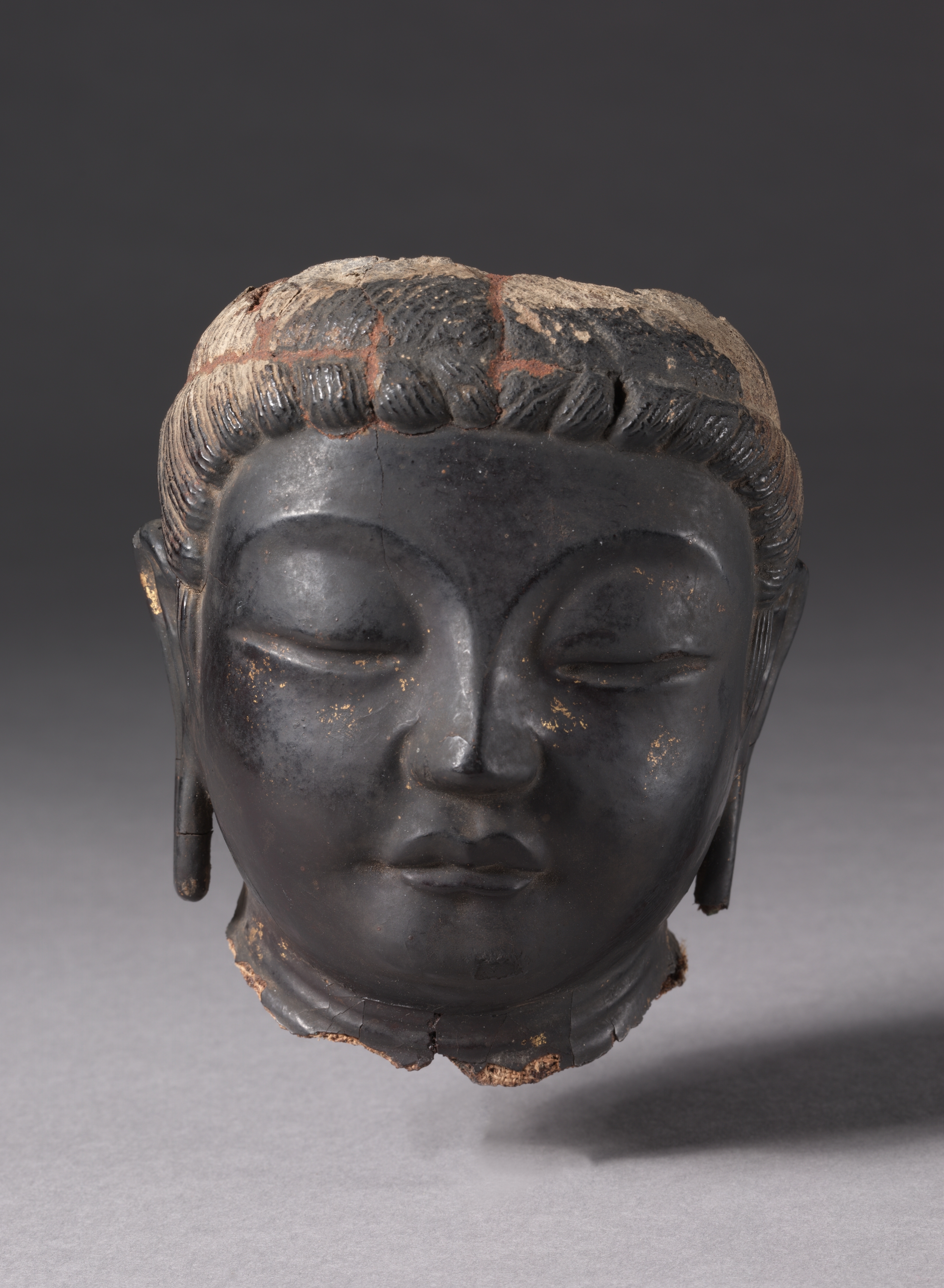
- Title
- Head of Bodhisattva (菩薩頭部) — Cleveland 1982.264, Nara period, 700s
- Period
- Japan, Nara period (710–94), 700s
- Region
- Japan
- Medium
- Dry lacquer (*kanshitsu*, 乾漆) with traces of gilding
- Dimensions
- Overall: 13.7 × 11.8 cm (5 3/8 × 4 5/8 in.)
- Collection
- Cleveland Museum of Art
- Accession
-
1982.264 - Rights
- CC0 (Cleveland Open Access). Gift of Dr. and Mrs. Sherman E. Lee.
Cleveland 1982.264: a Tenpyō-period (*Nara* 710–94, *700s* in the catalog dating) dry-lacquer Bodhisattva head, 13.7 cm. Given to the museum by Sherman E. Lee, the director (1958–1983) who built Cleveland's Asian collection, and his wife in 1982 — the last year of Lee's directorship. The fragment is one of very few documented Tenpyō dry-lacquer specimens in a Western collection.
Fragments of Tenpyō-period sculpture in Western collections are unusual to begin with; kanshitsu (dry-lacquer) Tenpyō fragments in Western collections are unusual enough that you can almost count them. Cleveland 1982.264 (13.7 × 11.8 cm, a Bodhisattva head broken at the neck and the crown) is one of them. The major dry-lacquer programmes of the Tenpyō period are still in situ in Nara, at Tōdai-ji Hokke-dō, at Kōfuku-ji, at Tōshōdai-ji. What left Japan during the long economic dispersal that began with Meiji shinbutsu bunri and continued through the early twentieth century was mostly fragments. Cleveland 1982.264 is a fragment in that exact sense: the surviving piece of a figure whose body is gone.
The fragment is small. The fragment is documented. The fragment was given to Cleveland by the museum director who shaped its Asian holdings, in the last year of his directorship. Each of those facts is load-bearing.
The fragment in your hand
13.7 cm is the height. 11.8 cm is the width. The fragment is roughly the size of a held grapefruit: small enough that a viewer with the curator’s permission could pick it up, large enough that the iconographic register is fully legible at viewing distance.
The break is clean at two points. At the neck, where concentric ridges still mark the base of the throat and traces of gilt remain. At the crown, where the hairline ends and the original uṣṇīṣa or jewelled crown of the Bodhisattva would have continued upward. The fragment is the head only, from the chin to the top of the hairline. The body is gone. The crown is gone. What remains is the face plus a thin band of headdress.
The original figure can be reconstructed by extrapolation. The standard Tenpyō Bodhisattva proportions place the head as roughly one-eighth of the standing figure’s total height. The original standing figure was therefore approximately 110–120 cm, or, if seated, roughly 80–90 cm including base. The original would have been part of a triad or attendant programme: a flanking Bodhisattva to a central Buddha, or one of a paired group. The single surviving head does not name the parent figure.
The dark matte surface throughout is the residual lacquer ground after the original polychromy and gilding have lifted. Traces of gold remain at the neck base, a witness to what the whole surface once was: a brightly gilt, polychrome-finished Tenpyō Bodhisattva, of which 1982.264 is the small, dark, weathered surviving testimony.
What the braided hair band tells us
The single most diagnostic iconographic detail on 1982.264 is the braided hair band that crosses the forehead at the hairline. A Buddha figure carries the uṣṇīṣa (the cranial protrusion at the top of the head) and the ūrṇā (the small tuft between the eyebrows). A Bodhisattva figure carries the jewelled crown and the elaborate hair register that the crown supports. The braided band on 1982.264 is the substrate of a Bodhisattva headdress, not the substrate of a Buddha uṣṇīṣa.
The downcast eyes are consistent with the Tenpyō Bodhisattva register more generally: the meditative-attendant posture of the bodhisattva listening to or attending the Buddha, rather than the active-teaching upturned-gaze register of the Buddha figures themselves. The full rounded cheeks, the closed lips with a slight upward set, the elongated earlobes pierced for kundala earrings: these are the canonical Tenpyō face-type elements that the technique allows. Kanshitsu enables surface modelling impossible in wood at this period: the cheek-volume and the eyelid-curve on 1982.264 are achievable in dry lacquer at this size and would have been considerably more difficult in any contemporary wood-carving technique.
The fragment, then, names itself iconographically: a Bodhisattva (not a Buddha), Tenpyō period (the face-type), dry-lacquer construction (the surface modelling), an attendant register (the downcast eyes). It does not name which Bodhisattva (Kannon, Monju, Fugen, Jizō, or another) because the canonical attribute that would identify the specific figure (the implement held in the hand, the seated mount, the crown ornament) was on the lost body, not on the surviving head.
Dry lacquer, downcast eyes, dark matte surface
The technique is kanshitsu (乾漆). Two sub-techniques exist: dakkatsu-kanshitsu (脱活乾漆), where a clay core is wrapped in lacquer-soaked cloth, hardened, and then the clay core is broken out and removed; and mokushin-kanshitsu (木心乾漆), where a wooden core stays in place and the lacquer-soaked cloth is built up on it. The standard bodhi reference for the technique is the kanshitsu technique-history article, which expounds the construction at length and need not be repeated here.
What the fragment specifically shows is the technique’s signature: surface modelling that is finer than what contemporary wood-carving could achieve. The fine cheek curves are achieved by adding kokuso-urushi (a clay-and-lacquer paste finishing layer) to the surface after the main cloth layers have hardened. The eyelid curves are achieved by the same method. The result is a surface that approaches the wax-modelling fineness of small Hellenistic bronze portraits: a register that Japanese wood-carving would not reach again until the Kamakura gyokugan (rock-crystal eye inlay) technique of the late twelfth century, and even then through a different solution to the same problem.
The dark matte surface that the fragment now carries is not what it looked like in the 700s. The original would have been heavily polychromed, with red lips, white skin, dark hair, a gilt crown, and (in the standard Tenpyō register) painted uṣṇīṣa hair or jewelled-crown details. The lifting of the polychromy has revealed the underlying lacquer-finished surface. That surface is what the technique produced before pigmentation; it is also, by accident, what the fragment now is.
Sherman E. Lee and the 1982 gift
The credit line reads: “Gift of Dr. and Mrs. Sherman E. Lee.” Sherman E. Lee (1918–2008) was the director of the Cleveland Museum of Art from 1958 to 1983, the longest directorship in the museum’s history, and the period during which Cleveland’s Asian collection became one of the major American holdings of East Asian art. Lee’s A History of Far Eastern Art (Prentice-Hall / Abrams, 1981 4th edition) was, and to a considerable extent still is, the standard one-volume English-language survey of East Asian art. He shaped curatorial taste in Asian art at North American institutions for thirty years.
The 1982 gift of 1982.264 came in Lee’s final year of directorship. The 1956 wood Buddha hand (Cleveland 1956.126), the Norweb Collection gift, entered the museum twenty-six years earlier, during the build-out phase of Lee’s curatorial vision; the 1982 dry-lacquer head entered in the consolidation phase. Both are fragments. Both are Nara-period. Both survived because the institutions that originally housed them, the Nara temples, did not retain them through the long economic dispersal of the late nineteenth and early twentieth centuries.
The Lee-personal gift, as distinct from an institutional purchase or a major collector’s bequest, is a curatorial-taste signal. It marks works that Lee personally valued and personally owned, given to the institution he led. The gift in his last year as director consolidates that taste signal: the dry-lacquer Bodhisattva head is the kind of object Lee built the collection around: fragment, foundational period, technically diagnostic, modest in scale, important in art-historical weight.
What the original figure was
The reconstruction is bounded by what the fragment shows. A standing or seated Bodhisattva figure in dry lacquer, Tenpyō Nara, c. 700s. Standing total height approximately 110–120 cm if standing, or 80–90 cm if seated. Part of a multi-figure programme: almost certainly a triad with a central Buddha and a flanking Bodhisattva pair, or possibly a programme such as the Tōdai-ji Hokke-dō Shitennō (Four Heavenly Kings), the Kōfuku-ji Hachibushū (Eight Legions), or a Yakushi triad attendant register.
The full polychromy: gilt face and body, dark painted hair, red lips, white skin tone in the face, brightly polychrome robes with red, green, and indigo passages over the gilt ground. The jewelled crown: gilt metal with semi-precious-stone inlay (the crown is the most likely location of a small Buddha figure, a moon or sun disc, or the canonical cintāmaṇi jewel that would have specified the Bodhisattva’s identity).
What the lost-body / lost-crown fragment cannot give us is the specific Bodhisattva identity. Without the held implement (which would have specified Kannon’s willow, Monju’s sword, Fugen’s lotus, etc.) and without the crown ornament (which would have specified the figure through the small Buddha-image or jewel mounted in it), the head alone is generic Bodhisattva, not specific Kannon-or-Monju-or-Fugen. The fragment names the period and the medium and the register; the specific dedicatory identity is lost with the body.
Reading 1982.264 against the in-situ canon
The Tōdai-ji Hokke-dō Fukūkenjaku Kannon (746) is the canonical Tenpyō dakkatsu-kanshitsu anchor: 362 cm seated, the surface modelling enabling the multi-arm multi-eye Esoteric programme that wood-carving at the period could not match. The Kōfuku-ji Hachibushū (734) is the canonical Tenpyō dakkatsu-kanshitsu multi-figure programme: eight legions in dry lacquer, each individually modelled. Together with the Tōshōdai-ji golden hall Bhaiṣajyaguru triad (763, kanshitsu and wood), they define the Tenpyō dry-lacquer canon as it survives in situ in Nara.
Cleveland 1982.264 is what those programmes look like at the fragment scale outside Japan. The technique is the same. The face-type is in the same family. The construction logic is the same. What is different is the survival state: the in-situ programmes survive as complete altar groups; the fragment survives as a piece divorced from its altar context. The fragment is what the in-situ programmes look like after the dispersal that did not happen to them but did happen to the figure 1982.264 once was part of.
This is the load-bearing comparison. The in-situ Nara programmes are the reference standard for what Tenpyō kanshitsu looks like, but they are also the reference standard for what survived in place. The Cleveland fragment is the reference standard for what survived through dispersal. The two are not opposed; they are complementary. Reading the in-situ canon teaches you what the technique could do at full scale; reading the fragment teaches you how much of that scale is missing from the Western collections record.
What stays open
The Cleveland catalog gives the cleanly verifiable facts: medium, dimensions, period, CC0 status, donor. What it does not give:
- The original temple of provenance. Was this fragment from a Tōdai-ji-circle work, a Kōfuku-ji-circle work, a Yakushi-ji or Tōshōdai-ji work, or a smaller sub-temple programme? The Cleveland file may carry provenance research; the public catalog does not.
- The pre-Lee ownership chain. The Lees acquired this work somewhere: through Tokyo or Kyoto dealers, through a London or New York gallery, or through an inherited collection. The pre-1982 ownership step is not in the public record.
- The specific Bodhisattva identity. As discussed, the fragment is generic-Bodhisattva. Whether the original was Kannon, Monju, Fugen, or another is not determinable from the head alone.
- The date narrowness within the 700s. The catalog gives the full 710–794 Nara-period century range with the further “700s” qualifier. Whether the work is early Tenpyō (730s), mid-Tenpyō (746-749), or late Nara (770s–790s) would benefit from technical analysis: kanshitsu construction details, polychromy paint composition, ring-dating of any surviving wooden core (if it is a mokushin-kanshitsu construction rather than dakkatsu-kanshitsu).
- Conservation history. The fragment is in stable condition but the conservation file would describe the breaks, the surface stabilisation, the gilt-trace preservation, and any prior restoration interventions.
The fragment is firm enough to anchor the Tenpyō dry-lacquer technique as a Western-collection specimen. It is open enough that focused curatorial-research access to the Cleveland file could deepen the dating, the identity, and the provenance chain substantially.
Related
- Kanshitsu: the Tenpyō dry-lacquer technique, the technique-history reference for kanshitsu.
- A Nara Buddha hand at Cleveland: 1956.126, the companion Cleveland Nara-period fragment in wood.
- Fukūkenjaku Kannon: lasso and three eyes, the iconographic-reading guide for the Tōdai-ji Hokke-dō canonical dakkatsu-kanshitsu honzon.
- Nikkō Bosatsu: the Yakushi attendant, a Yakushi-triad attendant reading for the kind of programme a fragment like 1982.264 might once have belonged to.
- Asuka transmission: Tang precedent into Yamato, the seventh-century continental-transmission context that the Tenpyō period builds on.
Sources
-
Cleveland's catalog entry. Confirms: 13.7 × 11.8 cm; dry lacquer with traces of gilding; CC0 Open Access; Gift of Dr. and Mrs. Sherman E. Lee. The curatorial-description text identifies the braided hair band, the full cheeks, the closed lips, the elongated ears, the break-at-neck and break-at-crown, the concentric ridges at the neck base with surviving gilt traces, and the dark matte surface.
-
API entry for the work. Returns full catalog data and the CC0 share_license_status confirmation.
-
Lee's standard one-volume survey of East Asian art, in its final pre-gift edition the year before he and his wife gave Cleveland 1982.264. The Tenpyō dry-lacquer section is one of the curatorial-eye markers of Lee's taste; the 1982 gift is consistent with what the volume reads as load-bearing.
-
Cleveland exhibition catalogue published in Lee's final year as director. The Tenpyō Bodhisattva head was added to the collection the year before this volume; later Cleveland scholarship on early Japanese Buddhist sculpture builds on Lee's framing of the medium.
-
bodhi technique-history article on *kanshitsu*. Covers *dakkatsu-kanshitsu* (clay-core, hollow) and *mokushin-kanshitsu* (wood-core, retained) at length. The body of this article does not re-expound the technique; the cross-link is the primary reference for readers who arrive on 1982.264 without the technical context.
-
bodhi article on Cleveland 1956.126 (the wood Buddha hand fragment, also Nara period). The hand fragment and the head fragment are companion specimens: the same museum, the same period, the same survival logic — the original figures are gone, the fragments are what remain.
-
Listed as a touchstone for the Lee-era American collecting of Japanese art, rather than for this specific work. Rosenfield's parallel collecting and his Harvard teaching shape the curatorial-taste field within which the Sherman E. Lee 1982 gift made sense.
-
Standard English-language synthesis of medieval Japanese sculpture. The Tenpyō *kanshitsu* section sets up the technological foundation that Kamakura-era yosegi-zukuri later inherits and replaces. Cited in the broader cluster context.