Shaka Nyorai in paint: the Met's Nanbokuchō devotional icon
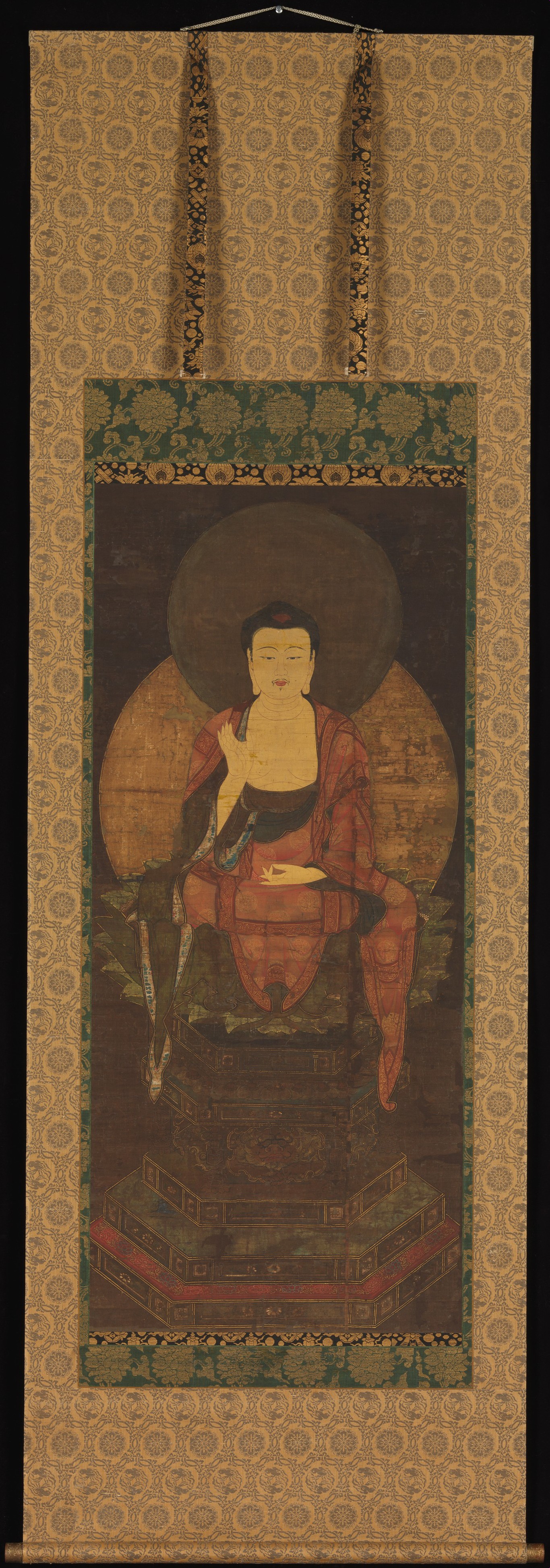
- Title
- Shaka Nyorai (釈迦如来)
- Period
- Nanbokuchō period (1336–92); 14th century
- Region
- Japan
- Medium
- Hanging scroll; ink, color, and gold on silk
- Dimensions
- Image 128.3 × 53.3 cm; overall with mounting 217.2 × 71.1 cm
- Collection
- The Metropolitan Museum of Art
- Accession
-
29.160.31 - Rights
- The Metropolitan Museum of Art, New York, accession 29.160.31. CC0 (public domain).
*Shaka Nyorai*, Japan, Nanbokuchō period, 14th century. Hanging scroll; ink, color, and gold on silk. Image 128.3 × 53.3 cm. The Metropolitan Museum of Art, New York, accession 29.160.31, H. O. Havemeyer Collection, Gift of Horace Havemeyer, 1929. CC0 (public domain). Source: metmuseum.org/art/collection/search/45591.
Met 29.160.31 is a 14th-century Nanbokuchō hanging scroll of Shaka Nyorai in the preaching mudra. The Met catalog calls the figure cross-legged; the Met’s own photograph shows the legs hanging pendant. The article reads the scroll as an identification problem under loss: what fixes it as Shaka rather than Amida, Yakushi, or Dainichi when the gesture is the only anchor and the gold that should carry the reading has flaked away.
The object, and where the catalog and the picture disagree
Start with a disagreement the museum has with itself. The Met’s catalog entry for accession 29.160.31 describes the figure as “sitting cross-legged on a lotus throne above a five-tiered hexagonal pedestal.”1 The Met’s own photograph of the scroll shows something else: both legs hang straight down from the seat, knees apart, the bare feet resting forward on a small separate lotus pad below the throne. That is not the folded meditation lotus. It is the pendant-leg seat (bhadrāsana, the “European” or enthroned posture), and once you have seen it on the silk you cannot un-see it against the catalog line that says cross-legged.
This is the kind of small, checkable conflict that decides whether a single painted Buddha is read carefully or read off a label, so the article keeps it in front rather than smoothing it away. The object is a Nanbokuchō hanging scroll the Met dates to the 14th century, ink, color, and gold on silk, the painted field 128.3 by 53.3 cm.1 The right hand is lifted with the palm turned out; the left rests low. Two circular halos sit behind the figure and do not match: a dark olive disc tight behind the head, a much larger ochre-gold disc behind the body, the silk of the larger one rubbed so thin that it now reads as a separate worn ring rather than the concentric pair the convention intends. The Met reads the hand gesture as the mudra of preaching, the Turning of the Wheel of the Law.1 The pedestal it calls five-tiered; on the scroll three principal hexagonal steps are clearly legible above a red-banded base, with the upper transitions hard to count under the abrasion, so the tier count is the Met’s and is recorded as the Met’s rather than asserted from the picture.
The pendant-leg seat is not a defect in the catalog and not a misreading on the museum’s part so much as a genuine fork, and the honest resolution runs through the iconography rather than around it. The pendant posture is most associated with Miroku, the future Buddha, and with enthroned Buddhas of state; it is also documented for the historical Buddha (the seated, both-legs-pendent bhadrāsana is attested for Shaka, not reserved to Miroku), and it is, separately, the stance of the Kamakura Shaka raigō, the descending historical Buddha discussed below.2 So the posture does not break the Shaka reading. What it does is make this scroll a case where the museum’s words and the museum’s image have to be held apart and reconciled by the viewer, which is exactly the discipline a solitary painted Buddha demands.
bodhi’s other Shaka coverage is sculptural and transmission-led: the 623 Hōryū-ji Kondō Shaka triad by Tori Busshi is the firmly dated starting position of the Japanese record. This scroll is the painted-icon mode of the same figure. The Tori triad is bronze, frontal, architectural, made to be a hall’s central object in three dimensions; the Met scroll is silk, single-figure, made to be rolled, carried, and hung where a cast triad cannot go. The historical Buddha is the same. The format does different work, and the painted format is the movable one.
Reading the figure as Shaka
A single seated gold Buddha is, by itself, ambiguous. Amida, Yakushi, Dainichi, and Shaka all appear as a frontal seated Buddha, and on a scroll with no inscription and no flanking program the identification rests on a short set of markers read against what is absent.
Yakushi Nyorai is fixed by the medicine jar in the left hand. There is no jar here, so it is not Yakushi. Dainichi Nyorai is fixed by the bound-finger chiken-in and by bodhisattva crown and ornament; this figure has neither the chiken-in nor a crown, so it is not Dainichi. Amida is the one that takes work, because Amida and Shaka share the plain monastic robe and the gold body, and Amida’s signature is itself a set of hand-mudras. The separation is the kind of gesture. Amida’s canonical hands are the meditation mudra and, above all, the welcoming-descent gestures of the Pure Land raigō, the hands beckoning the soul outward. The Met reads this scroll’s right hand as the preaching mudra, the Turning of the Wheel of the Law: the gesture that points to the first sermon at the Deer Park, not to a Pure Land descent.1 Preaching mudra, plain robe, no jar, no crown, no chiken-in: the figure is the historical Buddha.
There is a complication worth stating flatly, because the article’s own argument creates it. The clean line “descent gestures mean Amida, not Shaka” is not quite true. The Kamakura period produced a Shaka raigō, a descending historical Buddha, distinguished from an Amida raigō not by the absence of descent but by the gesture: Shaka raigō is identified by the abhaya mudra of the right hand, the left foot advancing, the Buddha shown moving forward to meet the devotee.2 So the discriminator is sharper than “Shaka does not descend.” It is that Amida’s descent uses the raigō-in nine-grade hand-sets while Shaka’s uses abhaya with an advancing step, and this static, seated, palm-out preaching figure is neither. The exclusion of Amida holds; it just holds for a more precise reason than the broad version, and the precise reason is the one this article commits to.
What remains genuinely open is not the identity but its security. The Met’s title and label commit to Shaka and record no reservation.1 A frontal seated Buddha with no inscription, no temple context, and no flanking pair (Monju and Fugen for a Shaka triad, Kannon and Seishi for an Amida one) is identified on gesture and negative evidence, never on a label the painter left. bodhi follows the museum’s identification, which is sound because the preaching mudra is legible and the disqualifying attributes of the other Nyorai are absent. The residual is the class risk, not a rival reading: solitary painted Buddhas with no textual or contextual anchor are the painted-Buddha category most exposed to mis-attribution when the gesture is ambiguous or, as here, the surface is damaged.
The painted Shaka had three modes
The single-figure painted Shaka is one of three painted modes the historical Buddha took, and seeing the Met scroll against the other two is the fastest way to read what is conventional in it and what is period-specific.
The first mode is the solitary devotional icon, which is what 29.160.31 is. Its documented ancestor is the Jingo-ji Shaka Nyorai in Kyoto, the late-Heian (12th-century) National Treasure called “Aka Shaka,” the “Red Shaka,” for its crimson robes. The Kyoto National Museum describes it as the only extant Heian-period Buddhist painting that depicts Shaka alone, and adds the point that carries the historical weight: through the Heian period, when esoteric and Pure Land devotion dominated the painted record, the number of Shaka paintings and sculptures held level with earlier periods, evidence that faith in the historical Buddha did not lapse under that dominance.3 The Jingo-ji scroll is cross-legged on a seven-fold lotus throne, the red robe carrying a shippō-tsunagi pattern in cut gold.3 The Met scroll sits two centuries downstream of it: by the 14th century the solitary painted Shaka is no longer the near-unique survival the Jingo-ji image is for the Heian. It is a repeatable devotional product in the same cut-gold-on-silk register as a first-rank Amida raigō. The two bracket the type’s trajectory: a rare assertion of historical-Buddha devotion under Heian esotericism at one end, a settled format at the other.
The second mode is the protective assembly. The Met itself holds the type-context the solitary scroll is abstracted from: a Nanbokuchō Shaka with Two Attendant Bodhisattvas and Sixteen Benevolent Deities (objectID 76971), Shaka on the lotus pedestal flanked by Fugen and Monju and ringed by the sixteen zenjin charged with protecting the Daihannyakyō, the Great Perfection of Wisdom Sutra, and its reciters. That scroll names the liturgical occasion the solitary icon leaves implicit: this class of painting hung in a temple during recitations of the Daihannyakyō.4 Read 29.160.31 as the central element of that assembly shown on its own: the honzon extracted from its retinue and its rite.
The third mode is the descent: the Shaka raigō already named. It matters here not as a comparandum the Met scroll resembles but as the boundary that makes the solitary preaching icon legible: the painted historical Buddha could be shown enthroned and teaching, escorted and protecting a sutra, or advancing to receive the dying. 29.160.31 is the first of those three, and it is the first precisely in the features it lacks: no retinue, no advancing foot, no sutra-protection cordon, only the seated figure and the wheel-turning hand.
What the loss took, and what the gold did
The condition is not background to the iconography on this scroll; it is part of how the iconography now has to be read. Gold across the face and body, with cut-gold kirikane on the red robe, is the material grammar that declares a high-devotion icon before any attribute argues it. Here most of it is gone. The body halo is rubbed to scattered ochre loss; the kirikane survives as broken filaments rather than the continuous patterned web it was; the gold on the flesh is thinned and patchy. The grudging survival of the gold is the condition the reading has to work through, not around.
This matters because the gold was doing iconographic labor, not decoration. Gold on the flesh is the convention that marks a fully awakened Buddha (a nyorai, gold-bodied by the canonical thirty-two marks) and separates the figure from a bodhisattva, who would wear crown and jewellery instead. On an intact icon the gold makes that argument instantly. On 29.160.31 the argument now has to be reconstructed from a flaked surface, which is one more reason the solitary painted Buddha is the hard case: the marker that should carry the reading at a glance is the marker time takes first.
Set the scroll in the room and the format’s logic is visible. Mounted, it runs to 217 cm, taller than a standing adult; the painted figure meets a viewer at roughly chest-to-head height rather than looking down from an altar. A bronze temple triad is pedestalled to be looked up at. This painted Shaka, on silk, hangs at the height of a sub-temple or memorial-hall wall, the preaching hand lifted near the eye-level of someone seated before it. The five-tier pedestal the Met records is the painter supplying, in pigment, the monumental throne the hanging scroll cannot own physically: the authority of the architectural base borrowed onto silk.
Provenance, and the one thing the record cannot give
The provenance is short and is the standard situation for a medieval devotional painting that reached an American museum early in the 20th century. The scroll entered the Metropolitan in 1929 as the gift of Horace Havemeyer, part of the H. O. Havemeyer Collection, accession 29.160.31; the machine-readable record gives no earlier owner, no temple of origin, no workshop.1 The object survives; the chain that made and used it does not. What can be said is type-level: the painted single Shaka belongs to a continuous minority strand of historical-Buddha devotion running from the Heian Jingo-ji image through Kamakura and Nanbokuchō, parallel to the dominant Amida and esoteric programs.3 That strand has a documented institutional spine in the 13th century: the Seiryōji Shaka in northwest Kyoto and the copy the precept-revivalist Eison ordered in 1249 for Saidaiji in Nara, the Ritsu-order Shakyamuni cult that ran alongside the new Pure Land and Nichiren movements.2 That is the same Eison and the same Saidaiji network bodhi treats in its Monju on the lion study; the painted Shaka and the Saidaiji Monju are two icon-types carried by one 13th-century reform movement, and the Met scroll is a later, anonymous witness to the painted half of it.
The residual is date and place, not identity. The Met assigns “Nanbokuchō, 14th century” with no workshop, no lineage, and no documented history before the 1929 gift, and the API record carries no curatorial dating argument beyond the iconographic line. The Wikidata item Q78847010 records the Met collection, the accession, the object ID 45591, and a 14th-century / Nanbokuchō inception, with no described-at-URL (P973) back-link and no pre-1929 provenance. Pinning the date more tightly, recovering any temple history, and collating the Shimizu–Wheelwright survey of period painting in American collections and Rosenfield’s account of post-1180 patronage at the page level all remain open; both books are cited here at volume level (Shimizu and Wheelwright for where Nanbokuchō Buddhist painting of this register sits in the corpus held outside Japan, Rosenfield for the post-1180 patronage context in which renewed historical-Buddha demand was sustained), and not to a precision they were not read at.56
Sources
| Source | Type | Citation |
|---|---|---|
| Met acc. 29.160.31, Shaka Nyorai (objectID 45591) | museum record | CC0; Met API + catalog text verified 2026-05-18 |
| Met objectID 76971, Shaka with Two Bodhisattvas and Sixteen Benevolent Deities | museum record | CC0; the protective-assembly type-context; Daihannyakyō recitation |
| Kyoto National Museum / Jingo-ji, Shaka Nyorai (“Red Shaka”) | museum record | National Treasure; Heian solitary-Shaka anchor; verified verbatim |
| taleofgenji.org, Shakyamuni: the historical Buddha | reference | Shaka raigō (abhaya + advancing foot); Seiryōji; Eison 1249 Saidaiji |
| Shimizu & Wheelwright (eds.), Japanese Ink Paintings from American Collections | book | Princeton University Press, 1976; corpus-frame, no pages cited |
| John M. Rosenfield, Portraits of Chōgen | book | Brill, 2011; post-1180 patronage context, no pages cited |
Related
- Hōryū-ji Kondō Shaka triad of 623 – the sculptural starting position
- Monju on the lion – the Saidaiji/Eison icon-cult this scroll’s strand shares
- Amida raigō – the welcoming descent this scroll’s gesture is not
- Dainichi Nyorai – the crown and bound-finger mudra this scroll lacks
- Met 19.140 Amida – the painted Amida icon for comparison
- Shaka Nyorai (entity)
- Eison – the Saidaiji precept-revivalist (entity)
- Kirikane (entity)
- Honzon (entity)
Footnotes
-
The Metropolitan Museum of Art, accession 29.160.31, Shaka Nyorai (objectID 45591); Japan, Nanbokuchō period (1336–92), 14th century; hanging scroll, ink, color, and gold on silk; image 128.3 × 53.3 cm, overall with mounting 217.2 × 71.1 cm; H. O. Havemeyer Collection, Gift of Horace Havemeyer, 1929; CC0, confirmed via the Met Open Access API objectID 45591. Catalog text verified verbatim 2026-05-18 via the Met object page (recovered through search indexing; direct HTML fetch returned HTTP 429, the expected Met-API-vs-catalog house pattern): “portrayed sitting cross-legged on a lotus throne above a five-tiered hexagonal pedestal,” “Turning the Wheel of the Law … the mudra of preaching,” “illuminated by double disks of halos and by gold applied to his face and body.” Claim borrowed: object facts, dating, medium, dimensions, credit; the preaching-mudra reading; the five-tier hexagonal pedestal as the museum’s count. Departure named: the museum’s “cross-legged” is contradicted by the museum’s own photograph, which shows the legs pendant (bhadrāsana); the article reports the discrepancy rather than resolving it to either side. ↩ ↩2 ↩3 ↩4 ↩5 ↩6
-
“Shakyamuni — the historical Buddha,” taleofgenji.org, accessed 2026-05-18, corroborated for the type by the Kyoto National Museum butsuga material and the bhadrāsana/posture web search (the seated both-legs-pendent posture documented for the historical Buddha, not reserved to Miroku). Claims borrowed: the Kamakura Shaka raigō as a revived “descending historical Buddha” type identified by the abhaya mudra of the right hand with the left foot advancing (distinct from Amida’s raigō-in descent); the Seiryōji Shaka in northwest Kyoto and the copy Eison ordered in 1249 for Saidaiji in Nara, the Ritsu-order Shakyamuni cult running alongside Pure Land and Nichiren. Reference tier; used for the iconographic discriminator and the institutional-strand context, not for object facts. The tie to the Saidaiji Monju cult is bodhi’s own cross-reading, flagged as such. ↩ ↩2 ↩3
-
Kyoto National Museum, Shaka Nyorai (Jingo-ji, “Aka Shaka”/“Red Shaka”), late-Heian (12th century), National Treasure. Museum English page fetched verbatim 2026-05-18: “the only extant Heian Period Buddhist painting that depicts Shaka alone”; despite the rise of Esoteric and Pure Land Buddhism the number of Shaka paintings and sculptures equalled that of previous periods, “demonstrating that … faith in Shakamuni remained strong throughout the period”; cross-legged on a seven-fold lotus throne; red robes (hence “Aka Shaka”) with a shippō-tsunagi pattern in kirikane cut gold. Cited as the Heian solitary-Shaka anchor and the source of the Heian-persistence claim; claims borrowed are quoted at clause level. ↩ ↩2 ↩3
-
The Metropolitan Museum of Art, objectID 76971, Shaka (Shakyamuni), the Historical Buddha, with Two Attendant Bodhisattvas and Sixteen Benevolent Deities, Japan, Nanbokuchō period (1336–92). Identity, period, and the iconographic/functional description (Shaka on a lotus pedestal flanked by the bodhisattvas Fugen and Monju, ringed by sixteen benevolent deities charged with protecting the Great Perfection of Wisdom Sutra and its reciters; hung in a temple during recitations of the Daihannyakyō) confirmed 2026-05-18 via the Met object-search result and the museum’s own indexed object text; the direct catalogue page could not be loaded. Cited at object-title/description level as the protective-assembly type-context for the solitary Met 29.160.31; accession number not confirmed (catalogue page inaccessible; Met object reference is by objectID 76971). ↩
-
Yoshiaki Shimizu and Carolyn Wheelwright (eds.), Japanese Ink Paintings from American Collections: The Muromachi Period (Princeton University Press, 1976). Cited at volume level as the reference frame for where Nanbokuchō–Muromachi Buddhist painting of this register sits in the corpus held in American collections. Internal pages not cited; no page-specific claim asserted. ↩
-
John M. Rosenfield, Portraits of Chōgen: The Transformation of Buddhist Art in Early Medieval Japan (Brill, 2011). Cited at volume level for the post-1180 institutional context (Nara-revival patronage networks and the period’s renewed interest in the historical Buddha) in which demand for painted Shaka icons of this strand was sustained. Internal pages not cited; no page-specific claim asserted. ↩