Monju Bosatsu on the lion: reading the wisdom bodhisattva
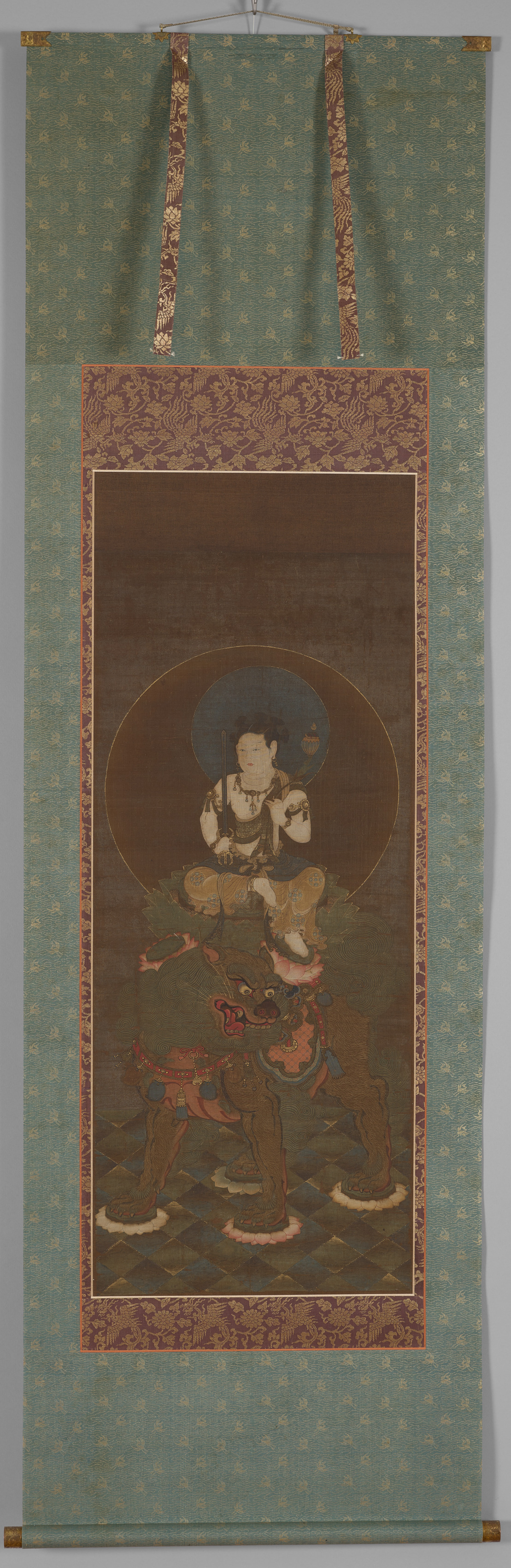
- Title
- Monju with Five Hair Knots (五髻文殊像) — Cleveland 1971.21
- Period
- Japan, Kamakura period, late 1200s–early 1300s
- Collection
- Cleveland Museum of Art
- Accession
-
1971.21 - Rights
- Cleveland Museum of Art, 1971.21, Purchase from the J. H. Wade Fund. CC0 / Open Access.
The lion, the sword, the sūtra, and the counted topknots are the standard reading key for Monju Bosatsu, and every reference site carries them. The part those sites leave out is why the iconography proliferated: Eison’s Saidaiji order made the wisdom bodhisattva the instrument of a thirteenth-century relief program for the outcast, and the youthful, princely, accessible Monju on the Cleveland scroll (1971.21) is more legible once that program is in view.
What the Cleveland scroll puts in front of you
Cleveland Museum of Art 1971.21, Monju with Five Hair Knots (五髻文殊像), is a Kamakura painting in ink, color, gold, and cut gold on silk, dated by the museum to the late 1200s–early 1300s. The painted field is about a metre tall and narrow. Almost all of it goes to one vertical event: a child-bodied figure on a lion that is walking, not standing, the front legs offset from the back.
The reading begins before the attributes. The figure is a boy (soft jaw, no facial hair, adolescent proportions, not an adult deity). That youth is not charm; it is the iconography. Monju’s body is kept young because the wisdom he personifies is held to be unclouded, and the painted record carries that doctrine in the face before it carries it in any held object. Read the sword first and you have read the scroll in the wrong order.
Four lotus pads sit under the lion, one beneath each paw, slightly flattened where the weight lands. Hung at devotional height, on a field a metre tall, those pads fall in the lower third, well below the eye-line a standing viewer takes to the bodhisattva’s face; they are read last, on the way down, and against the dark ground and the busy lion they are easy to lose. They do specific work. They lift the animal off the earth and mark it as not an animal. The Cleveland catalog reads the gold-painted mane and the lotus underfoot together as the markers of the lion’s supernatural status.1 The pads are the discreet half of that pairing, and the half a quick look drops.
The lion is the loud part
The mount names the form: Kishi Monju (騎獅文殊), Monju-riding-the-lion. The lion is not a throne and not ordinary transport. In the iconographic tradition the lion’s roar stands for the proclamation of the Dharma, the teaching that goes out and is not refused, the way the elephant under Fugen stands for patient practice. The two bodhisattvas flank Shaka Nyorai as the standard triad: wisdom on one side, practice on the other. The elephant side has its own study; this one stays on the lion.
On the Cleveland silk the lion carries the labor. Every strand of the mane is drawn in gold, one line at a time, so the head reads as a mass of fine bright filaments against the darker body; the mouth is open, the head turned slightly back toward the rider. The open mouth is the roar made visible. The painter spent the gold here and not on the bodhisattva: the figure’s jewelry is gold but sparing, while the mane is the most worked passage on the scroll. Where the surface labor concentrates is where the doctrinal weight sits.
The lion also fixes the geography. Monju’s holy mountain is Wutaishan (五臺山; Japanese Godaisan), the five-terraced massif in Shanxi where the bodhisattva was held to manifest, and the lion is the vehicle on which he is imagined arriving from it.
The hands, in two registers
The two canonical hand-attributes are a sword and a text. The sword is held up in the right hand, read as cutting through delusion. The text is the Prajñāpāramitā, the perfection-of-wisdom literature, held at the left, sometimes as a scroll or bound volume and sometimes substituted by a lotus that carries the sūtra on its blossom. Both Wikipedia and the Onmark dictionary give exactly this pair; it is the part of Monju every reference site already has.2
The Cleveland scroll runs the softer version. The catalog describes the figure holding a sword and a flower stem rather than a brandished blade and a book.1 Same doctrine (wisdom cuts; wisdom is the perfection-of-wisdom text), pitched as a princely youth with a stem rather than a wrathful instrument. Reading the attributes therefore means reading their register: the same Monju is drawn as a swordsman or as a boy with a flower, and the choice is the painter’s argument about whether wisdom is shown here as force or as grace. The grace register is not incidental to this article’s larger point. It is the register Eison’s cult needed, and the section on that cult returns to it.
The popular presentation tends to over-read at this point. The sword is an iconographic attribute as taught in the wisdom literature; it is not an instruction to the viewer to cut their own delusions with it. bodhi describes what the attribute encodes in the record and leaves the devotional second person to the worship tradition.
The hair is the index
The single most diagnostic feature of a Japanese Monju is not the lion or the sword. It is the hair. The topknots are counted, and the count names the ritual form and the mantra attached to it.
- Ichiji Monju (一字文殊), one topknot: the one-syllable form, associated in the ritual literature with protection against calamity and disturbed sleep.
- Gokei Monju (五髻文殊), five topknots: the five-knot form, the Cleveland scroll’s form.
- Rokkei Monju (六髻文殊), six topknots: a six-knot variant tied to a six-syllable form.
- Hachiji Monju (八字文殊), eight topknots: the eight-syllable form, used in rites of national and personal protection. The Met holds a Nanbokuchō Monju Bosatsu with Eight Sacred Sanskrit Syllables (object 45596) that fixes this form as a documented painted type, not only a textual category.3
The five knots are where the reading deepens past the count. The standard gloss makes them the five terraces of Wutaishan; the Shingon correlation makes them the five wisdoms and the five cosmic elements. The more specific reading, carried convergently by the Museum of Fine Arts, Boston Gokei Monju, several Met Gokei Monju, and the University of Michigan scroll, is that the five knots are the Five Wisdom Buddhas themselves: Ashuku (Akṣobhya), Amida (Amitābha), Fukujōju (Amoghasiddhi), Hōshō (Ratnasambhava), and Dainichi (Mahāvairocana), the Godai Nyorai set that organizes the esoteric mandara.4 Monju’s accession into the thirteen-deity Jūsanbutsu set of Shingon also dates from the thirteenth century, the same window as the Cleveland scroll. The count is the index; the five-Buddha reading is what the index points at.
A caution on sourcing. The crisp one/five/six/eight scheme is the form in which it reaches a general reader through reference compendia and museum labels, which assemble it from temple practice and ritual manuals; it is reliable as a reading key. The five-Buddha correspondence is corroborated across several independent museum catalog entries, which is firmer than compendium-only. What is not pinned here is the rite level: the exact mantra-syllable assignments form by form sit in the Japanese esoteric ritual manuals (the zuzō and shidai literature), and a rite-by-rite pass needs that literature in hand. The article flags that gap rather than papering it.
The crossing, and a dated example of it
The richest Japanese form is not the solitary bodhisattva. It is the pilgrimage group: Monju on the lion with four attendants, moving across water. This is the Watari Monju or Tōkai Monju (渡海文殊), Monju-crossing-the-sea. The party travels on cloud over wave, understood as crossing from Wutaishan, and the sea-crossing is a specifically Japanese elaboration of the continental Godaisan cult, not something inherited whole from China.
The four companions are a fixed cast, each read by attribute and age:
- Zenzai-dōji (善財童子; Sudhana), the pilgrim youth of the Gaṇḍavyūha, who visited a long sequence of teachers; the seeker, kept young like Monju.
- Utennō (優填王; King Udayana), the aged king of Khotan, who leads the lion by its rein; his age and his place at the lion’s head are the markers.
- An elderly holy man, Saishō Rōnin (最勝老人) in the Japanese sources.
- Butsudahari (仏陀波利; Buddhapāli), the monk who in legend went to Wutaishan after Monju and met him there.
The prior version of this article cited a Daigo-ji painting as the stock exemplar; that attribution would not verify to a catalog record, so it is dropped in favor of one that does. The Tokyo National Museum holds a sculptural Watari Monju group, C-1854, that carries its own documentation in the wood. Five colored figures with crystal eyes: Monju on the lion and four standing attendants, the King of Khotan and Zenzai-dōji among them. An inscription on the lion’s head names the sculptor, Kōen (康円, 1207–?), Unkei’s grandson and the successor to Tankei, and the date, Bunnei 10 (1273). The votive donor was Gyōgen, a Kōfuku-ji priest; the set was installed as the principal images of Kangakuin, founded at Kōfuku-ji in 1285. It is an Important Cultural Property.5 The Japanese sea-crossing reads, in the sculpture, off the pedestal: the waves are engraved into the base, the iconographic event cut into the stone the figures stand on rather than painted around them. That a securely dated Kei-school hand (the lineage bodhi tracks in its Kei-school genealogy) produced a Watari Monju in 1273 is the cleanest single anchor for the type’s Kamakura currency, and it ties the wisdom-bodhisattva iconography directly to the workshop history the sculpture cluster documents.
Set against that group, the Cleveland scroll is the solitary form: Monju, lion, four lotus pads, no retinue. Read it as the central element of that larger composition, shown on its own.
Why the iconography spread: Eison and the living Mañjuśrī
Here is the part the reference sites do not carry. Onmark, the dominant page on this subject, runs the topknots and the sea-crossing cast in detail and never mentions Eison; Wikipedia’s Manjushri article is Chinese-weighted and has no Japanese cult history at all. The reason Monju iconography proliferated in thirteenth-century Japan is not primarily aesthetic. It is the Saidaiji order founded by Eison (叡尊; also Eizon, 1201–1290), the Shingon Ritsu movement that fused esoteric Buddhism, precept revival, and organized relief for the outcast hinin: beggars and the sick, including those with leprosy.
David Quinter’s From Outcasts to Emperors (Brill, Japanese Studies Library vol. 50, 2015) argues that the Mañjuśrī cult was the cult most tightly bound to that program, and the argument is sharper than “wisdom for everyone.” Eison held that Mañjuśrī would incarnate as an outcast to elicit charitable deeds; the cult bound charitable relief, elite patronage, and state-protection ritual into one apparatus; and the theology reached into the icchantika question (whether beings traditionally believed to lack the capacity for awakening were excluded from it) and answered that they were not.6 Quinter’s wider intervention is historiographical: the Nara-revival monastics, long filed as conservative reformers, were doing something inventive, using icon construction and assembly as the medium of a social argument.6
The sharp case is Hannyaji (般若寺) in Nara, sited by the province’s largest outcast community. Eison and his order staged large enshrinement ceremonies there for a Mañjuśrī statue in 1267 and 1269; the 1267 Hannyaji Mañjuśrī Engi and Eison’s 1269 votive text for the statue are documents Quinter treats and translates in the volume, and his earlier study, “Creating Bodhisattvas: Eison, Hinin, and the ‘Living Mañjuśrī’” (Monumenta Nipponica 62, no. 4, 2007, pp. 437–479), reads the same texts.67 The statue was positioned not as a representation but as an active presence: the living poor at the gate and the carved bodhisattva inside were made to interpret each other.
This is the divergence worth naming flatly. The museum reading takes a Kamakura Monju for its realism and its princely grace, which the Cleveland entry does. The Eison reading takes the same iconography as the working instrument of a relief cult. These are not rival accounts of one fact; they are accounts of different things, and bodhi commits to holding both, because the iconographic detail decides between them less than the context does. The grace register from the section on the hands, the boy with a flower rather than the swordsman, is exactly the register a cult promoting universally accessible wisdom would want on the silk. The residual uncertainty is real and worth stating: Quinter’s documents establish the cult and its theology; they do not certify that the Cleveland scroll specifically was made for a Saidaiji-network rite, and no provenance or technical study of 1971.21 is published that could. The cult explains why the type spread; it does not, by itself, place this object inside it.
The continental root, and the question left open
Monju’s cult entered Japan through the Tendai monk Ennin (円仁, 794–864), who reached Wutaishan during his years in Tang China and carried the Godaisan devotion back. The five-terraced mountain that named the five knots is the same mountain the sea-crossing party is shown crossing toward. There is an older strand too: Chinese monks held the Nara-period monk Gyōki (668–749) to be a Mañjuśrī manifestation, and Monju images travelled with continental monastics to Nara well before Ennin. So the Ennin route is the main transmission, not the only one, and this article asserts it as the main one rather than the sole one.
Which leaves the one question this guide cannot close from the reproduction. The reading method is secure: the lion is the roar, the youth is unclouded wisdom, the five knots index the five-Buddha set, the crossing is the Japanese elaboration of the Wutaishan cult, and Eison’s order is why the type spread. What is not settled is whether the exact mantra-syllable assignment for each topknot form can be pinned to a named Japanese ritual manual rather than carried, as here, on the convergence of museum labels and the compendium tradition. That is not a flaw in the picture. It is the next place to dig, and it needs the zuzō literature on a desk, not a museum tombstone.
Sources
| Source | Type | Citation |
|---|---|---|
| Cleveland Museum of Art acc. 1971.21 | museum record | Monju with Five Hair Knots; CC0 / Open Access; accessed 2026-05-18 |
| Tokyo National Museum acc. C-1854 (Kōen, 1273) | museum record | Watari Monju group, Important Cultural Property; e-Museum / NICH; dated, sculptor-attributed |
| The Met object 45596 | museum record | Monju Bosatsu with Eight Sacred Sanskrit Syllables, Nanbokuchō; the Hachiji-Monju documented type |
| Museum of Fine Arts, Boston: Gokei Monju (+ Met / UMMA Gokei Monju) | museum record | five-knot = Five Wisdom Buddhas correspondence, multi-museum convergent |
| David Quinter, From Outcasts to Emperors | book | Brill JSL vol. 50, 2015: Saidaiji/Eison Mañjuśrī cult; argument verified, pages flagged |
| David Quinter, “Creating Bodhisattvas: Eison, Hinin, and the ‘Living Mañjuśrī‘“ | article | Monumenta Nipponica 62, no. 4 (2007), pp. 437–479: Hannyaji votive texts |
| Mark Schumacher, A to Z Photo Dictionary: Monju | reference | onmarkproductions.com; topknot scheme + Watari cast, flagged temple-empirical |
Related
- Fugen Bosatsu on the elephant: the paired bodhisattva
- Shaka Nyorai: the central figure of the Shaka triad
- The Kei-school genealogy: the workshop lineage Kōen belongs to
- The sixteen arhats — reading a numbered set
- Monju Bosatsu (entity)
- Eison (entity)
- Kōen, Kei-school sculptor (entity)
- Watari Monju (entity)
Footnotes
-
Cleveland Museum of Art, accession 1971.21, Monju with Five Hair Knots (五髻文殊像), Japan, Kamakura period, late 1200s–early 1300s; hanging scroll, ink, color, gold and cut gold on silk; Purchase from the J. H. Wade Fund; CC0 / Open Access, accessed 2026-05-18. Claim borrowed: the object facts and dating; the figure as a Gokei Monju holding a sword and a flower stem (the grace register, not a brandished blade and a book); the gold-painted mane and the lotus underfoot read together as the markers of the lion’s supernatural status. No published technical or provenance study located beyond the museum tombstone; the late-1200s–early-1300s dating is the museum’s stylistic attribution. ↩ ↩2
-
Mark Schumacher, “Monju Bosatsu (Bodhisattva),” A to Z Photo Dictionary of Japanese Buddhism, onmarkproductions.com, accessed 2026-05-18; corroborated for the iconographic spine by the English Wikipedia Manjushri article and the Soto Zen “Learning to look” page. Claim borrowed: the standard sword-and-Prajñāpāramitā pair and the lion-as-Dharma-voice reading carried by every general reference site; the topknot-count scheme and the Watari Monju four-companion cast (Schumacher crediting JAANUS). The site does not mention Eison or the Saidaiji Mañjuśrī cult: the specific differentiation gap this article fills. Reference-compendium tier; the topknot mantra-syllable assignments are temple-empirical, not tied to a ritual manual. ↩
-
The Metropolitan Museum of Art, object 45596, Monju Bosatsu with Eight Sacred Sanskrit Syllables, Japan, Nanbokuchō period (1336–92). Cited as the Hachiji-Monju (eight-syllable / eight-topknot) form fixed as a documented painted type, not only a textual category. Met catalogue page not consulted directly; object identity, title and Nanbokuchō dating confirmed via the Met’s indexed listing and the museum’s own object-search results. Cited at object-title level; catalogue page not consulted. ↩
-
Museum of Fine Arts, Boston, Gokei Monju, the Bodhisattva of Wisdom, with His Hair Arranged in Five Knots (collections.mfa.org object 24543), corroborated by the Metropolitan Museum Gokei Monju objects (752006, 45236, 853238) and the University of Michigan Museum of Art scroll (1954/1.207). Claim borrowed: the five knots read as the Five Wisdom Buddhas: Ashuku (Akṣobhya), Amida (Amitābha), Fukujōju (Amoghasiddhi), Hōshō (Ratnasambhava), Dainichi (Mahāvairocana), convergent across independent museum entries, and Monju’s thirteenth-century accession into the Shingon Jūsanbutsu. Object pages reached via the museums’ indexed listings 2026-05-18; cited at the correspondence level, accession numbers not confirmed. ↩
-
Tokyo National Museum, accession C-1854, Manjushri (Monju Bosatsu) on a lion, and standing statues of attendants (騎獅文殊菩薩及び侍者立像), by Kōen (康円, 1207–?); five wooden figures, colored, with crystal eyes; Important Cultural Property. e-Museum / NICH catalog fetched 2026-05-18 and corroborated via Google Arts & Culture (“Seated Monju Bosatsu and Attendants,” Kōen), the Tokyo National Museum exhibition page (Unkei, his followers, and Kōen), and Kōfuku-ji. Claim borrowed: an inscription on the lion’s head names Kōen (Unkei’s grandson and Tankei’s successor) and the date Bunnei 10 (1273); the votive donor was Gyōgen, a Kōfuku-ji priest; the group was enshrined as the principal images of Kangakuin, founded at Kōfuku-ji in 1285; the work is a Godaisan / Tōkai Monju with the sea-crossing rendered as waves engraved into the pedestal, a Japanese elaboration of the continental cult. Replaces the prior unverified Daigo-ji exemplar. ↩
-
David Quinter, From Outcasts to Emperors: Shingon Ritsu and the Mañjuśrī Cult in Medieval Japan (Leiden: Brill, Japanese Studies Library vol. 50, 2015; ISBN 9789004293397; 340 pp.). Argument verified 2026-05-18 against the author’s published introduction (academia.edu item 13303669) and the H-Net review (Morris), the Monumenta Nipponica review (Watt), and the Project MUSE reviews (articles 651011 / 665297). Claims borrowed: Eison held that Mañjuśrī would incarnate as an outcast to elicit charitable deeds; the cult bound charitable relief, elite patronage, and state-protection ritual into one apparatus; the theology engaged the icchantika / universal-buddhahood question and rejected traditional exclusions from salvation; the historiographical intervention is against the “conservative Nara reformer” reading. The 1267 Hannyaji Mañjuśrī Engi and Eison’s 1269 votive text for the Hannyaji statue are documents Quinter treats and translates in the volume; the 1267 Engi surfaced near p. 289 in search, but the pagination has not been checked against the printed book; cited at document level. ↩ ↩2 ↩3
-
David Quinter, “Creating Bodhisattvas: Eison, Hinin, and the ‘Living Mañjuśrī,’” Monumenta Nipponica 62, no. 4 (2007), pp. 437–479. Volume/issue/year/pages verified via the Sophia University Monumenta Nipponica author index and Project MUSE. Cited for the Hannyaji votive-text reading (the icon and the relief work made to interpret each other); the argument summary is taken from the verified abstract and the published reviews, not a full-text reading. ↩
Sources
-
e-Museum / NICH catalog fetched 2026-05-18, corroborated via Google Arts & Culture (Koen, 'Seated Monju Bosatsu and Attendants') and the TNM exhibition page (Unkei/followers/Kōen) and Kōfuku-ji. Five wooden statues, colored, beaded (crystal) eyes; Monju seated on a lion with four standing attendants (King of Khotan / Utennō, Sudhana / Zenzai-dōji among them); inscription on the lion's head names Kōen (1207–?), Unkei's grandson and Tankei's successor, and the date Bunnei 10 (1273); votive donor Gyōgen, a Kōfuku-ji priest; enshrined as the principal images of Kangakuin (founded at Kōfuku-ji 1285). 'Godaisan Monju' / 'Tōkai Monju'; the sea-crossing rendered as engraved waves on the pedestal, a Japanese elaboration. Important Cultural Property. Replaces the prior unverified Daigo-ji exemplar.
-
Argument verified against the author's published introduction (academia.edu, item 13303669, fetched 2026-05-18) and the H-Net (Morris) and Monumenta Nipponica (Watt) reviews and Project MUSE review (article 651011/665297): Eison held that Mañjuśrī would incarnate as an outcast to elicit charitable deeds; the cult bound charitable relief, elite patronage, and state-protection ritual; the icchantika / universal-buddhahood theology rejected traditional exclusions from salvation; the historiographical intervention is against the 'conservative Nara reformer' narrative. The 1267 Hannyaji Mañjuśrī Engi and Eison's 1269 votive text for the Hannyaji statue are documents Quinter translates/treats in the volume (1267 Engi surfaced near p. 289 in search; exact pagination not checked against the printed book; cited at document level). Brill JSL vol. 50, 2015, ISBN 9789004293397.
-
Same-subject reference corroborating the five-knot = Five Wisdom Buddhas (Ashuku/Amida/Fukujōju/Hōshō/Dainichi) correspondence, convergent with the Met Gokei Monju objects (752006, 45236, 853238), UMMA 1954/1.207, and Sydney L. Moss. Object page accessed via search index 2026-05-18; accession number not confirmed (cited at object-title/correspondence level).