Hōryū-ji Kondō Shaka triad (623): Tori Busshi and the dedicatory inscription
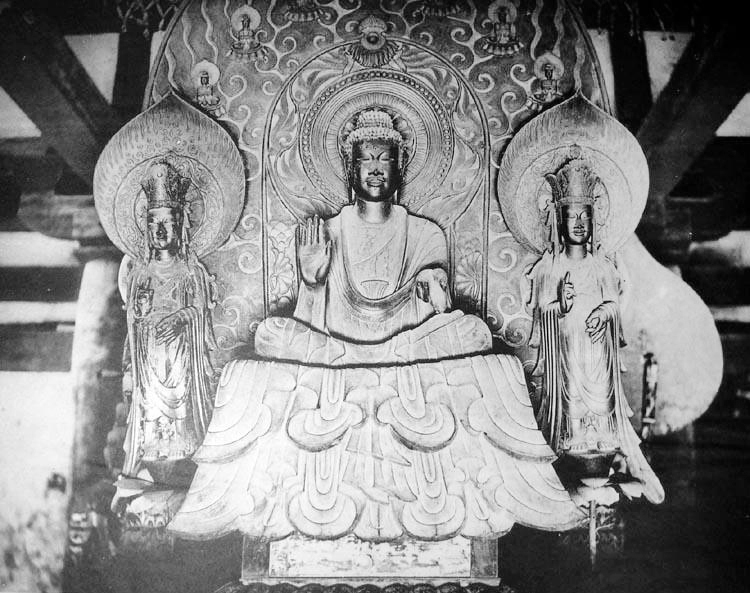
- Title
- Shaka triad (釈迦三尊像)
- Period
- Asuka
- Medium
- Gilt bronze, central Shakyamuni seated; two flanking standing bodhisattvas; shared back-mandorla bearing the dedicatory inscription
- Dimensions
- Central Shaka: 86.4 cm seated; flanking bodhisattvas: 90.7 cm and 92.4 cm
- Collection
- Hōryū-ji, Kondō (金堂), Nara
- Accession
-
National Treasure of Japan (国宝) - Rights
- PD-Japan-oldphoto via Wikimedia Commons
The first dated Japanese sculpture
The bronze triad in the Kondō of Hōryū-ji carries a fourteen-line inscription on the back of its shared mandorla. The inscription gives the date the figures were completed — Suiko 31, third month, completed — corresponding to the spring of 623 in the common-era calendar. It names the sculptor: Shiba no Kuratsukuri no Tori Busshi. It states the occasion: a memorial offering, vowed by the family and court of Prince Shōtoku after his death in 622, for the merit of Shōtoku, his consort Kashiwade no Iratsume (who died shortly before him), and his mother Empress-dowager Anahobe no Hashihito (who died in 621).
This is the firmly dated origin point of Japanese Buddhist sculpture in the surviving record. There are earlier figures — the Asuka-dera Buddha is conventionally dated 606 — but the Asuka-dera Buddha carries no contemporary inscription pinning its date. The Kondō Shaka triad does. Everything in the Japanese Buddhist sculptural tradition after 623 can be measured against the surface, scale, and style of these three figures.
The article reads what the inscription says, what the figures look like, and what the moment of 623 means as a starting point.
What the inscription says
The dedicatory text on the back of the shared mandorla is one of the most-studied documents in early Japanese history. The first half records the deaths of Shōtoku’s mother (621), consort (early 622), and Shōtoku himself (622); the second half states the vow to commission a Shaka image of the same height as Shōtoku for the merit of all three, and records the completion of the commission in 623 by Tori Busshi.
The inscription is the source of three load-bearing facts: (1) that the figures are a memorial commission for Shōtoku, not a temple foundation offering; (2) that the central Shaka is intended to be the same height as Shōtoku himself; (3) that Tori Busshi is the named maker. Each of these facts is unusual for a 7th-century Japanese sculpture and each has been the foundation of later scholarship.
The “same height as Shōtoku” line — isshaku iku-sun no Shaka zō — is the load-bearing one for material-history work. The central Shaka measures 86.4 cm seated, which scales to approximately the height of a seated adult man. The line has been read variously as a literal claim (the figure is Shōtoku’s exact height) or as a conventional formula. Either way, it is the earliest instance of a Japanese Buddhist image being explicitly measured against a particular human body — and it inaugurates a long Japanese tradition of equivalent-scale memorial images.
Reading the figures
Stand in front of the triad and the first thing to register is the flatness. The figures are designed for frontal viewing. The drapery folds — the long descending zigzag cascades down the front of the Shaka’s robe and the bodhisattvas’ garments — read as decorative rather than naturalistic. The cloth does not describe a body underneath; it describes a pattern that signals “robe.”
The faces are elongated, slightly inhuman, with the upturned corners of the mouth that art-historical literature has called the archaic smile (a label borrowed from early Greek sculpture and applied to comparable East Asian work from the same broad period). The eyes are slightly almond-shaped, half-closed. The expression is not exactly serene — it is withdrawn, set at a remove from the viewer’s space.
The central Shaka holds the right hand raised in abhaya-mudrā — the gesture of fearlessness, palm out — and the left hand lowered in varada-mudrā — the gesture of granting wishes, palm out. The two flanking bodhisattvas stand frontally, each holding what was originally a lotus stem (the upper parts are now partially missing or restored), and their crowns rise high above their heads.
The shared back-mandorla — a flame-shaped panel that frames all three figures from behind — is unbroken across the triad, rather than three separate haloes. This is a distinctive Asuka-style feature: the figures read as a single unified composition rather than as three separate sculptures placed adjacent to one another.
What this is not is naturalistic. Compared with the Hokuendō Mujaku of c.1212, where Unkei sculpts a particular old man with sunken cheeks and accumulated weight, the 623 figures are explicitly not particular. They are types. The style of the Tori-school workshop carries the early-6th-century Chinese Northern Wei aesthetic — the linear drapery, the elongated faces, the symmetrical cascade — into the Japanese tradition as a starting point.
Tori Busshi and the workshop
Tori Busshi is the only named sculptor in early-7th-century Japan whose name is preserved on a surviving work. He is the grandson of Shiba Tatto, who arrived in Japan from the Korean peninsula in 522 and is conventionally treated as one of the founding figures of the Tori-school sculptural lineage. The Tori-school style is named after him.
What Tori Busshi inherited was the technical vocabulary of bronze casting and the stylistic vocabulary of Northern Wei Chinese Buddhist sculpture, transmitted through the Korean peninsula. What he did with it — in 623 and across his career — was to establish a Japanese workshop production model that scaled. The Kondō Shaka triad is not a unique virtuoso piece; it is the canonical type-piece for a workshop that produced multiple comparable figures across the early 7th century, most of which are no longer extant.
The naming of Tori Busshi on the back-mandorla is itself unusual. Most 7th-century Japanese Buddhist sculpture is anonymous. The fact that this commission carries a maker’s name — alongside the patron’s name and the date — has been read as a signal of the prestige of the commission (a memorial for Shōtoku) rather than as a routine practice of the period.
The Asuka style as a starting position
What the Kondō Shaka triad establishes is the starting position of the Japanese tradition, against which everything later is in dialogue. The Asuka style — elongated, stylised, frontally-oriented, with the unified back-mandorla and the archaic smile — is a particular synthesis: Chinese Northern Wei prototypes filtered through Korean intermediary workshops and adapted to Japanese patronage conditions.
The style does not last. By the Hakuhō period (c.645–710), Japanese sculpture is already shifting toward a more naturalistic, three-dimensionally-modelled idiom drawn from Chinese Sui and early Tang prototypes. By the Tenpyō period (c.710–794), the Yumedono Guze Kannon — itself an Asuka-style figure but with a different stylistic register — sits alongside fully Tang-derived figures, and the Tori style has become one mode among several. By the Heian period the linear, frontal Asuka mode is largely abandoned; by the Kamakura period of Unkei and Tankei, the Japanese sculptural tradition has gone through three major stylistic transitions and arrived at its own portrait-realism mode.
But the starting point holds. Everything later is in some relation to what happens in 623 — the choice of bronze, the choice of triad composition, the choice to inscribe the maker, the choice to commission an image at human scale for a memorial purpose.
The Shōtoku context
The Kondō Shaka triad is not just a sculpture; it is a memorial. The three deaths in 621–622 — Shōtoku’s mother, his consort, and Shōtoku himself, in close sequence — were a dynastic crisis as well as a personal loss. Shōtoku (Prince Umayado) had been the most powerful court patron of Buddhism in his generation; he had reportedly commissioned the founding of Hōryū-ji itself (the original 607 foundation, though the present Kondō is part of the early-8th-century rebuild after a 670 fire). His sudden death left a succession problem and a religious-political vacuum.
The triad is the family’s response. The “vowed by the consorts and the king’s persons” line of the inscription frames the commission as a collective family vow; the choice of Shakyamuni — the historical Buddha, the founder — rather than Maitreya or Amida is doctrinally specific (Shaka is Shōtoku’s preferred deity in the Nihon Shoki record); the choice to make the central figure the same height as Shōtoku makes the figure a substitute body, an equivalent presence.
The Shōtoku cult that develops in the centuries after 622 — and that becomes one of the central currents of Japanese Buddhism by the Kamakura period — has its origin point at the Kondō Shaka triad. The figure is not a portrait of Shōtoku, but it is the first object explicitly for Shōtoku, and the long Shōtoku-veneration tradition begins here.
What stays open
Three questions remain open on the Hōryū-ji Kondō Shaka triad:
- Workshop composition. Tori Busshi is the named master, but the casting of a three-figure bronze triad at this scale required a workshop. The names of the workshop members are not preserved. A targeted study against the contemporary Nihon Shoki and against later Tori-school output could potentially reconstruct the workshop’s structure, but on current evidence the workshop is anonymous.
- The 670 fire and the present Kondō. The Kondō was destroyed by fire in 670 and rebuilt in the early 8th century; the present hall is the rebuild. Whether the bronze triad was rescued intact from the burning Kondō and replaced in the rebuilt hall, or whether some restoration occurred in the early 8th century, is debated. The conservation history of the figures themselves between 623 and the present is not fully reconstructed.
- The “same height as Shōtoku” line. The inscription’s claim that the central Shaka is the same height as Shōtoku has been read literally (the figure as a portrait of Shōtoku’s body) and conventionally (as a memorial formula). The seated measurement (86.4 cm) does scale plausibly to an adult man’s height, but the standing equivalent is a calculation, not an observation. Whether Shōtoku was actually approximately this height is unverifiable; whether the line was meant to be a literal claim is a textual-interpretation question that deserves a focused study.