An Aizen Myōō sculpture, and the painting acquired thirty years later to complete it
- Title
- Aizen Myōō (愛染明王像) — wood sculpture
- Period
- Kamakura period (1185–1333), early 1300s
- Region
- Japan
- Medium
- Wood with black lacquer and red pigments
- Dimensions
- Overall 75 × 59 × 35 cm
- Collection
- Cleveland Museum of Art
- Accession
-
1987.185 - Rights
- Cleveland Museum of Art, 1987.185 — CC0 (Open Access). Bequest of Elizabeth M. Skala.
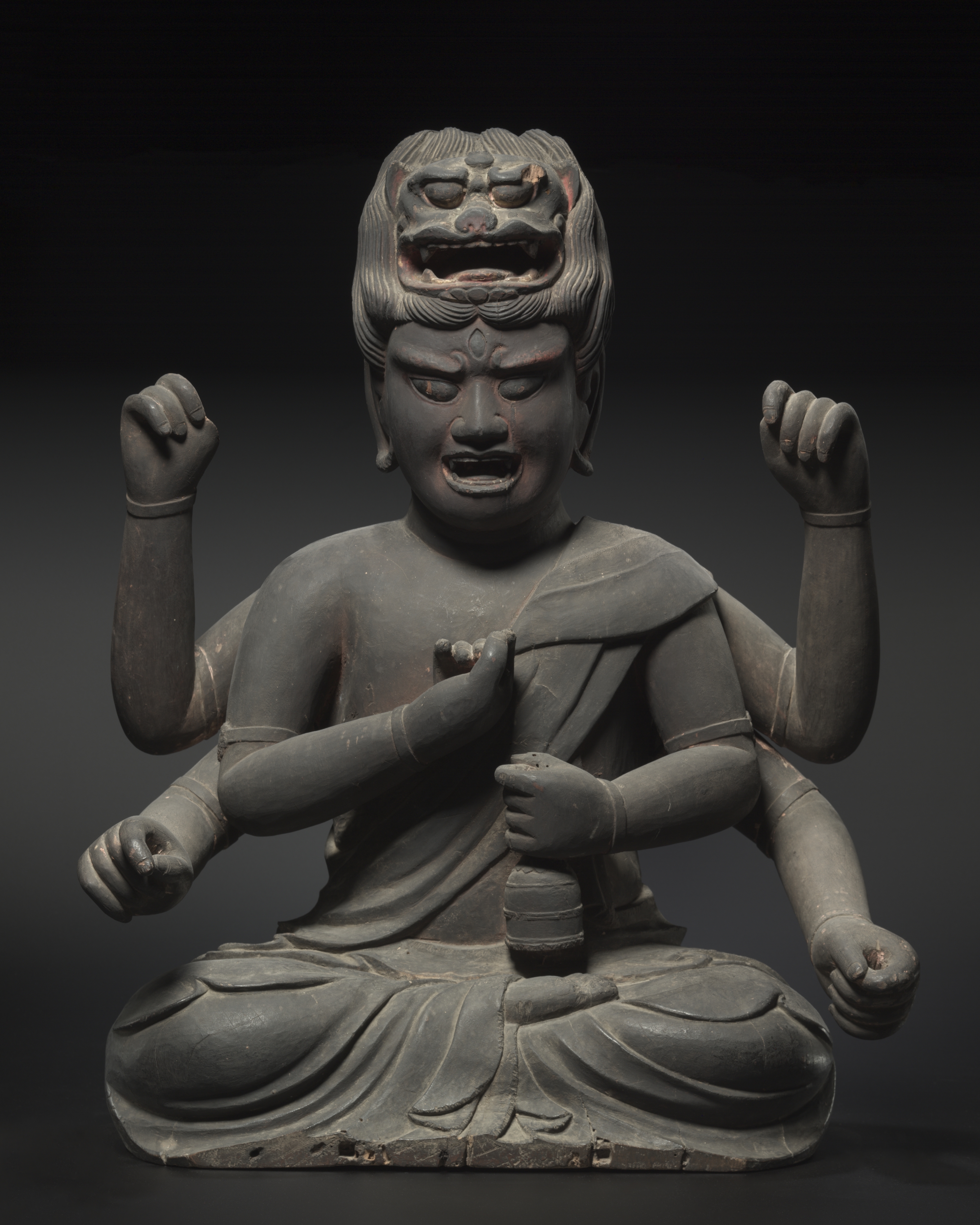
Cleveland 1987.185. The lion crown projecting from the top of the topknot is Aizen's fixed iconographic anchor. The empty hands and missing dais are the conservation losses that the 2017 painting acquisition was meant to address.
The sculpture lost its hands’ implements at some point before 1987. The painting Cleveland bought in 2017 puts them back.
That sentence is the article’s structural claim. Cleveland 1987.185 is an early-fourteenth-century wood Aizen Myōō, 75 centimetres tall, six-armed, with the lion crown on the topknot and the open mouth — all the structural elements of the iconography — but with the hands empty. Every implement Aizen is meant to hold has been lost. The original dais is gone. The figure as it currently stands is iconographically deficient: a recognisable Aizen by its surviving features, but unable to tell the viewer what it is for.
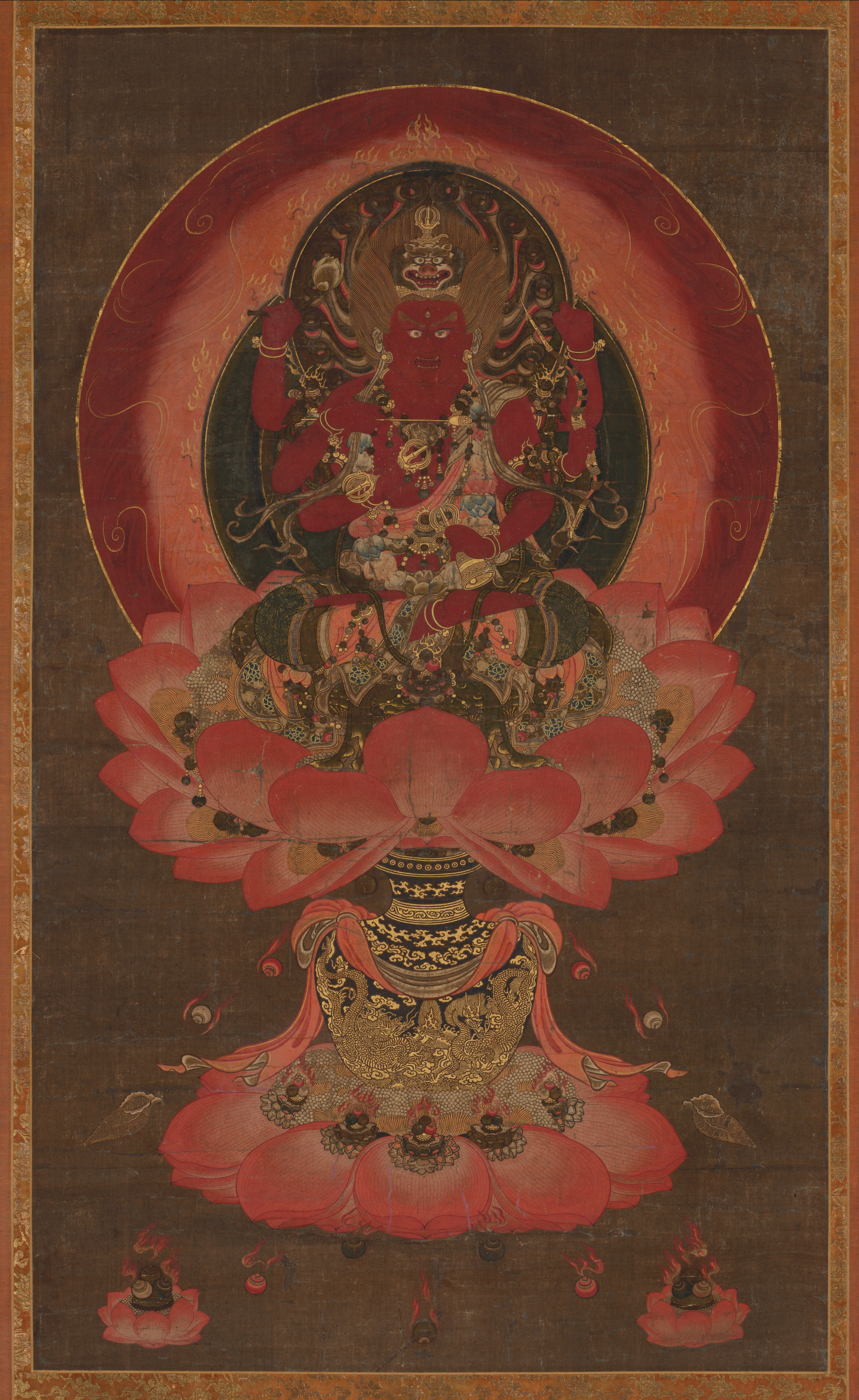
Cleveland 2017.101 is the iconographic key. The hanging scroll, painted within the same century or so as the sculpture, shows the same deity with everything intact: vajra in the primary right, vajra bell in the primary left, bow and arrow in two of the secondary hands, lotus bud in one, threatening fist in the last, lotus throne on a vase from which flaming wish-fulfilling jewels emerge. The painting tells the viewer exactly what the sculpture’s six hands once held, and exactly what it once sat on. Cleveland acquired the painting in 2017 — thirty years after the sculpture’s bequest — for that purpose specifically.
The lion on the head
The fastest way to identify any Aizen Myōō is the small lion projecting from the top of the head. Cleveland 1987.185 preserves it clearly. The lion is part of the iconographic vocabulary that distinguishes Aizen from the other Wisdom Kings: the canonical four — Fudō Myōō, Gōzanze Myōō, Gundari Myōō, Daiitoku Myōō — plus the fifth Kongōyasha Myōō make up the Godai Myōō (Five Wisdom Kings) of the standard Mikkyō pantheon, but Aizen sits outside that core group as a separate sixth or seventh Wisdom King, and the lion crown is one of the visual markers that signals the distinction.
What the lion does iconographically is harder to summarise honestly. Cleveland’s catalog text says the lion holds its mouth open “to devour thoughts and desires.” That is the conventional formulation. The deeper iconographic logic — that Aizen converts the passions (Sanskrit kleśa, Japanese bonnō) rather than destroying them, and that the lion’s open mouth and Aizen’s own open mouth are paired symbols of this conversion — runs through the Mikkyō scholarly literature without a single fixed formulation. The reader who wants the standard Met curatorial framing has it: kings of brightness, the Wisdom Kings as the wrathful protective face of the cosmic Buddhas, the lion-crowned Aizen as the specific channeller of aizen (literally love-dyed) into enlightenment.
Aizen Myōō and the conversion of passion
The doctrinal core is a Vajrayana move that translates poorly. The kleshas — the passions, the so-called defilements — are in most Buddhist frameworks the very things that bind a practitioner to suffering. The Tantric framework that Mikkyō imported into ninth-century Japan does not accept this binding logic. The kleshas are not obstacles to be defeated; they are the raw material from which enlightenment is built. Aizen Myōō, the Wisdom King of Passion, is the iconographic seal of that doctrinal move. The red body is the colour of passion. The six arms hold the instruments of both desire (the bow and arrow, weapons of attraction) and conversion (the vajra and vajra bell, the implements of indestructible wisdom). The lion crown bites through the conventional binding.
This is not a metaphor for sexuality in the pop sense. It is a specific doctrinal claim about how enlightenment is to be reached, and the Mikkyō tradition treats Aizen as one of the deities through whose ritual program a practitioner could perform that conversion. The Met’s curatorial summary on the Wisdom Kings calls this the central Vajrayana adaptation of Buddhism preserved most cleanly in the Aizen iconography. Cleveland’s catalog summary is more cautious — channels carnal desire into a lust for spiritual enlightenment — but the underlying doctrinal point is the same.
The sculpture: Cleveland 1987.185
The sculpture is early fourteenth-century, the catalog gives early 1300s, and the construction technique tells the standard Kamakura wood-sculpture story. The central block — head, torso, legs — is carved from a single piece; the four secondary arms are carved separately and joined to the body at the shoulders. The visible joints at the shoulders confirm the construction; the small attachment holes along the front legs mark where the original lotus dais was joined to the figure. The dais itself is gone. The current wooden support is later and not part of the original work.
The surface is partially preserved. Red pigment passages survive on the chest and face. Black lacquer survives on the hair and on the surviving textile drapery. The exposed wood at the joints and on the lower limbs is what remains where the original polychromy has worn through over seven centuries. The principal right hand once held a vajra; the principal left hand once held a vajra bell; the secondary hands held the bow, arrow, lotus bud, and threatening fist of the canonical six-armed iconography. None of the implements survives. The hands are empty.
What survives in the sculpture is the structural iconography — the six arms, the lion crown, the open mouth, the seated posture, the partial pigment record — without the narrative iconography that would tell the viewer what specific ritual operation the figure performs. The painting acquired thirty years later fills exactly that gap.
The painting: Cleveland 2017.101
The hanging scroll is dated to the same broad early-fourteenth-century window. Cleveland’s catalog gives Kamakura period to Nanbokuchō period, 1300s — a slightly wider date range than the sculpture but overlapping with it. The painting at 102 × 60.5 cm is workshop-grade — ink, color, and gold on silk, with restrained gold passages at the mandorla and along the figure’s body, no extensive cut-gold ornament. The composition fills the silk with the figure and the flaming red-and-gold mandorla; the lotus throne sits on a vase from which flaming wish-fulfilling jewels emerge in clusters at the base.
The six implements are all in place. The principal right hand holds a five-prong vajra. The principal left hand holds the vajra bell. The two secondary upper hands hold a bow and a single arrow. One secondary hand holds a lotus bud. The last is in the threatening fist gesture. The arrangement matches the standard iconographic specification across the Mikkyō Aizen tradition.
What the painting also shows — and what most published descriptions of Aizen Myōō image-types skip — is the dais. The vase from which the flaming jewels emerge is the iconographically correct base for an Aizen Myōō figure: not a plain lotus throne, not a free-floating lotus, but a jeweled vase from which the wish-fulfilling jewels overflow. The Cleveland sculpture’s missing dais was one of these. The 2017 painting is therefore not just an implement key but a dais key.
Eison at Iwashimizu, 1281
The Aizen Myōō iconography that both Cleveland works preserve is the iconography that the Shingon monk Eison (1201–1290) elevated as a defensive ritual program during the 1281 Mongol invasion attempt.
The historical context: Kublai Khan’s first invasion fleet in 1274 was driven back at Hakata Bay before the Mongol forces could make significant inland progress. The second invasion in 1281 brought a much larger fleet — by some accounts the largest amphibious operation in pre-modern history — and the Japanese court responded with a combination of military defensive preparation and ritual defensive preparation. Eison, by then in his late seventies and the founder of the Shingon Risshū lineage at Saidai-ji, was commissioned to perform an Aizen Myōō goma ritual at Iwashimizu Hachiman-gū — the shrine of the kami Hachiman, the war-god of the Japanese imperial line. The ritual was credited by both the court and the warrior government with contributing to the kamikaze (divine wind) that destroyed the Mongol fleet later that year.
David Quinter, in From Outcasts to Emperors: Shingon Ritsu and the Mañjuśrī Cult in Medieval Japan (Brill, 2015), treats the 1281 Iwashimizu ritual as the political-institutional high-water mark of the Shingon Risshū’s medieval career. The iconographic program Eison elevated — six-armed red-bodied Aizen Myōō on the jewel-vase lotus throne, with the full canonical implement set — is the iconography that both Cleveland 1987.185 and Cleveland 2017.101 preserve. The two works are not Eison commissions, and neither one is documented as having come from his Saidai-ji lineage. But they are early-fourteenth-century works in an iconographic register that the late-thirteenth-century Mongol-invasion ritual program had elevated to political-religious centrality.
Sister works, intentionally paired
The pairing is curatorial intent rather than historical fact. The sculpture and the painting were made independently in the early fourteenth century — different workshops, different patronage, different geographic and institutional origins. They came to Cleveland through different routes: the 1987 sculpture via Elizabeth M. Skala’s bequest, the 2017 painting via the J. H. Wade Fund. Cleveland’s curators chose to acquire the painting in 2017 specifically because it would complete the existing sculpture for the viewer.
This is an unusually transparent case of museum logic. Most acquisitions are justified on their own merits — the work matters because it matters. The 2017 Aizen Myōō painting was acquired because another work in the same collection needed it. The catalog text states this explicitly: the painting depicts the implements now missing from the sculpture’s hands, and the type of dais on which the wooden sculpture would have once been placed.
The implication for the viewer: Cleveland 1987.185 and Cleveland 2017.101 should be read together, not separately. They are not a coherent historical pair. They are a curatorially-constructed pair — two early-fourteenth-century Japanese Aizen Myōō works that the museum’s acquisition program decided would serve as iconographic complements to each other in the late twentieth and early twenty-first centuries.
What stays open
Three gaps. The first is the workshop attribution: both works are catalogued without a specific atelier. Comparable Kamakura-period Aizen Myōō sculptures have in some cases been attributed to the Kei school or to Saidai-ji-affiliated workshops; the Cleveland sculpture is not currently placed within any specific workshop tradition in the published catalog. The second is the prior provenance: Cleveland’s records name the bequest and the acquisition fund but not the prior chain. The third is the dating window: early 1300s for the sculpture and 1300s for the painting are both ranges, not points. Closer dating would require pigment analysis on the sculpture’s surviving polychromy and silk-and-pigment analysis on the painting.
These are gaps within a stable iconographic identification, not gaps in the identification itself. The Aizen Myōō reading is fixed by the lion crown, the six arms, the implement set (visible in the painting; reconstructible for the sculpture via the painting), the red body, the jewel-vase lotus throne, and the standard Kamakura wood-sculpture and silk-painting techniques.
Related
Further works cited
- Title
- Wisdom King of Passion (Aizen Myōō) — hanging scroll
- Period
- Kamakura (1185–1333) to Nanbokuchō (1336–92) period, 1300s
- Region
- Japan
- Medium
- Hanging scroll; ink, color, and gold on silk
- Dimensions
- Painting 102 × 60.5 cm; overall with mounting 183.2 × 80.3 cm
- Collection
- Cleveland Museum of Art
- Accession
-
2017.101 - Rights
- Cleveland Museum of Art, 2017.101 — CC0 (Open Access). J. H. Wade Fund.
Cleveland 2017.101. The painting acquired in 2017 specifically to show the implements and dais missing from Cleveland 1987.185. The pairing is curatorial intent, not historical fact: the two works were made independently in the early fourteenth century and brought together by Cleveland thirty years apart in accession.
Sources
-
Cleveland's catalog describes a six-armed seated figure with the lion crown and the open-mouth-devouring-thoughts iconography; construction is the central block (head/torso/legs) plus four separately-carved arms; attachment holes along the front legs mark the original base placement, now missing.
-
Cleveland's 2017 acquisition. The catalog text states explicitly that the painting was acquired to complement 1987.185 — the painting shows the implements now missing from the sculpture's hands and the dais on which the sculpture would have originally been placed. This is one of the more transparent cases of a museum acquiring a work as an iconographic key to a deficient adjacent work.
-
The October 2017 acquisition announcement that frames the painting's purchase as an iconographic complement to the existing 1987 sculpture. The press release names the J. H. Wade Fund as the acquisition source.
-
Standard English-language curatorial overview of the Myōō group iconography. Aizen as the *Wisdom King of Passion* — *aizen* literally meaning *love-dyed* — channels the Tantric doctrine that the kleshas (passions) are not obstacles to enlightenment but the raw material from which enlightenment is forged. Met treats this as one of the key Vajrayana doctrinal moves preserved most cleanly in the Aizen iconography.
-
Standard reference for the Sanskrit Rāgarāja / Japanese Aizen Myōō pairing. The six arms are canonical: primary right vajra, primary left vajra bell, two for the bow and arrow, one for the lotus bud, one for the threatening fist. Body red; lion crown; flaming mandorla; lotus-throne-on-vase-with-wish-fulfilling-jewels base. The iconography is stable across the Japanese tradition from the Kamakura period forward.
-
Quinter's monograph treats the Shingon Risshū revival and the institutional career of Eison (1201–1290) in detail. The 1281 Mongol-invasion goma ritual at Iwashimizu Hachiman-gū is treated as the political-institutional high-water mark of the Shingon Risshū's relationship with the court and the bakufu. The Aizen Myōō iconography that Eison's ritual program elevated is the same iconography that the Cleveland works preserve.
-
Standard reference for Eison's dates and institutional position. Founder of the Shingon Risshū lineage at Saidai-ji; performed defensive rituals at Iwashimizu Hachiman-gū in 1281 during the second Mongol invasion attempt; the ritual program elevated Aizen Myōō as a defensive-tutelary deity for the medieval Japanese polity.
-
Princeton's digital project on the Takezaki Suenaga *Mōko shūrai ekotoba* (Illustrated Account of the Mongol Invasion) — useful for the 1274 / 1281 historical context that frames the Eison Aizen ritual.