Kanshitsu: the Tenpyō dry-lacquer technique
- Title
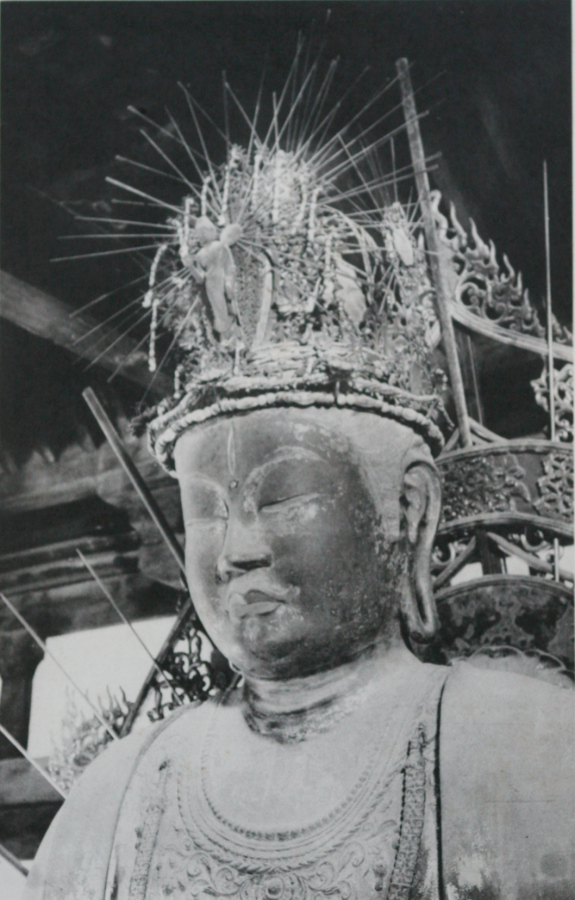
- Fukūkenjaku Kannon (不空羂索観音坐像) — Tōdai-ji Hokke-dō, the canonical *dakkatsu-kanshitsu* specimen
- Period
- Nara period, Tenpyō, c. 747 (746 in some sources)
- Region
- Yamato / Nara
- Medium
- *Dakkatsu-kanshitsu* (hollow dry-lacquer): clay core, lacquer-soaked cloth wound and hardened, then the core removed; *kokuso-urushi* finishing layer for surface modelling. Originally polychromed and gilt; silver Amida figure in the crown
- Dimensions
- 362 cm seated
- Collection
- Tōdai-ji Hokke-dō (Sangatsudō), Nara
- Accession
-
Hokke-dō principal honzon - Rights
- Public domain (PD-Japan-oldphoto). Photograph by Ogawa Seiyō (小川晴暘, 1894–1960), February 1933, published in *Asukayen, Histoire des Beaux-Arts Japonais — Tōyō-bijutsu* Special Issue 4 (Asukayen, Nara). Source: Wikimedia Commons.
The canonical *dakkatsu-kanshitsu* specimen: Tōdai-ji Hokke-dō Fukūkenjaku Kannon (c. 747), 362 cm. The hollow dry-lacquer technique — clay-core construction, lacquer-soaked cloth layering, *kokuso-urushi* finishing — at full Tenpyō workshop scale. Ogawa Seiyō plate, 1933.
Kanshitsu (乾漆, “dry lacquer”) is the Tenpyō (8th c.) construction technique that produced the Tōdai-ji Hokke-dō programme. Dakkatsu-kanshitsu uses a clay core, lacquer-soaked cloth wound and hardened, then the core removed. Mokushin-kanshitsu uses a wooden core that stays in place. The technique enables surface modelling impossible in wood — the Hokke-dō Fukūkenjaku and Kōfuku-ji Hachibushū are the canonical surviving examples.
What kanshitsu solves
If yosegi-zukuri is the technique that solves the cypress drying-crack problem at scale, kanshitsu is the technique that solves the surface modelling problem.
Wood is, by its nature, a subtractive medium. The carver removes material; the final surface is a function of where the chisel stopped. Surface texture in wood comes from chisel-mark choices, plane planning, and post-carving lacquer-gesso (kokuso urushi) build-up. The fineness of the modelling is constrained by the woodgrain and the carver’s blade.
Lacquer is, by its nature, an additive medium. Layer by layer, the surface builds up. Each layer dries to a hard, non-porous finish that takes the next layer cleanly. Surface texture can be modelled to any fineness the artisan can control — eyebrow ridges, lip-corner expressions, cloth-fold creases, the modelled musculature of an arm. The lacquer technique offers a degree of expressive surface modelling that wood cannot match.
The trade-off is that lacquer alone has no structural body. A figure has to have something inside the lacquer that gives it the volume and weight to hold its form. The two principal kanshitsu variants differ in what that inside body is.
Dakkatsu-kanshitsu
Dakkatsu-kanshitsu (脱活乾漆) — “hollow dry-lacquer” — is the technique deployed at full Tenpyō workshop scale. The mechanics:
- The figure is modelled in clay at full scale. The clay is built up over an internal armature (typically wood or metal). The clay model carries the full sculptural detail at the surface modelling resolution the workshop intends.
- The clay surface is wound with multiple layers of cloth soaked in lacquer. Each layer dries; the next is applied over it. The build-up typically runs 8–15 layers, depending on the figure’s scale and the workshop’s preference.
- Once the lacquer-cloth shell is hard, the clay core is removed through an opening in the back or base of the figure. The figure is now hollow, with the lacquer-cloth shell holding the form.
- Surface details are applied using kokuso-urushi (木屎漆) — a paste of lacquer, flour, and wood powder. The kokuso allows fine surface modelling that is more refined than the lacquer-cloth shell alone.
- The figure is finish-coated with additional layers of pure lacquer; pigments may be mixed into intermediate layers; the final surface receives gold leaf or polychrome painting.
The hollow construction has the same internal-cavity advantages that yosegi-zukuri later exploits: lighter weight, internal-dedication space, structural distribution. But the surface achievable on dakkatsu-kanshitsu is more refined than on any wooden technique that follows.
Mokushin-kanshitsu
Mokushin-kanshitsu (木心乾漆) — “wood-core dry-lacquer” — is the late-Tenpyō and early-Heian variant where the wooden armature is itself the figure’s structural body, with kanshitsu lacquer applied as the surface-modelling medium.
The mechanics:
- The figure is roughly carved in wood at full scale. The wooden core carries the principal volumes (head, torso, limbs) but does not carry fine surface detail.
- The wooden core is wrapped in lacquer-soaked cloth in selective passages — typically the principal expressive surfaces (face, hands, primary drapery).
- Surface detail is applied with kokuso-urushi over the cloth layers and over the bare wood passages.
- The figure is finish-coated in the same way as dakkatsu work.
Mokushin reduces the lacquer cost and the workshop time relative to dakkatsu. The wooden core is significantly faster to produce than a clay core wound with 8–15 lacquer layers and then de-cored. As lacquer became scarce and expensive in the late-Tenpyō period, mokushin became the more practical option. The Heian-period Buddhist sculpture corpus is dominated by ichiboku-zukuri and later yosegi-zukuri in pure-wood construction; the kanshitsu technique itself goes into decline as a primary construction method, surviving mostly as a finishing technique for selected high-value commissions.
The Tenpyō workshop scale
The kanshitsu technique requires a particular workshop infrastructure. Lacquer must be tapped from cultivated trees, refined, stored, and used within a working window. The cloth must be sized and cut. The clay must be sourced, conditioned, and disposed of. The pigments and gold leaf must be supplied. Each step is more cost-and-labour-intensive than the equivalent step in pure wood construction.
What allows the technique to scale, in 8th-century Yamato, is the institutional Tenpyō workshop. The Tōdai-ji project under Emperor Shōmu (r. 724–749) and the broader Nara-period state-Buddhist programme provided the patronage, the labour, and the materials at the scale required. The Shōsō-in repository at Tōdai-ji preserves the inventory record of lacquer, pigments, gold leaf, and cloth supplied to the temple workshops — a documentary anchor for the institutional context.
The 746 dating of the Hokke-dō programme is the canonical Tenpyō kanshitsu reference. The 3.62 m Fukūkenjaku Kannon, with its silver halo of ornament, three eyes, and eight arms, is the technique deployed at the upper register of Tenpyō workshop ambition. The flanking Bonten (Brahmā) and Taishakuten (Indra), also dakkatsu-kanshitsu, are the supporting figures in the same Hokke-dō programme.
The Kōfuku-ji Hachibushū
Slightly earlier than the Tōdai-ji Hokke-dō programme, the Kōfuku-ji Eight Heavenly Beings (Hachibushū, 八部衆) — dated to 734 per the Saidai-ji engi — represent the most extensive surviving kanshitsu corpus in a single hall. Eight figures include Ashura (with three faces and six arms), Karura (the garuḍa bird-king), Kinnara (the celestial musician), Mahōraga (the serpent-king), and four others.
The Kōfuku-ji Ashura is among the most-photographed works in Japanese Buddhist sculpture — three faces with subtly different expressions, six arms holding ritual implements, the slender adolescent body modelling that is achievable in dakkatsu-kanshitsu but not in wood. The technique-modelling-finer-than-wood claim is most directly demonstrable in the Ashura’s facial detail, which carries cheek-modelling, lip-corner expressiveness, and eye-socket sculpting at a resolution wood would force the carver to compromise on.
The Tang precedent
Like virtually every Tenpyō technical innovation, kanshitsu is not a Japanese invention. The technique arrives via the Tang Chinese workshops that the Tenpyō court was in active diplomatic exchange with through the 8th century.
The Tang technique itself derives from earlier hollow-cast bronze conventions and Chinese funerary lacquerware. The Korean kingdoms (Silla in particular, by this date) served as a secondary intermediation route.
The dakkatsu-kanshitsu technique reaches Yamato in the late-7th and early-8th century via these continental routes. By the 720s and 730s, Yamato workshops are producing canonical kanshitsu work (the Kōfuku-ji Hachibushū 734); by the 740s, the technique is at full deployment scale (the Tōdai-ji Hokke-dō programme 746).
This places kanshitsu in the same trans-cultural-transmission pattern that every Japanese Buddhist technique up through Heian shares. The Tenpyō moment is the Tang-precedent reception at peak workshop ambition; the Heian and Kamakura periods read as Yamato adaptation of the Tang inheritance.
Where this technique sits
Kanshitsu is the dominant Tenpyō construction method, and the Tenpyō moment is the most luxuriously surfaced sculpture in Japanese history. The Hokke-dō programme and the Kōfuku-ji Hachibushū are the surviving canonical references; the surface modelling at this scale and refinement does not return to Japanese Buddhist sculpture later.
The technique declines through the Heian period as lacquer costs rise, court patronage shifts, and the ichiboku-zukuri / warihagi-zukuri / yosegi-zukuri wood-construction trajectory takes over. By the Kamakura period, kanshitsu survives mostly as a finishing technique for selected high-value commissions, not as a primary construction method.
A reader visiting the Tōdai-ji Hokke-dō, the Kōfuku-ji Hachibushū hall, or the Tenpyō galleries at the Tokyo or Nara National Museums is, in technique-historical terms, looking at an 8th-century continental import deployed at peak Yamato workshop ambition — a workshop infrastructure that 1,300 years of subsequent Japanese Buddhist sculpture never reproduced. The Tenpyō surfaces are anomalous in that sense: more luxurious than anything later, by a wide margin, because the institutional and material conditions that made them possible never recurred.
Related
- Yakushi and the Twelve Generals — a Kamakura medicine triad
- Fukūkenjaku Kannon: lasso and three-eyed — the canonical kanshitsu work at the Tōdai-ji Hokke-dō, treated at single-work-study depth.
- Yosegi-zukuri: the multi-block construction that scales — the Heian wood-construction technique that succeeds kanshitsu as the dominant Japanese Buddhist sculpture method.
- Asuka transmission: Tang precedent into Yamato — the institutional-historical foundation that the Tenpyō kanshitsu workshop builds on.
Sources
-
The single most-cited kanshitsu work. ~362 cm dry-lacquer figure, 746 dating. Bodhi covers this work in dedicated entity primer (figures/fukukenjaku-kannon) and single-work-study article (fukukenjaku-kannon-lasso-three-eyed). The dakkatsu-kanshitsu technique deployed at full Tenpyō workshop scale
-
Eight figures including Ashura, Karura, Kinnara, Mahōraga. Dakkatsu-kanshitsu. Tenpyō workshop output dated to 734 per the Saidai-ji *engi*. The most extensive surviving kanshitsu corpus in a single hall. The Ashura figure is among the most-photographed works in Japanese Buddhist sculpture
-
Brahmā and Indra attendant figures flanking the Fukūkenjaku Kannon in the Hokke-dō. Dakkatsu-kanshitsu. The full Hokke-dō programme is the canonical surviving Tenpyō kanshitsu hall
-
Holds the documentary record of Tōdai-ji workshop construction including kanshitsu materials. The Tenpyō-period workshop infrastructure cross-references the Shōsō-in inventory of lacquer and pigment supplies
-
Standard English-language survey. Tenpyō chapter covers the Hokke-dō programme, the Kōfuku-ji *Hachibushū*, and the dakkatsu-kanshitsu technique. Cited at work level.
-
Foundational Japanese-language scholarship. Technical-mechanical analysis of the dakkatsu-kanshitsu and mokushin-kanshitsu sequence. English reception via Mason
-
Anchors the Tang Chinese kanshitsu precedent — the technique arrived from Tang workshops via diplomatic transmission to Tenpyō Yamato. Cited at work level.
-
Cross-checked technical specifics: clay core modelling, multiple lacquer-soaked cloth layers, kokuso-urushi finishing, gold-leaf application
-
Cross-checked dating, programme identification, the dakkatsu-kanshitsu construction summary
-
Cross-checked the Tang Chinese precedent (the Tang technique itself derives from earlier hollow-cast bronze conventions and Chinese funerary lacquerware), the Korean intermediation, the Tenpyō Japanese deployment