Yakushi and the Twelve Generals: a Kamakura medicine triad
- Title
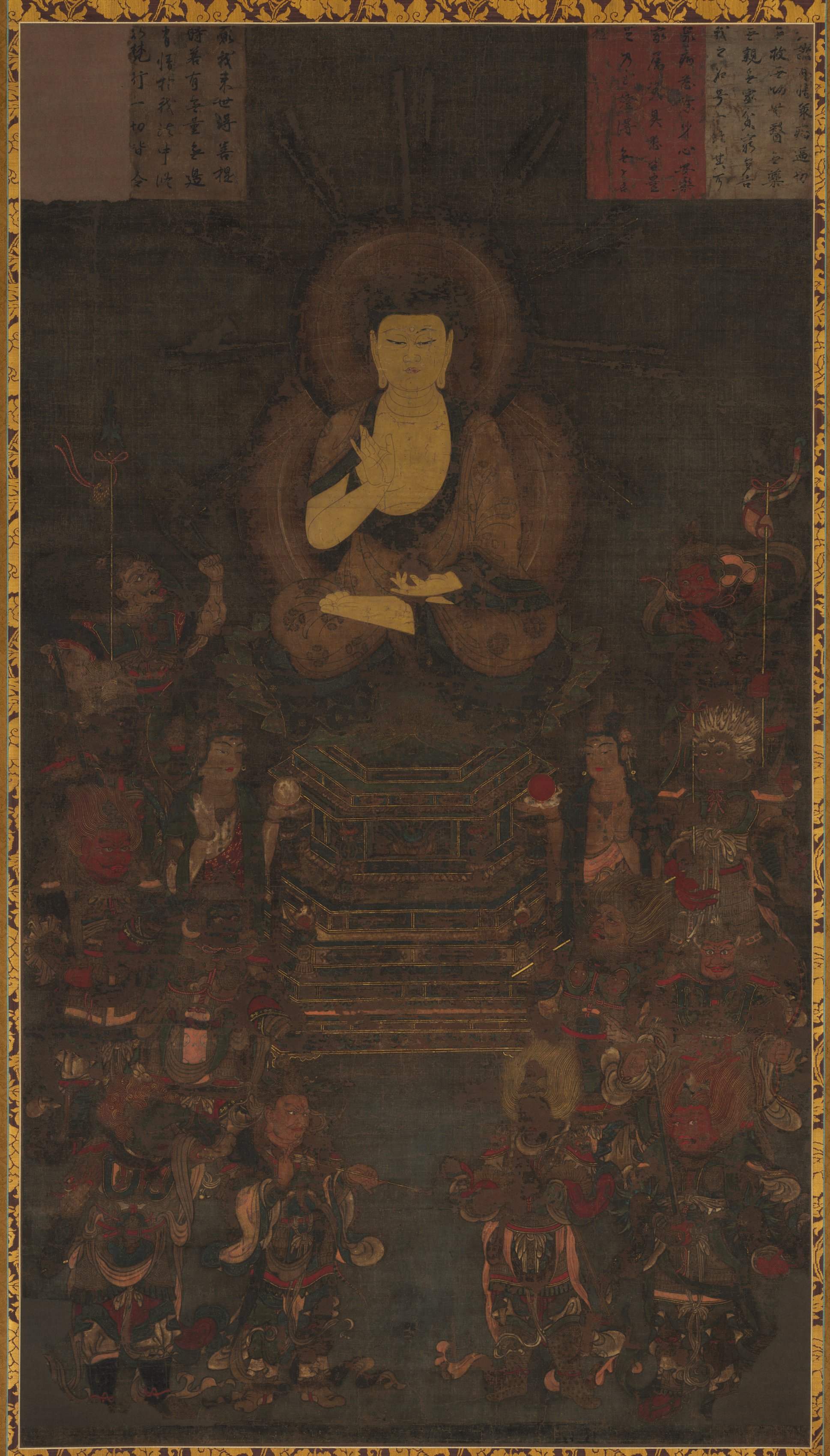
- Medicine Master Buddha (Yakushi Nyorai) and the Twelve Divine Generals — Cleveland 1938.422, Kamakura 1200s
- Period
- Kamakura period (1185–1333), 1200s
- Region
- Japan
- Medium
- Hanging scroll; ink, color, gold, and silver on silk
- Dimensions
- Image: 151.2 × 84.1 cm (59 1/2 × 33 1/8 in.). Overall: 261 × 106.6 cm (102 3/4 × 41 15/16 in.). With knobs: 261 × 113.3 cm (102 3/4 × 44 5/8 in.)
- Collection
- The Cleveland Museum of Art
- Accession
-
1938.422 - Rights
- Cleveland Museum of Art (Public Domain / CC0). Edward L. Whittemore Fund, 1938.422.
Cleveland 1938.422: the canonical Yakushi triad-with-twelve-generals programme on silk, 1200s. Yakushi at centre holds the medicine jar; Nikkō and Gakkō flank; the twelve generals carry zodiac animals on their crowns. Inscription cartouches transcribe the Bhaiṣajyaguru vow.
Look at the left hand first. It rests on Yakushi’s lap, palm up, holding a small covered jar. The jar is what disambiguates this seated Buddha from every other seated Buddha in Japanese painting. The Amida triad has the same lotus throne, the same flanking attendants, the same mandorla. Yakushi has the jar.
The jar in Cleveland 1938.422 is small enough that a quick viewer might miss it. The painter, in 1200s Kamakura, did not miss it: the jar is rendered in clear gold pigment against the gold-rendered robe, with a faint dark line tracing the lid. It is the iconographic anchor for the entire programme. Everything else in the painting (the sun-and-moon attendants, the twelve armed generals, the inscription cartouches at the top) exists because of what is in that jar.
The medicine jar
The jar holds the yakushi-tsubo: the medicine container that names the Buddha. In the Sanskrit, Bhaiṣajyaguru, “Medicine Master.” In the Japanese, Yakushi Nyorai (薬師如来), same meaning, different language. The compound that forms his full Sanskrit title, Bhaiṣajyaguru-vaiḍūrya-prabha-rāja, means “Medicine Master and King of Lapis Lazuli Light.” The lapis-lazuli marker is why early Chinese Yakushi paintings sometimes give him a blue-tinged body; the Cleveland painter has chosen the more common gold body of the Kamakura register.
The right hand is held forward in the abhaya-mudrā, the gesture of fearlessness. The combination of abhaya right and medicine-jar left is the standard Yakushi posture in painted-triad form across East Asia. Other Buddhas in seated form use other combinations (Shaka usually has the earth-touching bhūmisparśa mudra, Amida the contemplation dhyāna mudra or the welcoming descent raigō-in). The Yakushi-specific combination is read first; everything else in the painting reads second.
Sun, moon, and the twelve who guard him
Nikkō Bosatsu (日光菩薩, the Sun Bodhisattva) stands on a lotus pedestal at Yakushi’s right side; Gakkō Bosatsu (月光菩薩, the Moon Bodhisattva) on a lotus pedestal at his left. The trio is the Yakushi sanzon: the canonical Yakushi triad. Each attendant carries a halo, hands in attendant gestures (one raised, one held lower), robes worked in the same gold-and-pigment register as Yakushi’s. Their identifying attributes are conventional rather than spectacular: Nikkō traditionally carries a solar disk, Gakkō a lunar disk, but in many painted triads (Cleveland 1938.422 among them) the attendant figures are differentiated mainly by the iconographic position and the slight differences in hairstyle and robe-pattern.
The twelve Divine Generals (十二神将, Jūnishinshō) are the working register of the painting. They are arrayed around the triad in armed and armoured fighting poses, distributed in two vertical files at left and right and two horizontal registers at top and bottom. Each general bears a weapon (sword, halberd, spear, club, bow) and each has at the crown of his head one of the twelve animals of the Sino-Japanese zodiac: rat, ox, tiger, hare, dragon, serpent, horse, ram, monkey, cock, dog, boar.
Each general embodies one of Yakushi’s twelve vows. The Bhaiṣajyaguru-sūtra enumerates the vows specifically: the vow to grant beings perfect form, the vow to heal illness, the vow to free beings from hunger and thirst, the vow to clothe the naked, the vow to liberate prisoners, and so on. The painters did not need to inscribe the correspondence: the convention is fixed enough that a Kamakura viewer would have read the general at the upper-left position as the general of the first vow without needing a label.
Vows wearing armour, zodiac heads
The pairing of vow and zodiac animal is older than Japan. The earliest documented instance is in Cave 220 of the Dunhuang complex on the Silk Road, dated 642 CE, where the twelve generals appear in a Yakushi Pure Land tableau with the twelve zodiac animals already attached to their crowns. The iconography is therefore Tang-period Chinese (its Indian Buddhist sources are textual rather than visual), transmitted into Japan with the great Yakushi-cult expansion of the late 7th and 8th centuries.
The canonical Japanese in-situ sculptural reference is Shin-Yakushi-ji in Nara, where twelve life-sized clay generals from the Tenpyō period stand in a ring around the Yakushi honzon. The Cleveland 1938.422 generals carry that programme forward in two-dimensional form: the armour, the dynamic fighting poses, the zodiac crowns are all there, but distributed across a vertical hanging-scroll picture plane rather than around a circular sculptural space.
The Kamakura painter has had to solve a compositional problem: twelve full-bodied armed figures plus a seated triad plus inscription cartouches do not naturally compose in a vertical 151 × 84 cm field. The solution is the two-vertical-file plus two-horizontal-register layout, with the most aggressively-posed generals at the top corners and the most reverent at the bottom. The eye reads down through the triad, encounters the generals as a peripheral protective ring, and stops at the lower edge, where the protective programme is most active and most reassuring.
The inscription cartouches and the Yakushi sutra
Three rectangular cartouches at the upper edge of the painting are drawn to look like decorative paper inscription slips affixed to the silk. Their contents are passages from the Bhaiṣajyaguru-sūtra: specifically from the section that names Yakushi’s vow that those who invoke his name and dedicate themselves will recover from illness.
The text-on-painting move is part of the long Pure Land tradition of integrating sutra extract and devotional image, but it is more characteristic of Yakushi paintings than of Amida ones. Yakushi’s textual programme is specific and practical: the believer is expected to recite the Yakushi Hongan Kudokukyō (薬師本願功徳経), the Japanese title of Xuanzang’s 7th-century Chinese translation, with the painted image as visual focus. Where the Amida raigō painting visualises an event (descent), the Yakushi painting visualises a vow-state: what Yakushi is rather than what he is doing in this instant.
The inscription cartouches therefore work less as text-blocks to be read than as iconographic markers that the painting contains the sutra it is paired with. The cartouche script is small enough that a viewer in a temple setting would have to approach the silk to read it; which is appropriate, because the inscription’s function is presence, not legibility.
From Boston 1916 to Cleveland 1938: the Warner chain
The Cleveland catalog records the provenance as Joseph Bangs Warner (Boston, by 1916) → Langdon Warner → Cleveland Museum of Art (1938). The 1916 entry is the painting’s first appearance in the Western public record: Joseph Bangs Warner lent it to Cleveland’s Inaugural Exhibition, when the museum opened on June 6, 1916.
Joseph Bangs Warner (1849–1922) was a Boston attorney and collector with substantial Japanese holdings, part of the broader Boston-school cohort of Japanese-art collectors active around the turn of the 20th century. The painting passed from his estate to Langdon Warner (1881–1955), the Harvard-trained art historian who taught Harvard’s first courses in Japanese and Chinese art, served as adviser on Asian art to the Nelson-Atkins Museum (1930–1935), and is associated with the post-war “saved Kyoto and Nara” mythology: the claim, contested by historians, that his advocacy spared major Japanese cultural sites from Allied bombing.
Langdon Warner was the conduit through which a substantial body of Japanese Buddhist painting and sculpture entered American museum collections in the first three decades of the 20th century. Cleveland’s 1938 acquisition through the Edward L. Whittemore Fund (itself a major Cleveland Asian-art mechanism named for the Whittemore Trust) placed the 1938.422 painting in the institution that would house it for the next nine decades.
Tokyo, 1997–1998
The Cleveland catalog records that the painting was sent to Japan for restoration in 1997, returning in 1998. The work was undertaken at what the catalog calls the Tokyo National Research Institute, the Tōkyō Bunkazai Kenkyūjo (東京文化財研究所), the principal Japanese government institution for cultural-property conservation research, in Ueno.
International conservation loans of this kind are administratively non-trivial: the painting traveled internationally for the restoration, was studied with Japanese conservation-science methods (multi-spectral imaging, fiber analysis, pigment identification by non-destructive methods), and returned with a Japanese conservation-record file that the Cleveland Asian-art curatorial team now holds alongside the catalog record.
The painting subsequently re-emerged in 2014 in the Admired from Afar exhibition at Tokyo and Fukuoka: its first major showing in Japan since the 1997–1998 conservation. It rotated through Cleveland’s Gallery 235 (Japanese) twice in the 2010s and early 2020s (2016–2017 and 2021–2022) but is currently not on view.
What stays open
The exact text of the three inscription cartouches at the top of the painting is not transcribed in the public catalog record. A careful reading (high-resolution Cleveland Open Access imagery permitting) would identify which specific passages of the Bhaiṣajyaguru-sūtra are quoted, which translation lineage they follow (Xuanzang’s Chinese is the standard, but other translations existed), and whether the cartouches preserve any donor or temple name.
The temple of origin is not recorded. The painting almost certainly came out of a working temple at some point in the late 19th century: the great Meiji-era haibutsu kishaku (suppression of Buddhism, 1868–1873) caused many such paintings to leave their temples and enter the private and dealer market. The 1916 first-appearance with Joseph Bangs Warner is therefore the end-point of an unrecorded earlier movement.
The Cleveland 1997–1998 conservation record is the densest unsurfaced research file. The Tokyo Bunkazai Kenkyūjo report would contain pigment analysis, support-fiber identification, repair history, and possibly conservation-period photographs that would deepen the article substantially.
A direct comparison with the closely related Yakushi-with-twelve-generals paintings at Boston Museum of Fine Arts and at Daigo-ji and Daikōmyō-ji in Kyoto (the closest stylistic and iconographic comparanda for Cleveland 1938.422) has not been published in English. The comparative programme is a clear open scholarly opportunity.
Related
For the twelve generals as a corpus-level iconographic programme, see Yakushi and the twelve heavenly generals: protective programme reading. For the painted Nikkō/Gakkō attendant pair in three-dimensional form, see Cleveland 1961.48 Nikkō Bosatsu. For the Cleveland Tenpyō dry-lacquer Bodhisattva head that pairs as the institution’s other Nara-period Yakushi-attendant survivor, see Cleveland 1982.264 Tenpyō Bodhisattva head. For the Tenpyō technique and the Tōdai-ji Hokke-dō honzon programme that supplies the iconographic register, see Kanshitsu: Tenpyō dry-lacquer technique. For the kirikane surface technique applied to the Kamakura painted Yakushi mandorla, see Kamakura bodhisattva kirikane.
Sources
-
Cleveland catalog. Confirms: accession 1938.422; 1200s Kamakura; hanging scroll, ink color gold and silver on silk; image 151.2 × 84.1 cm; overall 261 × 106.6 cm; Edward L. Whittemore Fund. Curatorial text: Yakushi Nyorai in meditative pose, right hand bestowing fearlessness, left hand holding a medicine jar, flanked by the bodhisattvas of the sun and moon Nikkō and Gakkō, with the Twelve Divine Generals around. Did-you-know: each of the Divine Generals has an identifying zodiac animal in his hair or headdress. Provenance: Joseph Bangs Warner (Boston, MA; by 1916–?) → Langdon Warner (sold to museum, ?–1938) → Cleveland (1938–present). Exhibition history: Inaugural Exhibition 1916; Exhibition of the Month: Herbs in Art 1953; restoration at Tokyo National Research Institute 1997–1998; *Admired from Afar* Tokyo and Fukuoka 2014; Cleveland Gallery 235 rotations 2016–2017 and 2021–2022.
-
Machine-readable record. Confirms: CC0 public domain; image URLs 1938.422_web.jpg, 1938.422_print.jpg, 1938.422_full.tif; dating 1185–1333 with 1200s most likely; technique 'Hanging scroll painting; ink, color, gold, and silver on silk'.
-
Encyclopedic synthesis. Confirms: Bhaiṣajyaguru-vaiḍūrya-prabha-rāja, 'Medicine Master and King of Lapis Lazuli Light.' Twelve great vows of Yakushi enumerated in the *Sūtra of the Vows of the Medicine Buddha of Lapis Lazuli Crystal Radiance* (藥師琉璃光如來本願功德經), translated from the Sanskrit by Xuanzang (596–664 CE). The text is the doctrinal foundation for the twelve-generals iconography.
-
Encyclopedic synthesis. Confirms: Langdon Warner (1881–1955), Harvard class of 1903 with specialty in Buddhist art, taught Harvard's first courses in Japanese and Chinese art, advisor to the Nelson-Atkins Museum 1930–1935. Field trips to Asia from the early 20th century. The post-war 'saved Kyoto and Nara' mythology is documented though contested by historians.
-
bodhi's canonical cross-object reading of the Jūnishinshō programme. This Cleveland 1938.422 article does not re-cover the twelve-generals iconographic programme in full; the cross-link is the primary reference.
-
bodhi's Cleveland Heian Nikkō Bosatsu article. The Nikkō/Gakkō attendant pair in 1938.422 is the painted counterpart of the Cleveland 1961.48 sculpted attendant.
-
Practical iconographic key. Cited for the Yakushi attribute set (medicine jar, abhaya mudra), the Nikkō-Gakkō attendant convention, and the differentiating marks of Yakushi from Amida and Shaka in painted triad form.
-
Reference for the canonical in-situ Shin-Yakushi-ji Tenpyō-period clay generals (8th century), the sculptural reference programme that the Cleveland painting carries forward in two-dimensional form. The Shin-Yakushi-ji generals are National Treasures; their proportions, armour, and pose-vocabulary establish the iconographic register.
-
Reference for the Tōkondō Yakushi triad at Kōfuku-ji (originally Nara period; current image is a Kamakura replacement). One of the canonical in-situ sculptural reference points for the Yakushi-with-Nikkō-and-Gakkō painted triad type.