Kannon Kakebotoke: a Nanbokuchō hanging-Buddha plaque at Cleveland (1985.16)
- Title
- Votive Hanging with Image of Kannon (Kannon Kakebotoke) — 観音懸仏
- Period
- Nanbokuchō period (1336–92), mid- to late 1300s
- Region
- Japan
- Medium
- Bronze with repoussé and etching
- Dimensions
- Diameter 52.5 cm (20 11/16 in.)
- Collection
- Cleveland Museum of Art
- Accession
-
1985.16 - Rights
- CC0 (Cleveland Open Access). Leonard C. Hanna Jr. Fund 1985.16.
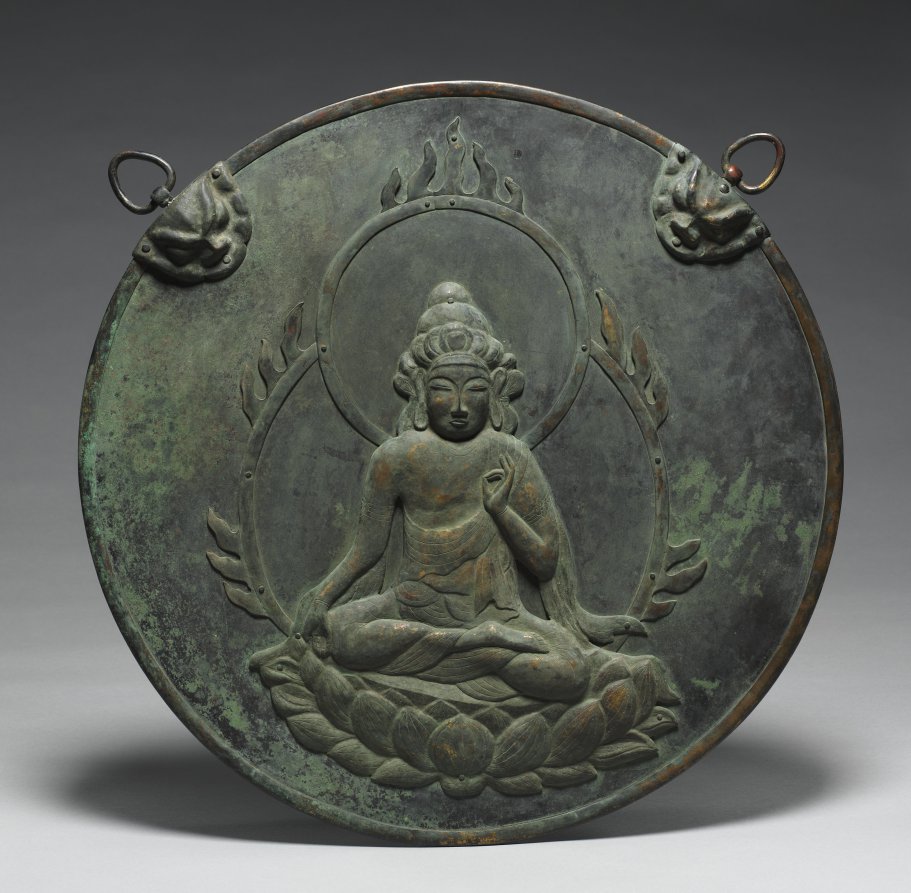
Bronze kakebotoke with seated Kannon in repoussé relief; Nanbokuchō period (1336–92), mid- to late 1300s; diameter 52.5 cm. The two animal-faced suspension cartouches at the upper edge mounted the disc against a shrine door or temple eave (per Cleveland's catalog), where it materialized the Buddhist honji of the kami enshrined inside or the deity celebrated there. CC0 (Cleveland Open Access).
Cleveland 1985.16 is a circular bronze kakebotoke (懸仏, “hanging Buddha”) from Nanbokuchō Japan, mid- to late 1300s. The repoussé Kannon at its centre is the Buddhist honji of a Shintō kami once enshrined behind it; tens of thousands of these shrine-mounted plaques were stripped from sanctuaries by the Meiji shinbutsu bunri edicts of 1868.
What the disc actually shows
The object is a circular bronze plate, 52.5 cm in diameter, oriented vertically, with two iron suspension rings at the upper edge.
The rings are mounted on cast cartouches that carry small animal-like faces — Cleveland’s catalog text describes the rings as “featur[ing] animal-like faces” rather than as the lotus-leaf cartouches the prior reading mistook them for, and a close look at the published photograph confirms the cartouches are zoomorphic (the rendering reads as lion-or-dragon-mask hardware, the kind of small protective-creature face that medieval Japanese metalwork often carries on functional fittings).1
The disc is bordered by a low integral rim. The whole surface has oxidized to a heavily mottled green-grey verdigris, with the warmer bronze ground showing through where the patina has thinned at the high points of the relief and at the flat field around the figure. The central figure is worked in repoussé from the back so that the relief stands proud of the ground by perhaps a centimetre at its deepest passages.2
The figure is a seated bodhisattva in princely form: a tall multi-lobed crown topped by a forward-leaning jewel finial, shoulder-length wavy hair falling in a characteristic three-strand pattern across each shoulder, a smooth bare torso with a sash crossing the right shoulder, the left hand raised at chest-height in vitarka mudra (thumb and middle finger touching, the remaining fingers extended), and the right hand resting low on the right thigh.
The hand-configuration is an iconographic correction from prior readings of this work: Cleveland’s catalog explicitly identifies the raised vitarka hand as the left and the resting hand as the right, and the published photograph confirms it.3
The figure is cross-legged in full lotus on a multi-tiered open lotus throne whose petals splay outward in two layered rings. Behind the head sits a thin circular ring halo, from which three stylized flame-emanations rise: a central tall flame above the crown and two lateral wing-like flame-arrays extending outward to the figure’s left and right.
The halo and flames read as a single integrated unit (a thin ring with stylized flames, in Cleveland’s phrasing), not as a halo plus a separate oval kōhai aureole.
Two structural details are worth slowing down on. First, the suspension hardware is heavy and intentional. The iron rings are mounted to take the weight of the 52.5 cm disc, and the animal-faced cartouches that anchor them are themselves cast or repoussé elements integral to the object rather than soldered fittings. The disc was made to hang, and the hanging is part of the iconography rather than a later modification.
Second, the etched lines that finish the figure (the hair, the lotus petal-veins, the flame-tongues, the eye and mouth contours) are visibly tooled rather than cast — a chasing pass over the repoussé ground that sharpens the figure without adding much depth.4 The result is a low-relief icon designed to read clearly from a distance of two or three metres in the dim interior of a shrine sanctuary or under a temple eave, where the verdigris would have read as bronze and the etched lines as the diagnostic.
What the disc is not is a free-standing sculpture. The form is honest about its function: it is a wall-object, an icon-as-medallion, a flat round read in elevation against the surface it was hung against.
At 52.5 cm diameter the Cleveland piece is a substantial mid-range example — larger than the small portable kakebotoke (20–30 cm) that hung at minor sanctuary sites, smaller than the major-temple presentation discs that approach a metre in diameter.5
What a kakebotoke is
A kakebotoke (懸仏, literally “hung Buddha”) is a circular metal plaque carrying a Buddhist deity in relief, mounted by suspension hardware against a vertical surface inside a sacred building.
Cleveland’s own catalog text describes the placement carefully: kakebotoke “often hung on the doors of a Shinto shrine hall to indicate the Buddhist manifestation of the god, or kami, inside, or along the eaves of a Buddhist temple hall to indicate the Buddhist deity celebrated there.”6
The form is materially a disc of bronze or copper-alloy, worked in repoussé from the back and chased on the front, sometimes gilded, sometimes inlaid; the plaque carries a single principal Buddhist figure (occasionally two or three), framed by a halo with stylized flames, and is typically between 20 and 100 cm in diameter.7
What makes the kakebotoke a distinct object class rather than a small-format relief sculpture is its institutional placement and theological function. At a shrine, the disc named, doctrinally, the Buddhist honji (本地, “original ground”) of which the kami was the suijaku (垂迹, “manifest trace”); at a temple, the disc made the principal honored deity of the hall externally legible to anyone passing under the eaves.
The kakebotoke is therefore not a Buddhist sculpture in a Shintō setting; it is the materialization of a Shintō kami’s Buddhist identity, made for shrine ritual rather than for temple ritual.
The shrine-side object class has a temple-side counterpart in the mishōtai (御正体, “true body”), the mirror-icon that sometimes carried a deity figure incised or applied to its reflective surface. Mishōtai and kakebotoke share a typological family: both materialize the honji-suijaku pairing through a circular metal plaque hung in a sanctuary, and the two terms are sometimes used interchangeably in the older Japanese-language literature.8
The cleaner modern usage reserves kakebotoke for the figural-relief disc and mishōtai for the mirror-form variant.
The Cleveland piece is a textbook kakebotoke. The circular bronze format, the integral suspension rings, the repoussé relief of a single principal figure with halo and aureole, the absence of any inscription or temple-marking on the disc itself: all of this places the work cleanly inside the type. The Kannon at the centre is the honji; the kami the disc once hung behind is unrecorded.9
The honji-suijaku theology and the shrine-temple multiplex
The institutional ground for the kakebotoke is the honji-suijaku (本地垂迹) doctrine that crystallized in Heian-period Japan and dominated Japanese religious thought from the late Heian through the end of the Edo period.
The doctrine holds that the Shintō kami of Japan are local, time-and-place-specific manifestations (suijaku, “manifest traces”) of universal Buddhist deities (honji, “original ground”). The Buddhist honji is the cosmic-doctrinal reality; the Shintō kami is its grounding in the Japanese landscape.
Each major kami at each major shrine was paired, sometimes with several centuries of negotiation, to one or more Buddhist honji.10
The institutional expression of the doctrine was the shinbutsu shūgō (神仏習合, “kami-Buddha amalgamation”) synthesis: the medieval pattern in which most major shrines were administratively and ritually combined with attached Buddhist temples called jingū-ji (神宮寺, “shrine-temple”) or miyadera.
At the great combinatory sites (Kasuga taisha and Kōfuku-ji in Nara, the Hie / Sannō shrines and Enryaku-ji on Mt. Hiei, Iwashimizu Hachiman-gū and its surrounding monastic compound, the Kumano sanzan, the Hakusan complex), the shrine and the temple were a single institution with a shared liturgical calendar, shared priestly personnel, and a shared visual programme.11
Grapard’s Kasuga study reads this institutional fusion as the normal case for medieval Japanese religion rather than as the exception, and treats the conventional modern separation of “Shinto” from “Buddhism” as a historiographic anachronism for any period before 1868.
Kakebotoke and mishōtai are the visual signature of this fusion at the most intimate scale: the inside of the shrine sanctuary itself. Where shrine architecture from the outside reads as Shintō (the kami’s residence), the rear wall of the honden read, in the medieval period, as Buddhist (the kami’s true ground).
The disc on that wall named the honji and made the doctrinal pairing materially present at the centre of the ritual. A worshipper at a Kannon-honji shrine encountering the kami at the door of the sanctuary was, in the doctrine made visible by the kakebotoke, also encountering Kannon at the rear wall of the same room.12
The iconographic vocabulary of the kakebotoke corpus tracks the doctrinal pairings of the major shrine-temple sites. The most common honji on surviving kakebotoke are Kannon (in several variants, most often Shō, Jūichimen, and Senju), Amida, Yakushi, and Shaka.
The kami these honji served varied by site: Hachiman was conventionally paired with Amida (and sometimes Shaka), the Kasuga kami with Fukūkenjaku Kannon, Yakushi, Jizō, and Jūichimen Kannon, the Kumano kami with Amida, Yakushi, and the thousand-armed Senju Kannon, the Sannō kami of Hie with Shaka and Yakushi.13
The Cleveland piece’s Kannon-honji places the disc inside this institutional vocabulary; without provenance, the specific shrine-of-origin and therefore the specific kami it materialized is not recoverable.
Chronology: from late Heian crystallization to Nanbokuchō maturity
The kakebotoke as a defined object class emerges in the late Heian period (eleventh and twelfth centuries), in step with the institutional consolidation of the shrine-temple multiplexes and the codification of the major honji-suijaku pairings.
The earliest dated examples cluster in the twelfth century; the form matures across the Kamakura period (1185–1333) into the standard repoussé-and-chased bronze disc with integral suspension hardware that the Cleveland piece exemplifies; the Nanbokuchō and early Muromachi periods (1336–1500) are the corpus’s largest surviving cohort by count.14
Production continues through the Muromachi and into the Edo period, though the late corpus is more variable in quality and the institutional fervour that produced the medieval flowering tapers.
The Cleveland Nanbokuchō dating (mid- to late 1300s) places the work near the temporal centre of the surviving corpus. The Nanbokuchō period, the half-century of dual northern and southern courts following Emperor Go-Daigo’s break with the Kamakura shogunate, was politically fractured but iconographically conservative; medieval shrine-temple production continued at major sites under whichever court held local patronage.
The visual idiom of the Cleveland disc (the proportional canon of the seated figure, the lotus-throne form, the flame-aureole rendering) sits cleanly inside the late-medieval Japanese Buddhist sculptural vocabulary that ran across the Kamakura-into-Muromachi transition with relatively little stylistic disruption.15
What is harder to recover, at the level of the single piece, is the workshop. Kakebotoke production was distributed across many regional bronze workshops attached to the institutional patronage of the major shrine-temple sites; only a small number of dated and inscribed pieces survive with workshop signatures, and the Cleveland disc carries no inscription that has been published.
The honest position on workshop is silence: a bronze workshop somewhere in fourteenth-century Japan, plausibly in the Kantō, Kinai, or central provinces where the largest concentrations of shrine-temple commissions clustered, but more specific attribution would require institutional research that has not been done on this piece.16
The 1868 watershed: shinbutsu bunri and the destruction of the corpus
The single most important historical fact for the survival profile of the kakebotoke is the Meiji shinbutsu bunri (神仏分離, “separation of kami and Buddhas”) policy of 1868.
In the first months of the Meiji restoration, the new government issued a series of edicts ordering the administrative and physical separation of Shintō shrines from their attached Buddhist temples, the removal of Buddhist clergy from shrine staff, and the removal of Buddhist objects, statuary, and ritual furniture from shrine sanctuaries.
The policy ran from the third lunar month of 1868 through approximately 1873, with the most intense disestablishment activity in the first eighteen months. The implementation varied by region (some prefectures executed the edicts as administrative reorganization with object-preservation, others as iconoclastic purge), but the cumulative effect was the dismantling of the medieval shrine-temple multiplex as an institutional form across Japan.17
For the kakebotoke corpus, the 1868 edicts were a watershed in the literal sense: tens of thousands of plaques were stripped from shrine walls in a few-year window, and the survival profile of the corpus is largely the story of what happened in those years.
Surviving kakebotoke followed three principal trajectories. Some were transferred administratively to the affiliated jingū-ji or to nearby Buddhist temples that absorbed the orphaned objects; these survive in temple holdings, often catalogued as anonymous medieval bronze plaques without documentation of the shrine-of-origin.
Some were melted down for the metal value, particularly in regions where the iconoclastic interpretation of the edicts dominated; these are the unrecoverable losses, and the proportion is large but unquantifiable.
Some were sold into the antiques market, often passing through the same Kyoto and Tokyo dealers who handled the displaced Buddhist statuary of the disestablished sub-temples; these are the kakebotoke that surface in Western museum collections, almost always without provenance documentation tying them to a shrine of origin.18
The Cleveland piece almost certainly belongs to the third trajectory. A Nanbokuchō kakebotoke that surfaces in a North American museum collection without recorded provenance, acquired in the twentieth century, is in the very large majority of cases a piece that left a Japanese shrine sanctuary in the 1868–73 disestablishment, entered the Japanese antiques market in the late nineteenth or early twentieth century, and reached its present institution through one of the standard dealer networks that connected Tokyo and Kyoto to New York, Boston, Cleveland, Chicago, San Francisco, and London across the period 1880–1960.
Cleveland acquired the disc through the Leonard C. Hanna Jr. Fund; no further provenance is published, and the standard Cleveland disclaimer about the limits of provenance documentation applies.19
The Meiji watershed is also why kakebotoke as an object class is comparatively under-studied in English-language scholarship. The institutional ground that produced them, the shrine-temple multiplex with its combined liturgy, shared personnel, and integrated iconographic programme, was dismantled within a few years, and the discipline of religious studies that grew up in late-Meiji and Taishō Japan organized itself around the post-1868 separation rather than around the medieval combinatory pattern.
Mark Teeuwen, Fabio Rambelli, Allan Grapard, Sarah Thal, Helen Hardacre, Cynthea Bogel, and James Dobbins are part of a scholarly recovery of the combinatory medieval period that has run from roughly the 1990s to the present; the kakebotoke corpus is one of the material categories that this recovery is still in the process of properly cataloguing.20
Where the iconographic article is honestly thin
The Cleveland kakebotoke is not the most studied object in the museum’s Japanese collection. The catalog text gives the diameter (52.5 cm), the iconographic identification (Kannon, with hand-and-halo configuration documented), and the institutional placement vocabulary (shrine doors or temple eaves), but does not publish a provenance, a workshop attribution, or a specific shrine-of-origin assignment.
No published technical study, alloy or pigment analysis, conservation report, or scholarly catalog entry treating 1985.16 specifically has been located. The work is one of the museum’s quieter Japanese metalwork holdings, present in the open-access programme but without the secondary-literature scaffolding that supports better-known pieces.21
Three honest gaps follow. First, the specific Kannon variant on the disc is read here as Shō Kannon (the basic single-headed two-armed form) on the visible attributes, but the small Amida figure that would diagnostically confirm the Kannon identification, typically placed at the front of a Kannon’s crown, is not clearly resolvable in the published photograph at this resolution. Cleveland’s identification of the figure as Kannon is presumed authoritative, but the variant attribution is a reading rather than a record.
Second, the shrine of origin and therefore the specific kami the disc materialized as honji is unrecoverable from the published documentation; the Kannon-honji vocabulary fits several major shrine-temple sites of the Nanbokuchō period (Kasuga’s Jūichimen Kannon pairing, the Kumano Senju Kannon pairing, the Hie–Sannō pairings, and many smaller regional shrines), but the Cleveland piece cannot be assigned to any of them without provenance.
Third, the workshop is unrecorded.
What can be said firmly is what Cleveland’s documentary record commits to and what the disc itself shows. A circular bronze repoussé-and-chased plaque with a centrally placed seated Kannon, two integral suspension rings, halo and flame-aureole, made in Nanbokuchō Japan in the mid- to late 1300s, acquired by Cleveland in 1985 through the Hanna Fund, public-domain, present in the Cleveland Open Access programme.
The disc is one of perhaps a few thousand surviving kakebotoke from a corpus that the 1868 shinbutsu bunri edicts cut at the root; the institutional context that made it a meaningful ritual object, the shrine-temple multiplex with the kami-as-suijaku and the Buddha-as-honji on either side of the rear sanctuary wall, was dismantled within a few years of its sale and survives now mainly in scholarship rather than in living institutional practice.
The disc reads, today, as a quiet medieval object whose original setting requires patient reconstruction to recover.22
Related
- Bato Kannon at Cleveland: a Kamakura figure on an Edo lotus throne
- Senju Kannon: reading the thousand arms
- Jūichimen Kannon: eleven heads and the canonical stack
- An Asuka-period gilt-bronze Kannon at Cleveland
Footnotes
-
Cleveland’s 2026-05-07 catalog text reads the suspension cartouches as “featur[ing] animal-like faces.” The prior bodhi article reading of the cartouches as “small lobed cartouches that read as stylized lotus leaves” was a fabrication-class misreading; the published photograph at 911 × 893 px clearly shows zoomorphic mask-form cartouches, the kind of protective-creature face (often a lion or kirin or shishi-mask) that Japanese medieval metalwork uses on functional hardware. The animal-faced cartouches are iconographically meaningful: they place the disc inside the same protective-creature visual vocabulary that Buddhist temple architectural metalwork (door fittings, altar furnishings, Niō-guardian-attached hardware) draws on, and indicate the kakebotoke was made by or for an institution connected to that broader visual culture. ↩
-
Cleveland Museum of Art, accession 1985.16, “Votive Hanging with Image of Kannon (Kannon Kakebotoke),” Japan, Nanbokuchō period (1336–92), mid- to late 1300s; bronze with repoussé and etching; diameter 52.5 cm (20 11/16 in.); classified as sculpture. Credit line: Leonard C. Hanna Jr. Fund. CC0 (Cleveland Open Access). Catalog page accessed 2026-05-07. The published record does not include a provenance history, a workshop attribution, or a specific shrine-of-origin assignment; the iconographic identification of the central figure as Kannon is Cleveland’s. ↩
-
The reading of the central figure follows from the visible attributes in the photograph and from Cleveland’s catalog text. Cleveland reads: “Kannon depicted cross-legged on a lotus flower pedestal with a thin ring halo with stylized flames surrounding the head. The left hand displays a mudra (thumb and middle finger touching), while the right rests on the thigh. Two metal rings at the top edge feature animal-like faces.” The princely-form body (bare torso, sashed shoulder, lotus throne) places the figure in the bodhisattva class; the calm countenance and the absence of weapons, multiple heads, or multiple arms places it in the calm-faced Kannon variants; the left-hand-vitarka and right-hand-on-thigh configuration is consistent with the basic Shō Kannon (聖観音) form. Without a clearly resolvable Amida figure at the front of the crown — Cleveland’s catalog does not specifically name one and the published photograph at this resolution does not confirm one — the iconographic identification rests on Cleveland’s catalog naming rather than on a single visible diagnostic. Cleveland’s identification is presumed authoritative. ↩
-
For the technical sequence of repoussé followed by chased etching as the standard medieval Japanese bronze-disc fabrication method, see Kageyama Haruki, The Arts of Shinto (Weatherhill / Shibundō, 1973), the chapter on metalwork. The repoussé pass establishes the relief from the back of the disc; the chased pass on the front sharpens the line-work and finishes details that the back-tooling alone could not resolve. The Cleveland disc shows both passes clearly. ↩
-
Cleveland’s 2026-05-07 catalog page publishes a diameter of 52.5 cm (20 11/16 in.) for 1985.16. (The bodhi article’s prior reading that “Cleveland’s catalog does not publish dimensions” was true at the 2026-04-26 access date but is now closed.) Surviving Japanese kakebotoke range from roughly 20 cm to over 100 cm in diameter; at 52.5 cm the Cleveland piece is a mid-range example, neither a small portable shrine disc nor a major-temple presentation piece. ↩
-
Cleveland Museum of Art, accession 1985.16, catalog text accessed 2026-05-07: “Kakebotoke (literally ‘hanging Buddhist deities’) like this appeared from the latter part of the Heian period. They often hung on the doors of a Shinto shrine hall to indicate the Buddhist manifestation of the god, or kami, inside, or along the eaves of a Buddhist temple hall to indicate the Buddhist deity celebrated there.” This catalog reading expands the placement vocabulary beyond the rear-sanctuary-wall placement that the older English-language scholarship (Kageyama 1973) emphasizes. The honest reading is that kakebotoke could occupy several institutional placements — door-mounted at shrine halls, eave-mounted at temple halls, rear-wall-mounted in shrine sanctuaries — and the specific placement at any given site is recoverable from architectural-and-archival evidence rather than from the disc alone. The Cleveland piece’s animal-faced suspension cartouches and 52.5 cm diameter are consistent with an eaves-or-door placement rather than a rear-sanctuary placement, where the visible mask-faces would have been functionally legible to viewers at close range. ↩
-
For the typological treatment of the kakebotoke form (circular bronze or copper-alloy disc, repoussé-and-chased, single principal figure framed by halo with stylized flames, suspension hardware integral to the disc, typical diameter 20–100 cm), see Kageyama Haruki, The Arts of Shinto (Weatherhill / Shibundō, Arts of Japan series, vol. 4, 1973), the metalwork chapter. Kageyama remains one of the few English-language sources to treat the kakebotoke as a defined object class; the Japanese-language scholarship is substantially deeper but harder to access. ↩
-
For the relationship between the mishōtai (御正体, “true body”) and the kakebotoke (懸仏, “hanging Buddha”) as related but distinct object classes within the medieval Japanese shrine-temple visual culture, see the discussion in Mark Teeuwen and Fabio Rambelli (eds.), Buddhas and Kami in Japan: Honji Suijaku as a Combinatory Paradigm (RoutledgeCurzon, 2003), particularly the chapters on the Heian-Kamakura institutional development of the combinatory pattern. The two terms overlap in older Japanese-language museum cataloguing and in the early-twentieth-century Western collecting literature; modern usage stabilizes around mishōtai for the mirror-form disc (with the figure incised or applied to a reflective surface) and kakebotoke for the repoussé-relief disc (with the figure stood proud of the ground). ↩
-
The kami the Cleveland disc once hung behind is not recorded in the catalog or in any public documentation located. Surviving kakebotoke from named shrine sites can sometimes be paired with their kami through the institutional iconographic correspondences (e.g., a Jūichimen Kannon kakebotoke from Kasuga is the honji of the third Kasuga kami, Ame-no-koyane); the Cleveland piece’s lack of provenance documentation makes such pairing speculative. ↩
-
For the honji-suijaku (本地垂迹) doctrine as the dominant Japanese religious paradigm from the late Heian through the Edo period, see the editorial introduction to Mark Teeuwen and Fabio Rambelli (eds.), Buddhas and Kami in Japan: Honji Suijaku as a Combinatory Paradigm (RoutledgeCurzon, 2003), pp. 1–53. Teeuwen and Rambelli read the doctrine as a “combinatory paradigm” rather than as a one-way Buddhist absorption of Shintō; the chapters by Sasaki, Iyanaga, and others trace the negotiated, site-by-site, century-by-century specifics of the kami-honji pairings. ↩
-
For the institutional pattern of the jingū-ji (shrine-temple) as the normal medieval-Japanese form, see Allan G. Grapard, The Protocol of the Gods: A Study of the Kasuga Cult in Japanese History (University of California Press, 1992), particularly chapters 2–4 on the Kasuga–Kōfuku-ji combinatory complex. Grapard’s argument that the modern conventional separation of “Shinto” from “Buddhism” is anachronistic for the medieval period informs the framing in this article: the kakebotoke is not a Buddhist object placed in a Shintō setting but a medieval shrine-temple object whose categorical separation between traditions is itself a Meiji-period imposition. ↩
-
For the visual-practice framing in which a medieval Japanese Buddhist icon is read as ritually-active presence rather than as representational image, see Cynthea J. Bogel, With a Single Glance: Buddhist Icon and Early Mikkyō Vision (University of Washington Press, 2009). Bogel’s framework develops from Heian Mikkyō visual culture and extends naturally to the kakebotoke and mishōtai object classes that share the same visual-theological register: the disc on the shrine wall is the kami’s Buddhist body made present, not a picture of it. ↩
-
For the major shrine–honji pairings of the medieval Japanese shrine-temple network — Hachiman with Amida (and sometimes Shaka); the four Kasuga kami with Fukūkenjaku Kannon, Yakushi, Jizō, and Jūichimen Kannon; the Kumano kami with Amida, Yakushi, and Senju Kannon; the Sannō kami of Hie with Shaka and Yakushi — see the chapters in Teeuwen and Rambelli 2003, the corresponding sections of Grapard 1992 on Kasuga, and Elizabeth ten Grotenhuis, Japanese Mandalas: Representations of Sacred Geography (University of Hawaiʻi Press, 1999), particularly the chapters on the Kasuga and Kumano shrine mandalas where the same honji pairings are mapped onto the painted shrine landscape. ↩
-
For the chronology of the kakebotoke object class — earliest dated examples in the twelfth century, mature production across the Kamakura and Nanbokuchō periods, continued production through the Muromachi and into the Edo with declining institutional fervour — see Kageyama 1973 metalwork chapter and the Japanese-language treatments in the Tokyo National Museum’s exhibition catalogues on shrine-temple metalwork (intermittent, 1980s–2000s). The English-language scholarly literature on the kakebotoke as an object class is comparatively thin; Kageyama remains the working starting point. ↩
-
The Nanbokuchō period (1336–92) is conventionally treated in Japanese sculpture-history scholarship as a continuation of the late-Kamakura idiom rather than as a stylistic break. Mōri Hisashi’s standard Sculpture of the Kamakura Period (Heibonsha / Weatherhill, 1974) reads the major-figure sculpture across the 1330s–1390s as a tapering Kamakura tradition; the same continuity holds for shrine-temple metalwork including kakebotoke. The Cleveland disc’s iconography and proportional canon are consistent with the Kamakura-derived Nanbokuchō idiom rather than with the more decorative Muromachi-period developments that follow. ↩
-
The Cleveland catalog page for 1985.16 does not record a workshop attribution. Surviving Japanese bronze kakebotoke with documented workshop attribution constitute a small fraction of the published corpus; the majority are catalogued by period and stylistic group only. The honest reading is that the Cleveland piece is a Nanbokuchō-period bronze workshop product without finer attribution available, and that finer attribution would require a technical study (alloy analysis, metallographic study, comparison against a reference corpus) that the published record does not surface. ↩
-
For the Meiji shinbutsu bunri (神仏分離, “separation of kami and Buddhas”) edicts of 1868 and their implementation across the period 1868–73, see Helen Hardacre, Shinto: A History (Oxford University Press, 2017), particularly chapters 11–13 on the Meiji Restoration religious reforms. Hardacre treats the regional variation in implementation, the role of National Learning (kokugaku) ideology in the iconoclastic interpretation, and the institutional consequences for the medieval shrine-temple multiplex as the doctrinal-and-administrative unit it had been since the Heian period. The 1868 edicts are the institutional fulcrum on which the modern conventional separation of “Shinto” from “Buddhism” turns; the medieval combinatory pattern that produced the kakebotoke ends here. ↩
-
For the on-the-ground mechanics of the 1868–73 separation as it affected portable Buddhist objects in shrine sanctuaries, see Sarah Thal, Rearranging the Landscape of the Gods: The Politics of a Pilgrimage Site in Japan, 1573–1912 (University of Chicago Press, 2005), particularly the chapters on the Konpira shrine-temple complex’s experience of the edicts. Thal documents the practical sequence by which Buddhist statuary, ritual furniture, and iconographic plaques were removed from the Konpira sanctuaries — some destroyed, some sold, some warehoused, some transferred to nearby temples — across roughly an eighteen-month window in 1868–69. The Konpira pattern was repeated, with regional variation, at hundreds of major shrine-temple sites; the kakebotoke that survive in Western museum collections without provenance are largely the residue of this dispersal. ↩
-
Cleveland Museum of Art, accession 1985.16, acquired 1985 through the Leonard C. Hanna Jr. Fund. The Hanna Fund was established by the 1957 bequest of Leonard C. Hanna Jr. and has been one of Cleveland’s principal vehicles for Asian-art acquisitions since the late 1950s. No further provenance documentation for the work is published on Cleveland’s catalog page; the standard provenance disclaimer (“information about this object, including provenance, may not be currently accurate”) accompanies the museum’s records. The 1985 acquisition date is consistent with the dealer-market trajectory described in the body, but does not by itself establish the pre-acquisition history. ↩
-
For the late-twentieth and early-twenty-first century scholarly recovery of the medieval Japanese combinatory religious pattern — the work of Mark Teeuwen, Fabio Rambelli, Allan Grapard, Sarah Thal, Helen Hardacre, Cynthea Bogel, James Dobbins, Bernard Faure, and others — see the editorial introduction to Teeuwen and Rambelli 2003 for a useful historiographic survey. The kakebotoke as an object class sits inside the broader material-culture category that this scholarship has been re-reading: the visual evidence of the medieval combinatory institution that the post-1868 separation tried to make invisible. Significant work remains to be done on the kakebotoke specifically; the Japanese-language scholarship is deeper than the English-language scholarship and the corpus catalogue is incomplete on both sides. ↩
-
As of 2026-04-26, no Wikidata item specifically identifying the Cleveland 1985.16 kakebotoke was located. The Wikidata coverage of the Cleveland Museum of Art’s Japanese collection is uneven; the major works are well-itemized but the secondary holdings, including most of the kakebotoke and metalwork pieces, are not. ↩
-
This article commits to what the documentary record supports, names what it does not, and resists the temptation to fill the gaps with speculative iconographic or attributional reading — the observation discipline this site holds to throughout. The Cleveland kakebotoke is a clear case for it: a real medieval object in a major Western museum, openly licensed, with thin published treatment, where the writing temptation is to extend the article with material that is not actually about this work. ↩
Sources
-
Cleveland's catalog records the work as 'Votive Hanging with Image of Kannon (Kannon Kakebotoke),' Japan, Nanbokuchō period (1336–92), mid- to late 1300s; bronze with repoussé and etching; diameter 52.5 cm; classified as sculpture. Credit line: Leonard C. Hanna Jr. Fund. CC0 (Cleveland Open Access). Catalog text: 'Kakebotoke (literally hanging Buddhist deities) like this appeared from the latter part of the Heian period. They often hung on the doors of a Shinto shrine hall to indicate the Buddhist manifestation of the god, or kami, inside, or along the eaves of a Buddhist temple hall to indicate the Buddhist deity celebrated there.' Iconographic detail: 'Kannon depicted cross-legged on a lotus flower pedestal with a thin ring halo with stylized flames surrounding the head. The left hand displays a mudra (thumb and middle finger touching), while the right rests on the thigh. Two metal rings at the top edge feature animal-like faces.'
-
The standard English-language collection on the honji-suijaku (本地垂迹) combinatory paradigm in Japanese religious history. Covers the doctrinal scaffolding by which Buddhist honji ('original ground') were paired with Shintō suijaku ('manifest trace') across the Heian, Kamakura, and Nanbokuchō periods, the role of jingū-ji (shrine-temples) in the institutional fusion, and the medieval object classes — including kakebotoke and mishōtai — that materialized the combinatory theology in shrine sanctuaries. Cited for the honji-suijaku theological framework and the institutional history of the shrine-temple multiplex.
-
Grapard's monograph on the Kasuga shrine-temple multiplex (the Kasuga taisha and Kōfuku-ji combinatory complex in Nara) as a case study of the medieval shrine-temple institution. Treats the iconographic programme by which the four Kasuga kami were paired with Buddhist honji (Fukūkenjaku Kannon, Yakushi, Jizō, Jūichimen Kannon) and the ritual life of the combined site. Cited for the institutional logic that underpins the kakebotoke object class at major shrine-temple sites.
-
Hardacre's comprehensive history of Shintō across two millennia, with substantive treatment of the medieval shinbutsu shūgō (神仏習合, kami-Buddha amalgamation) period and the Meiji-era shinbutsu bunri (神仏分離, separation of kami and Buddhas) edicts of 1868 that dismantled the combinatory institutions. Cited for the institutional chronology of the kakebotoke removal from shrines and the broader Meiji religious-policy frame that erased much of the medieval shrine-temple material culture.
-
Thal's site-study of the Konpira shrine-temple complex on Shikoku across the Edo and Meiji periods. The 1868 chapters narrate the practical execution of the shinbutsu bunri edicts at one of the most heavily combined sites in Japan — the destruction, re-attribution, sale, and warehousing of Buddhist statuary, ritual furniture, and iconographic plaques including kakebotoke. Cited for the on-the-ground mechanics of the 1868–73 separation as it affected portable Buddhist objects in shrine sanctuaries.
-
Bogel's monograph on the visual practice and iconographic programme of early Mikkyō (Esoteric Buddhist) icon-making in Japan. The framework — that an icon is not a representation but a ritually-active visual presence — extends to the kakebotoke and mishōtai classes that emerge from the same Heian Mikkyō visual culture. Cited for the visual-practice framing of medieval Japanese Buddhist disc-icons.
-
Dobbins on the institutional refashioning of Japanese Buddhism in the Meiji period. The 1868 shinbutsu bunri edicts were one of several policies that disestablished the combinatory medieval pattern; Dobbins's treatment of the Pure Land sects' navigation of the same period gives the institutional context for what happened to the Buddhist material culture removed from shrines. Cited for background on Meiji religious policy as it bears on the survival profile of kakebotoke.
-
Kageyama's English-language survey of Shintō visual and material culture, including the mishōtai (mirror-icons) and kakebotoke (hanging-Buddha plaques) that crystallized in the Heian-into-Kamakura honji-suijaku synthesis. The book remains one of the few English-language references to treat the kakebotoke as an object class with its own typology and chronology. Cited for the basic typological treatment of the kakebotoke form.
-
Ten Grotenhuis on the Japanese mandala tradition, including the Kasuga and Kumano shrine mandalas that depict the same shrine-temple complexes whose sanctuaries held kakebotoke. The shrine-mandala paintings and the kakebotoke plaques are parallel iconographic strategies for materializing the honji-suijaku theology; the painted mandala reads the shrine landscape outward, the kakebotoke reads the kami-as-honji inward at the central object. Cited for the parallel-iconography frame between shrine mandalas and kakebotoke.
-
Cleveland's published catalog page for 1985.16, accessed 2026-04-26. The page records the title, period, date, medium, and Leonard C. Hanna Jr. Fund credit line; no provenance documentation is published. The work is single-accessioned (no .a / .b component split).