Zaō Gongen and the Kinpusen mountain cult: a Kamakura wood at Cleveland (1973.105)
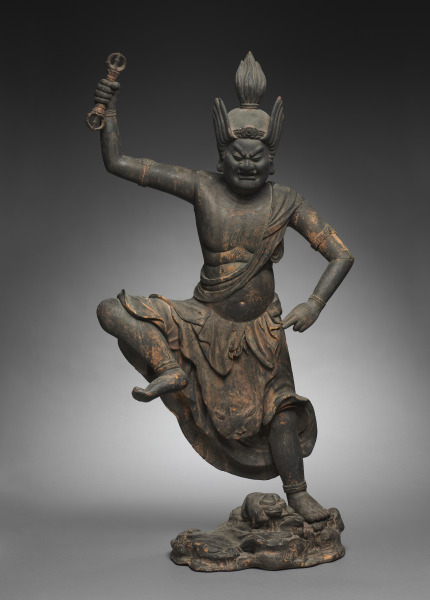
- Title
- Zaō Gongen — 蔵王権現像
- Period
- Kamakura period (1185–1333), 1200s
- Region
- Japan
- Medium
- Wood with traces of polychromy
- Dimensions
- Average height 106.7 cm (42 in.)
- Collection
- Cleveland Museum of Art
- Accession
-
1973.105 - Rights
- CC0 (Cleveland Open Access). Purchase from the J. H. Wade Fund 1973.105.
Cleveland 1973.105: Zaō Gongen, the wrathful tutelary deity of Mt. Kinpusen at Yoshino. Wood with traces of polychromy; Kamakura period, 1200s; height 106.7 cm. Provenance: Setsu Gatōdō Co., Ltd., Tokyo, to the Cleveland Museum of Art via the J. H. Wade Fund, 1973. CC0 (Cleveland Open Access).
Cleveland 1973.105 is a 1200s Kamakura wooden Zaō Gongen, 106.7 cm tall: blue-skinned wrathful warrior with hair flaming upward, right hand raised holding a three-pronged vajra, left hand at the hip in the sword-fist mudra, right leg lifted in a wide warrior kick, standing on a rocky pinnacle. The figure is the tutelary deity of Kinpusen in Yoshino and the iconographic anchor of Shugendō.
What the photograph shows
The figure stands a little over a metre tall in carved wood, the surface darkened where original polychromy has worn or been lost and brighter where the pigment survives in the recesses of the carving — chiefly traces of red-orange and rust colour in the deepest folds of the drapery. The body is single-faced: one head, one set of fangs, two arms, two legs. This is the canonical Zaō Gongen body-count, and it distinguishes him at first glance from the Five Wisdom Kings, several of whom carry multiple heads or multiple arms.
The head is large in proportion to the body, the brow is heavily furrowed, the eyes are wide-set and bulging, and the mouth opens to show fangs in a snarling expression. The crown carries a tall flame-shaped crest at the centre and two outward-flaring flame-projection wings at the temples, the three together giving the head a pronounced silhouetted triangulation when read against the gallery wall. Whether the central crest and the side projections are stylised hair worked as flame, separately carved flame-headdress elements affixed to the head, or some combination of the two is not resolvable at the published photograph’s resolution. Cleveland’s catalog records the original complexion as blue-black; only traces of that pigment survive on the visible surface.1
The right arm is raised above the head. The fist is closed around a vajra of the Esoteric ritual armoury — Cleveland’s catalog identifies it as a “three-pronged cylinder” (the sankoshō, 三鈷杵, three-pronged vajra), with the central prong driving upward and two flanking prongs curving outward. The individual prong-count is not securable from the photograph’s resolution at the angle of capture, but the iconographic context (Heian-Kamakura Zaō Gongen sculptural and bronze-plaque corpus, Met votive plaque accession 59978 explicitly sankoshō-engraved, Sanbutsu-ji Mt. Mitoku group on the same iconographic programme) makes the three-pronged identification the canonical reading and Cleveland’s catalog confirms it.
The left arm is bent at the hip with the fist closed: the gesture is conventionally read as the taikenjō / ken-in (剣印, sword-fist) mudra in which the index and middle fingers are extended together to form the blade with the thumb folded over the lower fingers to lock the form. From the photograph’s angle, the closed fist at the hip is plain; the specific finger-position is conventional rather than visually verified at this resolution. The two-arm gesture programme is the signature: vajra above, sword-fist at hip, the deity poised between the two ritual implements that frame the entire Esoteric tradition’s protective vocabulary.2
The right leg is lifted in a wide-stance kick. The thigh is raised forward and slightly downward, the knee bent sharply, the foot pulled back toward the hip. The left leg supports the entire weight of the figure on a low irregular rocky outcrop carved as a roughly rounded mound rather than a stepped or pyramidal plinth. This is the Zaō stance: the canonical right-leg raised kick that any Zaō Gongen image carries and that no other figure in the Japanese Buddhist iconographic repertoire claims as a signature.
The dynamism is structural and torsional. The supporting hip is loaded forward and the shoulders counter-rotate slightly opposite the kicking leg, so the carved figure twists around its own vertical axis under the gesture.
Stillness, in this register, has to do the work of motion. The kick will not land. The vajra will not fall. The carved wood has to suggest both — across centuries, on an altar — through the static geometry of its torsion alone.
A pelt is draped across the lower body. Cleveland’s catalog notes specifically that the figure wears the pelt of a large feline with the face of the animal preserved near the deity’s knee.1 At the published photograph’s resolution the feline face reads as a flattened mask with rounded ears, jaw and snout pressed against the carved surface, the ears intact above the brow line. This is the koromogake feline-pelt costume convention that several wrathful figures share with Zaō Gongen, one of the markers that ties him visually to the broader wrathful-deity register without resolving him to any specific other figure. Above the pelt, a cloth scarf wraps the left shoulder and falls behind the body.
What the photograph cannot resolve at published scale: the per-figure assignment of the polychromy programme (which colour zones survive where), the inscription state of any base or interior cavity, and whether the figure is hollowed (yosegi-zukuri, joined-block construction) or carved from a single block (ichiboku-zukuri, single-block). The Sanbutsu-ji Zaō Gongen group at Mt. Mitoku resolves both technical questions through inscription evidence and 1921 repair documentation; no equivalent technical record has been located for Cleveland 1973.105.3
The Kinpusen mountain complex and Shugendō
Zaō Gongen does not exist outside Kinpusen. The deity is the tutelary figure of one specific sacred-mountain complex: the Kinpusen range in the Yoshino district of Nara Prefecture, with Kinpusen-ji’s Zaōdō (Zaō Hall) at the southern end of the cherry-blossom-famous Yoshino slope and Mt. Ōmine extending the sacred geography southward into the Ōmine ridge.
The mountain is identified textually with two Indian-Buddhist eschatological sites: with Mount Daṇḍaka, where the historical Buddha Śākyamuni is said to have practised austerities, and with the Tuṣita Heaven, where the future Buddha Maitreya (Miroku) waits to descend into the human world.4 The doctrinal logic of the place compresses the buddhological past, present, and future into a single mountain.
The Heian institutional foundation rests on the Fujiwara regents and the retired emperors. Heather Blair’s Real and Imagined: The Peak of Gold in Heian Japan (Harvard, 2015) traces the hundred-kilometre pilgrimage from the Heian capital to the rocky summit and the political competition among Fujiwara aristocrats and royal pilgrims that funded the tenth- and eleventh-century build-out at Kinpusen.5 The cult was repeatedly entangled in violent altercations with the great Nara temple Kōfuku-ji, which sought to absorb Kinpusen into its institutional jurisdiction and was repeatedly resisted by the Kinpusen cultic community.
Shugendō, the mountain-asceticism tradition that takes Zaō Gongen as its principal protective figure, treats Kinpusen as one of its two foundational sites alongside the Kumano sanzan complex on the Kii Peninsula. The Tōzan branch of Shugendō (associated with Shingon) anchors at Kinpusen-ji; the Honzan branch (associated with Tendai) anchors at Shōgo-in in Kyoto with practice grounds also extending into Yoshino-Ōmine. Miyake Hitoshi’s collected essays — published in English in 2001 as Shugendō: Essays on the Structure of Japanese Folk Religion under H. Byron Earhart’s editorship — provide the standard structural-historical reading of the two-branch organisation, the ritual sequence of the omine-iri mountain entry, and the cosmological frame within which Zaō Gongen functions as the protective tutelary of the Kinpusen-Yoshino practice landscape.6
The legendary founder is En no Gyōja (役行者, ‘En the Ascetic,’ active second half of the seventh century, also known as En no Ozunu, 役小角), the Yamato-region mountain ascetic to whom the Kinpusen-ji foundation legend attributes the very revelation of Zaō Gongen.7 In the canonical Kinpusen-ji narrative, En no Gyōja prayed at the summit of Kinpusen for a powerful protector of the mountain and the deity manifested in three successive forms (first as Shaka, then as Senju Kannon (Thousand-Armed Kannon), then as Miroku) before settling on the wrathful Zaō Gongen form as the consolidated visible manifestation of all three.
The doctrinal scheme that licenses this consolidation is honji-suijaku (本地垂迹, ‘original ground and trace manifestation’). Under the scheme, a Buddha or bodhisattva (the honji) manifests as a local Japanese kami (the suijaku) for the salvation of the local population.8 Zaō Gongen is the canonical Shugendō application: the gongen form, a ‘provisional manifestation’ that is neither pure-Buddhist Shaka nor pure-Buddhist Kannon nor pure-Buddhist Miroku but the consolidated mountain-resident wrathful protector who carries all three Buddha-identities at once. Carmen Blacker’s The Catalpa Bow (Allen and Unwin, 1975), the standard English-language fieldwork study of yamabushi mountain ascesis, frames the deity as the figure through which Shugendō practitioners enter the protective mountain field on the Kinpusen-Ōmine ridge.9
The three-Buddha compression
The doctrinal logic that turns the figure into Zaō Gongen rather than a generic wrathful deity is the compression of three Buddha-identities into one. Cleveland’s published descriptive text reads the compression as Shakyamuni (the historical Buddha), Thousand-Armed Kannon (Senju Kannon), and Miroku (the future Buddha): past, present, and future protectors of the world consolidated into a single mountain-resident manifestation.1 The same triadic compression structures the institutional centrepiece at Kinpusen-ji’s Zaōdō, where three colossal wooden Zaō Gongen images are enshrined together as the visible programme, one for each honji, in the second-largest wooden hall in Japan after the Tōdai-ji Daibutsuden.10
The compression is not merely additive. The standard sectarian logic, as recorded in the Japanese Wiki Corpus entry and in Schumacher’s photographic dictionary, runs as follows. The deity first appeared to En no Gyōja in the form of Shaka, then in the form of Senju Kannon, then in the form of Miroku. Each form was rejected by the ascetic as insufficiently powerful for the protection of the mountain. The fourth manifestation, the wrathful blue-black Zaō Gongen, was accepted, and the doctrinal reading takes the wrathful form as the consolidation of all three preceding peaceful manifestations rather than as a fourth deity added to a list. Past, present, and future are folded into one ritual-protective body.
The triadic honji attribution is occasionally given in slightly different form in the secondary literature. The most common recensions name Shaka (past) and Miroku (future) as fixed; the present-Buddha slot is given variably as Senju Kannon (Thousand-Armed Kannon, Cleveland’s reading), as the standard Kannon (Avalokiteśvara) without specific arm-count, or, in some Tendai-affiliated Honzan-branch sources, as Yakushi Nyorai (the Medicine Buddha) in the present-tense slot. The Cleveland reading and the Kinpusen-ji Zaōdō programme both take the Senju Kannon variant as canonical; the article follows Cleveland’s reading.
Two implications follow from the compression. First, Zaō Gongen is not a deity that can be ‘reduced’ to one of his three honji without doctrinal loss; the wrathful form is the consolidated form, and any of the three peaceful Buddha-identities recovered from him is the partial manifestation, not the original. Second, the three-aspect logic assigns the deity a temporal scope that the iconography cannot show but that the doctrinal frame insists on: the figure protects across the past, the present, and the future cycle simultaneously, which is the eschatological cover that Heian-Kamakura aristocratic patrons sought when they funded the Kinpusen institutional build-out and that the Kinpusen kyōzuka deposits put on archaeological record.
The kyōzuka archaeological evidence
The earliest dated archaeological evidence for the Kinpusen cult is the sutra mound (kyōzuka, 経塚) deposited at the summit of Kinpusen by the Fujiwara regent Fujiwara no Michinaga (藤原道長, 966–1028) in Kankō 4 (1007).11 The deposit consisted of fifteen scrolls of the Lotus Sūtra and other Buddhist texts, copied at Michinaga’s personal commission, sealed in a bronze container, and buried at the mountain’s summit on the eleventh day of the eighth month of the year.
The eschatological logic of the kyōzuka practice is the doctrine of the three ages of the Buddhist Dharma: the True Dharma, the Semblance Dharma, and the Final Dharma (mappō, 末法), with the closing of the Final Dharma followed by the descent of Maitreya 5,670,000,000 years in the future. The buried sutra texts were intended to survive the mappō collapse and be available to Maitreya at his descent: a cross-temporal information deposit anchored to the same Maitreyan-future logic that the Zaō Gongen iconography compresses into its present-form body.
The Michinaga deposit was opened and studied in 1691 (Genroku 4) by the Tokugawa-period scholar Kibe Hisamasa, and parts of the deposit material have entered Japanese museum holdings. The Tokyo National Museum’s Heiseikan special exhibition on sutra mounds documented the Kinpusen deposits in detail, including the bronze sutra containers, the engraved bronze plaques, and the votive bronze mirrors deposited by later Heian-Kamakura pilgrims at the same Kinpusen sutra-mound site.12
The Met holds one of the bronze votive plaques excavated from a Kinpusen kyōzuka, accession 59978, a flame-shaped bronze plaque incised with Zaō Gongen on a rocky outcrop, right foot upraised, three-pronged vajra in the right hand, left hand in the sword-fist mudra at the waist.13 The Met plaque carries the iconographic programme that the Cleveland Kamakura wood carries in carved form, two centuries later, in monumental sculpture rather than handheld engraved bronze.
The archaeological evidence pulls the iconography back to the Heian period with documentary security. The Cleveland wood is therefore not the formative document; it is a Kamakura inheritance of a programme that the Michinaga 1007 deposit and the subsequent kyōzuka practice had already stabilised. The Sanbutsu-ji Mt. Mitoku group (eight late-Heian Zaō Gongen carvings, with the primary 1.15-metre figure dated to about 1168 and attributed to Kōkei, the father of Unkei) is the most concentrated documented sculptural set of the immediately pre-Cleveland generation.14
The Meiji 1872 abolition and what survived
The Heian-Kamakura Zaō Gongen visual record came under direct institutional threat in 1872. The Meiji-government decree of that year, the Shugendō haishi-rei (修験道廃止令, ‘order abolishing Shugendō’), formally banned the Shugendō tradition as the institutional carrier of Zaō Gongen practice. The decree was the operational application to mountain religion of the broader 1868 shinbutsu bunri (神仏分離, ‘separation of kami and Buddhas’) policy: the Meiji effort to disentangle Shinto kami worship from Buddhist temple practice as part of the construction of State Shinto.15 Helen Hardacre’s Shinto: A History (Oxford, 2017) is the standard English-language treatment of the policy and its consequences.
For Shugendō the decree was structurally fatal in the immediate term. Shugendō was, by definition, a tradition that operated through the integrated mountain-temple-shrine complex; the gongen terminology that named its tutelary deities was the verbal marker of exactly the syncretism that the new decree forbade. At Kinpusen-ji and across the Yoshino-Ōmine ridge, Meiji officials removed Buddhist icons, rebranded mountain-temple complexes as Shinto shrines, and dispersed the institutional infrastructure that had sustained the cult for a millennium. At Mt. Haguro (the principal Tōhoku Shugendō site), the parallel rebranding turned the temple-shrine multiplex into the Dewa Sanzan Shinto-shrine network.
The visual record took the consequences directly: temple icons were sold, dispersed, or destroyed; the international art market absorbed many of the surviving Heian-Kamakura sculptural and painted Zaō Gongen pieces as the Meiji-era Japanese-art dispersal moved through the Yamanaka and Co. and Matsuki Bunkyo dealer networks into U.S. and European collections.16
The Cleveland 1973.105 wood entered international circulation in this institutional aftermath. The published provenance, recorded by the Internet Archive’s mirror of the Cleveland catalog entry, runs: Setsu Gatōdō Co., Ltd. (a Tokyo art dealer) to the Cleveland Museum of Art via the J. H. Wade Fund in 1973. The pre-dealer chain (what temple held the figure, when it left that temple, and through which intermediate dealers it passed before reaching Setsu Gatōdō) is not published. The almost-certain background to the chain is the Meiji 1872 disestablishment dispersal pattern; the figure carries the institutional fingerprint of the decree even if the specific sequence of post-decree custodians is not documentary.
Shugendō was legally re-established as a religious tradition only after the postwar constitutional guarantee of religious freedom. The principal Shugendō headquarters reformed in the late 1940s and the early 1950s; Kinpusen-ji at Yoshino reconstituted as the Tōzan branch headquarters; the Honzan branch reformed at Shōgo-in. The re-established tradition has been institutionally vigorous in the postwar decades and continues to maintain the Yoshino-Ōmine practice infrastructure, but the Heian-Kamakura visual record (the one that the Cleveland wood preserves) was already dispersed by then. What survives in U.S. and European institutional holdings (Cleveland; Met; LACMA and others) is a Heian-Kamakura corpus that left Japan because the Meiji decree dismantled the institutional context that had kept it on the mountain.
Where the reading commits and where it remains open
The iconographic identification is secure: the single-faced wrathful warrior in the Zaō stance with the canonical sankoshō-and-ken-in gesture programme is Zaō Gongen. The Sanbutsu-ji Mt. Mitoku group (late Heian, c. 1168, attributed to Kōkei) carries the same programme in carved wood; the Met’s Heian votive plaque 59978 carries it in engraved bronze; Kinpusen-ji’s Zaōdō houses three colossal sculptural witnesses of it as the doctrinal centrepiece of the cult.
The doctrinal frame is also secure: Zaō Gongen is the wrathful gongen manifestation of three honji consolidated into one body, Shaka (past), Senju Kannon (present), and Miroku (future), in the canonical Shugendō application of the honji-suijaku scheme. And the institutional history is documentary: the Heian cult was funded by Fujiwara patronage and the retired emperors; the Michinaga 1007 sutra-mound deposit is the earliest dated archaeological evidence; the Meiji 1872 Shugendō haishi-rei dismantled the institutional infrastructure and triggered the visual record’s international dispersal, of which Cleveland 1973.105 is one surviving witness.17
Three things remain open.18 First, no specific workshop, sculptor, or temple-of-origin attribution is published. The figure’s stylistic features are consistent with thirteenth-century mountain-temple sculptural practice broadly; the most likely production context is a Yoshino-Ōmine or other mountain-cult-affiliated temple commission of the Kamakura thirteenth century. A finer attribution waits on a published technical study.
Second, the construction technique (yosegi-zukuri joined-block versus ichiboku-zukuri single-block) is not specified. The Cleveland record gives the medium simply as ‘wood.’ The contemporaneous Mt. Mitoku Sanbutsu-ji primary image is yosegi-zukuri (with a documented prayer-inscription cavity); seven additional Sanbutsu-ji figures of the same period are ichiboku-zukuri. Cleveland 1973.105 could plausibly be either; the question would be resolved by a museum-published condition report.
Third, the polychromy programme is not documented at the published photograph’s resolution. Cleveland’s catalog notes a blue-black complexion, traces of which survive on the visible surface; the full original colour scheme is not reconstructed in the published material. A high-resolution IIIF reproduction or a museum-curated condition report would tighten the reading.
What the wood offers is the iconographic programme complete, in carved Kamakura wood, surviving the Meiji decree by passing through the Tokyo art market into a U.S. museum that has kept the figure on view in its Japanese gallery since acquisition. What it cannot offer at the published state is the workshop, the construction technique, or the original polychromy.
Related
- Senju Kannon: reading the thousand arms
- Bato Kannon: the horse-headed wrathful form
- Yakushi and his Twelve Generals
- Senju Kannon
Footnotes
-
Cleveland Museum of Art, accession 1973.105, “Zaō Gongen” (蔵王権現像), Japan, Kamakura period (1185–1333), 1200s; wood; classified as sculpture; average height 106.7 cm (42 in.); credit line “Purchase from the J. H. Wade Fund 1973.105”; CC0 (Open Access); on view in Gallery 235B (Japanese). Catalog page accessed 2026-04-26. The descriptive text identifies the figure as “the guardian deity of Mount Kinpu in Yoshino south of Nara” and as a combined manifestation of Shakyamuni, Thousand-Armed Kannon, and Miroku; it notes the wild hair, blue-black complexion, fangs, three-pronged vajra in the raised right hand, and the pelt of a large feline with the animal’s face preserved near the knee. Provenance: acquired 1973 from Setsu Gatōdō Co., Ltd., Tokyo, with the J. H. Wade Fund (per the Internet Archive’s mirror of the Cleveland catalog entry, accessed 2026-04-26 at archive.org/details/clevelandart-1973.105-zao-gongen). The accession is single (no .a / .b component split). ↩ ↩2 ↩3
-
For the canonical Zaō Gongen iconographic vocabulary — single-faced wrathful warrior, hair standing on end, right hand raised holding a three-pronged vajra (sankoshō, 三鈷杵), left hand at the hip in the sword-fist mudra (ken-in, 剣印, alt. taikenjō), right leg raised in a wide warrior kick, supporting left leg on a rocky pinnacle — see Mark Schumacher, “Zao Gongen,” Onmark Productions photographic dictionary (onmarkproductions.com/html/zao-gongen.shtml), accessed 2026-04-26, with institutional photographs of the Kinpusen-ji Zaōdō, Mt. Mitoku Sanbutsu-ji, and other major Zaō Gongen sites. The Met votive plaque accession 59978 (Heian, bronze) carries the same iconographic programme in the engraved-bronze medium that the Cleveland Kamakura wood carries in carved form; the iconography is stable from the late Heian forward. ↩
-
For the technical-construction question (yosegi-zukuri joined-block versus ichiboku-zukuri single-block) at Mt. Mitoku Sanbutsu-ji’s primary 1.15-metre Zaō Gongen image, with prayer-inscription evidence dating the figure to about 1168 (late Heian) and standard scholarly attribution to Kōkei (the father of Unkei), see the institutional documentation summarised at nippon.com (accessed 2026-04-26). The seven additional Zaō Gongen images at Sanbutsu-ji are noted as ichiboku-zukuri (single-block) in contrast to the primary image’s yosegi-zukuri (joined-block) construction. No published technical study of Cleveland 1973.105 has been located; its construction technique remains unconfirmed. ↩
-
For the textual identification of Kinpusen with Mount Daṇḍaka (the site of Śākyamuni’s austerities) and with the Tuṣita Heaven (the dwelling of Maitreya before his future descent), and for the doctrinal compression of past-present-future buddhology into a single sacred-mountain site, see Heather Blair, Real and Imagined: The Peak of Gold in Heian Japan (Harvard University Asia Center, 2015), particularly the early chapters on the Heian mythogeography of Kinpusen, with cross-reference to the Japanese Wiki Corpus entry on Zao Gongen (japanesewiki.com/Buddhism, accessed 2026-04-26). ↩
-
Heather Blair, Real and Imagined: The Peak of Gold in Heian Japan (Harvard University Asia Center / Harvard University Press, 2015), is the standard English-language treatment of Heian Kinpusen as the pilgrimage destination of the Fujiwara regents and the retired emperors. Blair documents the political-institutional competition between Kinpusen and the great Nara temple Kōfuku-ji, the Fujiwara patronage that funded the Heian build-out, and the archaeological evidence (especially the Michinaga 1007 sutra mound; see §“The kyōzuka archaeological evidence” below) that grounds the Heian institutional history. ↩
-
Hitoshi Miyake (ed. H. Byron Earhart), Shugendō: Essays on the Structure of Japanese Folk Religion (University of Michigan Center for Japanese Studies, Michigan Monograph Series in Japanese Studies vol. 32, 2001), is the English-language standard structural-historical reference for Shugendō. Miyake’s essays systematise the tradition’s history, organisation, ritual sequence, austerities, thought, and cosmology; the two-branch organisation (Tōzan-ha at Kinpusen-ji, Honzan-ha at Shōgo-in) and the omine-iri mountain-entry practice frame are particularly load-bearing for the Cleveland 1973.105 reading. For the post-2000 critical-studies orientation that supplements Miyake with material-culture and visual-evidence emphasis, see Andrea Castiglioni, Fabio Rambelli, and Carina Roth (eds.), Defining Shugendō: Critical Studies on Japanese Mountain Religion (Bloomsbury, 2020). ↩
-
For En no Gyōja (役行者, also En no Ozunu, 役小角) as the legendary seventh-century mountain ascetic and the foundational figure of the Shugendō tradition, with the Kinpusen-ji foundation legend in which the deity manifests in three successive forms (Shaka, Senju Kannon, Miroku) before consolidating as Zaō Gongen, see Schumacher’s “Zao Gongen” entry on Onmark Productions (accessed 2026-04-26) and the Met’s catalog entry for the Muromachi-period Portrait of En no Gyōja attributed to Jakusai (accession 44952). The narrative is hagiographic and not independently historically verifiable; it functions as the canonical institutional charter for the Kinpusen-ji cult. ↩
-
For the honji-suijaku (本地垂迹) doctrinal scheme and the term gongen (権現, ‘provisional manifestation’) as the technical vocabulary by which a Buddha or bodhisattva (the honji, ‘original ground’) manifests as a local Japanese kami (the suijaku, ‘trace manifestation’) for the salvation of the local population, see the JAANUS entry “Gongen 権現” by Mary Neighbour Parent (aisf.or.jp/~jaanus/deta/g/gongen.htm, accessed 2026-04-26). The scheme is a Heian institutional development that becomes standard in the Heian-Kamakura medieval Japanese theological synthesis. Zaō Gongen is one of the canonical applications. ↩
-
Carmen Blacker, The Catalpa Bow: A Study of Shamanistic Practices in Japan (George Allen and Unwin, 1975), remains the standard English-language anthropological-fieldwork study of the yamabushi mountain-asceticism tradition. Blacker participated directly in Shugendō ascents during her fieldwork; her chapters on the Kumano-Kinpusen-Ōmine practice landscape position Zaō Gongen as the principal protective tutelary figure for the Kinpusen-Yoshino branch of the tradition. Cited here for the practice context against which the Heian-Kamakura sculptural and bronze-plaque corpus is read; the practice itself is not the article’s subject. ↩
-
For the Kinpusen-ji Zaōdō (Zaō Hall) at Yoshino as the second-largest wooden structure in Japan after the Tōdai-ji Daibutsuden, with three colossal Zaō Gongen images enshrined as the honji-triad programme (Shaka past, Senju Kannon present, Miroku future), see the Kinpusen-ji official site (kinpusen.or.jp/english, accessed 2026-04-26) and the Japanese Wiki Corpus entry on Kinpusen-ji Temple. The current Zaōdō structure is dated to 1592 (Bunroku 1, Momoyama period) but the institutional layout — the triadic enshrinement — preserves the doctrinal programme that the Heian-Kamakura cult established. ↩
-
For the Fujiwara no Michinaga 1007 (Kankō 4) sutra-mound deposit at the summit of Kinpusen — fifteen scrolls of the Lotus Sūtra and other Buddhist texts copied at Michinaga’s commission, sealed in a bronze container, buried on the eleventh day of the eighth month of the year, opened and studied by Kibe Hisamasa in 1691 (Genroku 4) — see Heather Blair, Real and Imagined (Harvard, 2015), and the Japanese Wiki Corpus entry on the practice. The Michinaga deposit is the earliest dated archaeological evidence of the Kinpusen cult and remains the foundational textual-archaeological reference for the Heian institutional history of Kinpusen. ↩
-
For the Tokyo National Museum’s special exhibition on sutra mounds (kyōzuka) at the Heiseikan, including the Kinpusen deposit material — bronze sutra containers, engraved bronze plaques, and votive bronze mirrors deposited by Heian-Kamakura pilgrims — see the TNM exhibition record (tnm.jp, accessed 2026-04-26). The exhibition’s framing as ‘Time Capsules for 5,670,000,000 Years’ makes explicit the Maitreyan-future eschatological logic of the kyōzuka practice, the same logic that the Zaō Gongen iconography compresses into the present-tense protective body via the Miroku honji-attribution. ↩
-
For the Met’s flame-shaped bronze votive plaque of Zaō Gongen retrieved from a Kinpusen-ji sutra mound — accession 59978, Heian period, incised on a rocky outcrop with the right foot upraised, the three-pronged vajra (sankoshō) in the right hand, and the left hand in the sword-fist mudra (ken-in) at the waist — see the Met catalog page (metmuseum.org/art/collection/search/59978, accessed 2026-04-26). The plaque is one of the documented Heian-period bronze-medium witnesses of the Zaō Gongen iconography and the principal Met comparandum to the Cleveland Kamakura wood. Met Open Access. The Met holds at least three Zaō Gongen objects across the period range (Heian 39707; Heian votive plaque 59978; Nanbokuchō or Muromachi 52701). ↩
-
For the Sanbutsu-ji group at Mount Mitoku in Misasa, Tottori Prefecture — eight late-Heian Zaō Gongen carvings, with the primary 1.15-metre figure of yosegi-zukuri (joined-block) hinoki construction dated by 1921-discovered prayer inscription to about 1168 and attributed by the standard scholarship to Kōkei (the father of Unkei), with seven additional ichiboku-zukuri (single-block) figures in the same hall, all designated Important Cultural Property — see the institutional documentation summarised at nippon.com (japan-topics/b10927/, accessed 2026-04-26). The Mt. Mitoku group is the most concentrated documented late-Heian sculptural Zaō Gongen set, one generation before the Kamakura context that produced Cleveland 1973.105, and the standard sculptural reference against which any Heian-Kamakura Zaō Gongen carving is measured. ↩
-
For the Meiji 1872 Shugendō haishi-rei (修験道廃止令, ‘order abolishing Shugendō’) and the broader 1868 shinbutsu bunri (神仏分離, ‘separation of kami and Buddhas’) policy as the operational instruments of the State-Shinto construction project, see Helen Hardacre, Shinto: A History (Oxford University Press, 2017), and the English-language Wikipedia summary of shinbutsu bunri (en.wikipedia.org/wiki/Shinbutsu_bunri) for the policy chronology. Hardacre’s broader work positions the Meiji religious-reform policies as the structural cause of the dismantling of the temple-shrine multiplex tradition, of which Shugendō was the most institutionally exposed case. The 1872 decree’s structural fatality for Shugendō is also treated in the Buddhistdoor Global feature series “Connecting the Past and Present of Shugendo” (parts 1 and 4, accessed 2026-04-26) for the mountain-religion-specific history. ↩
-
For the Meiji-era and early-twentieth-century international dispersal of Japanese Buddhist sculpture and painting through the Yamanaka and Co. and Matsuki Bunkyo dealer networks, with the Shugendō suppression of 1872 as a contributing institutional context for the supply side of the dispersal, the standard accounts are in the museum-provenance literature on Boston, Cleveland, and Met Asian-art holdings. Cleveland 1973.105 is published with provenance from Setsu Gatōdō Co., Ltd., Tokyo, in 1973 (per the Internet Archive’s mirror of the Cleveland catalog entry, accessed 2026-04-26 at archive.org/details/clevelandart-1973.105-zao-gongen); the pre-dealer chain is not published. The institutional context for the figure leaving its original Japanese temple custodianship is the Meiji disestablishment of Shugendō rather than any documented event-specific dispersal. ↩
-
The single-faced wrathful warrior in the Zaō stance with the canonical sankoshō-and-ken-in gesture programme is iconographically secure as Zaō Gongen across the Heian-Kamakura visual record; the Sanbutsu-ji Mt. Mitoku group (c. 1168, Kōkei-attributed), the Met Heian votive plaque (59978), and the Kinpusen-ji Zaōdō triad supply the late-Heian and Kamakura sculptural and bronze-medium reference points against which Cleveland 1973.105 reads as a Kamakura wooden inheritance of an iconographic programme already stabilised by the Heian kyōzuka deposits. The doctrinal compression of Shaka, Senju Kannon, and Miroku into a single wrathful body is documented in the Cleveland descriptive text and in the Kinpusen-ji Zaōdō programme; the institutional history is documented in Heather Blair, Real and Imagined: The Peak of Gold in Heian Japan (Harvard University Asia Center, 2015) for the Heian formation and in Helen Hardacre, Shinto: A History (Oxford University Press, 2017) for the Meiji 1872 dismantling. ↩
-
Evidence that would resolve the article’s open uncertainties: (1) a curatorial or technical-study attribution of Cleveland 1973.105 identifying the workshop and probable temple of origin; (2) a museum-published construction-technique report (yosegi-zukuri versus ichiboku-zukuri) and condition record; (3) a polychromy condition report or high-resolution IIIF reproduction to reconstruct the original colour programme. Q10514059 is the Wikidata Q-ID for Zaō Gongen as the principal deity of Shugendō; Q102968630 is the Q-ID for a separate bronze mirror with Zaō Gongen iconography in the kyōzuka-deposit corpus. ↩
Sources
-
Cleveland's catalog records the work as 'Zaō Gongen' (蔵王権現像), Japan, Kamakura period (1185–1333), 1200s; wood; classified as sculpture; average height 106.7 cm (42 in.). Credit line: Purchase from the J. H. Wade Fund 1973.105. CC0 (Open Access). On view in Gallery 235B (Japanese). Cleveland's descriptive text identifies the figure as 'the guardian deity of Mount Kinpu in Yoshino south of Nara' and as a combined manifestation of Shakyamuni, Thousand-Armed Kannon, and Miroku as protectors of the past, present, and future. The published descriptive text notes wild hair, blue-black complexion, fangs, a three-pronged vajra (sankōshō) in the raised right hand, and the pelt of a large feline with the face of the animal near the deity's knee. Provenance: acquired in 1973 from Setsu Gatōdō Co., Ltd., Tokyo, with the J. H. Wade Fund. The accession is single (no .a / .b component split).
-
Met catalog page accession 59978: a flame-shaped bronze votive plaque incised with Zaō Gongen on a rocky outcrop, right foot upraised, three-pronged vajra (sankōshō) in the right hand, left hand in the sword-fist mudra (ken-in) at the waist. Catalog text identifies the plaque as having been retrieved from a sutra mound (kyōzuka) of Kinpusen-ji in Yoshino. Heian-period dating; Met Open Access. Cited as the bronze-medium iconographic comparandum that the Cleveland wooden Kamakura Zaō Gongen carries forward in carved form.
-
Met holding of a Heian-period Zaō Gongen, cited as a Heian-medium comparandum to the Kamakura Cleveland wood. The Met holds at least three objects identified as Zaō Gongen across the Heian, Heian, and Nanbokuchō / Muromachi accession set: 39707 (Heian), 59978 (Heian votive plaque), and 52701 (Nanbokuchō or Muromachi).
-
Met holding of a Nanbokuchō or Muromachi Zaō Gongen, cited as a later-period comparandum demonstrating the iconography's stability across the Heian–Kamakura–Muromachi arc.
-
Sanbutsu-ji on Mount Mitoku in Misasa, Tottori Prefecture, holds a 1.15-metre standing Zaō Gongen of yosegi-zukuri (joined-block) Japanese cypress (hinoki) with a prayer-inscription dating discovered during 1921 repairs that fixes the date to about 1168 (late Heian). The standard scholarly attribution is to Kōkei (the father of Unkei). The hall holds seven additional Zaō Gongen images of the same period, all designated Important Cultural Property, the others carved from single blocks of wood (ichiboku-zukuri) rather than joined-block. The figure stands on one leg in the canonical wide-stance kick, with the right fist raised, the left hand in the ken-in (sword-fist) mudra at the waist, and hair standing on end. Cited as the late-Heian sculptural reference for Zaō Gongen (slightly earlier than and proximate-workshop to the Kamakura Cleveland wood).
-
Kinpusen-ji at Yoshino is the head temple of Tōzan Shugendō and the canonical institutional centre of the Zaō Gongen cult. The Zaōdō (Zaō Hall), the second-largest wooden structure in Japan after the Tōdai-ji Daibutsuden, enshrines three colossal Zaō Gongen images representing Shaka (past), Senju Kannon (present), and Miroku (future) — the three honji of the deity in his three-aspect compression. The current Zaōdō is dated to 1592 (Bunroku 1, Momoyama period). The triadic enshrinement at Kinpusen-ji's Zaōdō provides the doctrinal-institutional reference against which any single-figure Zaō Gongen image (such as Cleveland 1973.105) is read: the single figure compresses the three-Buddha programme that the Zaōdō distributes across three monumental sculptures.
-
Blair's monograph on Heian Kinpusen (Kinpusen as the 'Peak of Gold') as the pilgrimage destination of the Fujiwara regents and retired emperors, including the Fujiwara no Michinaga 1007 sutra-mound deposit. Standard English-language treatment of the Heian institutional formation of the Kinpusen cult and the political entanglements with Kōfuku-ji that accompanied it. Cited for the Heian institutional foundation that the Kamakura sculptural corpus (including Cleveland 1973.105) inherits.
-
Grapard's monograph on Kyushu Shugendō (Mt. Hiko, Usa-Hachiman, the Kunisaki Peninsula). Cited as the standard English-language methodological frame for shrine-temple-mountain complex study that has been applied to Kinpusen and Yoshino in the secondary literature. Grapard's earlier journal articles on shrine-temple multiplexes provide the institutional-history vocabulary used here.
-
Blacker's anthropological-fieldwork study of yamabushi mountain ascesis, including direct participation in Shugendō ascents. Standard English-language reference for the mountain-practice context that surrounds Zaō Gongen as Shugendō's tutelary figure. Cited for the practice context against which the Heian-Kamakura sculptural and bronze-plaque corpus is read.
-
Hardacre's standard English-language history of Shinto. Cited for the Meiji 1872 Shugendō abolition decree (Shugendō haishi-rei, 修験道廃止令) and the broader shinbutsu bunri (separation of kami and Buddhas) policy that dismantled the Shugendō institutional infrastructure and forced the rebranding of mountain-temple complexes as Shinto shrines, with consequences for the survival of the Heian-Kamakura Zaō Gongen visual record.
-
[11]— University of Michigan Center for Japanese Studies (Michigan Monograph Series in Japanese Studies vol. 32) print referenceMiyake Hitoshi's collected essays, edited and translated into English by H. Byron Earhart. The first comprehensive English-language treatment of Miyake's lifelong scholarship on Shugendō. The first part of the volume systematises Shugendō's history, organisation, ritual, austerities, thought, and cosmology; the second part frames Shugendō in the broader Japanese folk-religion register. The English-language standard reference for the structural-historical study of the tradition. Miyake's work is the principal scholarly continuation of the post-Blacker English-language Shugendō field.
-
The newest English-language overview of Shugendō scholarship, with chapters by leading specialists. Cited for the post-2000 critical-studies frame that succeeds Blacker 1975 and supplements Miyake's structural-historical reading with the more recent material-culture and visual-evidence orientation that the bodhi reading on Cleveland 1973.105 aligns with.
-
Tokyo National Museum special exhibition on kyōzuka (sutra mounds) including the Fujiwara no Michinaga 1007 Kinpusen deposit material. Cited for the archaeological evidence of the Heian-period Kinpusen cult, the bronze sutra containers, and the votive bronze plaques bearing Zaō Gongen iconography that were excavated from the Kinpusen deposits. The Michinaga 1007 deposit is the earliest dated archaeological evidence of the cult and the textual locus for the eschatological framing of the kyōzuka practice (the Maitreyan 5,670,000,000-year horizon).
-
[14]2026-04-26Japanese Architecture and Art Net Users System (JAANUS) aisf.or.jp/~jaanus/deta/g/gongen.htmJAANUS entry for the term gongen (権現, 'provisional manifestation'): the doctrinal vocabulary of the Heian honji-suijaku scheme by which a Buddha or bodhisattva (the honji, 'original ground') manifests as a local kami (the suijaku, 'trace manifestation') for the salvation of the local population. The Zaō Gongen of Kinpusen is one of the canonical examples; the term gongen was legally abolished by the Meiji 1868 separation decree but the iconographic and institutional inheritance was not.
-
Schumacher's photographic dictionary entry for Zaō Gongen: institutional photographs of Kinpusen-ji, Mt. Mitoku Sanbutsu-ji, and other major sculptural sites; the canonical iconographic vocabulary; the En no Gyōja foundation legend; the three honji compression; the Meiji 1872 Shugendō suppression aftermath. Cited as a Tier-2 institutional cross-reference. Onmark Productions site; its content dates from 2013–2022.
-
Japanese Wiki Corpus entry for Zaō Gongen: the En no Gyōja foundation narrative, the honji-suijaku doctrinal frame, the three-Buddha compression, the institutional history of Kinpusen-ji, the Tendai/Shingon overlay, the Meiji 1872 abolition. Cross-reference for the canonical secondary-source narrative.