Miroku in the act of thinking: a late-Asuka bronze at Cleveland 1950.86
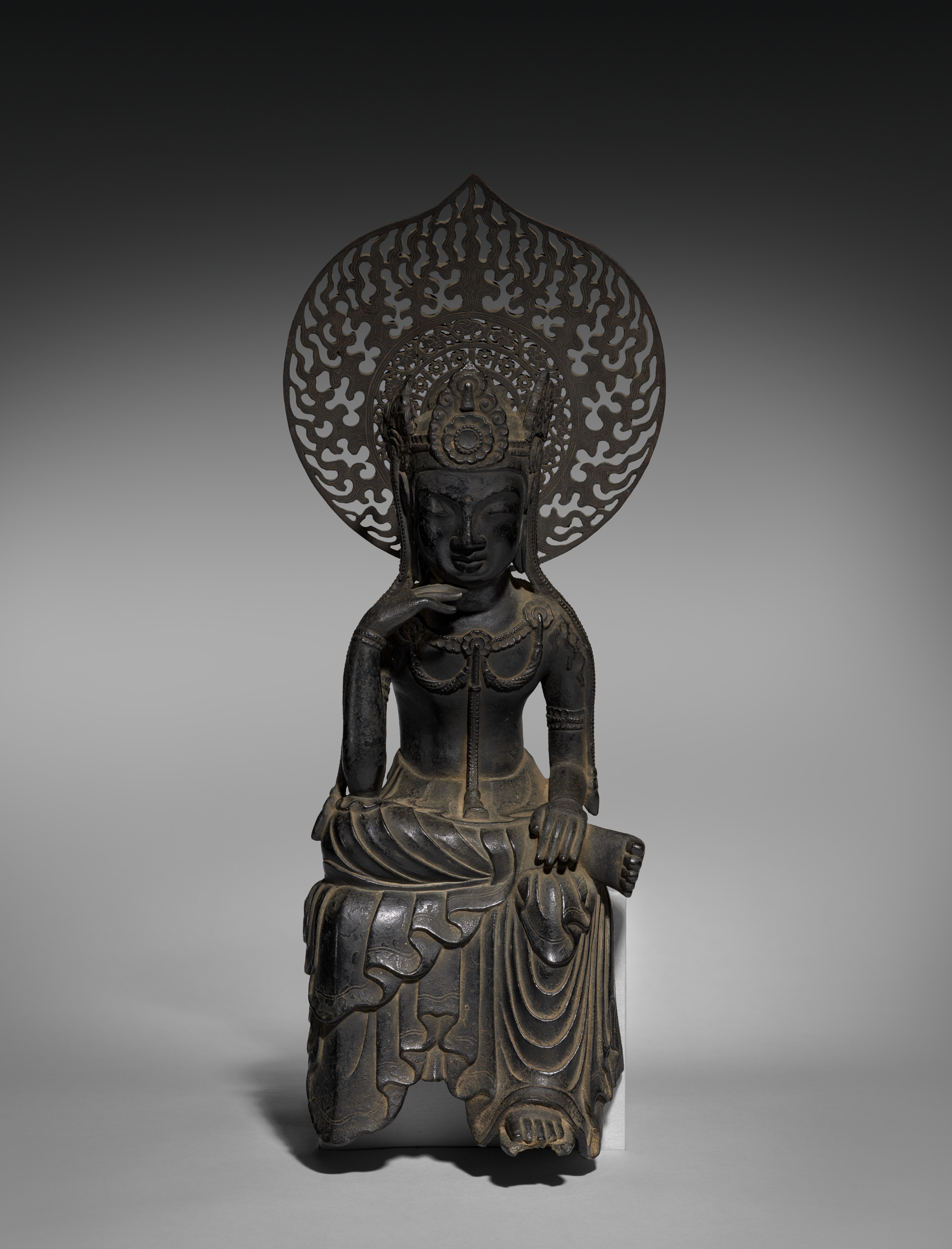
- Title
- Buddha of the Future (Miroku Bosatsu, 弥勒菩薩像)
- Period
- Asuka period (538–710), late 600s
- Region
- Japan
- Medium
- Cast bronze, incised, with traces of gilding
- Dimensions
- Overall 45.8 cm (18 1/16 in.); figure 39.4 cm (15 1/2 in.)
- Collection
- Cleveland Museum of Art
- Accession
-
1950.86 - Rights
- Cleveland Museum of Art, 1950.86: CC0 (Open Access). John L. Severance Fund.
Cleveland 1950.86. Cast bronze, incised, traces of gilding. Late 600s, Asuka period. Overall 45.8 cm; figure 39.4 cm. The pose is *hanka shiyui* (half-lotus contemplation), the iconographic mode in which Miroku is shown thinking through whether the time is right to descend into the world.
The only iconographic type in East Asian Buddhist sculpture that shows a Buddha actively thinking. The Cleveland piece is small, late, refined, and it sits at the terminus of a transmission line that began in north China around 480 and reached the Japanese archipelago perhaps two hundred years later.
What you’re looking at
A small cast-bronze figure, 45.8 cm overall, 39.4 cm for the figure itself. The bodhisattva sits on a tall cuboid pedestal in hanka shiyui (half-lotus pensive), the right ankle resting on the left knee, the left leg pendant with the foot supported on a small lotus footrest just below the cuboid base. The right hand is raised so the fingertips just brush the right cheek; the left hand rests gently on the right ankle. He wears a tall openwork crown with a central jewel cluster, long pendant earrings, a heavy looped necklace with a central pendant, and a scarf or ribbon crossing the bare torso. Long pendant drapery folds cascade from the waist over the front of the pedestal.
Behind the head, a large openwork mandorla, pointed-leaf in silhouette, pierced through with stylised flame and cloud scrollwork. The bronze surface is overall dark, the original gilding now reduced to traces visible in the recesses of the drapery and crown. The figure is not symmetrical: the supporting left arm hangs slightly differently from the raised right arm, the head is tilted very slightly down and toward the touching hand, and the whole composition has an asymmetric inwardness that the hanka shiyui type relies on.
The pose is not a static convention. It is the literal pose of someone thinking: the leg drawn up to test the body’s stillness, the head tilted toward the hand, the supporting hand resting on the ankle as if to brace the slight forward inclination of the upper body. The bodhisattva is thinking, and the pose is doing the work of saying so.
The thinking Buddha
Miroku Bosatsu (Skt. Maitreya; Ch. Mile) is the next Buddha. In Buddhist eschatology he is currently waiting in Tuṣita Heaven, the second of the desire-realm heavens; some unimaginable future after the dharma of the historical Buddha (Śākyamuni) has faded entirely, he will descend into the world and turn the wheel of teaching again. Miroku is therefore iconographically unstable: he is a bodhisattva now, before his final birth, which is why Cleveland 1950.86 is captioned Miroku Bosatsu rather than Miroku Butsu. But he is already a Buddha-to-be, which is why the figure carries the crown and jewellery of a heavenly being rather than the plain monastic robe of an enlightened-and-descended Buddha.
The half-lotus pensive pose (hanka shiyui 半跏思惟) is iconographically specific. Hanka names the half-crossed legs; shiyui names the gesture of finger-to-cheek contemplation. The pose is reserved for a small set of figures in the East Asian Buddhist visual canon, and in Japan from the late sixth century forward it becomes the signature pose of Miroku. The thinking depicted is doctrinally legible: the bodhisattva is contemplating whether the moment is right to descend, and so is also contemplating the fate of all beings in the present age between his arrival and his departure.
That this is the only Buddha-figure type in the East Asian canon shown actively thinking (rather than meditating, teaching, descending, or appearing in vision) is the iconographic claim Cleveland 1950.86 makes most efficiently.
The transmission route: 486 to 686
The Cleveland figure sits at the terminus of a near-two-hundred-year East Asian transmission of the pensive-Maitreya iconography. Three Met-held objects, all Public Domain under Met Open Access, anchor the chain:
| # | Object | Met accession | Period | Medium | Date |
|---|---|---|---|---|---|
| 1 | Buddha Maitreya (Mile) | 26.123 | Northern Wei dynasty | Gilt bronze, piece-mold cast | 486 (Taihe 10th year) |
| 2 | Pensive bodhisattva | 2003.222 | Three Kingdoms (Korea) | Gilt bronze | mid-7th c. |
| 3 | Tile with Buddha Triad | 2015.300.249 | Asuka period (Japan) | Earthenware with traces of color | second half 7th c. |
The Met’s dated 486 Northern Wei Maitreya is the most-cited early-Chinese anchor of the pensive type: gilt bronze, piece-mold cast, with a Taihe-era inscription that fixes it to a year. The Met’s mid-seventh-century Three Kingdoms pensive bodhisattva is the Korean middle of the chain, almost certainly intended as Maitreya, in the same half-lotus pose with the same finger-to-cheek gesture. The mid-7th c. Three Kingdoms bronze and the Cleveland late-600s Asuka bronze are likely separated by no more than a generation.
The transmission ran along visible institutional routes. Jonathan Best’s History of the Early Korean Kingdom of Paekche (2006) is the standard English-language history of the Korean kingdom most closely involved in the export of Buddhism and Buddhist sculptural traditions to Asuka Japan in the late sixth and seventh centuries. The Nihon Shoki records the formal arrival of Buddhism in 552 (or 538, depending on the source) as a state-to-state gift from the Paekche king Sŏng to the Yamato court, including a gilt-bronze image of the Buddha. The earliest surviving Japanese Buddhist images, dated by inscription to the early-to-mid seventh century, work in the same gilt-bronze medium and the same Northern-Wei-derived iconographic vocabulary that the Paekche court was using a generation earlier.
Cleveland 1950.86 is downstream of that whole transmission. By the late seventh century the Asuka style had refined the type: smaller proportions, more linear drapery, the openwork mandorla, the slightly more naturalistic facial modelling. The figure is a portable late-Asuka inflection of an iconographic mode that arrived in Japan as a foreign import within living memory.
Wood and bronze, Kōryū-ji and Cleveland
Two of the most famous Miroku images in the Japanese tradition are not in bronze but in wood. The Kōryū-ji hōkan Miroku (the “crowned Miroku” at Kōryū-ji in Kyoto) is the figure designated Japan’s National Treasure no. 1 in the postwar listing; it is the first object on the National Treasure register. The Chūgū-ji hanka shiyui image, at the subsidiary nunnery of Hōryū-ji in Nara, is the second most-cited example. Both are seated hanka shiyui, both are larger than life-size, both are seventh century.
The Kōryū-ji figure has been at the centre of one of the longest-running attribution debates in Asuka sculptural studies. The wood-species identification (red pine, Pinus densiflora) is not native Japanese and not common in seventh-century Japanese sculpture; it is a wood much more readily associated with Korean carving traditions. The technical-study finding has been used to argue either (a) that the figure is a direct Korean import, made in Silla and given to the Hata clan founder Hata no Kawakatsu around 603 (the Nihon Shoki records this gift), or (b) that the figure was made in Japan by a Korean immigrant sculptor working with imported wood. The Chūgū-ji figure, by contrast, is carved from camphor (kusunoki), a Japanese wood: part of the case that it was made in a Japanese workshop, possibly working from Korean visual prototypes but not from imported material.
The Cleveland figure is bronze, and small, and the comparison cuts across the wood-versus-bronze divide. The Asuka bronze tradition existed in parallel with the wood tradition; both inherited the same Korean-mediated Northern Wei iconographic vocabulary; both produced hanka shiyui Mirokus in the same period. Cleveland 1950.86 demonstrates the bronze track at small portable scale, the way the Kōryū-ji and Chūgū-ji figures demonstrate the wood track at colossal temple-altar scale. The two tracks are not competing styles. They are two media operating inside the same iconographic programme.
Hakuhō and the openwork mandorla
The late-Asuka period is sometimes split off as a separate sub-period, Hakuhō (白鳳, traditionally 645–710), partly to mark the stylistic shift between the early-Asuka Tori-busshi school (Kuratsukuri no Tori, active in the early seventh century at the Hōryū-ji workshop) and the later, more refined late-seventh-century pieces. The Tori-busshi style is angular, frontal, with deeply ridged archaic drapery. The Hakuhō style is rounder, more naturalistic, with finer linear drapery and a willingness to carry detail through to the smaller-scale ornament.
Cleveland 1950.86 reads Hakuhō. The face is rounded rather than angular; the proportions of the body to the pedestal are settled and adult rather than archaic-childlike; the drapery folds are linear and incised rather than ridged. The openwork mandorla is itself a Hakuhō signature. The pierced flame-and-cloud scrollwork on a pointed-leaf silhouette is a treatment that becomes the standard halo type at this scale through the late seventh and early eighth centuries, visible also on small bronzes of the period in Japanese collections including the Tokyo National Museum holdings and the Hōryū-ji Treasure House (the Kanteki / hand-held image group, transferred to the imperial collection in 1878 and now divided between the Hōryū-ji repository and Tokyo National Museum).
The “late 600s” Cleveland dating sits inside this stylistic window. The figure could plausibly be early 670s or as late as the early 700s and not look out of place.
Why Miroku, why thinking
The Miroku cult in early Japan is not a peripheral devotional choice. McCallum’s Four Great Temples (2009) frames it as central to the formative Buddhist establishment: the prospect of future salvation, on a defined eschatological timeline, was the doctrinal feature of the new faith that resonated most strongly with the Yamato aristocracy. The Hata clan’s sponsorship of the Kōryū-ji Miroku (and the Soga clan’s broader sponsorship of the Buddhist establishment culminating in the Asuka-dera bronze of 606) were patronage commitments to a faith whose central temporal claim was that the present age would not last.
The half-lotus pensive pose is the iconographic compression of that claim. The bodhisattva is thinking about now. He is not yet here. The pose tells the donor (the seventh-century Japanese aristocrat or temple establishment that commissioned a private-altar bronze like Cleveland 1950.86) that the saviour is real, the saviour is named, the saviour is currently considering. The image makes the eschatology immediate without making it imminent. This is a doctrinally specific use of an iconographic mode, and it explains why the type is so heavily concentrated in the early Japanese corpus rather than being one among many available options.
Where the reading commits and where it varies
The reading commits to: the hanka shiyui pose as Miroku-specific in the Japanese tradition from the late sixth century forward; the figure as iconographically a future-Buddha-as-current-bodhisattva, not a transcendent Buddha; the bronze medium, small scale, and openwork mandorla as Hakuhō-period signatures; the transmission line running Northern Wei → Three Kingdoms Korea → Asuka Japan as the operative iconographic genealogy.
The reading defers on: whether the small element at the top of the openwork crown is a stūpa, a triple jewel cluster, or another future-Buddha marker (the resolution of the photograph does not let me discriminate, and the Cleveland catalog does not specify); whether the figure is more precisely 670s or 690s within the late-600s window (the museum gives the broader bracket and the body of late-Asuka bronze comparanda does not yet permit a tighter dating from style alone); whether the original temple of commission can be reconstructed (no provenance pre-1950 acquisition is published); whether the Kōryū-ji figure is a Silla import or a Japanese-made object using imported wood (this is the largest open question in Asuka sculptural studies; McCallum frames the debate as live rather than settled).
What the reading does not defer on is the iconographic claim. Hanka shiyui is the pose of thinking, the bodhisattva shown is Miroku, the thinking is about descent, and the descent has not yet happened. The Cleveland figure is a small, refined, late-Asuka instance of an iconography that is among the most precise visual statements early Japanese Buddhism produced.
Related
Sources
-
Cleveland's catalog identifies the work as a small cast-bronze Miroku Bosatsu of the Asuka period dated to the late 600s; classified as Sculpture in the Japanese Art department; CC0 Open Access. The descriptive text frames the figure within the early-Japanese Buddhist devotional tradition and notes the gentle grace appropriate to a portable private-altar bronze of this scale.
-
Met OA API record verified Public Domain 2026-05-12. A dated 486 Northern Wei gilt-bronze Maitreya — the most-cited Chinese iconographic ancestor of the East Asian pensive-Maitreya type that reaches Cleveland 1950.86 through Korea two centuries later. The Taihe 10th-year inscription makes it one of the firmly dated anchors of the early transmission. Used here as the Chinese end of the visual chain that the Cleveland Asuka figure terminates.
-
Met OA API record verified Public Domain 2026-05-12. A mid-seventh-century Three Kingdoms Korean gilt-bronze pensive bodhisattva — almost certainly intended as Maitreya — in the same *hanka shiyui* pose Cleveland 1950.86 carries forward. This is the Korean middle-of-the-chain comparandum: Cleveland's late-600s Japanese bronze inherits this iconographic mode directly. The Met's Korean pensive bronze and Cleveland's Japanese pensive bronze are likely separated by no more than a generation.
-
Met OA API record verified Public Domain 2026-05-12. A second-half-seventh-century Asuka earthenware tile with a Buddha triad — Japanese, almost exactly contemporary with Cleveland 1950.86 but in a different medium. Used here as the Asuka-period material-culture comparandum demonstrating that the bronze tradition was one of several simultaneous Asuka modes of representing the Buddha (alongside earthenware tile, wood, dry lacquer).
-
The Kōryū-ji *hōkan Miroku* (crowned Miroku) is the most famous Asuka *hanka shiyui* image. Designated Japan's National Treasure no. 1 — the first object on the postwar National Treasure list. The wood-species identification (red pine, *Pinus densiflora*) has been used as the strongest argument for the figure being either a direct Korean import (Three Kingdoms Silla) or made in Japan by Korean immigrant sculptors. Donald F. McCallum's *The Four Great Temples* (2009) is the standard English-language treatment of the Asuka-period sculptural transmission within which this debate sits.
-
The Chūgū-ji *hanka shiyui* image at the subsidiary nunnery of Hōryū-ji. A National Treasure. Sometimes identified as Nyoirin Kannon by later catalogers — the attribution debate is one of the live disagreements in Asuka sculptural studies. The figure shares the pose and meditative gesture with Kōryū-ji but is carved from camphor (Japanese wood) rather than red pine, which is part of the case for a Japanese-workshop production.
-
The standard English-language treatment of Asuka-period sculptural transmission. Cited here for the framework — the immigrant-sculptor / Korean-import question, the Kōryū-ji and Chūgū-ji Miroku debate, the relationship between bronze and wood traditions in the period — rather than for specific page-tied claims; no page anchors are given.
-
Mid-twentieth-century comparative study of small portable Asuka bronzes. Cited for the framework that places small-scale Miroku bronzes like Cleveland 1950.86 within a wider portable-devotional category.
-
Standard English-language history of Paekche, the Three Kingdoms Korean state most closely involved in the transmission of Buddhism and Buddhist sculptural traditions to Asuka Japan in the late sixth and seventh centuries.