Three Pure Lands stacked on one mountain at Kumano
- Title
- Mandala of Kumano Shrine (熊野曼荼羅)
- Period
- Nanbokuchō period (1336–92), early 14th century
- Region
- Japan, Wakayama (depicted)
- Medium
- Hanging scroll; ink, color, and gold on silk
- Dimensions
- Image 131.9 × 57.9 cm; overall with mounting 220 × 76 cm
- Collection
- The Metropolitan Museum of Art
- Accession
-
2006.521 - Rights
- The Metropolitan Museum of Art, Open Access (Public Domain). Purchase, Gift of Dr. Mortimer D. Sackler, Theresa Sackler and Family, 2006.
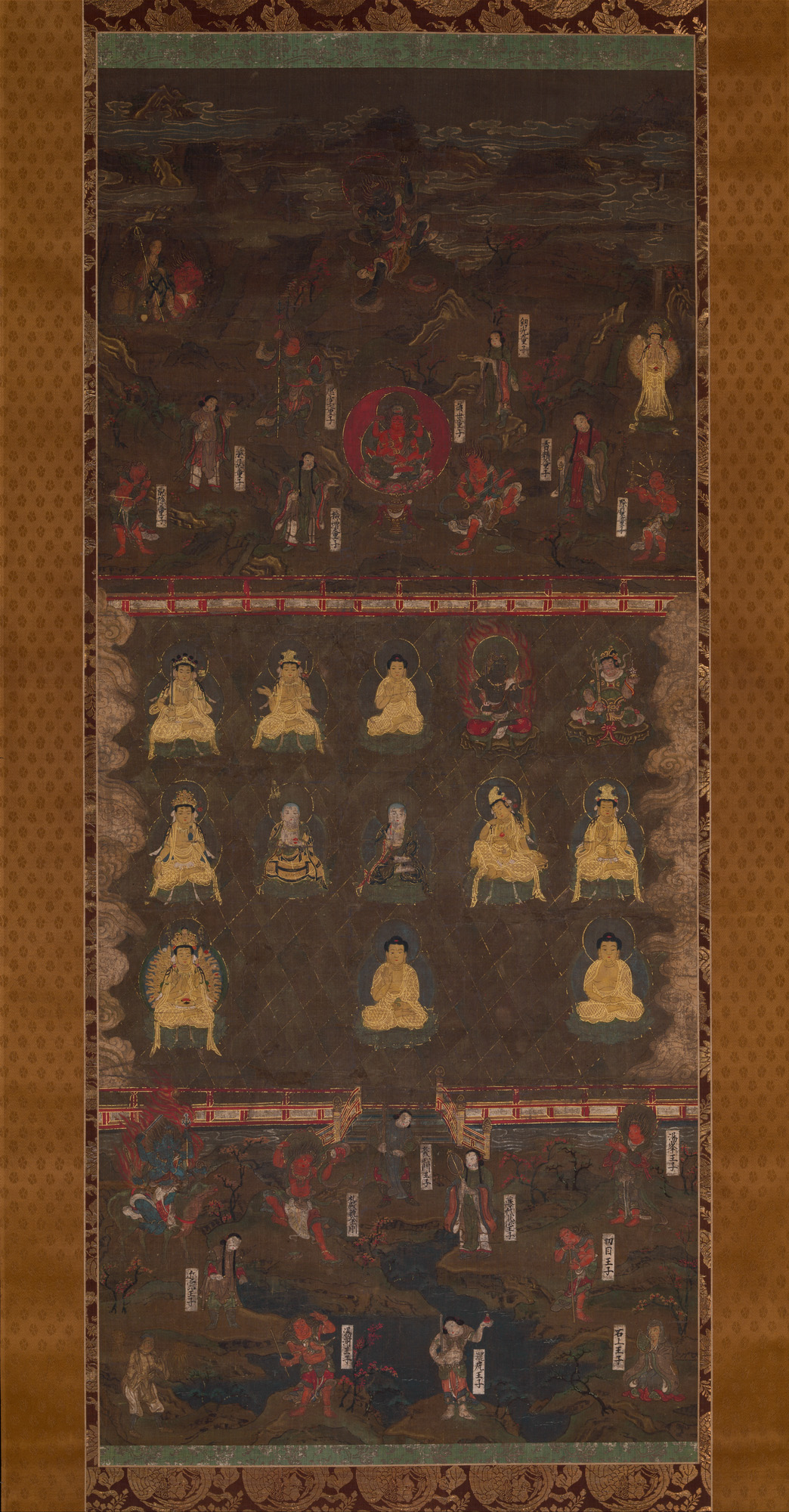
Met 2006.521. Three shrines stacked vertically, three honji Buddhas in gold discs, one of the cleanest surviving compositions of the Kumano shrine-mandala genre in an American collection.
A medieval Japanese pilgrim who walked to Kumano was promised three Pure Lands at one site. The mandala makes that promise legible.
That sentence is the article’s organising claim. The Met’s Mandala of Kumano Shrine (accession 2006.521, Nanbokuchō period, early fourteenth century) is the cleanest American-collection image of the doctrinal manoeuvre the Kumano cult performed across the late Heian and Kamakura periods: the binding of three separate shrines, three separate kami, three separate Buddhist Pure Lands, into one pilgrimage circuit on a single peninsula.
Three Pure Lands at one mountain
The Kumano Sanzan (the three Kumano grand shrines) are physically scattered across the southern Kii peninsula in present-day Wakayama Prefecture. Kumano Hongū Taisha sits inland on the Kumano River. Kumano Hayatama Taisha (the Shingū shrine) is at the river’s mouth on the Pacific coast. Kumano Nachi Taisha is in the mountains to the south, beside the 133-metre Nachi Falls. The medieval pilgrimage route (the Kumano Kodō) connected the three over several days of mountain walking from any of the major approaches.
The doctrinal binding came later, and harder. By the late Heian period the kami of each shrine had been paired with a Buddhist honji (original ground) under the honji-suijaku combinatory system. The pairings stabilised into a remarkable three-way symmetry:
| Kumano shrine | Kami | Honji Buddha | Pure Land |
|---|---|---|---|
| Hongū | Ketsumimiko-no-Ōkami | Amida Nyorai | Western (Sukhāvatī) |
| Shingū / Hayatama | Hayatama-no-Ōkami | Yakushi Nyorai | Eastern (Lapis Lazuli) |
| Nachi | Fusumi-no-Ōkami | Senju Kannon | Southern (Potalaka) |
Three pilgrimage destinations. Three kami. Three Buddhas. Three Pure Lands, mapped onto three of the cardinal directions of cosmic Mahayana geography. The Kumano cult was effectively claiming that the entire universal-soteriological map was walkable in a week.
Susan C. Tyler, writing in Japanese Journal of Religious Studies 16/2-3 (1989), treats the honji-suijaku system as a combinatory paradigm rather than a syncretic compromise. The kami are not Buddhist deities in disguise, and the Buddhas are not foreign overlays on a Shinto substrate. They are paired manifestations of one institutional reality. The Kumano mandala is the visual condensation of that argument. The three Buddhas painted in gold discs above the three shrines are not visiting; they are the doctrinal ground of the institution that the shrines house.
Stacked, not bird’s-eye
Kumano shrine mandalas do not work the way Kasuga shrine mandalas work. The Kasuga miya mandara lifts the viewer above the Nara shrine compound and lays out a bird’s-eye plan. The eye climbs a single road through a unified architectural site to a single sacred mountain. The Kasuga composition is geographic.
Met 2006.521 inverts that strategy. The three Kumano shrines are stacked vertically up the silk in a sequence that does not correspond to any physical viewpoint a person could ever occupy. There is no single ridge above the Kii peninsula from which Nachi appears directly above Shingū which appears directly above Hongū. The composition is not geographic. It is doctrinal. The three shrines are arrayed in the order the cult itself assigned them: Nachi at the apex because Senju Kannon’s compassion is the highest expression of the bodhisattva ideal, Shingū in the middle because Yakushi’s healing function operates in the present world, Hongū at the base because Amida’s Pure Land is the destination at the journey’s end.
This is the chief iconographic distinction between the Kumano shrine mandala and the Kasuga shrine mandala. Both are miya mandara. Both encode honji-suijaku. But Kasuga reads as a virtual pilgrimage to one geographic site, and Kumano reads as a vertical doctrinal diagram of three sites collapsed into one image.
Nachi at the apex, the waterfall on the right
The upper register of Met 2006.521 is Nachi. The shrine sits on a forested ridge; the 133-metre Nachi Falls plunges down the right side of the silk, rendered in a slim vertical column of pale water against the dark mountain. Above the Nachi shrine hall, the first gold disc holds a small seated Buddha. That Buddha is Senju Kannon (the Thousand-Armed Kannon), though at the resolution available the thousand-arm convention is suggested rather than counted. The pairing is fixed: Nachi’s kami Fusumi-no-Ōkami is Senju Kannon’s suijaku.
Nachi Falls is not painted as a landscape feature beside the shrine. It is painted as the shrine’s core element. In the historical Kumano cult, the falls itself was the principal object of veneration at Nachi; the shrine architecture grew up around the falls as a sacred element predating the institutional shrine. D. Max Moerman, in Localizing Paradise: Kumano Pilgrimage and the Religious Landscape of Premodern Japan (Harvard Asia Center, 2005), treats the Kumano sites as a religious landscape, meaning that the topography itself is the object of devotion, with the shrine architecture functioning as the institutional housing of features that were already sacred. Painting Nachi Falls at full vertical scale on the silk preserves that priority. The falls is not decoration. It is the upper register’s actual subject.
Shingū in the middle, Hongū at the base
The middle register of the painting is the Hayatama Shrine at Shingū, the shrine at the mouth of the Kumano River where the river meets the Pacific. The shrine is shown on a river bend with cedar groves. Above the central hall, a second gold disc holds the seated figure of Yakushi Nyorai, the medicine Buddha. The Shingū kami Hayatama-no-Ōkami is Yakushi’s suijaku. Yakushi’s Pure Land in Mahayana cosmography is the eastern Lapis Lazuli realm. The Shingū’s physical position on the Pacific coast (east of the Hongū inland shrine) makes the doctrinal pairing geographically apt as well as theologically clean.
The lower register is Hongū. The shrine sits on a sandbar between water courses, a topographically specific composition: the historical pre-1889 Hongū site was on a flat sand plain at the confluence of the Kumano, Otonashi, and Iwata rivers. (The shrine was relocated to its current hillside site after a catastrophic 1889 flood; the painting predates the relocation by some five and a half centuries and shows the older topography.) Above the Hongū hall, the third gold disc holds Amida Nyorai. Hongū’s kami Ketsumimiko-no-Ōkami is Amida’s suijaku. Amida’s Pure Land is the western paradise of Sukhāvatī. The Hongū site at the base of the painting is the destination, the medieval pilgrimage’s culminating shrine, and the rebirth-pure-land that the Pure Land schools made the centre of late-Heian devotional life.
Small painted pilgrim figures thread the routes between the three shrines. The Met catalog tags include Buddhism, Bodhisattvas, Buddha, Deities, Shintō. The metadata classifies the painting as a Buddhist work; the actual content treats Buddhist and shrine-kami iconography as a single integrated system. That is the entire institutional argument of the Kumano cult.
Cleveland 1953.16 as the comparandum
The closest American-collection comparandum is Cleveland 1953.16, Mandala of the Three Shrines at Kumano (熊野宮曼荼羅図), 1300s, Kamakura–Nanbokuchō transition, John L. Severance Fund. Cleveland’s image at 134 × 62 cm is within a centimetre of Met 2006.521’s 131.9 × 57.9 cm. The iconographic program is the same: three shrines stacked vertically, Nachi at the apex with the waterfall, honji Buddhas in gold discs above each hall. Cleveland’s catalog text calls 1953.16 “a unique surviving example” of the three-shrines-architecturally-stacked composition.
The Met scroll substantially qualifies that “unique” claim. Two stacked Kumano mandalas in two major American museums (Cleveland’s 1953 Severance Fund purchase and Met’s 2006 Sackler-funded purchase) bracket what is in fact a small but real American holding of the genre. (The Smithsonian’s Freer Gallery holds further Kumano mandala material, including a triptych of separate Hongū / Shingū / Nachi panels at accession F1958.18, structured differently than the stacked single-scroll composition.) The Met scroll’s gold work in the upper register is slightly more emphatic than Cleveland’s; the Senju Kannon disc above Nachi is more visibly elaborated, but the underlying program is the same composition working a single iconographic template.
What survived of the Kumano cult
The 1868 shinbutsu-bunri edict ended the production of Kumano shrine mandalas as it ended the production of Kasuga shrine mandalas. The legal separation of kami worship from Buddhist practice meant that the central doctrinal claim of the genre (that the three kami of Kumano were also Amida, Yakushi, and Senju Kannon) could no longer be officially stated in religious art. The shrines remained; the temples that had operated alongside them were dismantled or repurposed; the mandala genre stopped.
What survived materially is split between Japanese institutions (Kumano Hayatama Taisha, Kumano Hongū Taisha, the Nachi temple complex itself, and several major Japanese museum holdings) and the late-twentieth-century American collections that emerged from the post-war Japanese antiquities market. The Met’s 2006 acquisition belongs to that latter wave. Cleveland’s 1953 acquisition is earlier than most American Japanese-religious-painting accessions, and the John L. Severance Fund attribution places it in the same Cleveland collecting program that funded the later Kasuga deer mandala (Cleveland 1988.19).
The political point is the same as for the Kasuga case. The Kumano shrine mandala is not a relic of an awkward Buddhist-Shinto compromise that Meiji modernity corrected. It is the trace of an institutional religious practice (the jingūji or shrine-temple system) that Meiji modernity criminalised, and one that organised the religious life of medieval Japan from at least the tenth century to the 1860s.
What the catalog is silent on
Three gaps remain after this reading. The first is the workshop attribution: Met 2006.521 is catalogued as unidentified artist. Comparable Kumano mandalas have in some cases been attributable to Kasuga-affiliated workshops, but the Met record does not commit to a workshop or atelier. The second gap is the prior provenance before the 2006 Sackler-funded Met purchase: the public catalog does not surface the immediate prior collection, the Japanese seller, or the date of the painting’s most recent appearance on the Western market. The third is the small-scale identification of the disc Buddhas at present image resolution: the three Buddhas are iconographically clear at the institutional level (Amida above Hongū, Yakushi above Shingū, Senju Kannon above Nachi), but at the resolution of the open-access image file the thousand-arm convention cannot be independently verified on the Nachi Senju Kannon disc, and defers to the published iconographic literature on that identification.
These are catalogue-text gaps and resolution gaps, not reading-disagreement gaps. The iconographic identification (three shrines, three honji Buddhas, three Pure Lands) is stable across the Met API record, Tyler 1989, Moerman 2005, and the Cleveland 1953.16 comparandum.
Related
Sources
-
Met API record (object 73370) confirms Public Domain status, image dimensions 131.9 × 57.9 cm, Nanbokuchō dating, and the 2006 Sackler purchase credit line. Tags include Buddhism, Bodhisattvas, Buddha, Deities, Shintō — Met curatorial classification aligns with honji-suijaku iconographic reading.
-
[2]2026-05-13The Metropolitan Museum of Art (Open Access API) collectionapi.metmuseum.org/public/collection/v1/objects/73370 -
The closest American-collection comparandum to Met 2006.521 — same iconographic program (three shrines stacked vertically, Nachi at top with waterfall, honji Buddhas in discs above each hall), close to identical scale. The Cleveland catalog text calls 1953.16 'a unique surviving example' of the three-shrines-architecturally-stacked composition; Met 2006.521 substantially complicates that 'unique' claim. The two scrolls should be read in tandem.
-
Standard English-language theoretical statement of the *honji-suijaku* doctrine as a combinatory system rather than a syncretic compromise. Tyler treats the Kumano cult alongside Kasuga as one of the two major late-Heian-into-Nanbokuchō shrine cults that built mandala iconography around the doctrinal pairing.
-
Standard English-language monograph on the Kumano cult. Moerman frames Kumano not as a single shrine site but as a *religious landscape* — the entire Kii peninsula treated as the operative devotional terrain. The Kumano shrine mandala is the visual condensation of that landscape.
-
Grapard on the longer institutional history of shrine cults and the *jingūji* (shrine-temple) combinatory pattern; useful background for the Kumano case even though the article's primary subject is the later Yoshida re-codification.
-
Cleveland's text names the bird's-eye perspective, the stacked three-shrine composition with Nachi at the apex and Hongū at the base, and the discs of honji Buddhas placed directly above each hall. The same reading transfers to Met 2006.521 with minor variations in the proportional treatment of the Nachi waterfall.
-
Citation-of-a-citation: the Yamamoto reading of Kumano mandala iconography is mediated to bodhi via Moerman 2005's discussion. Not directly verified; page anchor and primary text not yet located.