Two Kasuga shrine mandalas, twenty-two years apart
- Title
- Kasuga Mandala (春日曼荼羅)
- Period
- Kamakura period (1185–1333), 13th century
- Region
- Japan
- Medium
- Hanging scroll; ink, color, and gold on silk
- Dimensions
- Image 90.2 × 42.5 cm; overall with mounting 161.3 × 58.7 cm
- Collection
- The Metropolitan Museum of Art
- Accession
-
1993.446 - Rights
- The Metropolitan Museum of Art, Open Access (Public Domain). Gift of Takemitsu Oba, 1993.
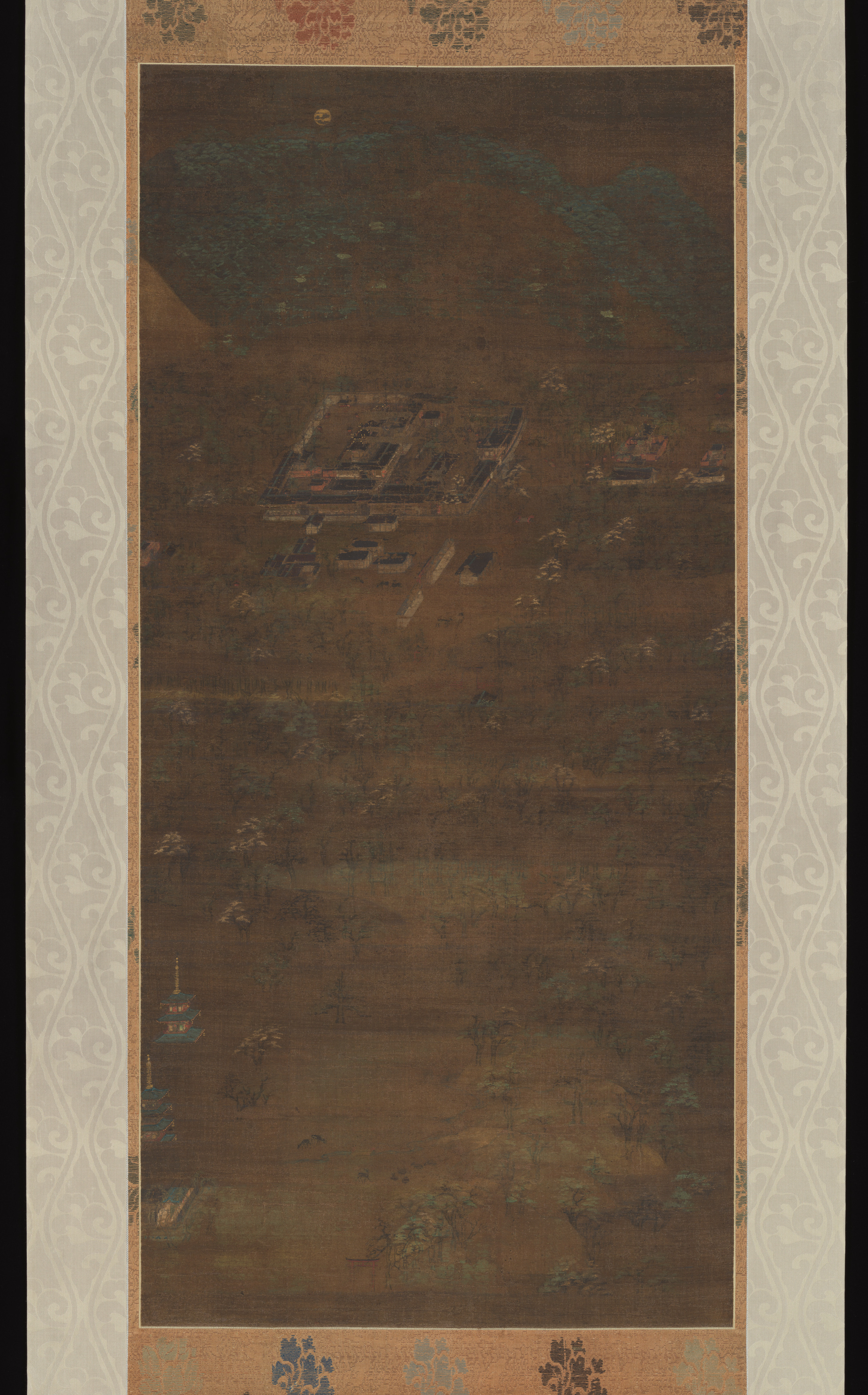
Met 1993.446. The earlier of the Met's two Kasuga shrine mandalas. The bird's-eye view collapses the actual east-of-Nara approach to Kasuga Taisha into a single vertical climb up the silk.
Two Kasuga shrine mandalas, twenty-two years apart, both bird’s-eye, both Kamakura. Neither one shows a deer carrying a disc.
That distinction is the article. The deer-and-disc composition (the one most readers reach for first when they hear Kasuga mandala) is a different iconographic strategy of the same cult, treated separately on bodhi at Kasuga deer mandala: five kami as five Buddhas at Cleveland 1988.19. The Met’s two scrolls work the other strategy: the Kasuga miya mandara (春日宮曼荼羅), the shrine-as-map. They were made for a viewer who could not get to Nara, and they are organised so that the eye can.
The bird’s-eye road in
Both Met scrolls open at the bottom margin with a pale path entering from below. The path is the painting’s first instruction. It tells you where to start, and it tells you that the painting is to be walked.
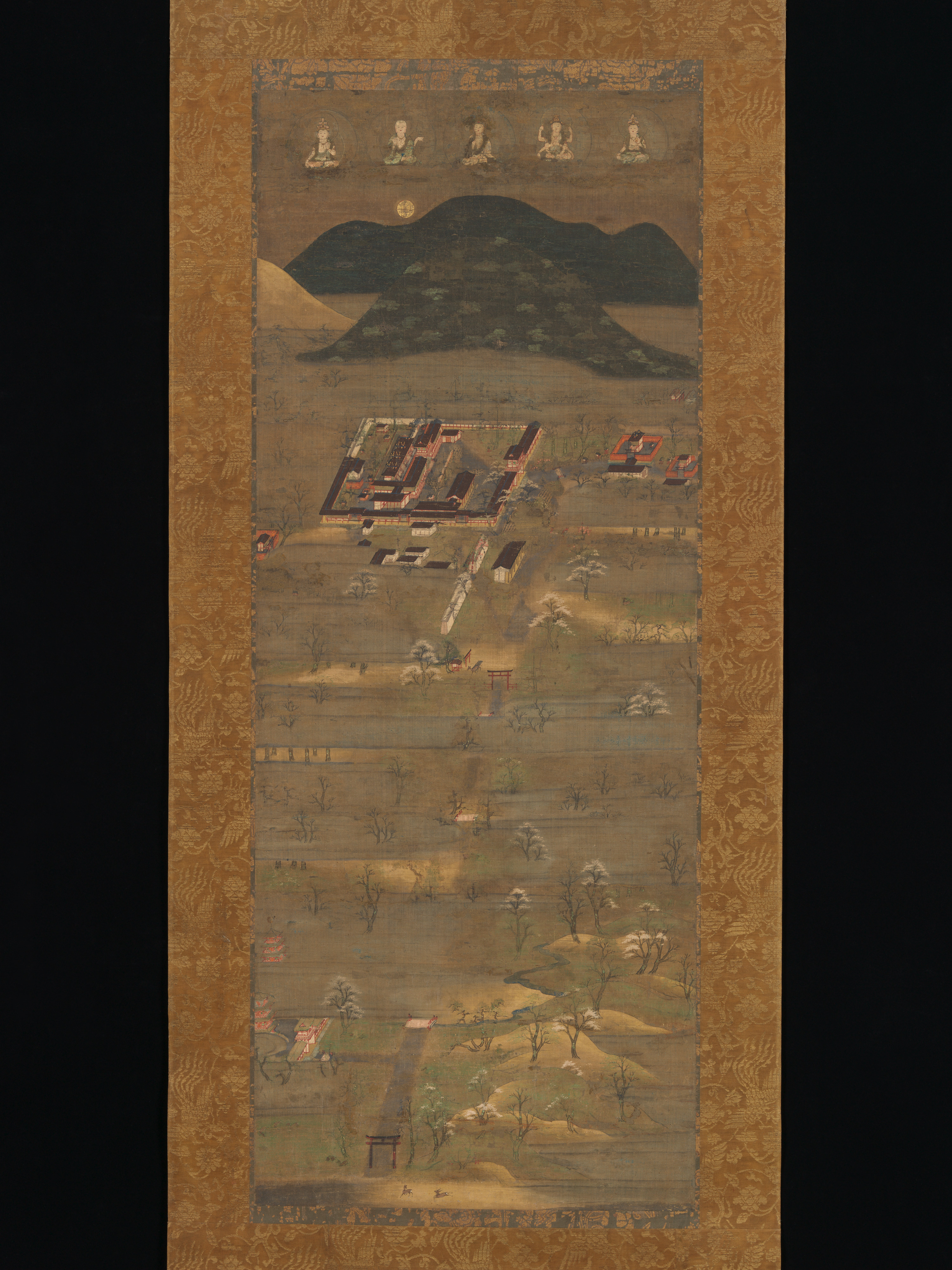
On Met 1993.446 the path enters from below right and switches back up the silk through a band of low trees; the same maneuver is sharper on Met 2015.300.12, where the path threads visibly between two pine clusters before it reaches the gate of the shrine compound. In both cases the path stops at the first hall (the Daiichi-den, the First Hall) and the eye is delivered into the architecture without ever being told it has arrived. This is the convention. Susan C. Tyler, in The Cult of Kasuga Seen through Its Art (Michigan, 1992), describes the shrine mandala as designed for viewing as a virtual pilgrimage: an aristocratic devotee in Kyoto, or a Fujiwara cadet branch settled outside Nara, could unroll the scroll in a household chapel and walk the eye up the silk to a site they could not physically reach. The Met’s own published copy on this iconography uses the same phrase. Tyler’s argument is not metaphorical. The path is not a compositional device; it is the entry of the mandala’s spatial logic.
What follows the path is the compound itself. Five halls: four roofed buildings in a row, then a fifth detached structure to the right. These are the four main honden of Kasuga Taisha plus the Wakamiya shrine, the subsidiary fifth that the medieval cult counted as part of the same site. Sacred deer move through the trees between the halls. Above the architecture, a low forested range rises — Mount Mikasa, the literal hill east of the shrine. Above the mountain, five small standing Buddha-figures float on stylised cloud.
The compound is doctrinally specific; the bird’s-eye angle is the painting’s claim to legitimacy.
Mount Mikasa as map and as map’s pivot
Mount Mikasa is not painted symbolically. It is the actual hill (about 295 metres above sea level) that rises directly east of Kasuga Taisha, a hill that the shrine’s east-facing approach orients toward. Pilgrims on the ground see the mountain through the trees behind the honden. The shrine mandala lifts the viewing eye above the trees and rotates the geography flat. The viewer is given the south-to-north climb of the actual pilgrimage road, but seen from a height no human ever stood at.
That maneuver matters because it is also the mandala’s pivot. The five honji Buddhas above the summit are not in the sky in the sense that they descend; they are of the mountain, the doctrinal ground that Mount Mikasa visually props up. Allan Grapard, in The Protocol of the Gods (California, 1993), reads the Kasuga–Kōfuku-ji complex as a single jingūji, a shrine-temple institution that did not separate kami worship from Buddhist practice until Meiji legislation forced the separation in 1868. The shrine mandala makes Grapard’s argument visually. The Buddhas above the mountain are the honji (original ground) of the Kasuga kami housed in the halls below. The mountain in between is not a barrier. It is the literal hinge: a hill that is both real geography and the upward axis of the doctrine.
This is the chief difference from the deer-mandala iconography. In the deer mandala the Buddhas sit inside a single gold disc carried down the mountain on the back of a sakaki-bearing white deer; the doctrinal claim is compressed into a portable theophany. In the shrine mandala the Buddhas stand in line above their literal mountain; the doctrinal claim is spatially distributed across the institution they ground.
Met 1993.446: the Oba scroll
Met 1993.446 is the earlier of the two. The catalog dates it to the thirteenth century, Kamakura period; the Met OA API record (object 44885, accessed 2026-05-13) gives the image dimensions as 90.2 × 42.5 cm, hanging scroll, ink color and gold on silk. The credit line is Gift of Takemitsu Oba, 1993.
The composition is the tighter of the two. The path enters narrowly at lower right. The shrine compound occupies a smaller share of the picture plane than on the Burke scroll; the mountain rises modestly behind it; the five Buddhas above the summit are small in the silk and rendered with restraint in the cloud beneath them. The palette is cool: muted reds and ochres in the shrine halls, dark green for the forest, a paler band of sky in the uppermost margin. The gold passages are restrained, concentrated at the halos of the upper Buddhas and along selected roof lines.
The Oba 1993 provenance is the unfamiliar element. The Met’s accession record names the donor as Takemitsu Oba; the donor’s biographical record is thin in English-language scholarship, and the scroll’s prior provenance (which Japanese collection it left, and when) is not surfaced in the Met’s open catalog text. This remains an open question. What is clear is that the gift falls roughly halfway between the 1975 Packard wave and the 2015 Burke bequest, and that 1993.446 is therefore the Met’s Kasuga shrine mandala from the long American-collecting decade that connected those two larger transfers.
Met 2015.300.12: the Burke scroll
Met 2015.300.12 is the later of the two. The Met OA API record (object 53186, accessed 2026-05-13) returns Mandala of Kasuga Shrine, Kamakura period, early 14th century, 100.2 × 39.7 cm, hanging scroll, ink color and gold on silk. The credit line is the Mary Griggs Burke Collection, Gift of the Mary and Jackson Burke Foundation, 2015.
The Burke scroll runs taller (ten centimetres longer in the image, a noticeable difference at this format) and the composition responds. The shrine compound is more elaborated: the five halls are individually detailed where the Oba scroll generalises them, and the deer in the trees between the halls are smaller and more numerous, suggesting closer observation of the actual Nara herd. The mountain behind the shrine is proportionally taller. The five Buddhas above the summit occupy more of the upper register, and the gold is distributed more evenly through the top third of the silk: at the halos, at the cloud, and along the upper edges of the mountain.
Two things follow from the comparison. The first is iconographic: by the early fourteenth century the genre’s vertical proportions have stretched, the upper register has been given more weight, and the doctrinal layer above the mountain is asserting itself more visibly. The second is workshop-historical: the two scrolls are not by the same hand, and not from the same workshop, but they are clearly working a single shared template. The variation between them is the variation between two iterations of a stable, institutionally-rooted production type.
Five Buddhas above, sacred deer below
The five Buddhas above the mountain on both scrolls are the honji of the five Kasuga shrine kami. The conventional pairings, stable through the medieval period:
| Kasuga shrine hall | Kami | Honji Buddha or bodhisattva |
|---|---|---|
| First Hall | Takemikazuchi | Fukūkenjaku Kannon |
| Second Hall | Futsunushi | Yakushi Nyorai |
| Third Hall | Amenokoyane | Jizō Bosatsu |
| Fourth Hall | Himegami | Jūichimen Kannon |
| Wakamiya | Wakamiya-no-mikoto | Monju Bosatsu |
The order in which the five Buddha-figures stand from left to right in the painted register above the mountain is not arbitrary in the surviving corpus, but at the scale of either Met scroll bodhi cannot reliably resolve which Buddha is in which position from the open-access image alone. The Cleveland 2015.137 catalog text names the five-Buddha presence without committing to specific left-to-right identifications. This is one place where bodhi’s reading defers: the small-scale resolution above the mountain rewards in-person inspection, which this reading has not had.
The sacred deer below are easier to read. They are the descendants (in the Kasuga foundation legend) of the white deer that carried the kami Takemikazuchi from Kashima Shrine in the east to Mt. Mikasa in 768. The Met OA tags on object 44885 include Temples; the deer pass without explicit metadata. They are part of the compound, not a separable iconographic layer.
Two American gifts, twenty-two years apart
Takemitsu Oba’s 1993 gift placed a Kamakura shrine mandala in the Met when the Met held no major shrine-mandala example. Mary Griggs Burke’s 2015 bequest doubled that holding. Between those two moments runs the long arc of late-twentieth-century American collecting of Japanese religious painting: a period in which a small handful of donors and one major collector built American museum holdings in the genre from near-zero to substantial.
The Met’s 2015 press materials on the Burke bequest name Mandala of Kasuga Shrine (acc. 2015.300.12) explicitly among the donated works. The Oba 1993 record is thinner. What the two acquisitions share is the type of object: Japanese religious painting from medieval institutional contexts, neither paintings nor sculpture from the secular Edo or Meiji art markets that dominated earlier American collecting waves. The shift visible across these two acquisitions is the same shift visible in the parallel Heian Shingon album case: by the 1990s and 2010s, the works being moved were institutionally-rooted devotional objects, not aesthetic exemplars. (Bodhi treats the parallel album case separately at Met 1975.268.8 and 2015.300.4: two Tametō album pages, forty years apart.)
Sister mandalas, not equivalent works
The reader who has come to this article from the Kasuga deer mandala piece needs the distinction restated. Both genres encode honji-suijaku doctrine. Both are products of the Kasuga–Kōfuku-ji combinatory institution. Both stop being produced after the 1868 Meiji shinbutsu-bunri edict. But they are not interchangeable, and the institutions that owned them used them differently.
The shrine mandala is the map. It locates the institution, names the halls, walks the eye up the path, and ends with the doctrinal layer above the mountain. Its primary devotional function (per Tyler 1992) is the virtual pilgrimage. The viewer who unrolls it is performing a journey.
The deer mandala is the theophany. It folds the institution into a single descending event: the deer of Takemikazuchi carrying the gold disc of the five Buddhas down from Mt. Mikasa, on cloud. Its primary devotional function is recognition. The viewer who unrolls it is witnessing.
A reader interested in shrine geography and the institutional logic of honji-suijaku should sit longer with the shrine mandalas. A reader interested in the doctrinal compression (five kami as five Buddhas as one descending event) should sit longer with the deer mandala. Both Met scrolls discussed here belong to the first group.
What the catalogs are silent on
Three gaps. The first is the Oba provenance: the Met’s open record names Takemitsu Oba as donor but does not surface the prior chain: which Japanese institution or private collection the scroll left, and when. The second is the left-to-right Buddha order on the upper register of either scroll: the iconographic convention is stable in the broader corpus but not consistently surfaced in the published catalog text for these two examples. The third is the lower-margin path’s terminus on the Oba scroll: the path enters cleanly but its junction with the first shrine hall is read more by inference than by clear visual evidence at the resolution available.
These are catalogue-text gaps, not reading-disagreement gaps. None of them undermines the iconographic identification or the dating, which are stable across the Met API record, the Cleveland 2015.137 comparandum, and Tyler 1992.
Related
- The Four Deities of Mt. Kōya — Shingon’s own shrine mandala
- Kasuga deer mandala: five kami as five Buddhas at Cleveland 1988.19
- Met 1975.268.8 and 2015.300.4: two Tametō album pages, forty years apart
- Yūzū nenbutsu engi: an illuminated handscroll
- Amida raigō: the welcoming descent
- The Nine Luminaries and the Seven Stars descending at Kasuga
Further works cited
- Title
- Mandala of Kasuga Shrine (春日宮曼荼羅)
- Period
- Kamakura period (1185–1333), early 14th century
- Region
- Japan
- Medium
- Hanging scroll; ink, color, and gold on silk
- Dimensions
- Image 100.2 × 39.7 cm; overall with mounting 183.5 × 55 cm
- Collection
- The Metropolitan Museum of Art
- Accession
-
2015.300.12 - Rights
- The Metropolitan Museum of Art, Open Access (Public Domain). Mary Griggs Burke Collection, Gift of the Mary and Jackson Burke Foundation, 2015.
Met 2015.300.12. The Burke scroll. Roughly fifty years later than the Oba scroll, with the mountain pushed proportionally taller and the gold passages distributed more evenly through the upper register.
Sources
-
Met API record (object 44885) returns full PD status, image dimensions 90.2 × 42.5 cm, and the Oba 1993 credit line. The catalog entry text on the Met's public page is currently rate-limiting against WebFetch; the iconographic reading here is built from the API record, the high-resolution image file, and the published Cleveland 2015.137 catalog text on the same genre.
-
Met API record (object 53186) returns full PD status, image dimensions 100.2 × 39.7 cm, and the Burke 2015 credit line. The title is the longer 'Mandala of Kasuga Shrine' (春日宮曼荼羅); the iconography is the bird's-eye shrine-compound map, not the deer-and-disc composition of the Burke deer mandala held at the same museum.
-
[3]2026-05-13The Metropolitan Museum of Art (Open Access API) collectionapi.metmuseum.org/public/collection/v1/objects/44885 -
[4]2026-05-13The Metropolitan Museum of Art (Open Access API) collectionapi.metmuseum.org/public/collection/v1/objects/53186 -
Cleveland 2015.137 is the third American-collection Kasuga shrine mandala (and the comparandum that grounds this article's iconographic reading where the Met text is rate-limited). The Cleveland catalog text spells out the bird's-eye composition, the five shrine halls, the deer, and the five honji Buddhas standing on cloud above the mountain — the same iconographic program as both Met scrolls.
-
[6]— Center for Japanese Studies, University of Michigan (Michigan Monograph Series in Japanese Studies, Vol. 8) print referenceThe standing English-language monograph on the Kasuga visual corpus. Tyler treats the shrine mandala (miya mandara) and the deer mandala (shika mandara) as two iconographic strategies of one cult — the former mapping the institution, the latter compressing its doctrine. The framing of viewing the shrine mandala as a *virtual pilgrimage* to a site the viewer cannot physically reach is Tyler's; the Met's own catalog text on the genre uses the same phrase.
-
Grapard reads the Kasuga–Kōfuku-ji complex as a single *jingūji* (shrine-temple) institution rather than two adjacent religious establishments. The shrine mandala makes that argument visually: the five Buddhas above the mountain are not visiting; they are the doctrinal ground of the institution that the painted compound houses.
-
The 2015 announcement that establishes the Burke 2015 gift as the largest single donation of Japanese art in Met history. The Kasuga shrine mandala (2015.300.12) is one of the works named in the press materials.