Kasuga deer mandala: five kami as five Buddhas at Cleveland 1988.19
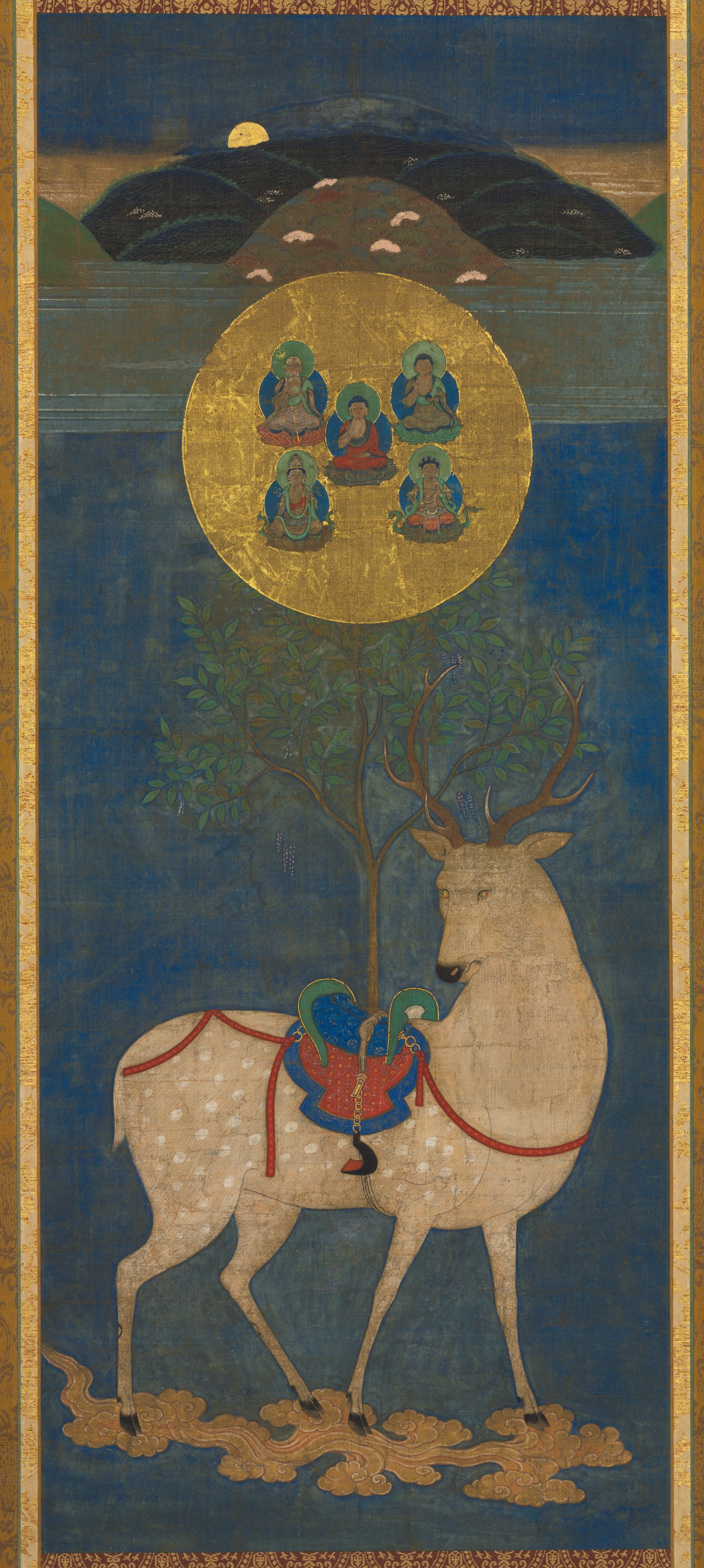
- Title
- Kasuga Deer Mandala — 春日鹿曼荼羅
- Period
- Nanbokuchō (1336–92) to Muromachi (1392–1573) period, mid-1300s to 1400s
- Region
- Japan, Nara
- Medium
- Hanging scroll; ink, color, and gold on silk
- Collection
- Cleveland Museum of Art
- Accession
-
1988.19 - Rights
- Cleveland Museum of Art, 1988.19 — CC0 (Open Access). John L. Severance Fund.
Cleveland 1988.19. The five Buddhas inside the gold disc are the *honji* — original ground — of the five Kasuga shrine kami. The deer is Takemikazuchi's messenger; the dark range above is Mt. Mikasa, the literal sacred geography immediately east of the shrine.
The deer carries a portable Pure Land. That is the operative claim of every Kasuga deer mandala — and Cleveland 1988.19 makes it about as concentrated as the genre gets.
What you’re looking at
Tall narrow silk, indigo at near-night density, the painting reads bottom-up. A white deer stands in profile on a low bank of golden cloud, the kind of cloud Heian and Kamakura painters reserve for the descent of holy presence. The deer is spotted, head turned slightly toward the viewer, an embroidered red-brocade saddle on its back. Out of the saddle rises a green sakaki branch — the Shinto offering tree, not a Buddhist motif. From the sakaki the picture’s logic switches: a large pale-gold disc floats above the branch, and inside the disc are five seated Buddhas. One sits centered and slightly larger; four sit around it in a compressed ring. Upper register, a low dark range of mountains and a small gold moon to the right.
The deer is the suijaku — the local Japanese trace. The five Buddhas are the honji — the cosmic ground. The mountain is the literal geography of Nara: Mt. Mikasa, directly east of Kasuga shrine, the mountain the deer is descending. That is the entire painting.
Five kami, five Buddhas
The Kasuga shrine venerates five kami. Kōfuku-ji, the Fujiwara clan’s Hossō-school temple, sits within walking distance — close enough that the two institutions functioned as one jingūji complex from at least the Heian period. The clergy of Kōfuku-ji identified each Kasuga kami with a Buddhist honji. The pairings stabilised by the late Heian and held through the medieval period:
| Kasuga shrine hall | Kami | Honji Buddha or bodhisattva |
|---|---|---|
| First Hall | Takemikazuchi | Fukūkenjaku Kannon |
| Second Hall | Futsunushi | Yakushi Nyorai |
| Third Hall | Amenokoyane | Jizō Bosatsu |
| Fourth Hall | Himegami | Jūichimen Kannon |
| Wakamiya | Wakamiya-no-mikoto | Monju Bosatsu |
The five Buddhas inside the gold disc on Cleveland 1988.19 are these five. The painting is not generic. It maps a specific shrine, a specific clan’s tutelary site, onto a specific cosmic pantheon. Allan Grapard’s reading of the Kasuga–Kōfuku-ji complex as a single combinatory institution rather than two parallel ones is the framework that makes the painting legible: the deer doesn’t translate between religions because there are not yet two religions to translate between.
The deer of Takemikazuchi
The deer is not decorative. According to the Kasuga foundation legend, in 768 the kami Takemikazuchi descended from Kashima Shrine in the east, riding a white deer westward to Mt. Mikasa to take up residence at the new Kasuga shrine the Fujiwara had built. The deer of Nara today — the protected herd that wanders Nara Park — are the legendary descendants of that mount. To kill a Nara deer was a capital crime through the Edo period.
The painting collapses the legend into a single image. The deer descending Mt. Mikasa, alone, on cloud, carrying the saddle that supports the sakaki that holds the honji disc — this is Takemikazuchi himself arriving, except instead of Takemikazuchi the painting shows his Buddhist honji identity, and instead of one kami the painting shows all five. It is the descent of the entire shrine pantheon as a single Buddha-revealing event.
Wisteria, mirror, mountain
Two secondary readings circulate in the scholarly literature, and Cleveland 1988.19 supports them at different strengths.
The first reading is Fujiwara. The wisteria (fuji) is the clan’s homophonic emblem; some Kasuga deer mandalas include a wisteria vine wrapped through the composition, marking the painting as a Fujiwara-clan devotional object more than a generic Buddhist one. The Sainsbury catalog entry on the genre notes this reading explicitly, citing Mariko Mimi Yiengpruksawan on the painting’s role in clan ritual life. Cleveland 1988.19 does not foreground a wisteria motif as strongly as some examples — the reading here defers to the broader corpus on this point.
The second reading is Amaterasu. Where a small mirror appears in the upper register of a Kasuga deer mandala — usually near the mountain, sometimes near the sun-disc — Sano Midori has read it as a nod to Amaterasu, the sun-goddess of Ise, and through her to the imperial line that the Fujiwara served as regents. This reading is not universal, and the Cleveland scroll’s upper register is dominated by the dark Mt. Mikasa range and the small gold moon — there is no strong mirror motif in this example. The reading is included here because it is live in the literature, and because the genre’s iconography is interpretable across more than one register at once. Where a Kasuga deer mandala includes the mirror, Sano’s reading is the most-cited route into it.
The mountain itself is the most reliable reading. Mt. Mikasa is the literal hill behind Kasuga shrine. Painted as a low dark range above the sacred disc, it locates the painting geographically: Nara, this specific shrine, this specific east-facing approach. The compression is doctrinal but the geography is real.
The genre across institutions
Cleveland 1988.19 is one of seven known institutional examples of the Kasuga deer mandala genre held outside Japan in major collections accessible to English-language scholarship:
| Institution | Accession | Period | Medium notes |
|---|---|---|---|
| Cleveland Museum of Art | 1988.19 | Nanbokuchō–Muromachi, mid-1300s–1400s | Ink, color, and gold on silk |
| The Metropolitan Museum of Art | 2015.300.11 (Burke) | Kamakura, late 13th–early 14th c. | Ink, color, gold, silver on silk |
| The Metropolitan Museum of Art | 2015.300.12 (Burke) | Nanbokuchō, 14th c. | Ink, color, gold, silver, cut gold on silk |
| Sainsbury Institute | 1188 (cat.) | medieval | catalog reference |
| Yale University Art Gallery | 127244 | medieval | accession publicly listed |
| MOA Museum (Atami) | varies | medieval | multiple holdings |
| The Art Institute of Chicago | 12032 | medieval | accession publicly listed |
The two Met Burke-collection scrolls (2015.300.11 and 2015.300.12) are the closest comparanda by date and iconographic program; both are Public Domain under Met Open Access, and the Burke catalog text — and the Met’s curatorial summaries — track Cleveland’s reading closely. The Met Kamakura scroll predates Cleveland by perhaps a century, and the deer is rendered with proportionally squarer proportions and the disc Buddhas occupy a larger share of the picture plane. The Met Nanbokuchō scroll, contemporary with Cleveland, is the more direct comparandum: Mt. Mikasa is rendered with shrine architecture nestled at its base, where Cleveland’s mountain is a dark range without explicit shrine notation.
The cross-institutional landscape matters because Kasuga deer mandalas were not luxury one-offs. They were the standard devotional image of an elite Nara cult that had branches and patrons throughout the medieval Japanese aristocracy. Seven known examples in major non-Japanese collections is a small sample of a corpus that ran into the hundreds.
After 1868: what survived, where
The Meiji government’s 1868 shinbutsu-bunri edict — the formal separation of kami worship from Buddhist practice — ended this genre. Helen Hardacre’s Shinto: A History (2017) tracks the institutional consequences in detail. Kōfuku-ji was among the more severely disrupted sites: monks were laicised or forced out, Buddhist halls were demolished or repurposed, and the Hossō-school institutional infrastructure that had given the Kasuga deer mandala its doctrinal and patronage logic was dismantled in the space of a few years. The mandala genre stopped being made because the religious framework that authorised it had been outlawed.
The paintings survived in three ways. A portion remained at the shrine and temple themselves, the disruption notwithstanding. A portion entered the Japanese antiquities market in the 1870s–1900s, when temple holdings were under economic pressure, and from there moved into private Western collections (the Mary Griggs Burke Collection at the Met being the major late-twentieth-century instance). A smaller portion entered Japanese museums directly. Cleveland 1988.19 came to Ohio through the latter twentieth-century market; the John L. Severance Fund accession credit places the acquisition in the late 1980s.
The political point is harder than it looks. The painting is not a relic of a syncretism that Meiji modernity corrected. It is the trace of a religious practice that Meiji modernity criminalised, and one that — by every account in the scholarly literature on the period — had been the normal religious situation of most Japanese for the better part of a thousand years.
Where the reading commits and where it varies
The reading commits to: five Buddhas equals five kami; the deer is Takemikazuchi’s messenger; the mountain is Mt. Mikasa; the painting is doctrinally specific to the Kasuga–Kōfuku-ji complex; the indigo silk and gold disc together encode a Pure Land visualisation displaced onto a Japanese shrine site.
The reading defers on: which specific honji sits in the central versus the surrounding positions of the disc (the convention is regular but not invariant across the surviving corpus, and Cleveland’s small disc rewards close-up inspection more than this resolution allows); whether the small gold object in the upper-right register is a moon-disc, a sun-disc, or a stylised mirror (Sano Midori’s mirror-reading would require a higher-resolution inspection than has yet been possible on the Cleveland silk); how heavily to read the Fujiwara-clan political layer in this specific example versus the genre at large (the Sainsbury catalog and Yiengpruksawan press harder on it than the Met curatorial summaries do).
What the reading does not defer on is the doctrinal point. Honji-suijaku was not a polite ecumenism. It was the operative theology of educated medieval Japan, and the Kasuga deer mandala is its most efficient single image.
Related
Sources
-
Cleveland's catalog identifies the work as a hanging scroll of the Kasuga Deer Mandala genre, painted in ink, color, and gold on silk; dated to the Nanbokuchō–Muromachi transition (mid-fourteenth to fifteenth century). The descriptive text frames the painting as a visualization of the *honji-suijaku* doctrine connecting Kasuga shrine and Kōfuku-ji temple.
-
Met OA API record confirms public domain (CC0). The Burke-collection Nanbokuchō Kasuga deer mandala; gold, silver, and cut gold on silk; the upper register reads explicitly as Mt. Mikasa with shrine architecture; the deer carries the same five-buddha disc. Comparandum: the closest Met holding to Cleveland 1988.19 by date and visual program.
-
The earlier of the two Met Kasuga deer mandalas in the Burke collection. Kamakura-period painting predating the Cleveland scroll by roughly a century; the iconographic program is the same but the deer is rendered with less elongated proportions and the gold-disc Buddhas occupy proportionally more of the picture plane. Useful for the diachronic comparison.
-
[4]2026-05-12Sainsbury Institute for the Study of Japanese Arts and Cultures (Cortazzi Collection / archive resource) sainsbury-institute.orgThe Sainsbury Institute catalog entry on a Kasuga deer mandala discusses the iconography with named-scholar citations: Yiengpruksawan on the Fujiwara-clan political context, Sano Midori on the secondary readings of the mirror and wisteria elements, and Stephen Little on the visual genre's relationship to the wider mandala tradition. Used as the source for the note that the secondary-reading literature treats the mirror motif (when present, in some examples) as a possible nod to Amaterasu and the wisteria as a Fujiwara clan signature. The Cleveland 1988.19 scroll itself does not foreground a mirror motif; the reading here defers to Sano Midori on examples where the mirror is present.
-
Standard English-language study of the Kasuga visual corpus. Cited here for the framework — the cult's integration of shrine geography (Mt. Mikasa) with Hossō-school doctrine at Kōfuku-ji — rather than for specific page-tied claims; no page anchors are given.
-
Frames the Kasuga–Kōfuku-ji *jingūji* (shrine-temple) complex as a single combinatory ritual institution; treats the *honji-suijaku* mapping not as later theological gloss but as the operative organizing logic of the cult from at least the early Heian period.
-
The standard theoretical re-framing of *honji-suijaku* as combinatory paradigm rather than syncretic compromise; useful for the prose framing 'not two religions but one combinatory practice.'
-
Cited for the Meiji 1868 *shinbutsu-bunri* edict that ended the production of the Kasuga deer mandala genre by enforcing the institutional and material separation of kami worship from Buddhist practice. The Kasuga–Kōfuku-ji complex was among the more disrupted sites.