The Kei school as a genealogy: reading a workshop through one bodhisattva
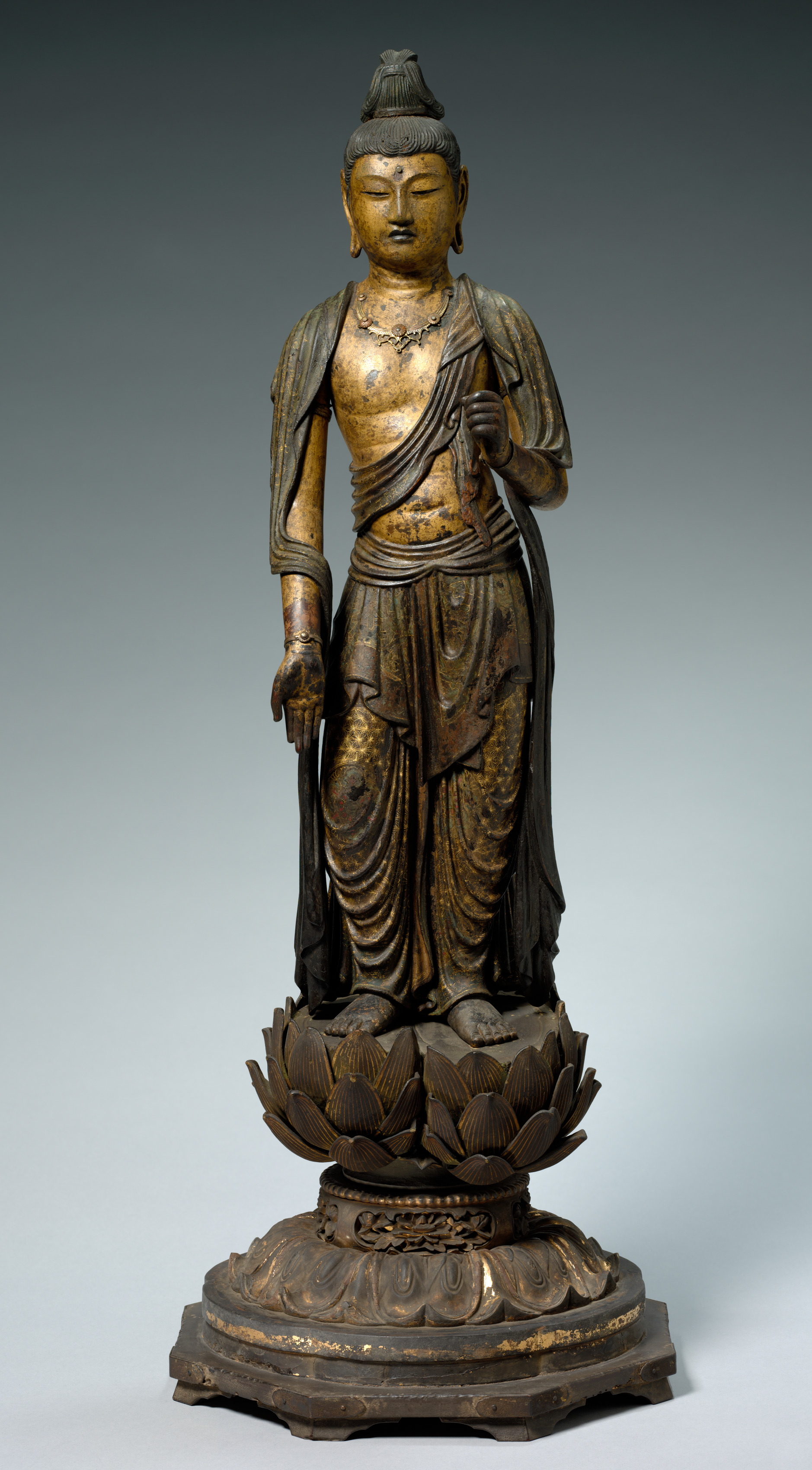
- Title
- Bodhisattva (Kannon / 観音菩薩像) — The Cleveland Museum of Art (acc. 1952.90)
- Period
- Kamakura period (1185–1333), c. 1200–1250
- Region
- Japan
- Medium
- Lacquered wood with color, gilt copper, and cut-gold (kirikane)
- Collection
- The Cleveland Museum of Art — Open Access
- Accession
-
1952.90 - Rights
- CC0 1.0 (public domain). The Cleveland Museum of Art, John L. Severance Fund, 1952 (acc. 1952.90). Cleveland Open Access; license re-confirmed via the Cleveland Open Access API on 2026-05-16.
With base 76.2 cm, figure 55.9 cm. Cataloged 観音菩薩像 (Kannon), a raigō attendant shown in motion. No signature, no deposit, no workshop attribution — read here as a node in the Kei lineage, not its author.
The Kei school was not a style but a workshop lineage of Nara busshi: Kōkei to Unkei to Tankei by blood and rank, Kaikei by skill alone. It transmitted authority through the shared 慶 character, the hokkyō–hōgen–hō-in ranks, and documents sealed inside the wood. Cleveland’s anonymous Kamakura Kannon (acc. 1952.90) is read here as what the lineage produced when the name fell off.
An object with no name on it
The Cleveland figure catalogued as Bodhisattva (acc. 1952.90; Cleveland id 130316) is a standing Kannon, Japanese, Kamakura period, dated by the museum to roughly the first half of the 1200s. The tombstone gives the medium as lacquered wood with color, gilt copper, and cut-gold leaf, and two heights: 55.9 cm for the figure, 76.2 cm with the base. The CC0 status was re-confirmed via the Cleveland Open Access API on 2026-05-16. Cleveland’s own note reads the figure plainly: it is one of the two bodhisattvas who flank Amida, shown “in motion,” with one foot in front of the other and the right knee bent, the torso swaying, because it accompanies the Buddha down to collect a dying devotee for the Pure Land.
Met at its own height, the figure is small in a way the photographs do not carry. At 55.9 cm of figure on a base that lifts it to 76.2, it stands about chest-high to an adult in a gallery case, close enough that the bent knee and the half-turned step read at conversational distance rather than across a hall. That scale is the first thing the genealogy has to account for and the museum label cannot: the documents that fix the Kei line are sealed inside the great hall figures, the over-life-size Hokuendō Miroku a viewer looks up at from the floor of a Nara temple. This Kannon is the portable end of the same production system, the size that left the temple and entered a collection, and it left the paperwork behind when it went.
What the record does not give is a maker. There is no signature, no recovered deposit, no attribution to a workshop or a hand. Sherman Lee, who acquired it for Cleveland and published it in the museum Bulletin in 1955 (Sherman E. Lee, “A Japanese Wood Sculpture of the Kamakura Period,” Bulletin of the Cleveland Museum of Art 42, no. 3, March 1955, pp. 45–48; specific pages for the argument not verified against the print volume), placed it within Kamakura sculptural practice and called it Kwannon; he did not, and could not from the object alone, sign it to a busshi. That blankness is the reason to use it here. This article is not about who carved the Cleveland Kannon. It is about the system that produced figures like it: the Kei school, read not as a style one can see in the drapery but as a genealogy one has to reconstruct from documents, ranks, and names.
A lineage, not a look
The first correction the scholarship forces is that “Kei school” (慶派, Kei-ha) is a lineage word before it is a style word. Takeshi Kobayashi, whose 1954 Nara National Research Institute monograph on Unkei is still the documentary spine of the field, is explicit that the master-to-master line “does not indicate necessarily the strain of blood, but only shows the sequence of masters” (Takeshi Kobayashi, Study on the Life and Works of Unkei, Nabunken Monograph No. 1, 1954; cited from the institute’s English synopsis, full pagination not verified). The line he and the standard accounts reconstruct runs from Jōchō, the eleventh-century court busshi who fixed the joined-block manner, through his successor Kakujō and Kakujō’s son Raijō, into the generation where the school takes its name: Kōkei, then Kōkei’s son Unkei, then Unkei’s eldest son Tankei.
The naming is the mechanism, and it is worth slowing down on. Most members of the school carry the character 慶 (kei) in their art-names (Kōkei, Kōben, Kōchō, Kōshō, Kōun), a borrowing from Kōkei, who consolidated the Nara workshop after the 1180 fires. The rival Kyoto lineage marked itself the same way with a different character, 善 (zen), in Zen’en, Zenkei, Zenshun. A name in this system is not decoration. It is the visible end of an apprenticeship: to receive the character is to be placed in the line. The transmission this article is about happens, in the first instance, at the level of a single written graph carried forward across four generations.
The look people call “Kei-school realism” is downstream of that. Mōri Hisashi, in the standard English survey, describes the manner Unkei set as a heroic realism, a sculpture of weight, torsion, and inhabited surface that the Kamakura warrior patrons preferred to the older court refinement (Mōri Hisashi, Sculpture of the Kamakura Period, Heibonsha/Weatherhill, 1974; Kei-school chapter, no page numbers given). But the manner travels because the lineage travels. The Cleveland Kannon has the manner (the sway, the bent supporting knee, the cloth that reads as cloth under its own weight) without having the name. It is the manner detached from the documented hand, which is the ordinary condition of most surviving Kei-school work and the reason the genealogy has to be read rather than seen.
Where the names are: inside the wood
The hardest evidence for the genealogy is not on the surface of any figure. It is inside it. The Kamakura busshi practiced zōnai nōnyū (像内納入), the sealing of written and physical material into the cavity of a hollow joined-block image: dedicatory petitions (ganmon), dated colophons, sponsor and devotee name-lists, sūtra texts, sometimes relics. The document, not the chisel-mark, is what authenticates. Kobayashi’s reconstruction of Unkei’s documented corpus is built on exactly this: “inscriptions on the pedestals of these statues” and dated dedicatory records, read together, are what let a figure be placed in the line at all.
The single richest instance for the genealogy is the Kōfuku-ji Hokuendō Miroku, completed in 1212. An inscription written in ink on the inner face of the image’s seat records, alongside Unkei as the directing master, the names of the Kei sculptors placed in charge of the surrounding figures of the hall’s programme: among them Genkei, Jōkei, Unga, Unjo, Unkaku, Tankei, Kōben, Kōun, and Kōshō (the named-apprentice inscription is reported in the Kei-school literature and the Kōfuku-ji documentation; the specific roster wording is not verified against a primary Japanese cultural-property report). Read for the genealogy rather than for the attribution of any one figure, that list is a workshop census taken at a single moment: it shows Unkei’s sons and the next 慶-named generation already operating as named sub-masters under the directing hand, the lineage caught in the act of reproducing itself. The narrower and contested question, whether crediting Unkei alone for figures another named busshi was “in charge of” is sound, is a real argument in the scholarship, and bodhi takes it up on its own terms in a separate study; here the inscription matters only as proof that the line was a documented, staffed institution, not a stylistic resemblance after the fact.
This is also exactly what the Cleveland Kannon lacks. No cavity find is recorded, no ink roster, no ganmon. By the evidentiary standard the genealogy actually runs on, the figure is mute. It can be placed in the period and the manner; it cannot be placed in the line. That is not a defect to apologise for. It is the normal state of the corpus, and naming it plainly is the honest version of the work the museum label cannot do.
Authority had a rank, and the rank moved
Names placed a busshi in the line; ranks placed him in the hierarchy. The court conferred three ascending Buddhist honours on sculptors, hokkyō (法橋), hōgen (法眼, “eye of the Law”), and hō-in (法印, the highest), and in the Kei school these functioned as the formal transfer of workshop authority. The hōgen rank passed from Kōkei to Unkei around 1196, near the elder’s death, which is as close as the documentary record comes to a dated handover of leadership of the Nara busshi (Onmark Productions, “Japanese Busshi, Kamakura Period,” compiling the standard rank chronology; rank dates corroborated against the Kei-school survey literature, not verified against a primary cultural-property citation). Tankei, Unkei’s eldest son and principal heir, rose across his long career to hō-in, the ceiling of the system.
Kaikei is the instructive exception, and he is the reason “lineage” and “authority” are not the same axis. He was, in the standard account, Kōkei’s most brilliant apprentice and not a blood relation, and he rose by the same ranks on skill and patronage rather than descent: hokkyō in 1203, hōgen in 1208. He took the religious name An Amidabutsu and signed work as the busshi An Amidabutsu, and from that contraction comes the An’amiyō, the standardised slender standing Amida he and his workshop produced in quantity. bodhi reads that form in its own single-work study and does not re-argue it here. For the genealogy the point is structural: the Kei school transmitted membership by name and descent, but it transmitted standing by rank, and rank was permeable enough that a non-kin apprentice could reach the second honour and run an independent atelier in Kyoto without ever leaving the lineage’s orbit. Authority in this workshop was inherited and earned at the same time, on two tracks that the single word “school” hides.
The Cleveland figure stands outside both tracks as far as the record goes: no name, no rank, no document. It is the workshop’s product without the workshop’s paperwork, and the gap between what the wood shows and what the archive would have to supply is precisely the subject.
Why the Kei line, and not the others
The genealogy did not win on merit alone; it won on a commission. Two of the three late-Heian sculptural lineages were Kyoto-based: the En-pa (円派) and In-pa (院派), descended like the Kei from Jōchō, carving with the delicacy and elegance the imperial court and aristocracy favoured. The Kei busshi were the Nara line, the so-called Nara busshi. When Taira no Shigehira burned Kōfuku-ji and Tōdai-ji in 1180, the reconstruction of the two great Nara temples became the largest sculptural programme of the age, and the rebuilding effort, with the priest Chōgen at its organising centre, routed the major commissions to the Kei workshop rather than to the Kyoto schools. The success of the Kei busshi in remaking that statuary, in a manner the new military order preferred to court refinement, is what carried the En-pa and In-pa into a long decline (Kei school survey accounts; Onmark Productions, compiling the post-1180 reconstruction history).
Rosenfield’s study of Chōgen sharpens what this meant for transmission. Chōgen, he argues, was the patron-node through which the leading image-makers of both Kyoto and Nara were engaged, and the memorial and imaginary portraits the moment produced (Unkei’s Mujaku and Seshin at the Hokuendō among them) are where the descriptive realism of the early Kamakura is most fully developed (John M. Rosenfield, Portraits of Chōgen, Brill, 2011; argument level, no page numbers given). The lineage, in other words, did not simply inherit a manner and pass it down a family tree. It was selected by a reconstruction economy, handed the period’s defining commissions, and forced by them to develop the realism that then became the thing later viewers read backward off any Kamakura figure, including, on sight alone, the Cleveland Kannon.
The Cleveland figure is the test of how far that backward reading can honestly go. It has the period, the medium, the raigō posture, and the realist sway. The economy that produced figures like it is the Kei-dominated reconstruction culture of thirteenth-century Nara and Kyoto. None of that licenses an attribution. The figure is best read as a Kei-milieu product: the kind of work the genealogy made possible and made common, carved by some hand the line trained or the line’s dominance made standard, with the documents that would prove it either never deposited or long lost.
What the genealogy can and cannot do for one figure
Set side by side, the two readings the Cleveland Kannon invites are easy to confuse and worth separating. The first: this is a Kei-school Kannon, because it has Kei-school realism. The second: this is an anonymous Kamakura raigō attendant produced inside a sculptural economy the Kei lineage dominated, with no evidence that places it in the line. The first treats the genealogy as a style detectable in the wood. The second treats it as an institution reconstructed from names, ranks, and sealed documents, the way Kobayashi, the field’s documentary baseline, actually builds it.
bodhi commits to the second. The genealogy is real and it is recoverable, but it is recoverable through the archive, not the eye: through the 慶 character carried across four generations, the hokkyō–hōgen–hō-in ranks moving authority from Kōkei to Unkei to Tankei while letting Kaikei rise outside the bloodline, and the ink rosters and ganmon sealed inside figures like the 1212 Hokuendō Miroku. A figure with none of that, the Cleveland Kannon, can be placed in the period and the milieu and no further, and saying so is the more useful claim, because it marks exactly where the evidence stops.
The residual uncertainty is honest and specific. A future opening or technical study of the Cleveland figure could in principle recover a deposit and change everything—none is recorded, and the article is written to the present state of the evidence, not a hoped-for one. The Hokuendō roster wording and the rank dates are reported here from the secondary and museum literature and are not yet verified against primary Japanese cultural-property reports; that is the load-bearing gap, and it is stated here rather than smoothed over. The genealogy is the thing this small bodhisattva cannot, by itself, confess to—and reading it well means saying that clearly rather than letting the manner stand in for the missing name.
Related
- Tōdai-ji Niō (1203) — Unkei and Kaikei working the same commission
- Kōfuku-ji Hokuendō Miroku (1212) — the inscribed centre of the genealogy
- Rokuhara-mitsu-ji Jizō — a documented Unkei-circle figure
- Tankei’s Sanjūsangen-dō chief image (1254) — the late-Kei endpoint
- Kei school (entity)
- Unkei (entity)
- Kaikei (entity)
- Tankei (entity)
Sources
-
[2]— The Bulletin of the Cleveland Museum of Art, vol. 42, no. 3 (March 1955), pp. 45–48 clevelandart.org/art/1952.90 -
[3]— Nara National Research Institute for Cultural Properties (Nabunken), Monograph No. 1 nabunken.go.jp/english/monograph/1.html