An early-Heian Shakyamuni carved from a single block, c. 900
- Title
- Shakyamuni
- Period
- Japan, Heian period, c. 900
- Region
- Japan
- Medium
- Wood with lacquer and traces of color
- Dimensions
- 57.2 x 46.4 x 38.1 cm (22 1/2 x 18 1/4 x 15 in.)
- Collection
- Cleveland Museum of Art
- Accession
-
1986.7 - Rights
- Shakyamuni, Japan, Heian period, c. 900. The Cleveland Museum of Art, Leonard C. Hanna Jr. Fund, accession 1986.7. CC0 (public domain).
Cleveland Museum of Art, accession 1986.7. Leonard C. Hanna Jr. Fund. CC0 (public domain).
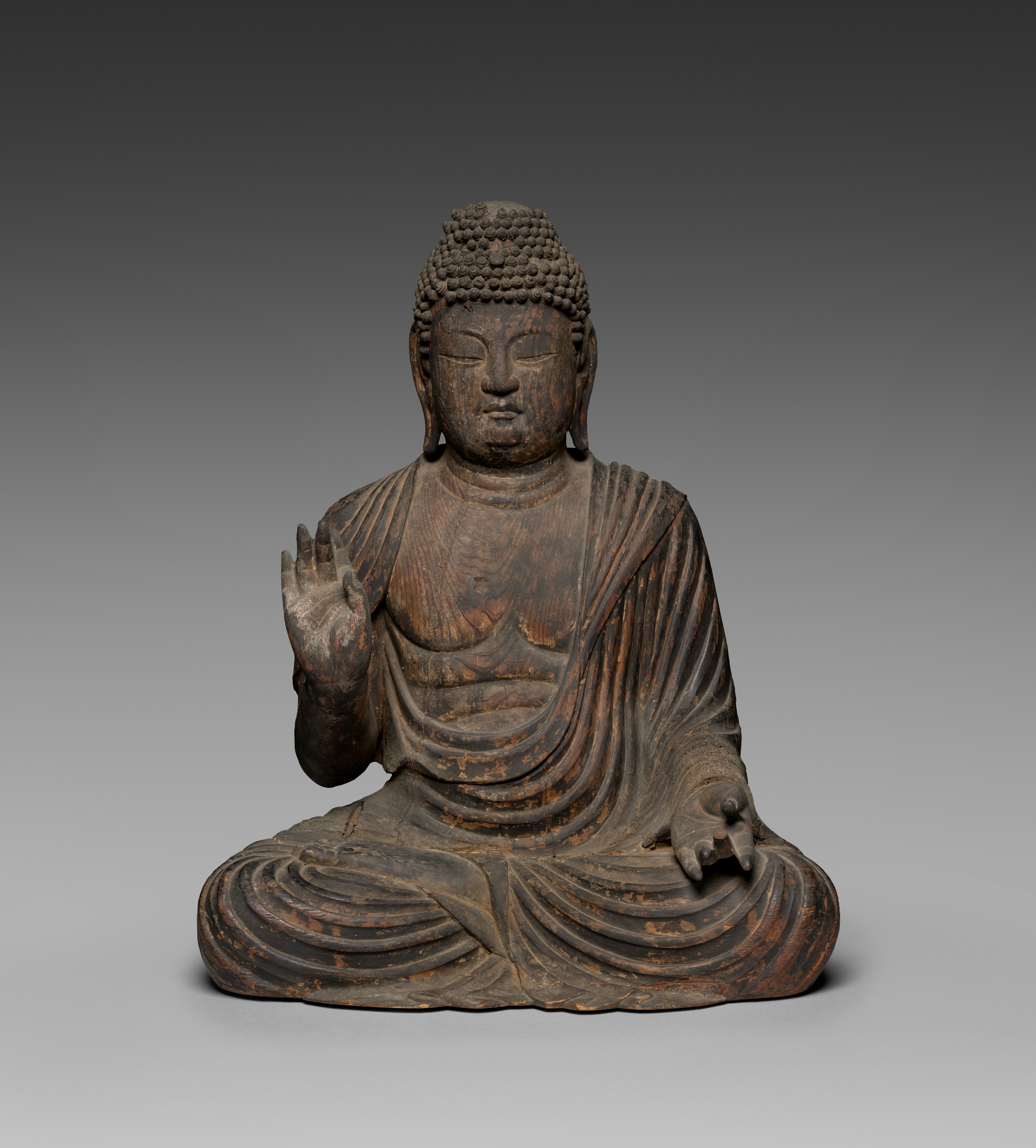
Cleveland 1986.7 is a seated Shakyamuni in wood, c. 900, carved from a single block (ichiboku) and cut with the hompa-shiki rolling-wave drapery that defines 9th–10th-century Japanese sculpture. It is a style anchor between the Nara bronzes and the Jōchō-era joined-block tradition.
The work
Cleveland 1986.7 is a seated Buddha, 57.2 cm tall, 46.4 cm wide, 38.1 cm deep, carved from one piece of wood and finished with lacquer and traces of color.1 The Cleveland catalog identifies the figure as Shakyamuni and dates it to c. 900, Heian period.1 The right hand is raised at the shoulder, palm outward; the left rests open and lowered on the left knee. The hair is the standard snail-shell curl (rahotsu) over a low cranial protuberance (ushnisha); the earlobes are long and pierced. No mandorla, halo, or pedestal survives; the figure is the block and nothing else.
The catalog states the identification plainly: “This image of Shakyamuni, the Buddha … is carved from one piece of wood. The distinctive pattern of thick, raised garment folds is characteristic of Japanese Buddhist sculpture of the 800s and 900s.”1 That is the whole argument of the object in two sentences: a single-block construction and a drapery system that dates itself. The identification as Shaka rather than Yakushi or Amida rests on the catalog and on the unmarked hands: no medicine jar (the reliable Yakushi attribute) and no Amida contemplation-mudra. The figure shows a raised-and-lowered hand pair consistent with the semui-yogan-in (reassurance-and-wish-granting) gesture, the generic gesture that is iconographically least committal and that Shaka most often carries. The point is worth stating because a seated wood Buddha of c. 900 with no surviving attributes is, on iconography alone, ambiguous; the article follows the Cleveland catalog’s Shaka identification and flags that the identification is institutional, not inscribed.
What carries the date is the carving. The drapery over the legs is cut in deep, repeated channels with a recurring high-then-low ridge profile: a tall rounded fold followed by a shallow flattened one, repeated across the lap in a measured rhythm. This is hompa-shiki, the “rolling-wave” pattern.1 On the Cleveland figure the rhythm is unusually disciplined: the alternation is regular enough across the front of the lap that the eye reads it as a system before it reads it as cloth. The wood has weathered to a dry dark brown; the lacquer survives in patches in the recesses of the folds, which is where it would have been protected from handling and light, and the high ridges are abraded almost to bare grain. The face is quiet and frontal, the eyes downcast and carved rather than inlaid. There is no crystal-eye (gyokugan) work, which is correct for the date and would be an anachronism here by three centuries.
The single-block construction is visible at the back, where the columnar mass of the original timber is least disguised. Early single-block figures tend to keep the cylindrical memory of the tree; this one does, the torso reading as a section of trunk worked down rather than as a built-up volume. The proportions follow that constraint. The figure is wider than it is deep (46.4 cm across, 38.1 cm front-to-back), the seated mass kept compact, the knees not thrown far forward; a single-block carver is always working inward from the diameter of the log, and the squat, contained seated posture of Cleveland 1986.7 is the posture a single trunk allows without piecing. Where a later joined-block image could project the knees and lap outward by adding side blocks, this figure holds everything within the original cylinder. The drapery does the expansion the body cannot: the rolling-wave folds spread across the lap and spill over the edge of the seat in deep loops, so the visual breadth of the figure is carried by cloth rather than by added timber.
The condition is legible as a use-history. The high points of the carving (the knees, the crown of the head, the forward ridges of the lap folds) are worn to dry bare grain, while lacquer and pigment survive in the protected recesses between folds and under the chin. The wood has checked: a single block dries unevenly and splits along the grain over centuries, and the surface carries the long vertical drying fissures characteristic of an old ichiboku figure that was never hollowed. Hollowing the back (uchiguri), the standard later remedy for exactly this cracking, is absent or minimal here, which is consistent with the early dating; the technical fix that defines the transition out of solid single-block construction has not yet been applied to this object.
Iconographic reading
The iconography here is deliberately thin, and that thinness is the reading. A Buddha figure of this date is identified by the standard physical marks (lakṣaṇa): the cranial protuberance, the snail-curl hair, the elongated earlobes, the monastic robe over both shoulders. The Cleveland catalog names exactly these: “elongated ears and curled hair are among the physical attributes described in sacred texts that distinguish him as a Buddha.”1 Beyond the marks there is no narrative attribute, no attendant, no setting. The figure is a Buddha-as-such, and the institutional name attached to it is Shaka.
The early-Heian context explains the austerity. The 9th and early 10th centuries are the period of the so-called Jōgan style and of the plain-wood image. Morse’s study of the formation of the plain-wood style, 760–840, treats the turn from the polychromed clay and dry-lacquer of the Nara period toward unpainted or lightly finished single-block wood as a coherent development, not a decline of resources, but a deliberate aesthetic and material program in which the wood itself carries religious value.2 The Cleveland figure sits at the late edge of that program, c. 900: still single-block, still drapery-driven, with lacquer and color present but thin, the wood doing most of the work.
The deeper frame is the sandalwood-image (danzō) tradition. Boehm’s study traces how Japanese Buddhist sculpture of the 8th to 14th centuries invoked the imported Indian and Chinese ideal of the sacred sandalwood image—small, fragrant, single-block—and reproduced its values in domestic woods.3 An early-Heian single-block Shaka at the scale of Cleveland 1986.7 (under 60 cm, intimate rather than monumental) is legible within that lineage: not a temple-hall colossus but a single-block image at the size where the block-and-knife relationship is the subject. McCallum’s work on the Zenkōji icon, though centered on a later gilt-bronze cult, supplies the conceptual background for why a single carved image mattered so much in medieval Japan: the image was conceived by many worshipers as a living presence, not a representation.4 The plain-wood single-block Buddha is one material answer to that idea: the icon as a body taken whole from one piece of living wood.
Comparanda
The canonical comparandum for hompa-shiki on a single-block early-Heian Shaka is the seated Shaka at Murō-ji, in its kondō, conventionally placed in the 9th century, the textbook example of the ponderous early-Heian body under thick rolling-wave folds.5 Set the Cleveland figure beside the Murō-ji type and the family resemblance is the drapery logic: the same deep-channel, alternating-ridge system, the same priority of cloth-rhythm over anatomy. The differences are scale and survival: Murō-ji’s is a temple icon with its polychromy and setting; Cleveland 1986.7 is a stripped, weathered, collection-scale figure where the wood has won.
The other end of the comparison is the Nara period that precedes it. Eighth-century Buddhas were predominantly worked in gilt bronze, hollow dry-lacquer (dakkanshitsu), or clay over an armature: media that allow thin walls, smooth modeled surfaces, and large scale without the weight or the cracking of solid wood. The early-Heian turn to the single wood block reverses those properties on purpose. Where a Nara dry-lacquer Buddha presents a continuous, idealized surface with the technique concealed, Cleveland 1986.7 keeps the knife visible and the timber’s mass declared. The hompa-shiki drapery is the formal signature of that reversal: deep, hard, repetitive channels are what a single block carved with a chisel produces well and what a clay or lacquer surface would never naturally take. Nishikawa and Sano’s survey reads the rolling-wave system precisely as the drapery idiom native to early-Heian single-block wood, not a decorative choice imported onto it.5
Within bodhi’s own corpus the most useful pairing is the Cleveland Heian seated Buddha in the Jōchō style (accession 1973.85), the comparable Heian-sculpture single-work study. Read in sequence the two objects bracket the period: 1986.7 is single-block, c. 900, drapery cut hard and deep, the wood austere; the Jōchō-style figure is the later 11th–12th-century manner: joined-block (yosegi) construction, shallow regularized folds, the gentler proportion that Jōchō codified for the Fujiwara court. The technical pivot between them is construction. The hompa-shiki single block is heavy, crack-prone as the timber dries, and limited in scale by the log; the joined-block method that bodhi treats in the yosegi-zukuri study solved all three problems and made the lighter Jōchō idiom possible. Cleveland 1986.7 is the “before” against which that pivot reads: it shows the constraints (weight, drying-cracks, the log’s diameter capping scale and posture) that yosegi was invented to escape, and the deep-cut drapery that the shift to shallow joined-block carving smoothed away. The hompa-shiki manner does not survive the construction change; by Jōchō’s generation the rolling wave is gone, replaced by the calm shallow folds of the Fujiwara court style. An object like 1986.7 is the last clear statement of the older system before the technical revolution overran it.
The MFA Boston wood-identification program, which has analyzed early Japanese wooden statues by species, is the kind of technical baseline that would, applied here, test whether 1986.7 follows the early-Heian preference for particular domestic woods; the Cleveland record reports “wood” without a species, so that line is open.5
Provenance and attribution
The Cleveland piece entered the museum in 1986 through the Leonard C. Hanna Jr. Fund.1 The catalog gives no named carver, no temple of origin, and no inscription; the dating is by style, not document. This is normal for the class. Early-Heian single-block Buddhas are very rarely signed or dated, and almost none retain a secure temple provenance back to the period; attribution proceeds through the drapery system and construction, which is exactly the evidence the Cleveland catalog cites.15
Two uncertainties should be named rather than smoothed. First, the date “c. 900” is a stylistic placement on the hompa-shiki and single-block evidence; the rolling-wave manner has a real duration across the 9th and 10th centuries, so a reasonable scholarly range would span roughly the late 9th to the early 10th century, and the catalog’s “c. 900” is a midpoint, not a fixed year.25 Second, the identification as Shakyamuni is the Cleveland catalog’s, supported by the absence of Yakushi’s medicine jar and Amida’s contemplation-mudra but not by an inscription or an attribute that positively names Shaka; an unattributed seated Heian wood Buddha could in principle be retitled if a temple context or attribute surfaced. There is no divergence to record here: the catalog says Shaka, the iconography does not contradict it, and the title follows the catalog. The honest residual is that “Shaka” here is an institutional identification of a generically posed Buddha, and the strongest, most defensible claims about this object are the ones the catalog itself leads with: single-block construction and the 9th–10th-century rolling-wave drapery.
Related
- The Cleveland Heian seated Buddha in the Jōchō style — the later-Heian counterpart
- Yosegi-zukuri — the joined-block construction that displaced the single block
- Shaka / Shakyamuni (entity)
- Ichiboku-zukuri — single-block construction (entity)
- Hompa-shiki — rolling-wave drapery (entity)
- Jōgan style (entity)
Footnotes
-
Cleveland Museum of Art, accession 1986.7, “Shakyamuni” (釈迦座像), c. 900, wood with lacquer and traces of color; 57.2 x 46.4 x 38.1 cm. Leonard C. Hanna Jr. Fund. Catalog text on the single-block carving, the thick raised garment folds as characteristic of 800s–900s sculpture, and the Buddha-mark identification. CC0. Live catalog and Open Access API, accessed 2026-05-16. ↩ ↩2 ↩3 ↩4 ↩5 ↩6 ↩7
-
Samuel C. Morse, “The Formation of the Plain-Wood Style and the Development of Japanese Buddhist Sculpture: 760–840” (PhD dissertation, Harvard University, 1985), on the early-Heian turn to single-block plain-wood images as a deliberate material-aesthetic program. Work-level citation; specific page numbers not verified. ↩ ↩2
-
Christian Boehm, The Concept of Danzō: ‘Sandalwood Images’ in Japanese Buddhist Sculpture of the 8th to 14th Centuries (Saffron, 2012), on the transmission of the sacred single-block sandalwood-image ideal into Japanese wood sculpture. Work-level citation; specific page numbers not verified. ↩
-
Donald F. McCallum, Zenkōji and Its Icon: A Study in Medieval Japanese Religious Art (Princeton University Press, 1994), on the medieval Japanese conception of the carved icon as a living presence rather than a representation. Work-level citation; specific page numbers not verified. ↩
-
Nishikawa Kyōtarō and Emily J. Sano, The Great Age of Japanese Buddhist Sculpture, AD 600–1300 (Kimbell Art Museum / Japan Society, 1982), survey treatment of early-Heian single-block sculpture, the hompa-shiki drapery system, and the Murō-ji Shaka as the canonical comparandum. Chapter-level citation; specific page numbers not verified. ↩ ↩2 ↩3 ↩4 ↩5