Reading the workshop off the scroll: e-busshi practice and the iconographic compendium
- Title
- Scroll from the Compendium of Iconographic Drawings (Zuzōshō) — Met 1975.268.5
- Period
- Japan, Heian period (794–1185), late 12th century
- Region
- Japan
- Medium
- Handscroll; ink and color on paper
- Dimensions
- 30.2 × 781 cm (11 7/8 in. × 25 ft. 7 1/2 in.)
- Collection
- The Metropolitan Museum of Art, New York
- Accession
-
1975.268.5 - Rights
- Public domain (CC0, Met Open Access). The Metropolitan Museum of Art, The Harry G. C. Packard Collection of Asian Art, Gift of Harry G. C. Packard, and Purchase, Fletcher, Rogers, Harris Brisbane Dick, and Louis V. Bell Funds, Joseph Pulitzer Bequest, and The Annenberg Fund Inc. Gift, 1975; accession 1975.268.5; object 45605. Public-domain status confirmed via the Met Collection API 2026-05-16.
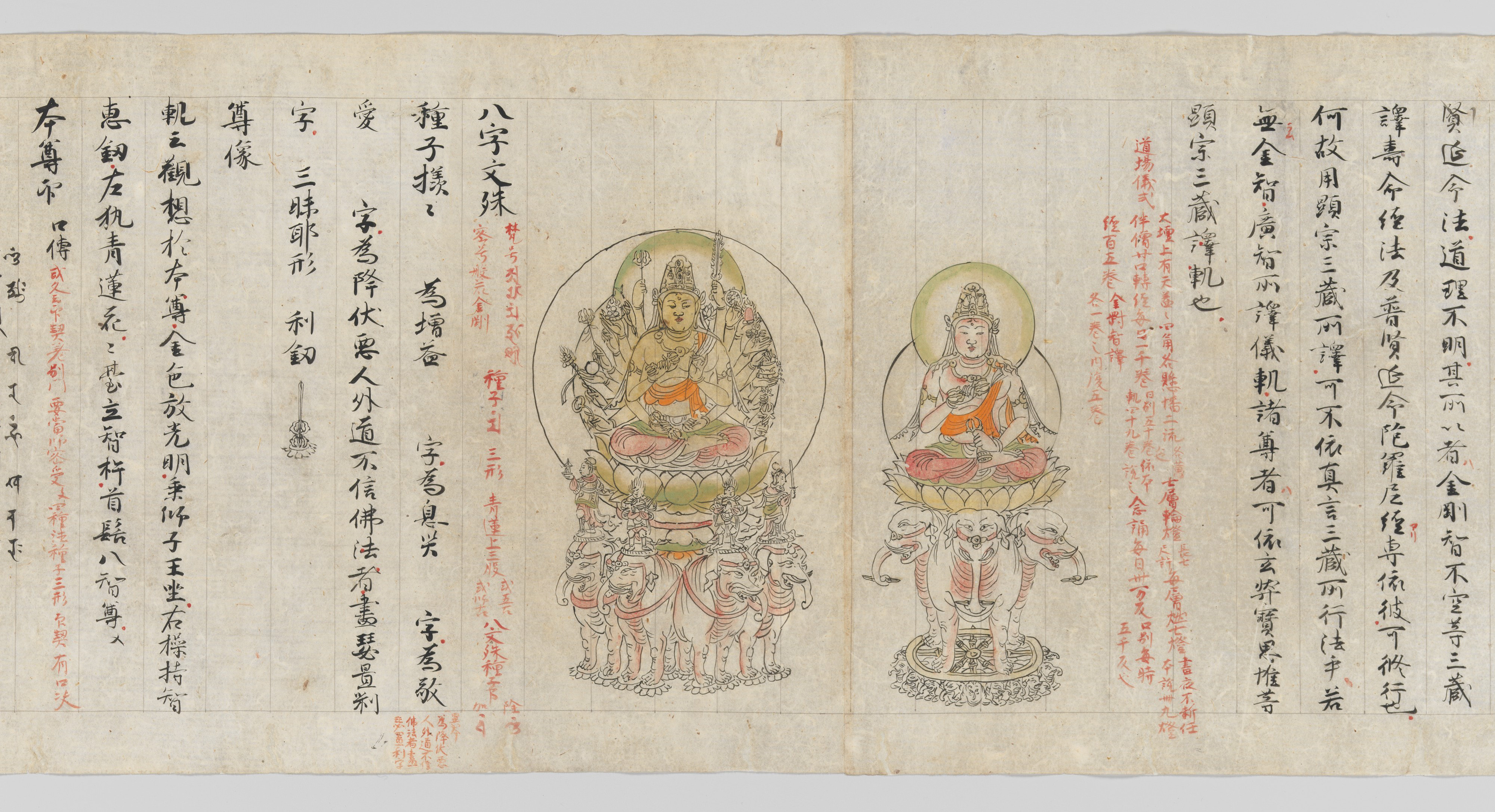
Met 1975.268.5, a late-12th-century section of the Zuzōshō, 30.2 × 781 cm. Two bodhisattva figures in ink line with sparse flat color, set in columns of running-script text and crowded vermilion notes. Not a devotional image: a working pattern, the instrument the e-busshi workshop transmitted. Met Open Access (CC0).
Met 1975.268.5 is a late-12th-century section of the Zuzōshō, a Heian esoteric iconographic compendium. Read as a working document, not an icon, it makes the e-busshi workshop legible: how iconography passed by copybook (funpon, zuzō) rather than by inspiration, how the painting was built in fixed stages, and why the painter-monk lineages organised around custody of the patterns.
What this scroll is, and why it is the evidence
The object is twenty-five feet of paper.1 Met 1975.268.5 is one section of the Zuzōshō (図像抄), the “Compendium of Iconographic Drawings,” a Heian esoteric reference work; this length was copied late in the twelfth century, ink and color on paper, 30.2 cm high and 781 cm long.2 It is not a painting that was made to be venerated. It is a painting that was made to make other paintings, and that difference is the whole subject of this article.
Two seated bodhisattvas occupy the visible register, each on a lotus over a tiered pedestal of crouching animal supporters. They are drawn in fine ink line with thin, flat color laid inside the contour (an orange-red robe block, a pale green halo, pink lotus petals), and nothing built up over it. Around them, and between them, run columns of black running-script text, and into the margins of that text a later hand has crowded vermilion: seed-syllables, mudrā readings, corrections wedged between the lines. The page is busy in the specific way a tool is busy. A devotional hanging scroll isolates its figure and clears the ground around it; this sheet packs the figure into prose and notation because the figure is one entry among hundreds and the notation is the point. The handling confirms it. This is not a painting that was ever hung on a wall and stood before. A handscroll is opened flat on a table or the floor in roughly arm-span sections, the right hand winding closed what the left has just read, so the two bodhisattvas are never seen together with their text the way a museum vitrine now stretches them out; they were met one panel at a time, at reading distance, by someone whose other hand held a brush.
The Zuzōshō belongs to a class of Heian esoteric compendia, alongside the Besson zakki and the later Asabashō, assembled to help monks and the painters who served them navigate a proliferating, contested body of iconographic and ritual variants.3 By the late Heian period the number of deities, the number of forms each deity could take, and the number of ritual programmes that called for them had outrun any one practitioner’s memory. A compendium scroll was the institutional answer: the correct form, fixed, transmissible, and checkable. To read the e-busshi workshop, this is the right document, because it is the part of the workshop’s apparatus that survives in legible form.
The e-busshi and the line that separates them from the busshi
A busshi (仏師) was a maker of Buddhist images. In the eleventh century the category split along the medium. The sculptor in wood kept the older term; the painter, and the specialist who colored sculpture, came to be called e-busshi (絵仏師), literally the picture-busshi.4 The term took its time. It is attested from the early eleventh century but only came into wide use in the latter half of the Kamakura period; tenth-century painter-monks such as Teihō, Heirakei, and Genchō were still being recorded simply as busshi.4 The vocabulary lagged the practice, which is the normal order of things.
The defining feature of the e-busshi was not a style. It was a status. The e-busshi was ordained, entered on the register of a Buddhist school, and worked inside or for a temple establishment, which distinguished him from two adjacent kinds of painter. He was not the secular court painter of the imperial e-dokoro (絵所), the Painting Bureau that handled yamato-e screens and narrative handscrolls for the throne and the nobility. And he was not, later, the Zen monk-amateur of ink painting, the gaso, though that line was drawn unevenly and not always observed.4 The e-busshi sat in the middle: a religious specialist whose product was doctrinally regulated and whose competence was custody of correct form. Rank tracked the standing. In 1068 the painter Kyōzen received hokkyō, the third Buddhist clerical rank, for painting the buddha-images at Hōjō-ji: a painter promoted into the same ladder of hokkyō, hōgen, and hō-in that the sculptors climbed, for work done with a brush.4
This is the reason a compendium scroll, not a finished icon, is the right evidence. The e-busshi’s authority was iconographic correctness under a doctrinal régime, and correctness was carried in documents like this one.
The copybook is the transmission, not the inspiration
The standard popular picture of a religious painter is a figure who beholds and renders. The e-busshi system was the opposite. Iconography moved by copy. The working term is funpon (粉本): a model drawing, the reproduction of an authoritative original, faithfully or in rough sketch, kept and used so that subject and form could be transmitted within the workshop rather than reinvented.5 A scroll like the Zuzōshō is the institutional, doctrinally annotated end of the same instinct: not one painter’s private pattern but a school’s canonical reference. The zuzō (figural iconographic drawing) and the funpon are the same tool at different scales of authority.
Two features of Met 1975.268.5 make the mechanism visible. First, the line is the carrier and the color is incidental. A finished esoteric icon would build pigment in layers and seal it with gold; here the contour does almost all the work and the color is a thin diagrammatic fill, present mainly to record which areas take which hue. What is being transmitted is the drawing (proportions, the count and disposition of arms, the attributes in the hands, the structure of the pedestal), not the surface. Second, the vermilion annotation. The red notes interlined into the text are corrections and clarifications added after the black copy was made: the document is being kept current, argued with, brought into line with a particular lineage’s reading. A devotional image is finished once. A pattern is maintained.
Miriam Chusid argues that in premodern Japan the preservation and faithful copying of Buddhist paintings was not antiquarianism but the live mechanism by which tradition reproduced itself and by which new icons were authorised; the copy carries the authority forward, and the new painting is legitimate because it descends from a correct model.6 Chun Wa Chan, reading the portable end of Buddhist art, makes the complementary point that the transmissibility of the model (its detachment from any one site or original) is precisely what let Buddhist visual culture propagate.7 On both readings the scroll is not a record of an aesthetic; it is the genetic material of an institution.
How the painting was actually built
Once the pattern is in hand, the finished painting is assembled in a fixed order, and the order is what made the division of labour possible. The clearest surviving technical reconstruction for an East Asian Buddhist painting on silk is Park Chi-sun’s account of Goryeo practice, close kin to the Japanese e-busshi method and explicit where Japanese workshop documentation is thin.8 The sequence runs: the silk is stretched tight on a frame and sized on both faces; the design is established, either brushed directly on the silk or transferred from a paper pattern fixed behind the support; the ink outline is drawn on the front; pigment is then applied to the back of the silk for the flesh and the larger garment areas, so that the color reads through the weave with a depth that surface paint cannot give; color is added to the front; and finally the contours are re-stated and the gold is laid.8
That last stage is where the workshop’s two gold techniques sit. Kindei (金泥) is gold ground fine, suspended in animal-skin glue, and applied with a brush like a pigment.8 Kirikane (切金) is gold leaf cut into hairline strips and minute geometric pieces and set onto a glue-drawn design: a separate, slower discipline that bodhi treats at length on its own published page and does not re-argue here.9 What matters for workshop practice is structural: the sequence is a chain of distinct, separable operations. Sizing, transfer, ink line, back-coloring, front-coloring, gold; each is a task that can be assigned. The pattern fixes the design so completely before any pigment is touched that a master can set the line and a graded set of assistants can carry the color, with the head of the workshop reserving the face, the principal contours, and the gold finish. The compendium scroll is what makes that delegation safe: when the form is settled in advance, the hands that fill it need not be the hand that conceived it.
The contract economy and the dedicatory clock
An e-busshi atelier was a production unit under deadline. Esoteric paintings were commissioned for a specific rite, an eshiki (memorial cycle), or a temple’s dedication, and the dedication had a date. The work had to be on the altar for the ceremony; a Buddhist painting that missed its consecration had missed its function. That is the practical pressure behind everything above. The pattern shortens the slowest and most error-prone stage, settling the iconography, to a controlled copy. The staged build lets several hands work the same painting in parallel. The hereditary workshop keeps a trained bench standing between commissions instead of assembling one each time. None of this is an aesthetic programme; it is how a regulated image got finished before a fixed religious deadline by a shop that had to take the next commission.
The economics also explain the secrecy. Funpon were guarded.5 If the workshop’s competitive asset is custody of the correct, doctrinally sanctioned patterns, the patterns are capital, and capital in a hereditary trade is transmitted down the family or the master-disciple line and withheld from rivals. The compendium and the private model drawing are the same asset at different levels of disclosure: the school’s reference, kept; the master’s working sheet, kept closer.
The named lineages, and the limit of the evidence
Custody of patterns plus hereditary transmission produces, predictably, schools. The status of e-busshi came to pass to sons or disciples through a vocational system, and lineages formed that specialised in training painter-monks.4 The clearest case is the Takuma school, founded by Takuma Tametō (active ca. 1132–74) and continued by his son Tametatsu; further sons divided the territory, Shōga building a Kyoto practice on monastic commissions while Tamehisa moved to Kamakura to serve the shoguns, with a documented succession of named painters: Tameyuki, Shunga, Chōga, Jōkō in the thirteenth century, Chōshō, Ryōzen, Eiga in the fourteenth.10 The shape is exactly the sculptors’ shape: a workshop organised as a genealogy by blood and discipleship, climbing the clerical-rank ladder, holding a body of transmitted form. The Met holds two pages of the closely contemporary Kontai butsugajō attributed to Tametō himself; bodhi reads those on their own published page, and points there rather than re-argue the attribution here.
Here the disagreement should be named plainly. The relationship between the e-busshi workshops and the court e-dokoro is read two ways. One reading treats them as a clean institutional binary, religious painter-monks on one side and secular bureau painters on the other, and the ordination criterion supports it.4 The other treats the boundary as porous in practice, with painters, models, and commissions crossing between temple atelier and court bureau, and with “e-busshi” itself a label that hardened only in the later Kamakura period over a practice that long predated it.6 bodhi reads with the second: the status was real and the ordination line was real, but the term lagged the work by more than a century and the patterns were the kind of asset that travels, so a hard institutional wall is the wrong model for the Heian phase. The residual uncertainty is honest and specific. The internal organisation of a Heian e-busshi shop — how many hands, in what graded roles, under what contract terms — is reconstructed largely from the surviving documents and the better-recorded sculpture workshops, not from a preserved painting-atelier record; the technical sequence above is anchored most securely on the Goryeo reconstruction and applied to the Japanese case by close analogy. The scroll shows the transmission instrument with certainty. It shows the labour around it only by inference, and this article keeps that line visible rather than smoothing it.
Related
- How to date a Japanese Buddhist painting — the workshop evidence read forward
- Five Wisdom Kings as workshop reference — the single-work close-read of the sibling Packard handscroll
- The Kontai butsugajō Tametō album pages — the Takuma-attributed pattern, read as objects
- Cleveland 1987.39 — a single Heian zuzō for the Ninnōkyō mandala
- Kirikane — the cut-gold finishing discipline, treated in full
- E-busshi (entity)
- Funpon (entity)
- Takuma school (entity)
Footnotes
-
Met Collection API, object 45605 (accession 1975.268.5): Scroll from the Compendium of Iconographic Drawings (Zuzōshō), Japan, Heian period, “late 12th century” (objectBeginDate 1167 / objectEndDate 1199), handscroll, ink and color on paper, 30.2 × 781 cm, Asian Art, classification Paintings, public domain (CC0); confirmed live 2026-05-16. Object facts are taken from the API, which is authoritative for them. ↩
-
The Metropolitan Museum of Art, accession 1975.268.5, The Harry G. C. Packard Collection of Asian Art (acquired 1975). Object-level facts per the museum record / API as above; no curatorial essay text is cited for this object, so the catalogue is cited at record level only. ↩
-
The Metropolitan Museum of Art, “Kings of Brightness in Japanese Esoteric Buddhist Art” (Met essays): the Zuzōshō is a ten-scroll encyclopedic iconographic text, designed to help monks navigate proliferating iconographic and ritual variations, its eighth scroll devoted to the Wisdom Kings; the Besson zakki and Asabashō are the comparable Heian esoteric compendia. Cited at essay/argument level, from the indexed summary of the essay. ↩
-
Japanese Wiki Corpus, “Ebusshi (絵仏師)”: definition (monk-specialist mainly engaged in producing Buddhist paintings and coloring statues); concept emerges early 11th c. in relation to the general (sculptor) busshi but “ebusshi” comes into wide use only in the latter half of the Kamakura period; 10th-c. painter-monks Teihō, Heirakei, Genchō recorded as “busshi”; the e-busshi distinguished from secular court e-dokoro painters by ordination and sect-register entry, and from Zen gaso ink painters (a distinction “not always made”); status passed to children/disciples by vocational system, producing training schools (Takuma cited); Kyōzen received hokkyō in 1068 for the Hōjō-ji buddha-paintings. Reference-tier; primary-source transcriptions and dates NOT independently pinned — flagged. ↩ ↩2 ↩3 ↩4 ↩5 ↩6
-
Funpon (粉本): model drawings — faithful or rough reduced reproductions of authoritative originals, kept and used to transmit subject and style within a workshop, and zealously guarded; the practice is documented across the long Japanese workshop tradition (the Kano school’s funpon copying is the best-known later instance) and the principle is continuous with the Heian zuzō / compendium tradition. General reference synthesis (web research, 2026-05-16); the specific Heian e-busshi funpon-custody practice is asserted at principle level and is not tied to a named primary contract. ↩ ↩2
-
Miriam Chusid, “Images Old and New: Buddhist Painting Preservation and the Transmission of Tradition in Premodern Japan,” Ars Orientalis 54 (2024), pp. 79–107: faithful copying and preservation of Buddhist paintings as the live mechanism reproducing tradition and authorising new icons. Cited at argument level; the bibliographic details (author, title, volume 54, 2024, pp. 79–107) are verified from the publisher index. Specific pages within the article are not verified against the full text. ↩ ↩2
-
Chun Wa Chan, “Portable Faith: Toward a Non-Site-Specific History of Buddhist Art in Japan,” Ars Orientalis 53 (2023), pp. 3–22: the detachability/transmissibility of Buddhist visual models from any one site as a condition of propagation. Cited at argument level; author, title, volume, and pages verified from the publisher index and the Open Buddhist University record. Specific pages within the article are not verified against the full text. ↩
-
Park Chi-sun, “Goryeo Buddhist Painting: Materials, Techniques, and Mountings,” in Goryeo Buddhist Painting: A Closer Look (Freer Gallery of Art / Arthur M. Sackler Gallery, Smithsonian Institution): silk stretched and sized both faces; design brushed directly or transferred from a paper pattern fixed behind the support; front ink outline; reverse-side coloring of flesh and large garment areas; front coloring with re-stated contours in color or gold; gold ground fine and brushed like pigment. The Goryeo sequence is applied to the Japanese e-busshi case by close analogy; this analogy is the load-bearing technical move and is flagged as such (a Japanese-specific Heian painting-technique reconstruction would tighten it). Web essay; pages N/A. ↩ ↩2 ↩3
-
Kirikane (切金), cut gold leaf set on a glue-drawn design, vs kindei (金泥), gold ground in glue and brushed: bodhi treats the kirikane finishing discipline in full on its published page (the cut-gold tradition on a Kamakura figure), and this article deliberately does not re-expound it — the finishing stage is named here only as the terminal operation in the workshop sequence. See the Related list. ↩
-
Encyclopædia Britannica, “Takuma School”: Japanese Buddhist-painting tradition flourishing 12th–14th c.; founded by Takuma Tametō (active 1132–74), continued by his son Tametatsu; sons Shōga (Kyoto, monastic commissions) and Tamehisa (Kamakura, shogunal service); 13th-c. members Tameyuki, Shunga, Chōga, Jōkō; 14th-c. Chōshō, Ryōzen, Eiga. Reference-tier; style/Song-relationship and the internal succession dates NOT independently primary-pinned — flagged. ↩
Sources
-
[5]— Freer Gallery of Art / Arthur M. Sackler Gallery, Smithsonian Institution publications.asia.si.edu/goryeo/en/essay-park-materials-techni…