The Wakamiya Kasuga mandala: a boy-god with a sword
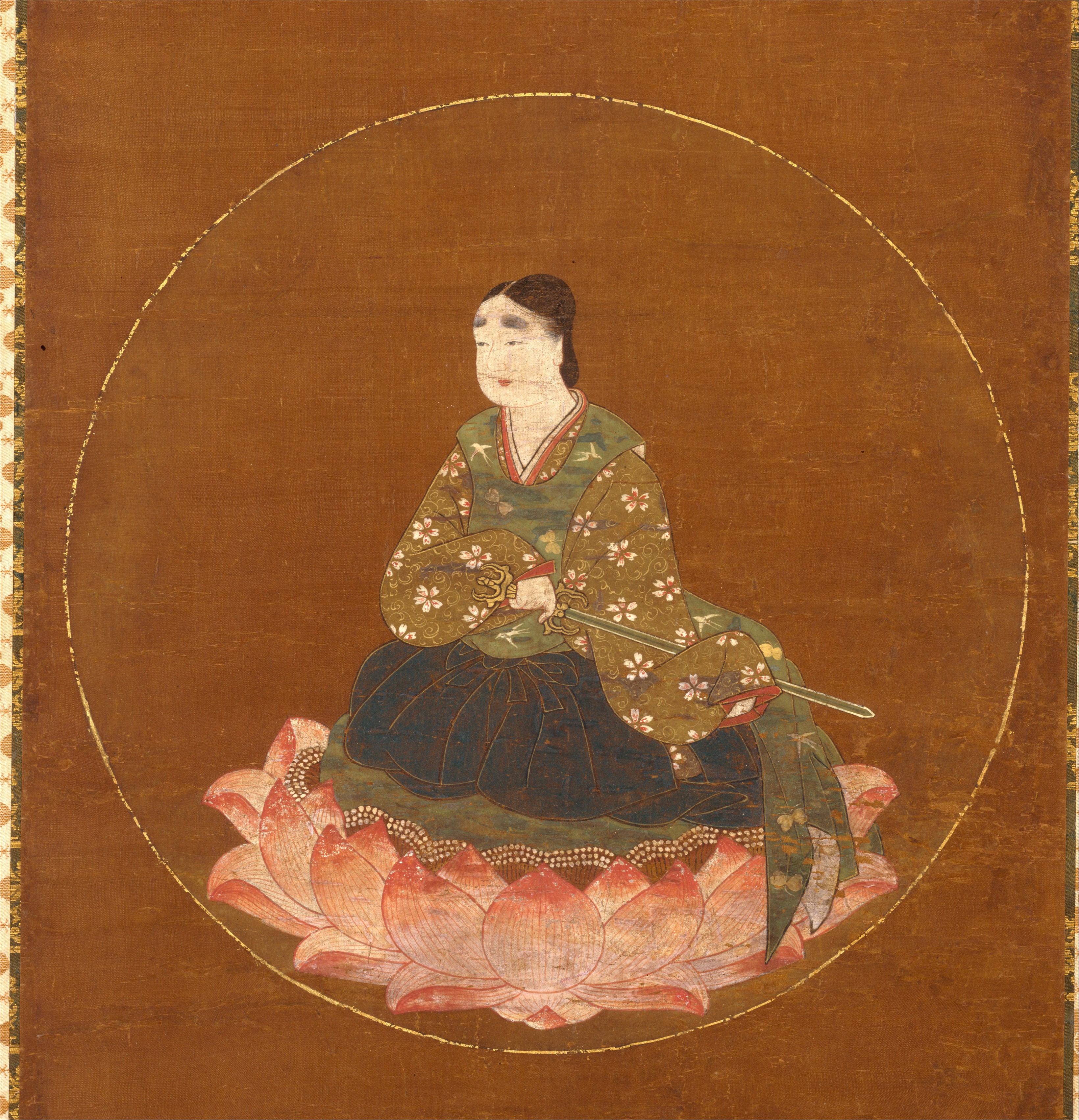
- Title
- Mandala of Wakamiya of Kasuga Shrine (Kasuga wakamiya mandara, 春日若宮曼荼羅)
- Period
- Nanbokuchō period (1336–92), early 14th century
- Region
- Japan
- Medium
- Hanging scroll; ink, color, gold, and cut gold on silk
- Dimensions
- Image 75.6 × 38.1 cm; overall with mounting 158.8 × 52.1 cm
- Collection
- The Metropolitan Museum of Art
- Accession
-
1997.113 - Rights
- The Metropolitan Museum of Art, Open Access (Public Domain). Purchase, Lila Acheson Wallace Gift, 1997, and Gift of the Mary and Jackson Burke Foundation, 2015.
Met 1997.113. The Wakamiya kami Ame-no-Oshikumone shown as a noble youth on a lotus disc, holding the sword that signals his Buddhist ground, Monju. One kami, one Buddha: the deer mandala's logic narrowed to a single figure.
The Kasuga Wakamiya mandala is the single-deity sibling of the Kasuga deer mandala. Met 1997.113 (Nanbokuchō, early 14th c., CC0) shows the Wakamiya kami Ame-no-Oshikumone as a noble youth on a lotus disc, holding the sword of Monju (Mañjuśrī). The deer mandala maps five kami onto five Buddhas; the Wakamiya mandala isolates one child-deity and its single Buddhist ground.
What it is, and what it is not
The Kasuga Wakamiya mandara is a shrine mandala of the Kasuga–Kōfuku-ji cult that takes as its subject one deity: the kami of the Wakamiya, the “young shrine” added to the Kasuga precinct in the late Heian period. Met 1997.113 is the cleanest publicly accessible example. The Met dates it to the Nanbokuchō period (1336–92), gives the object date as early 14th century, and records it as a hanging scroll in ink, color, gold, and cut gold on silk, image 75.6 by 38.1 cm.12 It entered the museum in two movements: a 1997 purchase on the Lila Acheson Wallace Gift, completed by a 2015 gift from the Mary and Jackson Burke Foundation.
The first thing to settle is what this is not. bodhi already covers the Kasuga deer mandala (the shika mandara), where a single white deer carries a sakaki branch and a gold disc holding five seated Buddhas, and those five Buddhas are the Buddhist “original grounds” of the five principal Kasuga shrine kami. That painting is a five-to-five doctrine diagram. The Wakamiya mandala is a different deity programme entirely. It does not show the five sanctuaries, the deer, or the five-Buddha disc. It shows one figure: the Wakamiya kami, named Ame-no-Oshikumone, and its single Buddhist counterpart. Both paintings run on the same underlying logic, the medieval Japanese identification of kami as local traces of Buddhist deities, but the deer mandala states that logic as a pantheon and the Wakamiya mandala states it as a portrait.
A wakamiya, in the Kasuga system, is a subsidiary shrine for the child of a deity enshrined in the principal sanctuary; the word signals youth and renewal. The Kasuga Wakamiya was built at the end of the Heian period and acquired its own great festival, the On-matsuri, performed annually from the twelfth century onward. Grapard’s Protocol of the Gods treats the Wakamiya cult as a distinct social formation within the larger Kasuga complex, ritually run by the shrine-and-temple clergy and organised by the population of Yamato Province.3 The mandala is the devotional image of that specific cult, not of Kasuga at large.
Iconographic markers
The figure is the whole reading. Ame-no-Oshikumone is shown, in Susan Tyler’s description of the type, “seated on a lotus blossom within a golden disc, attired in the clothing of a noble youth while holding a sword.”4 Every element of that sentence is a marker, and Met 1997.113 carries all of them.
- The youth. The figure wears the soft white robes and bound hair of a courtly boy, not the armour of a warrior kami or the regalia of an enthroned adult deity. This is the iconographic content of wakamiya made visible: the deity is depicted as the child it is theologically defined to be.
- The lotus and the gold disc. The boy sits on a lotus inside a circular gold field. The lotus seat and the disc are Buddhist-icon furniture, not Shinto shrine furniture. Placing a kami on them is the painting’s central claim: this native deity occupies the visual position of a Buddha.
- The sword. The slender blade in the figure’s hand is the load-bearing attribute. It is the sword of Monju (Sanskrit Mañjuśrī), the bodhisattva of wisdom, whose blade cuts through the delusion of the unenlightened mind. The sword is how the painting names the Buddhist ground without writing it down: the viewer who knows the attribute reads “Monju” off the weapon. The Met’s own catalog states the allusion directly, and the Wikidata record for the object lists “sword” and “Ame-no-Oshikumone” among what it depicts.15
- The shrine at the mountain’s foot. Below the disc, the Wakamiya mandara typically sets a compressed view of the shrine compound against the dark mass of Mount Mikasa, the hill immediately east of Kasuga. The deity floats above its own earthly site. ten Grotenhuis reads the whole miya mandara genre as exactly this: sacred geography made into a devotional surface, the real approach-route to a shrine folded into a hanging scroll.6
The leave-out here is deliberate. The doctrine that licenses the lotus-disc-and-sword move is honji-suijaku, “original ground and manifest trace”; it is explained at length in bodhi’s deer-mandala reading and is not re-argued here. What the Wakamiya mandala adds to that doctrine is compression. Where the deer mandala needs a deer, a branch, a disc, and five Buddhas to say “five kami are five Buddhas,” the Wakamiya mandala says “this child-kami is Monju” with a robe, a lotus, and a sword.
Variants and the deer-mandala contrast
Kasuga mandalas are not one thing. The surviving corpus splits into several distinct iconographic programmes, and confusing them is the standard error in popular and even some catalog writing. The relevant distinctions:
| Type | What it depicts | The doctrinal statement |
|---|---|---|
| Kasuga miya mandara (shrine map) | Bird’s-eye view of the whole Kasuga compound, halls and torii and approach, sometimes with the five honji Buddhas above Mt. Mikasa | The site itself is sacred ground; walk it with the eye |
| Kasuga shika mandara (deer mandala) | A white deer bearing a sakaki branch and a gold disc of five seated Buddhas | The five Kasuga kami are five named Buddhas |
| Kasuga Wakamiya mandara | One youthful figure on a lotus disc with Monju’s sword, above the shrine | One child-kami, Ame-no-Oshikumone, is Monju |
Met 1997.113 is the third type. It is most easily confused with the second, because both isolate the kami-as-Buddha claim into a single floating disc, and both are roughly contemporary (the Met holds Nanbokuchō deer mandalas as well). The discriminating marker is the figure inside the disc. A deer mandala’s disc holds five seated Buddhas in formal Buddha-iconography. The Wakamiya mandala’s disc holds one boy in courtly dress with a sword: a kami rendered as a kami, placed in a Buddha’s compositional seat, with a single attribute pointing to a single Buddhist ground. If the disc contains five Buddhas, it is a deer mandala or a five-sanctuary mandala. If it contains one sword-bearing youth, it is Wakamiya.
There is a scholarly point worth naming under the dating. The Met assigns “Nanbokuchō period (1336–92)” but its own object-date fields run 1300–1333, which is late Kamakura, before the Nanbokuchō split of 1336. The two labels are not quite consistent, and the museum has not published a rationale for either. Tyler and Grapard both place the floruit of Kasuga mandala production across the 13th and 14th centuries broadly, which accommodates this scroll comfortably without resolving the decade.43 bodhi’s reading follows the Met’s headline attribution, “Nanbokuchō, early 14th century,” while flagging that the museum’s own machine record points a few decades earlier and that the question is not settled by anything published. The honest position is a wide early-fourteenth-century window, not a fixed reign.
Representative works
The Wakamiya mandara is rarer in accessible Western collections than the deer mandala or the shrine-map mandala, and the corpus is dominated by Japanese temple and shrine holdings outside open-license reach. Met 1997.113 is the principal CC0-clear example and the anchor for this reading. For comparison within the broader Kasuga genre, the publicly accessible landscape is:
- The Metropolitan Museum of Art, 1997.113: the Wakamiya mandala read here; Met Open Access, Public Domain; Wikidata Q78872474.
- The Metropolitan Museum of Art, 1993.446 and 2015.300.12: two Kasuga miya (shrine-map) mandalas, the bird’s-eye compound view, both Met Open Access; covered in bodhi’s Oba/Burke shrine-mandala reading. These are the genre sibling that shows the whole compound rather than one deity.
- Cleveland Museum of Art, 1988.19: a Kasuga shika (deer) mandala, CC0; the five-kami-as-five-Buddhas programme that the Wakamiya mandala narrows to one.
- Harvard Art Museums: a Kasuga miya mandara (shrine-map type) is held and publicly catalogued; cited here by collection as a further shrine-map comparandum, not reproduced.
The point of the comparanda is the discrimination drill, not breadth. Put 1997.113 beside Cleveland 1988.19 and the difference is immediate and total: one disc, one boy, one sword versus one deer, one branch, five Buddhas. They are the same theology addressed to two different objects of devotion, the Wakamiya cult on one hand and the five-sanctuary Kasuga cult on the other.
There is a reason the Wakamiya type is the rarer survival. The deer mandala and the shrine-map mandala both served the Kasuga cult at large, the cult of the Fujiwara clan and the Kōfuku-ji establishment, a patronage base broad enough to keep the genre in steady production for centuries. The Wakamiya mandala served one subsidiary cult inside that complex. Its patrons were the people who kept the On-matsuri, a narrower and more local devotional community, and its image was made in correspondingly smaller numbers. When the Meiji government’s 1868 shinbutsu-bunri edicts severed kami worship from Buddhist practice and dismantled the institutional Buddhism that had authorised the whole genre, the thin Wakamiya corpus was the more easily lost. A Wakamiya mandala that is CC0-clear, securely attributed to the early fourteenth century, and held where it can be read at high resolution is therefore a more unusual teaching object than its plain composition suggests. The sword does the work of an entire five-Buddha disc, and the painting trusts the viewer to know why.
Related
- Hannya Bosatsu — the besson mandala of the Perfection of Wisdom
- The Kasuga deer mandala: five kami as five Buddhas
- The Met’s two Kasuga shrine-map mandalas
- The Kumano shrine mandala: the other great kami-cult miya mandara
- Honji-suijaku (entity)
- Monju / Mañjuśrī (entity)
- Miya mandara (entity)
Footnotes
-
The Metropolitan Museum of Art, accession 1997.113, “Mandala of Wakamiya of Kasuga Shrine (Kasuga wakamiya mandara)”; Met catalog (object 39482) records the Nanbokuchō dating, the medium, the dimensions, the Wallace/Burke credit line, and the curatorial statement that the youthful figure holds a sword “an allusion to his Buddhist counterpart Monju … the bodhisattva of wisdom,” and that a wakamiya is a subsidiary shrine for the child of a principal deity; accessed 2026-05-16. ↩ ↩2
-
Met Open Access API, object 39482: public domain (CC0), period “Nanbokuchō period (1336–92)”, objectDate “early 14th century”, objectBeginDate 1300 / objectEndDate 1333, medium “Hanging scroll; ink, color, gold, and cut gold on silk”, image 75.6 × 38.1 cm; accessed 2026-05-16. ↩
-
Grapard, The Protocol of the Gods (1992), on the late-Heian foundation of the Wakamiya, the On-matsuri, and the Wakamiya cult as a distinct ritual-social formation within the Kasuga–Kōfuku-ji complex (cited at work level; page numbers not verified). ↩ ↩2
-
Tyler, The Cult of Kasuga Seen Through Its Art (1992), for the Wakamiya kami Ame-no-Oshikumone “seated on a lotus blossom within a golden disc, attired in the clothing of a noble youth while holding a sword,” an allusion to Monju, and for the 13th–14th-century floruit of Kasuga mandala production (quoted phrase verified via the Tyler-derived Met description; book page not verified). ↩ ↩2
-
Wikidata Q78872474 (the object), “Mandala of Wakamiya of Kasuga Shrine”; instance of painting, collection Metropolitan Museum of Art, inventory 1997.113, 14th century, depicts sword / deity / lotus / Ame-no-Oshikumone; accessed 2026-05-16. ↩
-
ten Grotenhuis, Japanese Mandalas: Representations of Sacred Geography (1999), reading the miya mandara genre as sacred geography rendered as a devotional surface, with Kasuga and Kumano the two best-attested kami-cult mandala traditions (cited at work level; page numbers not verified). ↩
Sources
-
[2]2026-05-16The Metropolitan Museum of Art (Open Access API) collectionapi.metmuseum.org/public/collection/v1/objects/39482