Two Takuma Tametō album pages, forty years apart
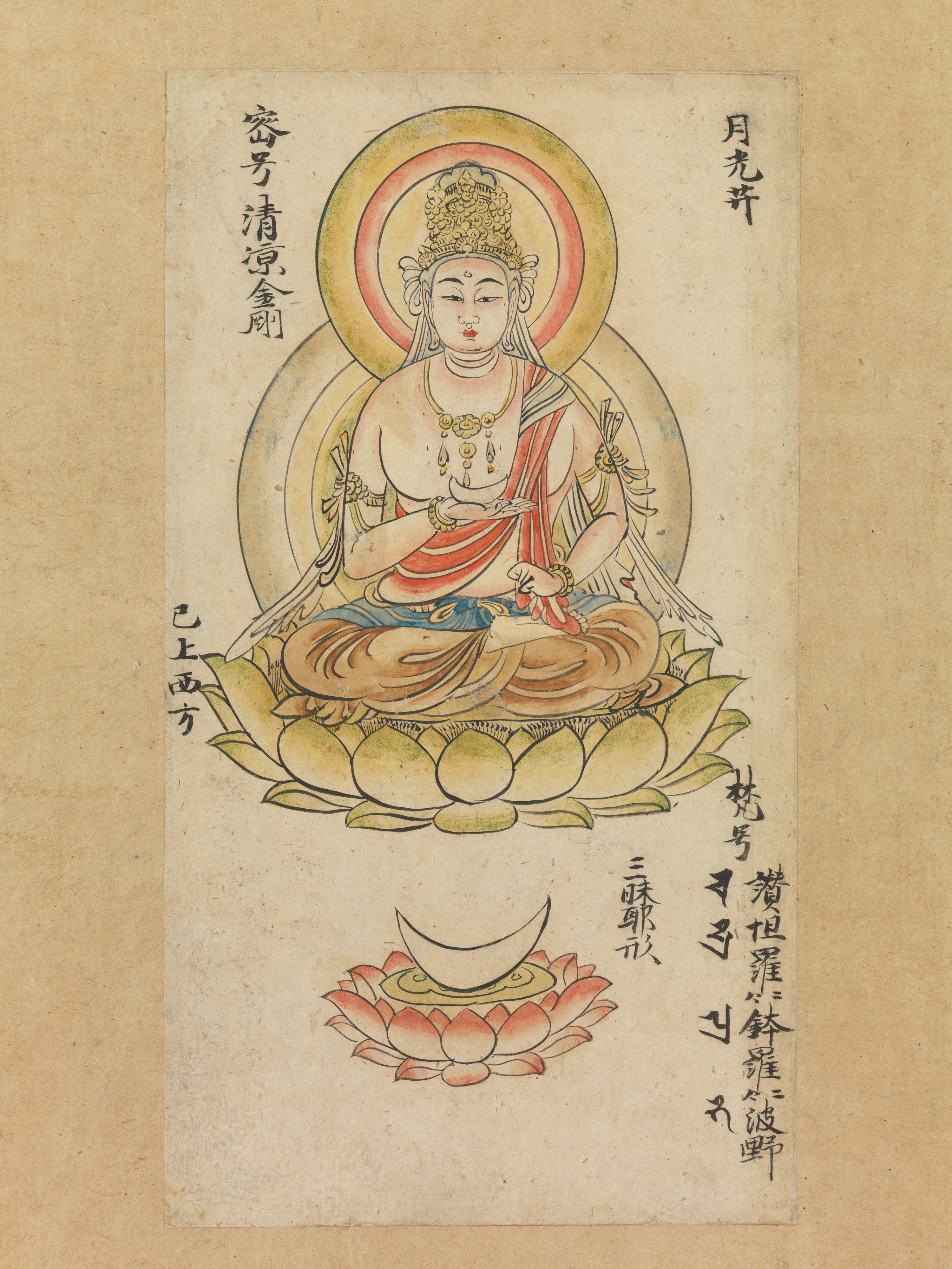
- Title
- Gakkō Bosatsu (月光菩薩), from the Kontai butsugajō (金胎仏画帖)
- Period
- Heian period (794–1185), mid-12th century (1134–1166)
- Region
- Japan
- Medium
- Page from a book mounted as a hanging scroll; ink, color, and gold on paper
- Dimensions
- Page 25.4 × 13.7 cm; with mounting 125.1 × 39.4 cm
- Collection
- The Metropolitan Museum of Art
- Accession
-
1975.268.8 - Rights
- The Metropolitan Museum of Art, Open Access (Public Domain). The Harry G. C. Packard Collection of Asian Art, Gift of Harry G. C. Packard, and Purchase, Fletcher, Rogers, Harris Brisbane Dick, and Louis V. Bell Funds, Joseph Pulitzer Bequest, and The Annenberg Fund Inc. Gift, 1975.
The Gakkō Bosatsu (Moonlight Bodhisattva) page from the dispersed album, mounted as a hanging scroll in Japan before its sale to Packard. The original album page is the inner rectangle; everything outside is later Western and Japanese remounting.
Two album pages, one painter, two American collectors, forty years apart.
The Met holds two surviving pages of a dispersed twelfth-century Heian iconographic album, the Kontai butsugajō — the “Album of Buddhist Deities from the Diamond World and Womb World Mandalas.” Both pages are attributed to Takuma Tametō, who is active around 1132–1174 by the documented record.1 Both arrived at the Met from private American collections. One came in 1975 with the Harry G. C. Packard gift; the other came in 2015 with the Mary Griggs Burke bequest. The Met catalogued them, mounted them as hanging scrolls in the Japanese convention, and treats them as separate works.
Looking at the two together does what looking at either alone cannot: it makes the album visible as the object it once was.
What the Kontai butsugajō was
The name compresses kongōkai (金剛界, the Diamond World) and taizōkai (胎蔵界, the Womb World) — the two mandalic schemata that organize the Shingon Buddhist pantheon — plus butsugajō (仏画帖, “album of Buddhist images”).2 The original was a bound album of paintings, page by page, illustrating the deity figures of both mandalas: buddhas, bodhisattvas, wisdom-kings, vidyārāja attendants, and the wider devic and protective pantheon that the Shingon transmission gathers under the two-mandala framework.
An iconographic album of this kind is not a devotional object in the sense a hanging Amida is a devotional object. It is a reference work. Shingon priests trained in the visualization practices that organize esoteric ritual needed accurate mental images of dozens of specific deities; mistaken iconography is, in the doctrinal logic, mistaken practice. A butsugajō gave the visualization a fixed visual register and gave the teacher a teaching aid.
Albums of this format circulated within Shingon institutions from the late ninth century onward; Kūkai brought the prototype back from his 804–806 Tang study tour. The twelfth century is when the surviving Japanese-produced examples cluster — the Kontai butsugajō attributed to Tametō and its near-contemporary the Zuzōshō compendium being the two most documented cases.3
Takuma Tametō, and the workshop he founded
Tametō is the documented founder of the Takuma school of Buddhist painters. The school continues through his son Tametatsu and into the Kamakura and Nanbokuchō periods; Tametō’s grandson (or great-grandson, depending on the source) Takuma Shōga, working in the Kamakura period, was a high-ranking Shingon priest who painted for Tō-ji and Jingo-ji in Kyoto.4
The school’s stylistic signature is documented: it adapts Southern Song Chinese figure-painting conventions — line-drawing of robes, three-quarter facial registers, particular treatments of haloes and lotus-pedestals — to the Japanese late-Heian-into-Kamakura context. The figures retain a Song idiomatic line, but the colour palette, the proportions, and the painted page-format work within the Japanese iconographic-album tradition rather than within Chinese hanging-scroll painting practice.
Tametō’s own corpus is small. The Kontai butsugajō attribution is the major workshop production; a handful of other twelfth-century Buddhist paintings carry stylistic attributions to him on the basis of the album’s documented register.
No single page of the Kontai butsugajō carries a signed inscription. The Tametō attribution rests on the album’s institutional history — the album is documented as a workshop production of the Takuma circle — and on the consistency of the hand across the surviving pages.5
Met 1975.268.8: Gakkō Bosatsu
The Moonlight Bodhisattva. Gakkō Bosatsu (月光菩薩, Skt. Candraprabha) is conventionally the proper-left attendant of Yakushi Nyorai in the Yakushi triad, paired with Nikkō Bosatsu (the Sunlight Bodhisattva) on the proper right. In the Womb World mandala, Gakkō appears in the Sun-and-Moon section of the outermost ring.6
The Met page shows the bodhisattva seated in three-quarter view, holding a moon-disc on a long stem at chest height. The disc is pale silver against a darker ground, with a small dark figure visible inside it — the hare or the cassia tree, the East Asian lunar emblems that distinguish the moon-disc from the sun-disc (which would carry a three-legged crow).
The colour palette is the album’s standard: cream-pale skin, muted earth-ochre robes layered with red and gold passages along the borders, lotus-pedestal foundation, restrained gold at the halo edge and in the textile patterns. The painted register is small — the page itself measures 25.4 × 13.7 cm — but the figure-density is high.
The Cleveland 1961.48 Nikkō Bosatsu (a wooden sculpture of the sibling deity, c. 800, treated in a separate article) is what completes this figure iconographically: a Moonlight and a Sunlight bodhisattva, the cosmological brackets of the Yakushi cult. The Met page captures the painted-iconographic-album register; the Cleveland sculpture captures the early-Heian wooden register. Between them, the Yakushi-triad attendant pair is visible across both media at the Western institutional level.
Met 2015.300.4: Daishōjin Bosatsu
Daishōjin Bosatsu (大精進菩薩) is “Great Vigorous Effort Bodhisattva.” The figure appears in the Womb World mandala as one of the deities of the jimyō-in (持明院) section — the section of the mandala dedicated to mantras and the bodhisattvas of skillful means.7
The figure is rare. Daishōjin is not one of the household-name bodhisattvas of Japanese Buddhism (Kannon, Jizō, Monju, Fugen); the appearance in the Kontai butsugajō is one of the few painted examples of the figure that survives in twelfth-century Japanese material. The iconographic identification is from the inscribed name in the album’s accompanying text and the attribute set the figure carries.
In the Met page, Daishōjin sits in the same three-quarter view, on a matching lotus-pedestal, in the same colour register. The hands hold a stemmed lotus blossom at chest height — the standard attribute of a bodhisattva of the jimyō-in. The composition is interchangeable with the Gakkō page at first glance: same scale, same palette, same lotus-pedestal, same dark mounting silk in the later remounting.
The interchangeability is the workshop signature. Tametō produced the album in a single sustained pass; the consistency of the format across the surviving pages is what allows the Tametō attribution to hold without a signed page.
The 1975 Packard wave and the 2015 Burke bequest
The album’s dispersal happened in Japan, presumably in the Meiji or early-Taishō period, when many pre-modern temple holdings were broken up for sale.8 By the twentieth century the Kontai butsugajō had become a body of individual album pages, each mounted as a hanging scroll by Japanese mounters in the standard kakemono format, with the original album page surviving as the inner rectangle and the later mounting silks and brocades providing the outer enclosure.
Two of those mounted pages reached the Met by parallel paths.
Harry G. C. Packard (1914–1991) assembled a major American collection of Japanese art in the postwar period, primarily through purchases in Japan in the 1950s and 1960s. The Met acquired his collection in 1975 — accession numbers in the 1975.268 series — in a combination gift-and-purchase that included a Godai Myōō handscroll (1975.268.6), a gosho mandara (1975.268.21), an Amida triad in bonji syllables (1975.268.22), and the Gakkō Bosatsu album page (1975.268.8) among many other works. The Packard wave is the foundational acquisition of the Met’s mid-Heian-into-Kamakura Buddhist painting holdings.
Mary Griggs Burke (1916–2012) assembled her Japanese collection over fifty years, beginning in the 1960s, and bequeathed it in 2015 — three years after her death — to the Met and to the Minneapolis Institute of Arts in a split bequest of roughly 300 works. The Burke wave came forty years after the Packard wave, was sourced through a different chain of dealers and consignments, and brought with it the Daishōjin Bosatsu album page (2015.300.4).
The two pages were once bound together. They are now mounted as separate scrolls, accessioned forty years apart under different fund lines, and reside in different storage racks within the Met’s Asian art conservation programme. The Met’s institutional reuniting of the album is digital — both records are in the Open Access API, both primary images are at high resolution, both are accessible to a reader who knows where to look.
What the album was for, and what its dispersal removed
A bound iconographic album functions as a sequence. A Shingon priest opens the album at page one, advances through buddhas, bodhisattvas, wisdom-kings, attendants, and the wider pantheon in a fixed sequence that mirrors the visualization order of the mandalic transmission. The album is a teaching object: page-by-page, the trainee learns each figure’s stance, attributes, halo, robe pattern, and posture.
When the album is broken up and the pages become individual hanging scrolls, the sequence is lost. The Gakkō Bosatsu page becomes a Yakushi-attendant iconographic note; the Daishōjin Bosatsu page becomes a rare jimyō-in figure. The relationship between the two — adjacent or near-adjacent pages in the original sequence — is no longer documented.
That is the cost of the dispersal. Each individual page survives well; the album as object does not.
There is a partial restoration available now. The Met’s Open Access API exposes the album pages with consistent metadata; the same is true of other dispersed Kontai butsugajō pages held at the Asian Art Museum of San Francisco, the Cleveland Museum of Art, and several Japanese institutional collections. A digital reconstruction of the album, page by page, in a plausible mandalic order, is in principle possible and has not yet been published.
What stays open
Three questions the published scholarship has not closed:
-
The full count of surviving pages. The album originally contained several dozen pages, possibly more than a hundred (a complete Kontai butsugajō would illustrate the full two-mandala pantheon, which runs to over four hundred deity-figures by the standard count). How many pages survive in dispersed Western and Japanese collections, and what fraction of the original whole that represents, is not currently published in consolidated form.
-
The album’s original temple of origin. A twelfth-century Shingon workshop album of this kind would have been produced for and held at a specific temple — likely Tō-ji, Kongōbu-ji at Mount Kōya, or one of the major Shingon mountain monasteries. The Met’s record does not name a temple of origin. The standard surveys cite the album as a Tametō workshop production without specifying the institutional commissioner.
-
The relationship between the surviving Met pages. Whether Gakkō Bosatsu and Daishōjin Bosatsu were adjacent in the original sequence, on the same or facing pages of the bound album, or separated by intervening pages, is undocumented. The two figures occupy different sections of the Womb World mandala — Gakkō in the outer Sun-and-Moon section, Daishōjin in the jimyō-in — so they are not facing-page neighbours in any mandalic reading. They would, however, likely have appeared within a few dozen pages of each other in the album’s transmission sequence.
These are the questions a reunified album catalogue would have to address.
Footnotes
Footnotes
-
The 1132–1174 active-dates range is the Met’s. The dates rest on the Britannica entry for the Takuma School, on Japanese-language family-records of the Sugawara-allied Takuma lineage, and on the documented production date of the Kontai butsugajō itself. ↩
-
The compressed form Kontai (金胎) abbreviates the two-character mandala names kongō (金剛, “diamond / vajra”) and taizō (胎蔵, “womb-treasury”). The full unabbreviated name would be Kongōkai-Taizōkai butsugajō; the album title routinely appears in the abbreviated form in both Japanese and English scholarship. ↩
-
The Zuzōshō (図像抄, “Compendium of Iconographic Drawings”) is a near-contemporary Heian iconographic compendium also held in fragments at the Met (object 45605). The Besson zakki and Asaba shō are the other major Heian iconographic compendia. The eleventh- and twelfth-century period sees the consolidation of the iconographic-album tradition as a Shingon institutional teaching format. ↩
-
Per Britannica, “Takuma School” (accessed 2026-05-13): the school is founded by Tametō, continues through Tametatsu, and includes Takuma Shōga (also known by his original name Takuma Tamemoto), who was a Shingon priest at Tō-ji and Jingo-ji. The lineage is documented through the fourteenth century. ↩
-
The attribution to Tametō rests on workshop-hand criteria — the consistency of the figure-painting register, the line-drawing of robes, the colour palette across the surviving pages — and on the album’s institutional documentation as a Takuma-workshop production. No single page carries a signed inscription. The Met’s record reads “Attributed to” rather than “By,” which is the appropriate scholarly hedging. ↩
-
In the Womb World mandala, Gakkō Bosatsu appears in the outermost ring, in the Sun-and-Moon section paired with Nikkō Bosatsu. In the Yakushi-triad iconographic format (which is not strictly a mandalic configuration but the canonical Buddha-and-attendants programme for Yakushi Nyorai), Gakkō is the proper-left attendant. ↩
-
Jimyō-in (持明院) literally “the section that holds the mantras” — jimyō being the Japanese rendering of Skt. vidyādhara, “mantra-holder.” The section of the Womb World mandala that gathers the bodhisattvas of skillful means and the protective mantra-traditions. ↩
-
The Meiji-period suppression of Buddhist temples (haibutsu kishaku, 1868 onward) and the subsequent reorganisation of monastic property are the primary mechanisms by which late-Heian and Kamakura-period Buddhist art entered the antiquities market and reached Western collectors. The Kontai butsugajō’s break-up dates in the published scholarship cluster around the late nineteenth and early twentieth centuries. The original album held a specific temple’s institutional iconographic record; the break-up converted that record into a series of independently saleable hanging scrolls. ↩
Further works cited
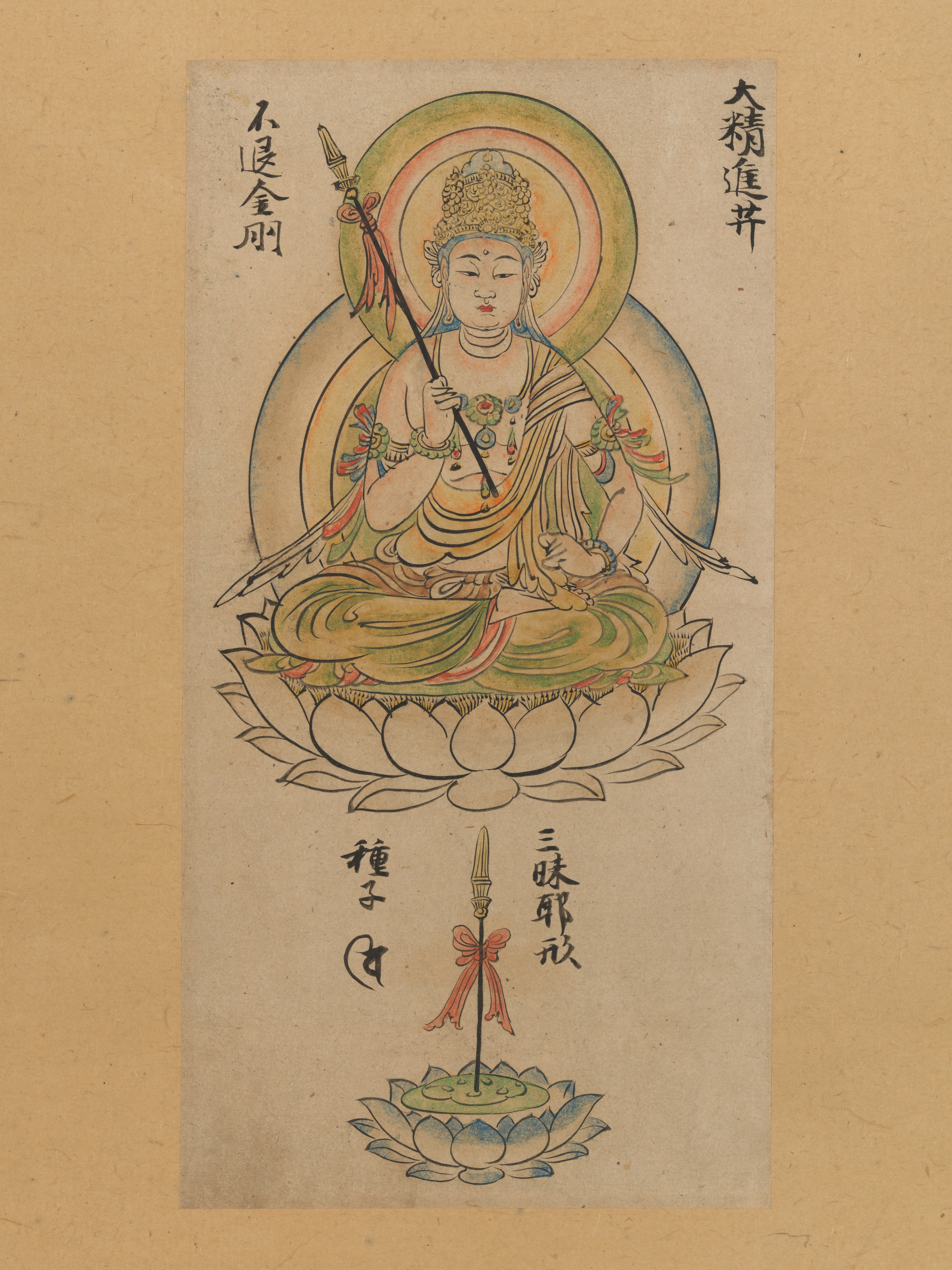
- Title
- Daishōjin Bosatsu (大精進菩薩), from the Kontai butsugajō (金胎仏画帖)
- Period
- Heian period (794–1185), 12th century
- Region
- Japan
- Medium
- Fragment of an album, mounted as a hanging scroll; ink, color, and gold on paper
- Dimensions
- Image 24.7 × 12.7 cm; overall with mounting 117 × 36 cm
- Collection
- The Metropolitan Museum of Art
- Accession
-
2015.300.4 - Rights
- The Metropolitan Museum of Art, Open Access (Public Domain). Mary Griggs Burke Collection, Gift of the Mary and Jackson Burke Foundation, 2015.
Daishōjin Bosatsu — "Great Vigorous Effort Bodhisattva" — a Womb World mandala figure from the same album. Reached the Met 40 years after the Gakkō page, via Mary Griggs Burke's 2015 bequest.
Sources
-
[3]2026-05-13The Metropolitan Museum of Art (Open Access API) collectionapi.metmuseum.org/public/collection/v1/objects/45618 -
[4]2026-05-13The Metropolitan Museum of Art (Open Access API) collectionapi.metmuseum.org/public/collection/v1/objects/53164 -
Standard English-language reference for the Takuma family and the late-Heian-into-Kamakura Buddhist-painting workshop
-
Standard English-language reference for the late-Heian-into-Kamakura Buddhist-painting context; the Tametō attributions and the Takuma school are discussed