Fujiwara no Muchimaro as an avatar of Dainichi
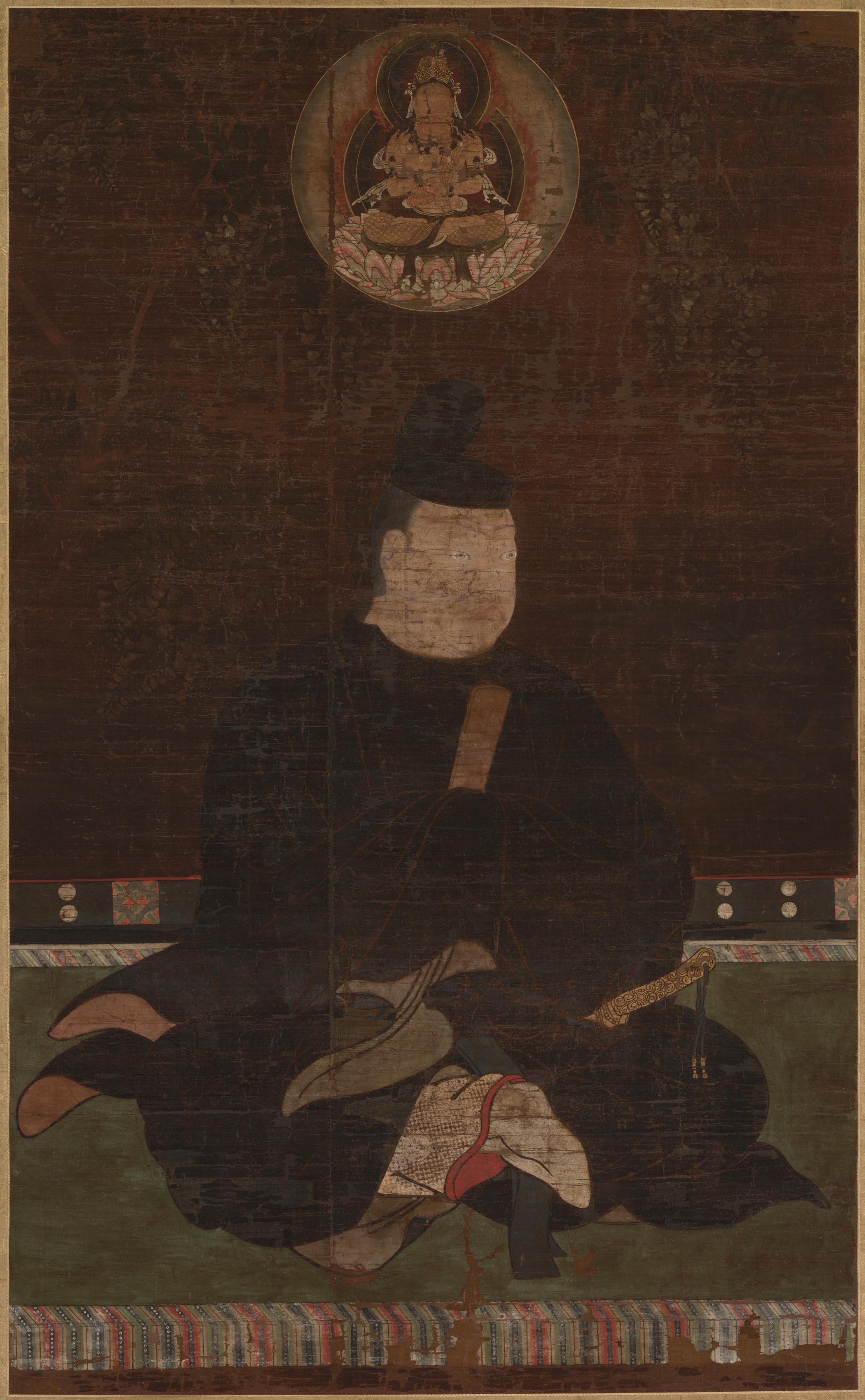
- Title
- Fujiwara no Muchimaro (藤原武智麻呂)
- Period
- Japan, Kamakura period (1185–1333), 13th–14th century
- Region
- Japan
- Medium
- Hanging scroll; ink, color, gold, and cut gold on silk
- Dimensions
- Painting 141.3 × 87 cm; overall with knobs 210.2 × 112.4 cm
- Collection
- Cleveland Museum of Art
- Accession
-
1983.5 - Rights
- Fujiwara no Muchimaro, Japan, Kamakura period (1185–1333). The Cleveland Museum of Art, Leonard C. Hanna Jr. Fund, accession 1983.5. CC0 (public domain).
Cleveland Museum of Art, accession 1983.5. Leonard C. Hanna Jr. Fund. CC0 (public domain).
Cleveland 1983.5 is a Kamakura-period hanging scroll of Fujiwara no Muchimaro (680–737), founder of Eizan-ji, with a small Dainichi Nyorai placed directly above his head. The placement asserts the ancestor is a trace (suijaku) of the cosmic Buddha: not a secular memorial portrait nor a kami image, but a deified human read through the logic the Kasuga cult applied to its gods.
What the scroll places where
Cleveland 1983.5 seats a court official in formal dress and then puts a Buddha over his head. The Buddha is small, on a gold disc, crowned in the manner of Dainichi Nyorai, and it floats just clear of the man’s hair, close enough that the eye reads the two figures as one vertical statement before it reads either one alone. The man is Fujiwara no Muchimaro (680–737), second son of Fujiwara no Fuhito and grandson of the clan founder Fujiwara no Kamatari (614–669).[^cma] The Cleveland catalog states the consequence without hedging: by situating Dainichi there, the painting “would seem to assert that Muchimaro is an avatar of Dainichi.”[^cma]
The picture is large. At 141 centimeters of painted surface, just over a meter and a third, Muchimaro is rendered close to life-size; the scroll with its mounting and knobs runs past two meters, the height of a standing-figure devotional hanging meant to be unrolled on a wall and looked up at, not turned through on a table. Stand at the distance the format assumes and the geometry does the argument for you. The minister’s head is at roughly a viewer’s own eye level; the Buddha sits a hand’s breadth above it, in the register the eye climbs to next. The composition is a sentence with the subject at the bottom and the predicate overhead, and the format was built to be read in exactly that order.
The vertical pairing is the whole argument of the picture, and it is worth saying what it is not. It is not a Buddha attended by a donor: the donor figure in a Buddhist votive painting is smaller, off-axis, and lower. It is not a kami portrait: Kasuga kami are rendered as Shinto deities or as their animal vehicle, not as a named historical minister in datable court dress. Muchimaro is the picture’s full-scale subject; Dainichi is the attribute that tells you what he is. The painting takes a documented human being and treats him the way the medieval combinatory cults treated their gods, as the local, particular trace of a universal Buddhist original.
A second marker confirms the reading and almost no one notices it on a first pass. Sprays of wisteria hang in the upper corners. Wisteria is fuji, the first element of Fuji-wara; the Cleveland entry reads the boughs as a heraldic sign of the sitter’s clan membership.[^cma] The plant is the quietest thing in the composition and the most pointed. The picture is not a generic deified worthy. It is a Fujiwara claim, made in a Fujiwara plant, about a Fujiwara ancestor, and the modesty of the cue is itself the signal that the patron expected a viewer who already knew how to read it.
The misreading the picture invites
The scroll is regularly filed under “Japanese portrait painting,” and that is the misreading worth naming, because it is the one a careful viewer reaches for first. A seated figure in court robes, frontal, formal, looks like the nise-e commemorative-portrait tradition, or like a temple founder’s memorial image, a soshi-zō. It is neither. Strip Dainichi out and the picture would be a memorial portrait; with Dainichi in, the picture is making a claim about the sitter’s nature rather than preserving his likeness. The man is not being remembered. He is being identified.
The opposite error is to call it a kami image and assimilate it to the Kasuga deer-and-disc mandalas. That fails for a reason worth being precise about. The Kasuga suijaku mandalas show kami, either as Shinto-form deities seated in shrine architecture, or as the Kasuga deer carrying a mirror-disc of the five Buddhist originals. Muchimaro is not a kami. He was a minister of state who rose to the senior court ranks and died in the smallpox epidemic of 737. The honji-suijaku logic that mapped the Kasuga kami onto Buddhas is here being run on a human ancestor instead, and that extension is exactly what makes the scroll worth a long look. The combinatory grammar did not stop at gods, and the painting is the proof that it did not.
Both misreadings share one root: they assume the genre is settled by the figure’s costume. It is not. The costume is court dress because the subject was a courtier; the genre is fixed by what stands over the head, not by what is worn below it. That is the single discrimination this article asks a viewer to carry away.
The logic the picture is running
Honji-suijaku, “original ground, manifest trace,” is the medieval Japanese framework under which a Buddhist deity, the honji or original ground, was held to manifest locally as a kami, the suijaku or descended trace. Teeuwen and Rambelli, introducing Buddhas and Kami in Japan, argue against the textbook version in which each kami has one tidy Buddhist counterpart; the medieval associations were many-to-many, built from doctrine, myth, ritual need, and lineage politics rather than from a fixed correspondence table.[^tr] That looseness is what lets the scheme reach past the kami. If the framework is a grammar rather than a lookup table, a powerful human can be slotted in as a trace as readily as a god can, which is precisely the operation Cleveland 1983.5 performs. The Cleveland entry generalizes the move in one sentence: “powerful humans could also be seen as manifestations of Buddhist deities.”[^cma]
The specific original chosen here is the load-bearing detail. Dainichi Nyorai is Mahāvairocana, the cosmic Buddha of the Esoteric (Mikkyō) systems, the Buddha out of whom the entire mandala-cosmos is generated. To make Muchimaro a trace of Dainichi is not to make him a trace of any convenient Buddha; it is the most far-reaching claim the iconographic vocabulary can make, because Dainichi is the ground of which every other Buddhist figure is itself a derivation. The painting does not say the minister resembles a Buddha. It says he is a local emergence of the Buddha from whom Buddhas emerge.
The choice tracks the institution behind the picture. The Fujiwara clan’s tutelary complex was Kasuga shrine paired with Kōfuku-ji, the clan temple at Nara. Grapard’s Protocol of the Gods describes that complex as a single combinatory system in which the shrine served the clan’s tutelary kami (ujigami) and the temple served the spirits of the clan’s deceased leaders.[^grapard] That two-part structure is the key to the scroll. A cult that already maintained, as a matter of clan religion, both a kami side and a deceased-leader side has the institutional grammar to treat a dead minister with the same combinatory apparatus it used on its gods. The deified Fujiwara forebear with a Mikkyō Buddha overhead is not an eccentricity of one painter; it is the Kōfuku-ji-and-Kasuga system’s logic turned onto a named ancestor rather than onto the Kasuga deities.
Muchimaro is also not the only human the period treated this way, which is what keeps the reading from being special pleading. The medieval cults of Shōtoku Taishi and of Tenjin (the deified Sugawara no Michizane) show the same operation performed on other powerful or wronged humans, who acquired Buddhist originals and were venerated through them. The Cleveland scroll is a clan-internal instance of a broader medieval habit, and the broadness is the point: the honji-suijaku frame was a general engine for assigning Buddhist ground to consequential humans, not a kami-only device.
Where the picture comes from
The Cleveland entry gives the institutional anchor. A comparable painting of Muchimaro is held at Eizan-ji in Nara, the temple Muchimaro is traditionally credited with founding, and which was once a branch temple of Kōfuku-ji.[^cma] That lineage carries more weight than it first shows. Eizan-ji’s Octagonal Hall, the Hakkaku-endō, was built to honor Muchimaro, and its principal image is a seated Dainichi Nyorai. The hall had already paired this particular ancestor with this particular Buddha in three dimensions, in wood, as the main object of a building. The Cleveland scroll is that same pairing carried into painting and compressed into a single vertical icon portable enough to hang anywhere the cult traveled. The picture is not an isolated curiosity. It is the devotional, movable form of a cult that had a temple, a hall named for the ancestor, and a sculpted main image of the Buddha he was held to manifest, all of it sitting inside the larger Kōfuku-ji and Kasuga system Grapard reconstructs.[^grapard]
Susan Tyler’s work on the Kasuga material supplies the interpretive control. The Cult of Kasuga Seen Through Its Art reads the twelfth-through-fourteenth-century shrine cult through its paintings and argues that the visual record is where the combinatory theology is actually worked out, not merely illustrated after the fact.[^tyler-book] Her earlier article on honji-suijaku faith makes the sharper point that the relationship between trace and original was not experienced as a demotion of the trace to a mere mask: the suijaku was a real and efficacious presence in its own right, not a lesser stand-in for an absent Buddha.[^tyler-art] Read against this scroll, that argument resists the flattening move of treating Muchimaro as nothing but a symbol that points at Dainichi. The picture’s claim is stronger and stranger than symbolism. It is that the ancestor is himself a working manifestation, venerable as Muchimaro and venerable as a trace of Dainichi at the same time, with neither reading cancelling the other.
Dating, the open question, and where scholarship divides
The Cleveland catalog dates the scroll to the Kamakura period (1185–1333) and, in its date field, to “1200s or 1300s,” a deliberately wide window straddling the Kamakura and Nanbokuchō boundary.[^cma] The hesitation is honest and worth preserving rather than smoothing. The technique, ink, color, gold, and cut gold (kirikane) on silk, is consistent with Kamakura-into-Nanbokuchō Buddhist painting across roughly a century and a half, and the museum does not narrow it. No painter is recorded; the work is anonymous, as most devotional painting of its class is.
The substantive disagreement is not about the decade but about how to classify pictures like this one, and it sits between the museum’s framing and the scholarly frame this article adopts. The Cleveland record presents the scroll within the broad honji-suijaku idea and leaves it there, treating the deification of a human as a straightforward extension of the kami case.[^cma] The position this article commits to, following Tyler and the Teeuwen–Rambelli combinatory model, is that the human case is not a footnote to the kami case but a distinct and revealing application of the same grammar: the picture is best read as a deified-ancestor icon inside a clan cult, not as a stray honji-suijaku image with an unusual subject.[^tr][^tyler-book] On that reading the museum’s gloss is true but undersells what the scroll demonstrates, namely that the combinatory engine ran on humans as a regular operation, not as an exception.
The residual uncertainty is the picture-to-picture genealogy. The Cleveland entry calls the Eizan-ji painting “similar” without specifying whether the Cleveland scroll is a copy of it, a shared-workshop product, or an independent realization of a common Fujiwara-cult prototype. The honest position is that the iconographic program is securely a Fujiwara-cult product tied to Eizan-ji and the Kōfuku-ji orbit, and that the precise filiation between the two surviving paintings is not settled in the accessible record. The reading committed to here, a deified Fujiwara ancestor on the honji-suijaku model with Dainichi as the chosen original and wisteria as the clan signature, does not depend on resolving that filiation. The dating and the picture-to-picture genealogy are the parts a future pass with the Japanese-language Eizan-ji and Kōfuku-ji scholarship would tighten.
Related
- The Wakamiya Kasuga mandala — a single kami as Monju
- Two Met Kasuga shrine mandalas — the bird’s-eye shrine map
- The Kasuga deer mandala — five kami as five Buddhas
- Honji-suijaku (concept)
- Dainichi Nyorai (entity)
- The Kasuga cult (entity)
Sources
-
[4]— Center for Japanese Studies, University of Michigan (Michigan Monograph Series in Japanese Studies 8) print reference