Keman: the openwork gilt-bronze altar pendant
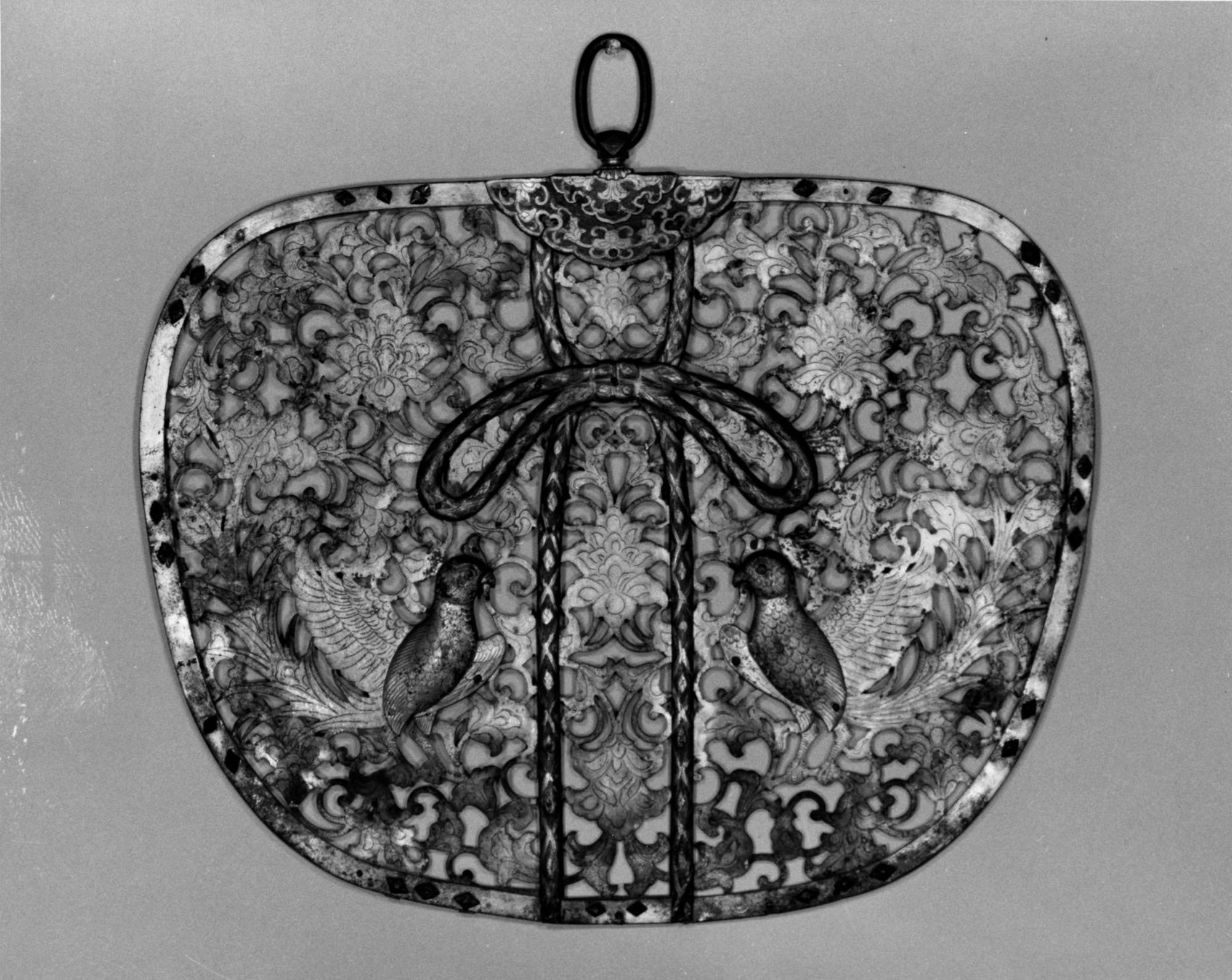
- Title
- Keman (Decorative Pendant Disk)
- Period
- Japan, Kamakura period (1185–1333), 13th c.
- Region
- Japan
- Medium
- Gilt bronze and silver; pierced openwork (sukashibori) with chased detail
- Dimensions
- H. 27.9 cm (11 in.); W. 38.7 cm (15 1/4 in.)
- Collection
- The Metropolitan Museum of Art
- Accession
-
68.76 - Rights
- Keman (Decorative Pendant Disk), Japan, Kamakura period, 13th c., gilt bronze and silver, The Metropolitan Museum of Art, New York, accession 68.76, Gift of John M. Crawford Jr., 1968. CC0 (public domain).
The Met keman (68.76), 27.9 × 38.7 cm, gilt bronze and silver, Kamakura 13th c. The flower-garland offering made permanent in pierced metal: sukashibori openwork with karyōbinga and flower-scroll. CC0.
A keman is a fan-shaped openwork metal pendant hung in a row before a Buddhist altar, a wreath of offered flowers refused the right to wilt and cut permanently into gilt bronze. The Met’s Kamakura disc (68.76, gilt bronze and silver, 13th c.) carries the karyōbinga-and-flower program; the Freer and Nara examples carry the seed-syllable one. Which program is on the field is the first thing a reader resolves, because it is what the pendant is for, not how it was decorated.
The knot that no longer ties anything
Look first at the bottom edge of the Met disc, accession 68.76. A knotted cord runs across it with two ends hanging free, worked into the gilt bronze as carefully as the birds above it. The knot fastens nothing. It is the tie of a wreath of fresh flowers, the loop that once held a real garland closed, kept on an object that has no garland to close because it is the garland, cut in metal. That is the whole logic of a keman in one detail, and it is the right place to start, because everything else about the form follows from it.
A keman (華鬘) is the Japanese reading of Sanskrit kusumamālā, “garland of flowers.” A wreath of strung blossoms laid before a buddha is the simplest offering a person can make. The keman is that offering made permanent: a flower-garland cut in gilt metal so it need never be renewed and cannot wilt. The Met catalogues this one as a “Decorative Pendant Disk” and a “temple hanger,” gilt bronze and silver, 27.9 cm high and 38.7 cm wide, Kamakura, 13th century.1 It belongs to butsugu, the equipment of the altar, alongside the flower-vase and the incense burner. It carries no buddha to be worshipped. It carries the flowers given to one.
Subtraction, not addition
The keman is a metalworking decision before it is an image. The technique is sukashibori (透彫), pierced openwork: the design is laid on a sheet or casting and the ground is then cut away, so the figure survives as lacework standing in air. Two named variants split the method. In ji-sukashi the foreground pattern is kept and the background removed; in moyō-sukashi the motif itself is the part cut out.2 The cutting ran from a starter hole opened out with a piercing graver, the sukashi-tagane, and a scroll saw, the tsurubiki-noko; on the Met piece the surviving metal is then chased with feather and petal detail, and gilt, with silver set in as a second color rather than gilding carried alone.
What makes the keman worth isolating from the rest of the altar metal is that it is the one piece of butsugu where the whole technique is subtractive. The sukashibori that pierces a keman is the same operation that opens the flame-scroll kōhai behind a sculpture and the pierced crowns of bodhisattvas.2 A keman is the freestanding member of that family: the openwork halo with no statue behind it, hung on its own as the offering. The piercing is not lattice for its own sake. On the Met disc the cut ground runs between the bodies of birds and the curl of a continuous flower-scroll, so every removed area is the space between two named things and the web that survives is what holds the disc together. The Met indexes the object under exactly two subject terms, birds and flowers, which is, with some precision, the entire content and all of it.1
Three programs, and what each one is for
A keman’s field is not free decoration. It carries one of a small set of programs, and which one it carries is the first thing to read off it, because the program is the function. There are, in the surviving record, three that matter.
The first is karyōbinga among flowers, and it is the Met disc’s. The karyōbinga (Sanskrit kalaviṅka) is the bird with a human head and torso said to live in Amida’s Pure Land and to sing the dharma in a voice no earthly bird has. A pair of them set into a continuous hōsōge scroll, the imaginary blossom that flowers only in that paradise, is the loaded program: the pendant hung before the altar shows the birds of the Pure Land singing among the flowers of the Pure Land, framed by the knot of a real offering made on the temple floor. The benchmark is not in a museum case but at Chūson-ji at Hiraizumi, whose Konjikidō roof was raised in 1124 by Fujiwara no Kiyohira. The Tokyo National Museum, exhibiting the hall’s fittings for the 900th anniversary, describes its gilt-bronze “Flower Garland with Kalaviṅka” as worked with “the mythical half-human, half-bird karyobinga said to inhabit the Pure Land,” its scrolling vines carrying the hōsōge “that blossom in the Pure Land.”3 The Konjikidō keman themselves are dated to the first half of the twelfth century, close to the 1124 roof-raising but, on the museum’s own wording, a presumption from style rather than a date the objects carry.
The second program is the seed syllable. Instead of birds, the field carries a Sanskrit bīja, the syllable that stands for a specific buddha, set on a lotus. The Freer holds a Kamakura keman, F1974.13, copper with gold and silver, where circular silvered medallions carry Sanskrit letters and the syllable bhai names Bhaiṣajya-guru, Yakushi, the Buddha of healing; below the openwork lotus hang five bells and two jingles from a cord tied in a bow.4 Nara National Museum holds six gilt-bronze shuji keman from Hyōzu Taisha in Shiga, an Important Cultural Property, where the syllable for Dainichi “rests on a lotus pedestal with striated petals…backed by a pointed mandorla surrounded by flames.”5 The difference is not stylistic. A karyōbinga keman shows the paradise; a seed-syllable keman names the buddha, and which buddha is legible from the letter. Read the program first and the object tells you what it was hung to do.
The third is the plain field: pure hōsōge scroll, lotus, peony, or foliate karakusa arabesque, used when neither birds nor syllable are wanted. It is the same offering with the iconographic content held down to the flowers alone.
Bronze against leather
Keman were made two ways, and the split is not cosmetic. The prestige line, the Chūson-ji set among it, is gilt bronze. A second tradition worked the same fan shape in oxhide: cut leather, painted and gilt, hung from the same beam.6 The named survival of that line is the set of thirteen gohi (oxhide) keman at Tō-ji in Kyoto, in openwork like the metal ones but with the birds and scroll painted in polychrome and cut gold leaf, in what one account ties to Heian Buddhist painting technique rather than metalwork.7
The two traditions reach the same image from opposite directions, and that is the point worth holding. A leather keman adds the program: it paints the scroll and the karyōbinga onto a cut hide. A bronze keman subtracts to it: it removes everything that is not the scroll and the birds until only they are left. Addition against subtraction, the same garland either way. The leather examples survive at all mostly because they were kept as temple treasures rather than left hanging in service, where hide does not last; the bronze ones survive because bronze does. The Met disc is unambiguously the subtractive line. The museum records it as gilt bronze and silver, and a pierced web that has to carry its own weight when hung is a metalworker’s solution, not a leatherworker’s. It is the cleanest place to watch subtraction resolve into an offering.
In the row, in the dark
A keman is not an eye-level object and is not seen one at a time. It hangs in a row of its kind from the transverse beam at the front of the inner sanctuary, the naijin, above and ahead of the principal image. A person standing back in the outer worship hall reads not one disc but a line of pierced gold strung across the dark upper register of the altar bay, the lamps behind it, the cut ground letting the dark and the flame through so the metal reads as something woven rather than as a row of plaques. Backlit and seen from below and in series is the working condition; it is what the sukashibori was developed to do.
The single disc in a museum vitrine reverses every one of those conditions: lit flat, isolated, raised to standing-eye height, turned so the front faces out, the dark behind it replaced by a gallery wall. It is the same object with its working life subtracted. The premise of John Rosenfield and Elizabeth ten Grotenhuis’s survey of Japanese Buddhist art in Western collections is, in part, that exactly this kind of altar furniture has to be read back into the hall it left before it can be understood at all.8 The Freer pendant keeps the evidence of that life that the Met disc has lost: F1974.13 still carries its cord-bow and its five bells and two jingles, the parts that moved and sounded when the beam was knocked or the hall was walked.4 The Met disc has shed its fittings. What hangs in the case is the field alone.
What the disc cannot tell you
Donald McCallum’s study of medieval Japanese gilt and cast bronze treats that metalworking culture as one that proliferated devotional objects by repeating a fixed type with workshop variation.9 The keman is the altar-furniture instance: the same programs and the same sukashibori from the Chūson-ji set forward, varied at the level of cutting quality, not invention. The Met disc is one competent, fully resolved instance of a type whose meaning is fixed.
What it will not tell you is its own hall. It came through the 1968 Crawford gift with no temple named, and a decontextualized keman cannot recover the sanctuary it hung in the way a karyōbinga can recover the Pure Land — the program is legible, the provenance is gone, and no amount of looking at the disc alone closes that. That is the honest limit. The reading runs the other way to the usual one: the iconography survives the loss of the building, and the building does not survive the loss of the iconography. The next move is not to read more about this disc. It is to stand under the Chūson-ji row, or the Tō-ji leather, where the keman is still doing the thing the Met object can now only be read back into.
Sources
| Source | Type | Citation |
|---|---|---|
| The Metropolitan Museum of Art acc. 68.76 | museum record | Keman (Decorative Pendant Disk), Kamakura 13th c., gilt bronze and silver, CC0; catalog facts + Birds/Flowers subject indexing (Met OA API) |
| Nara National Museum, Seed Syllable Pendants (金銅種子華鬘), acc. 1187 | museum record | e-Museum / NICH; six gilt-bronze shuji keman, ICP, Kamakura 13th–14th c., Dainichi bīja on flamed lotus pedestal, ex-Hyōzu Taisha (verbatim) |
| Freer Gallery of Art acc. F1974.13 | museum record | Smithsonian NMAA; Buddhist altar pendant (keman), Kamakura, copper/gold/silver, CC0; bhai/Yakushi seed syllable, cord-bow, 5 bells + 2 jingles (verbatim) |
| Tokyo National Museum: Chūson-ji 900th anniversary | museum record | Konjikidō roof raised 1124 (Fujiwara no Kiyohira); “Flower Garland with Kalaviṅka” gilt-bronze keman, karyōbinga + hōsōge of the Pure Land (verbatim) |
| Gabi Greve, “Flower Garlands (keman)“ | reference | Tō-ji’s thirteen gohi (oxhide) openwork keman, polychrome + cut gold leaf; four-form taxonomy (attributed, tertiary) |
| Keman (華鬘) reference | reference | corroborating: kusumamālā etymology, naijin placement, oxhide/wood/thread materials, Chūson-ji National Treasure |
| Sukashibori (透彫) reference | reference | ji-sukashi / moyō-sukashi, sukashi-tagane and tsurubiki-noko tools, keman / kōhai / keko / kōro application (verbatim) |
| John M. Rosenfield and Elizabeth ten Grotenhuis, Journey of the Three Jewels | book | Asia Society / Tuttle, 1979; the premise that Western-collection altar furniture must be read back into its hall (work level, no pages) |
| Donald F. McCallum, Zenkōji and Its Icon | book | Princeton University Press, 1994; medieval gilt/cast-bronze type-replication culture (work level, indirect, no pages) |
Related
- Kyōzō — the incised Buddhist mirror, read through a Bishamonten
- Gilt bronze: how a ritual implement was made
- Kyōzō, the incised Buddhist mirror
- Kanshitsu, the Tenpyō dry-lacquer technique
- Yosegi-zukuri, the joined-block construction
- Keman (entity)
- Sukashibori, pierced openwork (entity)
- Butsugu, Buddhist altar furniture (entity)
- Karyōbinga (entity)
Footnotes
Sources
-
Object facts (title 'Keman (Decorative Pendant Disk)' / 'temple hanger' object name; gilt bronze and silver; H. 27.9 W. 38.7 cm; Kamakura 13th c.; Gift of John M. Crawford Jr. 1968; classification Metalwork; subject indexing Birds + Flowers; public domain) carried from the 2026-05-16 Met Collection Open Access API pull; catalogue HTML 429'd again 2026-05-18, expected per the Met-API-vs-catalog house note, no curatorial prose retrieved.
-
[2]2026-05-18Nara National Museum (e-Museum, National Institutes for Cultural Heritage) emuseum.nich.go.jp/detailFetched 2026-05-18, used verbatim: six gilt-bronze seed-syllable keman, Important Cultural Property, Kamakura 13th–14th c., each L 43.3 × W 42.2 cm, Nara National Museum, formerly Hyōzu Taisha (Shiga); 'downward facing lotus flowers...strung together', 'the upper part bows outward like a paddle fan'; the Sanskrit seed syllable for Dainichi 'rests on a lotus pedestal with striated petals...backed by a pointed mandorla surrounded by flames'. The museum-grade anchor for the seed-syllable (shuji) keman program, replacing the prior encyclopedia-tier load on that point.
-
[3]2026-05-18National Museum of Asian Art (Freer Gallery of Art), Smithsonian Institution asia-archive.si.edu/object/F1974.13Fetched 2026-05-18 via the asia-archive.si.edu mirror (asia.si.edu 403'd, house pattern): Kamakura 1185–1333; copper with gold and silver; 44.8 × 31.5 × 2.2 cm; Purchase – Charles Lang Freer Endowment; CC0 / public domain; provenance research underway. Curatorial text verbatim: cord in a bow form, circular medallions with Sanskrit letters on silvered surfaces, five hanging bells, two jingles, metalwork of 'lotus leaves, buds and flowers, with incised lines imparting a naturalistic appearance'; the seed syllable 'bhai' denotes Bhaiṣajya-guru (Yakushi). Used for the seed-syllable program, the surviving bell/jingle/cord-bow fittings, and the second documented comparandum.
-
Corroborating source only: kusumamālā etymology and naijin placement, both also carried by the museum records; the oxhide/wood/thread alternative-materials list; the Chūson-ji National Treasure mention. Not the sole support for any single claim.
-
Used for the ji-sukashi / moyō-sukashi distinction and the sukashi-tagane / tsurubiki-noko tool names; technique-level facts. Wikipedia verbatim 2026-05-18: 'Prominent uses are in ritual objects such as keman (pendent ornaments), keko ("flower basket"), and kōro (incense burners)' — corroborates the keman / butsugu application.
-
Search-extract verbatim re-confirmed 2026-05-18: Konjikidō's roof raised 1124 by Fujiwara no Kiyohira; 'Flower Garland with Kalaviṅka', a gilt-bronze ornament that formerly adorned the Golden Hall; 'a copper altar fitting called the kondo keman featuring depictions of the mythical half-human, half-bird karyobinga said to inhabit the Pure Land'. The Chūson-ji keman themselves dated 'presumed... first half of the twelfth century' per the corroborating extract — distinguished in-body from the hall's 1124 roof-raising, not conflated.
-
Fetched 2026-05-18. Used only for the named leather corpus: thirteen gohi (oxhide) keman at Tō-ji, Kyoto, in openwork (sukashibori) with polychrome and gold leaf 'reflecting traditional techniques of Buddhist painting of the Heian period'; and the four-form taxonomy (fretwork, uchiwagata fan, floral wreath, pearl wreath). Tertiary, attributed not adjudicated; the load-bearing leather-corpus fact is the Tō-ji thirteen.
-
Cited at work level for the premise that altar furniture separated into Western collections has to be read back into its architectural use. Cited without page numbers.
-
Cited at work level for the medieval Japanese gilt/cast-bronze culture of proliferating a fixed devotional type by workshop repetition. Indirect (Zenkōji is the Amida-triad replication cult, not butsugu); cited as the closest available framing source in the absence of a butsugu-specific monograph.