Shōtoku Taishi at sixteen, with the long-handled incense burner
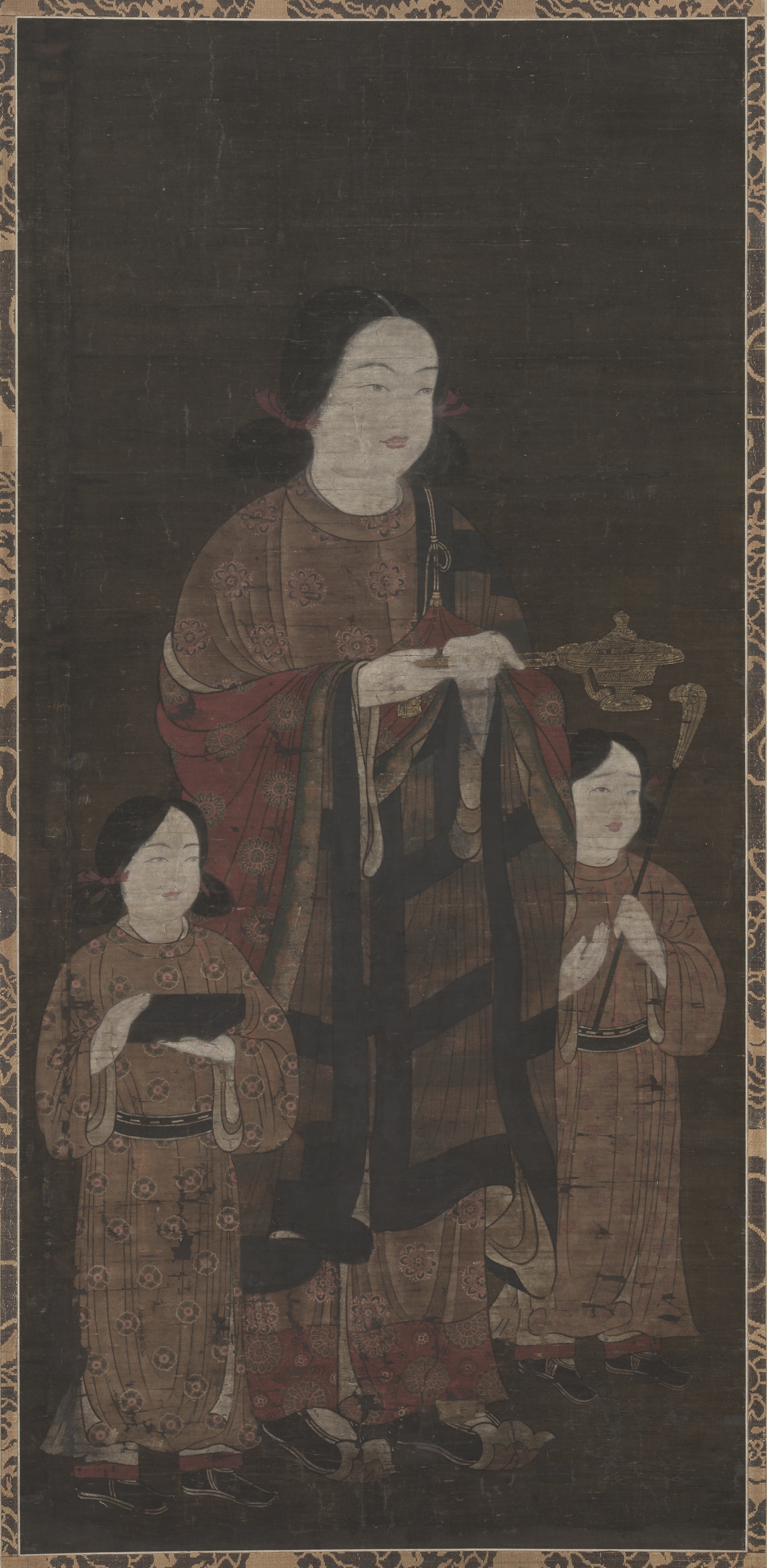
- Title
- Shōtoku Taishi at Sixteen (聖徳太子孝養像及び二王子像)
- Period
- Muromachi period (1392–1573), 1400s–1500s
- Region
- Japan
- Medium
- Hanging scroll; ink and color on silk
- Dimensions
- Image 121.9 × 57.5 cm; overall with mounting 207.3 × 83.2 cm
- Collection
- Cleveland Museum of Art
- Accession
-
1964.278 - Rights
- Cleveland Museum of Art, 1964.278 — CC0 (Open Access). Severance and Greta Millikin Collection.
Cleveland 1964.278. The central long-handled incense burner is the iconographic anchor that fixes this as a kōyō-zō (filial-piety image) rather than any of the other half-dozen canonical Shōtoku image-types.
The long-handled incense burner is what fixes the date.
Not the date of the painting — Cleveland’s catalog gives the Muromachi window (1400s–1500s) and this article does not improve on that — but the date in the prince’s life. Shōtoku Taishi held the long-handled bronze censer at age sixteen, in the year 587, praying at the bedside of his ailing father Emperor Yōmei for the imperial recovery that the Soga clan and the early Japanese Buddhist court had been arguing about for a generation. Yōmei survived briefly. The prince’s intercession is the moment, in medieval Japanese cult-historical narrative, when the imperial line accepted Buddhism. The censer is the iconographic seal of that moment.
The incense burner at sixteen
Cleveland 1964.278 places the censer at chest height, vertical, with the smoke rising in restrained pale ribbons. The prince’s hands hold the long bronze handle in front of him with the same steadiness any later monk would bring to the same gesture. He is not yet a monk; he is sixteen. But the robes he wears are unmistakably monastic — a dark outer robe layered over a paler under-robe, the layering of a Buddhist cleric rather than the layered silks of a court prince. His hair is dressed in the two side-loops — mizura — that medieval Japanese painting reserves for an unmarried boy. The face is idealised, full, the cheeks rounded; the eyes are downcast in concentration.
This is the kōyō-zō (孝養像). The literal translation is filial-piety image — kōyō meaning the Confucian virtue of filial devotion, zō meaning image or statue. The Japanese iconographic tradition fixes the image-type at age sixteen, fixes the gesture at intercession with the censer, and fixes the institutional reading at the prince’s role in bringing Buddhism to the imperial court. Other canonical Shōtoku image-types — the age-two Namu Busshi, the age-seven scholar-of-Buddhist-sutras, the age-thirty-five regent-with-shaku-tablet — show different episodes from the prince’s hagiographic biography. The censer is the one that says sixteen.
Kōyō-zō: the filial-piety image type
The image-type itself is older than Cleveland 1964.278 by some four centuries. Kevin Gray Carr, in Plotting the Prince: Shōtoku Cults and the Mapping of Medieval Japanese Buddhism (Hawaiʻi, 2012) — the standing English-language monograph on the medieval Shōtoku cult — treats the kōyō-zō as one of the two devotional cores of the cult, alongside the age-two Namu Busshi image (covered separately on bodhi at Prince Shōtoku at age two: the Namu Busshi image-type at Cleveland 1989.76).
Carr’s reading: the two image-types map different theological functions of the same figure. The age-two image works the Pure Land register — the toddler-prince clasping hands in gasshō and uttering the name of the Buddha is treated as a manifestation of Avalokiteśvara or of Amida himself; the post-Hōnen revival of the twelfth and thirteenth centuries pushed this reading into provincial Pure Land devotional life. The age-sixteen image works the institutional-historical register — the prince’s intercession is the founding event of imperial-court Buddhism, and the painting tradition was organised principally around Hōryū-ji (the prince’s Asuka-period foundation) and Shitennō-ji (his Osaka foundation), the two temples that traced their religious authority back to Shōtoku personally.
What Cleveland 1964.278 belongs to is the institutional-historical strand. The painting is not primarily a Pure Land devotional object; it is a cult-historical icon. The reader who approaches it expecting Avalokiteśvara-in-disguise has the wrong image-type. The reader who approaches it expecting the foundation moment of court Buddhism is reading correctly.
What Cleveland 1964.278 shows
The composition is plain. Three figures stand on a low ground plane with no architectural setting, no landscape, no descending Pure Land deities, no other narrative context. The neutral pale silk runs from edge to edge of the painting. The prince occupies the centre at full vertical height. The two attendants flank him at roughly two-thirds his scale.
The reduction is significant. Earlier kōyō-zō compositions sometimes include the sickbed of Emperor Yōmei in a small inset, or include attendant courtiers, or include incidental landscape that locates the intercession at the Naniwa palace. Cleveland 1964.278 strips all of that. The painting commits to the prince and the censer; everything narrative is in the iconographic seal of those two elements. This is consistent with the later Muromachi period of the painting’s making: by the fifteenth and sixteenth centuries, the kōyō-zō had become a portable devotional image-type rather than a narrative tableau, and the visual logic had compressed to the figure-plus-censer minimum.
The palette is muted. Dark earth-pigments in the prince’s monastic outer robe, paler ochre in the under-robe, restrained colour passages in the attendants’ textiles, a pale skin tone idealised for adolescent youth. The Cleveland Museum’s text classifies the medium simply as ink and color on silk — no gold leaf, no silver, no cut-gold ornament. The painting belongs to the workshop end of the production tradition, not the high-end Pure Land devotional commission end.
The two attendant princes
Cleveland’s catalog identifies the two attendant figures as Prince Eguri — Shōtoku’s brother — and Prince Yamashiro-no-Ōe — Shōtoku’s son. The brother holds a small sutra box. The son holds a nyoi sceptre, the medieval Japanese cleric’s wand of office that doubled as a teaching gesture-prop.
The identification is iconographically conventional and chronologically loose. Yamashiro-no-Ōe is historically Shōtoku’s son, born some years after the age-sixteen intercession episode of 587 — a son cannot historically have stood beside a sixteen-year-old father. The Cleveland reading is therefore not a historical-narrative claim; it is an iconographic-typological claim. The kōyō-zō image-type allows two princely attendants whose identification varies across surviving examples. In some sixteenth-century examples the two attendants are read as Korean monks Eji and Esō who are recorded in the hagiographic biography as having instructed the young prince. In others they are read as Shōtoku’s own immediate family — brother and son — collapsed into a single timeless icon of the prince’s lineage. Cleveland 1964.278 commits to the family reading. Whether the painting’s original Muromachi workshop intended that specific identification, or whether the identification accrued later in the painting’s life, is a question the catalog text does not resolve.
The Met’s comparandum scroll — accession 29.100.508, Prince Shōtoku at Age Sixteen, Nanbokuchō 14th c., in the style of Toba Sōjō, H. O. Havemeyer Bequest 1929 — also shows attendants but reads them differently in the published catalog. The variation between examples is the variation between local workshop preferences in a stable iconographic template.
Carr 2012 and the Shōtoku cult map
Carr’s monograph is the principal source. Plotting the Prince (University of Hawai’i Press, 2012) treats the medieval Shōtoku cult not as a single coherent religious devotion but as a mapped landscape of overlapping image-types, institutional bases, theological framings, and political readings. The cult is plotted across:
- Hōryū-ji — the Asuka-period Hōryū-ji compound near Nara, the prince’s principal foundation; the Yumedono ritual hall and the Eden hall preserve the highest-status Shōtoku image-types.
- Shitennō-ji — the Osaka foundation; the cult’s Pure Land devotional centre.
- The Shōtoku-eden picture-biographies — illustrated handscrolls of the prince’s life produced from the late Heian onward, treated separately at Met 45371 (the Illustrated Biography of Prince Shōtoku).
- The kōyō-zō and Namu Busshi devotional image-types — the two image-types treated by bodhi.
Cleveland 1964.278 belongs to the kōyō-zō register of Carr’s map. It is not a top-rank Hōryū-ji-affiliated commission — those were higher-status objects with gold and cut-gold ornament — but it is a workshop iteration of the same iconographic template that Hōryū-ji and Shitennō-ji ritual life operated through.
What survives elsewhere
The kōyō-zō image-type survives in roughly three layers across global collections. The high-status painted layer — large hanging scrolls with gold or silver, often from the Nanbokuchō or earlier — is concentrated in Japanese institutional holdings (Hōryū-ji, Shitennō-ji, Tokyo National Museum, and the Nara National Museum). The workshop-grade Muromachi painted layer — Cleveland 1964.278’s stratum — is more broadly distributed in both Japanese and American collections, with major examples at the Met (29.100.508 and 49122, both Public Domain under Met Open Access), Seattle Art Museum, and the British Museum (acc. 1931,1116,0.1.3). The sculptural age-sixteen layer is comparatively thin in non-Japanese collections; most surviving age-sixteen kōyō-zō sculptures remain in Japanese institutional ownership.
The post-1868 Meiji shinbutsu-bunri edict did not affect the Shōtoku cult as severely as it affected the Kasuga or Kumano cults. The Shōtoku cult was already framed as Buddhist (rather than shinbutsu-combinatory) in its medieval institutional articulation; Hōryū-ji and Shitennō-ji remained explicitly Buddhist temples through the Meiji transition. What did change was the cult’s institutional centrality — by the mid-twentieth century the medieval Shōtoku cult had become an antiquarian and art-historical subject rather than a living devotional context, and works like Cleveland 1964.278 began moving from temple holdings into the American collecting market in larger numbers.
What stays open
Three gaps remain. The first is the dating window: Cleveland gives Muromachi 1400s–1500s. A century-wide window is wide; closer dating would require pigment analysis or comparison with closely-attributable signed Muromachi-school works. The second is the workshop: the painting is catalogued as unidentified. Comparable Muromachi kōyō-zō have in some cases been linked to Hōryū-ji-affiliated workshops or to the Kasuga-affiliated school at Kōfuku-ji, but the Cleveland catalog text does not propose a specific workshop attribution. The third is the precise identification of the two attendants: the Eguri/Yamashiro reading is the catalog’s, but the image-type’s history shows the identification varying across examples, and a different identification (e.g., Korean monk instructors) cannot be ruled out at present evidence.
These are gaps within a stable iconographic identification, not gaps in the identification itself. The kōyō-zō reading is fixed by the long-handled censer, the mizura hairstyle, the monastic robes, and the Muromachi-period dating. Carr 2012 grounds the cult-historical framing. The Met comparandum at 29.100.508 grounds the genre’s wider iconographic distribution.
Related
Sources
-
Cleveland's catalog text identifies the central iconography as the prince's intercession for Emperor Yōmei's recovery from illness and reads the two attendants as Prince Eguri (brother) and Prince Yamashiro-no-Ōe (son). The Yamashiro identification is iconographic rather than chronologically literal — the historical Yamashiro-no-Ōe was born well after Shōtoku's age-sixteen episode.
-
The standing English-language monograph on the medieval Shōtoku cult. Carr treats the kōyō-zō (age-sixteen filial-piety image) and the Namu Busshi sculpture (age-two image) as the two devotional cores of the cult — the painting tradition that organised Hōryū-ji and Shitennō-ji ritual life, and the sculptural type that proliferated through provincial Pure Land temples after the Hōnen revival. The two image-types map different theological functions of the same figure: one ritual-historical (Buddhism arrives in Japan because of this prince), one Pure Land devotional (the prince is Avalokiteśvara or Amida in disguise).
-
The closest Met comparandum to Cleveland 1964.278. The Met scroll predates the Cleveland one by roughly a century and a half (Nanbokuchō 14th c. versus Muromachi 1400s–1500s); attribution to the style of Toba Sōjō (Kakuyū, c. 1053–1140) is conventional rather than literal — the actual painter is a much later workshop hand working in the visual register identified with the Hōryū-ji-affiliated lineage. The 1929 Havemeyer bequest places the painting in the Met's earliest pre-war Japanese-painting holdings — a generation earlier than the Cleveland 1964 acquisition.
-
Met curatorial summary of the kōyō-zō image-type as one of the canonical Shōtoku iconographies, depicting the prince at sixteen in monk's robes holding a censer, hair in the two side-loops (*mizura*) of an unmarried boy, the long-handled incense burner as the fixed iconographic anchor.
-
The Cleveland sculpture treated by bodhi at /articles/shotoku-taishi-age-two-namu-busshi/. The age-two Namu Busshi image-type is the sculptural counterpart to the age-sixteen kōyō-zō painted image-type. Carr 2012 treats the two together as the cult's two devotional cores.