The six Jizō of Edo: a bodhisattva programmed for the six realms
- Title
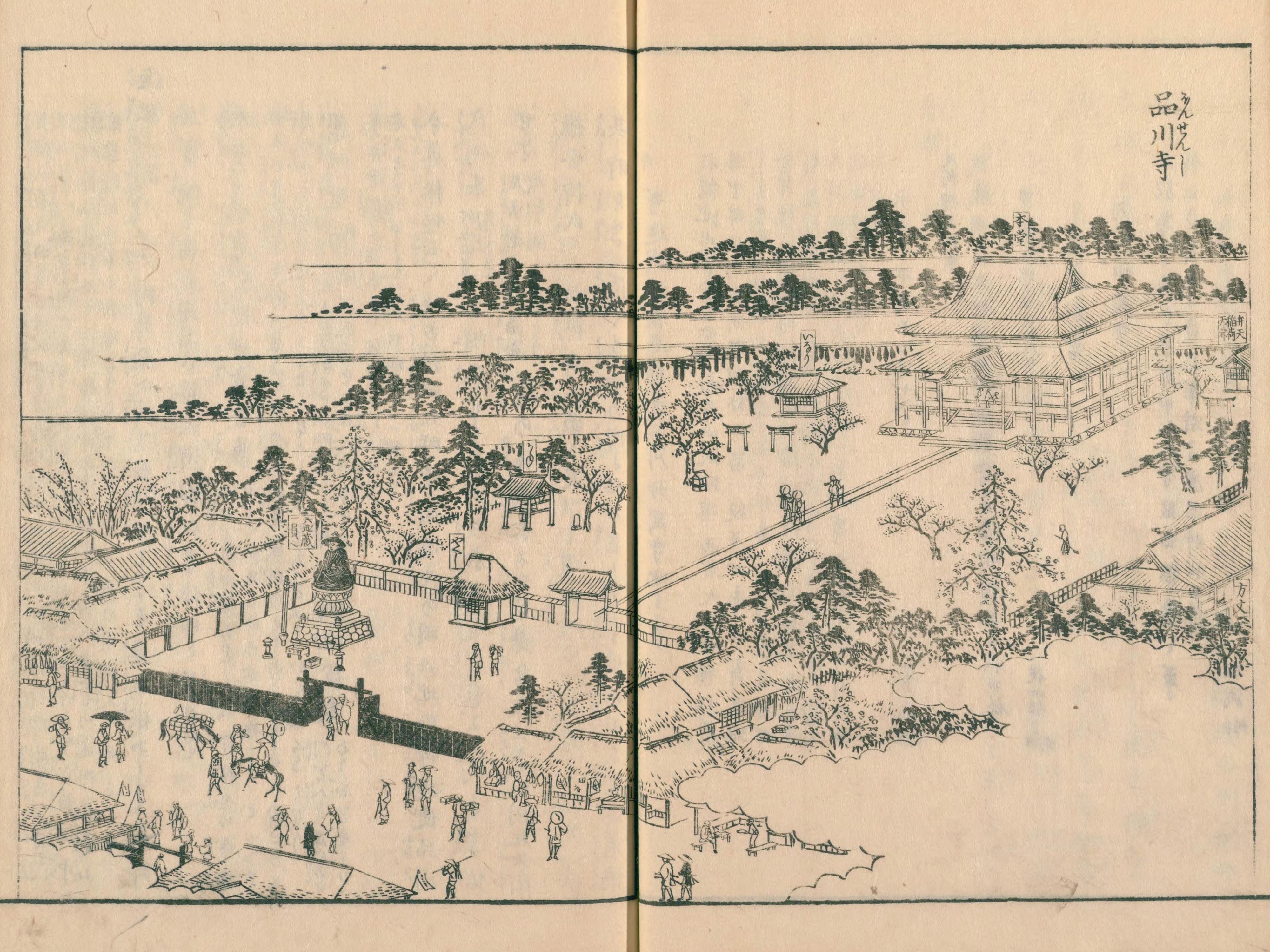
- Honsen-ji (Shinagawa) showing the first Edo Roku Jizō — woodblock from the Edo Meisho Zue, vol. 2 book 4
- Period
- Edo period — Tenpō era (1834)
- Region
- Japan, Shinagawa
- Medium
- Woodblock print illustration on paper
- Dimensions
- Original folio approximately 22 × 16 cm; high-resolution scan 4000 × 3000 pixels
- Collection
- Wikimedia Commons (originally National Diet Library)
- Accession
-
Edo Meisho Zue 04 Honsen-ji - Rights
- Public domain (PD-Art). Hasegawa Settan (1778–1843), in *Edo Meisho Zue* vol. 2 book 4 (1834); source National Diet Library Digital Collections via Wikimedia Commons.
Honsen-ji at Shinagawa, depicted by Hasegawa Settan in 1834 for the *Edo Meisho Zue*. The bronze Jizō at the precinct front is the first of the Edo Roku Jizō (cast 1707, 275 cm — the largest and earliest of the six), and remains in situ at Honsen-ji today. The woodblock is the contemporary documentary record of the programme as it functioned in late-Edo Edo, three decades before the Meiji upheaval that would dismantle the sixth statue.
Six statues, six roads
In the third year of Hōei (1706), a monk named Jizō-bō Shōgen of Fukagawa in eastern Edo recovered from what his vow-record describes as an incurable disease. He had prayed, for himself and his parents, to the bodhisattva Jizō. He attributed his recovery to the prayer. He made a vow, in turn, modelled on the existing Roku Jizō (六地蔵) tradition at the six road-entrances to Kyoto: to commission six bronze Jizō Bosatsu statues, one at each of the six road-entrances of Edo, by public subscription.1
Fourteen years later, the programme was complete. From 1707 to 1720, the master bronze-caster Ōta Suruga-no-kami Fujiwara Masayoshi cast six substantial bronze figures of Jizō, each at temple-scale (267–275 cm), each on a multi-tier lotus pedestal, each in the canonical monk-form with shakujō and wish-fulfilling jewel. The casting was funded by donations from more than 72,000 individuals, the donor names cast directly into the bronze of each statue’s body and pedestal.2
The six were sited at the six principal road-entrances of Edo:
- Honsen-ji (Shinagawa): Tōkaidō, the southwestern coastal route to Kyoto (1707, 275 cm)3
- Tōzen-ji (Higashi-Asakusa): Ōshū-kaidō, the northeastern route to the Tōhoku provinces (1710)
- Taisō-ji (Shinjuku): Kōshū-kaidō, the western inland route (1712, 267 cm)
- Shinshō-ji (Sugamo): Nakasendō, the inland route to Kyoto (1714, 268 cm)
- Reigan-ji (Kiyosumi-Shirakawa): Mito-kaidō, the northern route to Mito (1717, 273 cm)
- Eidō-ji / Eitai-ji (Fukagawa): the sixth, southeastern position; demolished (1720)4
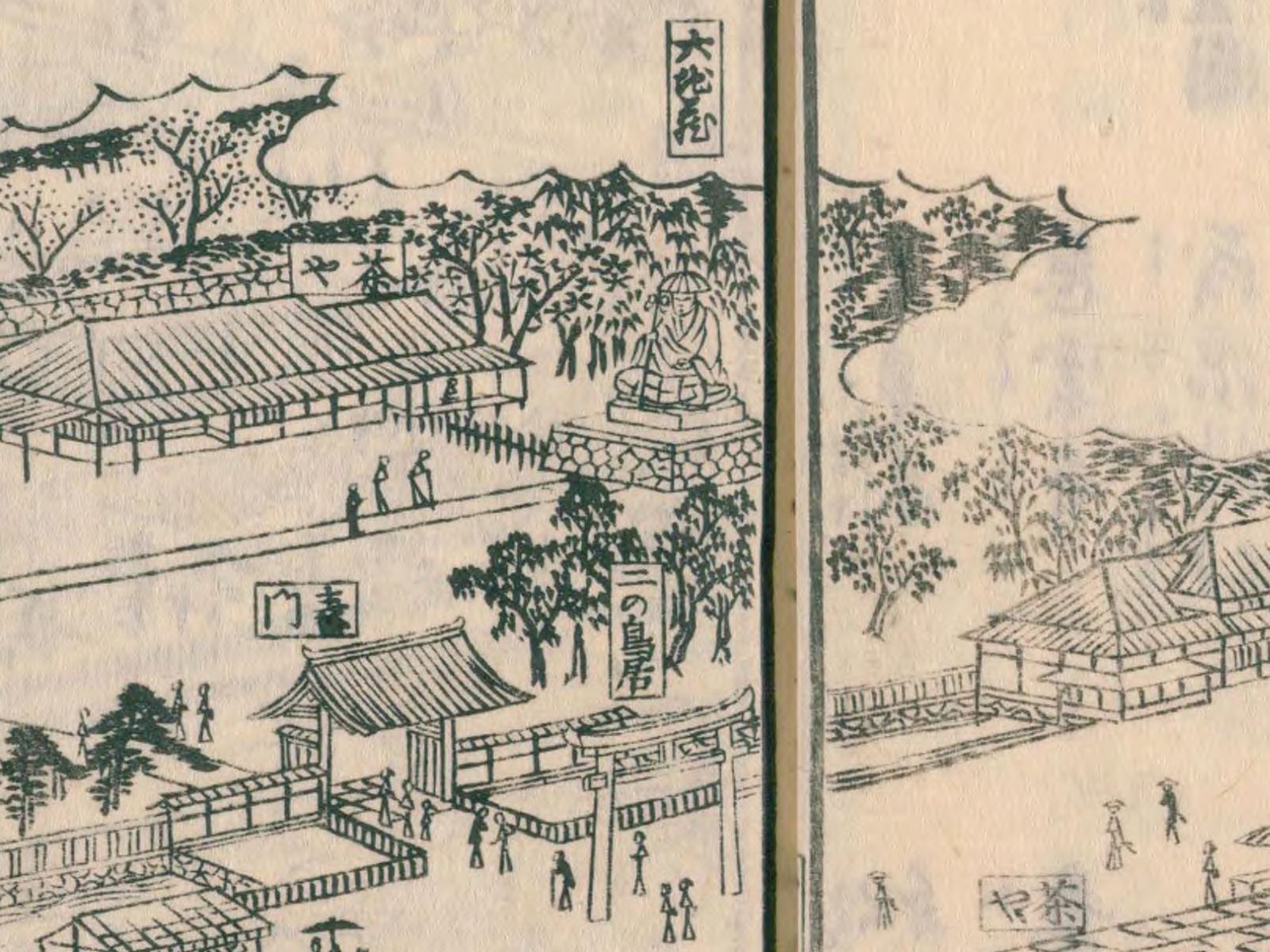
Five remain in situ today. The sixth, at Eidō-ji in Fukagawa, was demolished during the Meiji-era Haibutsu Kishaku (廃仏毀釈, “abolish Buddhism and destroy [its] images”) campaign of 1868–1875.5 Hasegawa Settan’s 1836 woodblock illustration of Eitai-ji in the Edo Meisho Zue (江戸名所図会) is the primary visual record of the lost figure.
What a single Jizō already carries
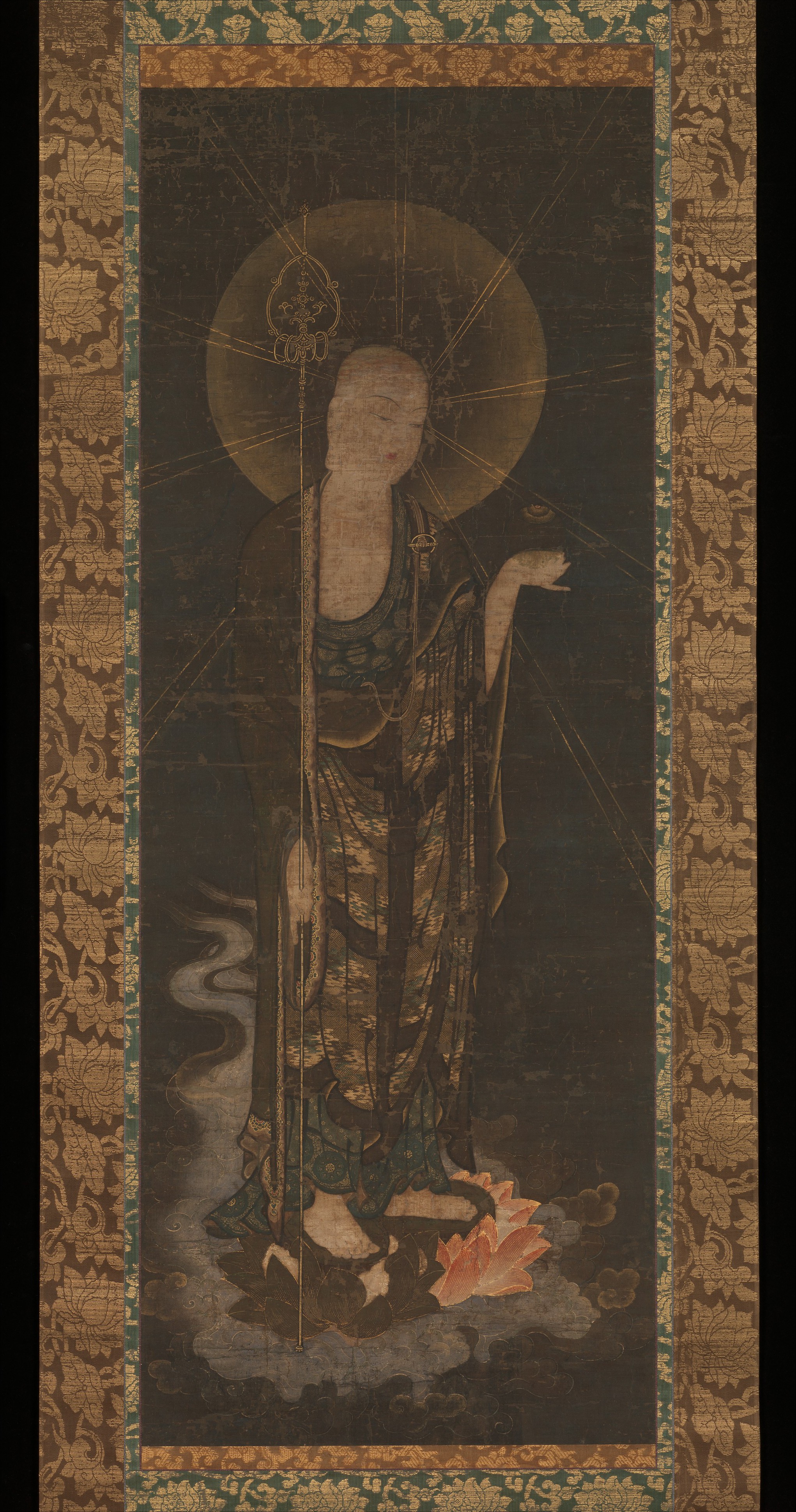
Before reading the programme of six, read the iconographic vocabulary the single figure carries. The Met’s late-Kamakura Welcoming Descent of the Bodhisattva Jizō (25.215.102, ca. 1300–33) is the single-figure register at full painted scale, and the iconographic vocabulary it shows is what the Roku Jizō programmatically externalises.
The six rings on the staff are the load-bearing iconographic content. A viewer who reads the Jizō’s staff at any single iconographic moment, painted or sculptural, is already reading the six-realm vow. The programmatic Roku Jizō is what happens when the same iconographic content is materialised at six locations and six pedestals across an urban landscape, instead of in six rings on one staff.
The doctrinal foundation: the six-realm vow
The doctrinal basis for the Roku Jizō programme is the Jizō Bosatsu Hongan-kyō (地蔵菩薩本願経, “Earth Store Bodhisattva’s Original Vow Sūtra”), Taishō Tripiṭaka 412, a sutra of Chinese authorship (or compilation) attributed to the Tang dynasty and translated into and circulated through Japan from the Heian period onward.6
The text establishes Jizō’s central vow: he will not enter Buddhahood until all sentient beings have been freed from the six realms of rebirth (rokudō, 六道): the cosmological topology of saṃsāra in Mahāyāna soteriology. Each of the six realms corresponds to a category of karmic-conditioned existence:
- Hell (jigoku, 地獄道): beings undergoing the consequences of severe karma
- Hungry ghosts (gaki, 餓鬼道): beings of perpetual insufficiency
- Animals (chikushō, 畜生道): beings of conditioned ignorance
- Asura (ashura, 阿修羅道): beings of perpetual conflict
- Humans (ningen, 人間道): the realm of moral choice
- Devas (tenjō, 天道): beings of conditioned happiness
The six are exhaustive: every conditioned being is in one of them at any moment, and rebirth cycles through them. Jizō’s vow is that he will walk all six until they are empty. This is the bodhisattva-vow structure of Mahāyāna soteriology in its specifically Jizō expression.
The Roku Jizō sculptural programme makes the vow architectural. Six discrete bodies, in six discrete locations, each addressing one of the six realms: the programme externalises the multi-realm scope of the vow into a multi-statue installation. The six rings on a single staff and the six bronze figures across a city are doctrinally identical; they differ only in iconographic register and in scale.
Glassman (2012) makes the structural argument explicit: Jizō’s multi-emanation forms (Roku Jizō, Sen-tai Jizō [千体地蔵, “Thousand-body Jizō”], and the seasonal regional groupings) are not folk simplifications of a unified theological figure. They are the bodhisattva’s transmigration vow expressed in plural embodied form.7 Glassman’s wider claim (that Jizō devotion is simultaneously elite and folk, doctrinal and ritual) applies here directly. The Edo Roku Jizō are elite institutional sculpture (72,000 named donors, named caster, Edo temple network) and folk devotional practice (the bibs, the offerings, the wayside-shrine register) at the same time, in the same six bronze bodies.
The Kyoto precedent and the Edo adaptation
The Edo programme of 1706 is not the first Roku Jizō. The Kyoto Roku Jizō tradition, six Jizō Bosatsu statues sited at the six principal road-entrances of Kyoto, with an associated pilgrimage circuit (Roku Jizō meguri, 六地蔵巡り), predates the Edo programme by several centuries; the Kyoto tradition’s origin is variously dated to the Heian period.8
Jizō-bō Shōgen’s 1706 vow names the Kyoto Roku Jizō as its model explicitly. The Edo programme is the Kyoto programme transplanted to the early-18th-century capital city, scaled to Edo’s larger geographical footprint (six much-larger statues, sited along six longer roads), and funded by the broader donor base that Edo’s urban demographic could mobilise.
The siting logic, at the six road-entrances of the city, is the same in both Kyoto and Edo. Jizō Bosatsu, in the canonical iconography, is the bodhisattva of travellers, of the borders between worlds, of the wayside. A figure sited at a city’s road-entry is doctrinally appropriate: he stands at the threshold where one realm meets another, welcoming travellers entering the urban space and protecting those departing it.
The wayside-shrine register that has dominated 20th-century English-language treatments of Jizō (the small stone Jizō at provincial roadsides, the child-Jizō at temple cemeteries) is the same iconographic argument operating at smaller scale. Roku Jizō is the urban, civic-scale implementation; the wayside Jizō is the rural, provincial-scale implementation. Both are the six-realm vow materialised at the threshold where the bodhisattva is doctrinally needed.
Hasegawa Settan’s Edo Meisho Zue as primary record
The article uses two woodblock illustrations from Hasegawa Settan’s Edo Meisho Zue (江戸名所図会, “Illustrated Famous Places of Edo”) as primary visual sources. The work was published in 1834–36 in the Tenpō era, more than a century after the Edo Roku Jizō’s completion, and constitutes the most detailed contemporary visual record of the programme as it functioned in its original urban context.
Settan (長谷川雪旦, 1778–1843) was a senior Edo-period illustrator whose practice combined topographical accuracy with the genre conventions of the meisho zue (名所図会, “illustrated guide to famous places”) tradition. The Edo Meisho Zue covers central and suburban Edo across twenty volumes, illustrating temples, shrines, festivals, and notable urban sites with the precision required of a practical guidebook and the iconographic detail required by the genre’s pious-tourism audience.
For the Edo Roku Jizō, Settan’s coverage is institutional: each of the six temples is depicted in its compound with the Jizō statue marked visually and labelled in the cartouche. The depictions are not photographic, but they are documentary in intent: Settan’s plates served as the standard visual reference for the temples for the following half-century, and for the Eidō-ji statue specifically, they remain the only contemporary visual record.
The use of Settan’s illustrations as bodhi’s primary images for this article is therefore not a stylistic choice but an evidentiary one. The five surviving statues are documented in modern photography (pre-1957 PD-Japan-oldphoto reproductions, post-1957 institutional and travel-photography records); the sixth, demolished, exists only in Settan’s woodblock. To anchor the article on the surviving five at the expense of the lost sixth would be to write a programme article that silently omitted the programme’s broken member. Settan’s illustrations restore the six as six.
The Meiji loss and what the woodblock holds
The Eidō-ji statue’s demolition during the Haibutsu Kishaku was not the only Meiji-era loss to the Edo Roku Jizō programme, but it is the most visible. The five surviving statues themselves passed through the period altered: some lost their original gilding, some were moved within their temple compounds during the urban reorganisation of late-19th and early-20th-century Tokyo, some lost subsidiary apparatus (subordinate sculpture, ornamental fittings, lacquer surface).
The five that remain are the inheritance of a partial loss. The programme as designed had six members; the programme that survives has five. The Hasegawa Settan woodblock of Eidō-ji is the single primary source through which the original six-member integrity of the programme can be visually reconstructed.
This is a particular feature of the Edo Roku Jizō’s iconographic condition. Most six-Jizō programmes, at wayside sites, at temple gates, at provincial shrines, exist as either complete sets or as fragmentary sets where the lost members were lost long enough ago that no contemporary record of them survives. The Edo programme is unusual in that its loss is documented to the year (1868–1875), the cause is named (Haibutsu Kishaku), and the visual record of the lost member is preserved at a level of contemporary specificity that allows the loss to be reckoned with as part of the programme’s full history.
How to read a Roku Jizō today
A visitor to one of the surviving Edo Roku Jizō, Honsen-ji in Shinagawa, Shinshō-ji in Sugamo, or any of the others, encounters a single bronze figure at temple-scale, on a lotus pedestal, sometimes under a small protective canopy. The figure carries its canonical attributes: shakujō with six rings, hōju jewel, monastic robes.
What the figure does not visually announce is that it is one of six. The Roku Jizō programme works only as a coordinated set; an individual figure read in isolation is iconographically complete but programmatically truncated. To read the figure at full historical depth requires holding in mind the other five (or, in the Edo programme’s case, the other four plus the absent sixth): the geographical distribution across the city’s road-entrances, the fourteen-year construction span, the 72,000 named donors whose inscriptions cover the bronze, the Meiji-era loss that emptied the sixth station.
The pilgrimage practice that the Roku Jizō meguri tradition institutionalises is the proper mode of reading. A visitor who walks all six stations in sequence, or who, in the Edo case, walks the five and acknowledges the absent sixth at Fukagawa, encounters the programme as the programme was designed to be encountered. The six rings of the single statue’s staff become the six bodies of the multi-statue programme become the six realms of the bodhisattva’s vow become the city of Edo as a topology of compassionate intervention.
The single figure with the six-ringed staff already says everything the programme says. The programme is what happens when the same statement is repeated at six locations, in cast bronze, at three-metre scale, with a city’s worth of donor names embedded in the metal of each one.
What stays open
The exact iconographic distinctions between the six Edo statues, whether each carries minor attributes specific to one of the six realms, or whether they are iconographically identical and only programmatically distinct, are not settled in the public scholarship. The donor inscriptions on each statue are documented, but a full comparative iconographic catalogue of the surviving five is, as of writing, available only in Japanese-language temple-treasure publications that bodhi has not yet indexed at primary-source depth.
The exact circumstance and date of the Eidō-ji statue’s demolition is not documented at year-and-month precision in the public sources consulted. The Meiji 1–8 (1868–1875) Haibutsu Kishaku window is the established frame; tighter dating would require access to Meiji-period records of the temple’s dissolution that are likely held in the Tokyo Metropolitan Archives and have not been transcribed for the English-language literature.
The earliest documented date and original-temple-site of the Kyoto Roku Jizō tradition that the Edo programme adapted is not established in the available sources at single-year precision. The Heian-period origin claim is conventional but inherits the dating uncertainty of an unbroken millennium of continuous renewal at the Kyoto sites.
What is firm is the programme as the historical record carries it: a 1706 vow by Jizō-bō Shōgen, a 1707–1720 casting programme by Ōta Masayoshi funded by 72,000+ named donors, six bronze Jizō Bosatsu at 267–275 cm at the six road-entrances of early-18th-century Edo, demolition of the sixth in the Meiji upheaval, five surviving today. The programme is the bodhisattva’s six-realm vow externalised into urban architecture.
Related
- Jizō Bosatsu: reading the saviour of the six realms: the cluster’s iconographic-vocabulary article; doctrinal-textual register
- Rokuharamitsuji Jizō (Unkei attributed, Kamakura): the canonical Kamakura sculptural Jizō; the type-specimen the Edo bronzes inherit at five-century remove
- Cleveland 1983.75: the Welcoming Descent of Jizō: the Kamakura painted-raigō register at single-figure scale
- Met 25.215.102 in painting context: substituted-bodhisattva raigō: the wider Kamakura painted register of Jizō as descending bodhisattva
- Kaikei’s Jizō (Met 2015.300.250): the named-Kei-school sculptural Jizō; the Kamakura-Kei foundation underneath the Edo programme
- Parinirvana as Edo devotional broadsheet (Cleveland 1916.1141): the Edo-period devotional register in another iconographic genre
Footnotes
-
The vow narrative is preserved in inscriptions recovered from inside one of the surviving statues and reproduced in the contemporary Honsen-ji and Shinshō-ji temple records. Jizō-bō Shōgen (地蔵坊正元) of Fukagawa is named as the originator; the year is Hōei 3 (1706); the model is explicitly the existing Kyoto Roku Jizō tradition. The vow’s structure (illness, prayer, recovery, programmatic commission) is the conventional Edo-period devotional-merit pattern; the institutional scale (six temples across the city, fourteen-year project, 72,000+ donors) is what distinguishes the Edo programme. ↩
-
Ōta Suruga-no-kami Fujiwara Masayoshi (太田駿河守藤原正義): the named master caster whose inscriptions on the body and pedestal of each statue record the dating, the donor list, and the consecration. The cast-into-the-bronze documentation is unusual for early-modern Japanese sculpture: most temple commissions of this period leave a paper record but not a bronze-cast record. The Edo Roku Jizō are therefore one of the best-documented Edo sculptural programmes, with primary-source attestation visible on the works themselves. ↩
-
Honsen-ji’s bronze Jizō at 275 cm is the largest and oldest of the surviving five. The Edo Meisho Zue vol. 2 book 4 (1834) woodblock illustration used as this article’s primary image depicts the statue at the precinct front of the Honsen-ji compound, in its mid-19th-century form before the Meiji upheaval. ↩
-
The Eidō-ji (Eitai-ji) statue’s demolition is attested in contemporary Meiji-period records and in the post-Meiji absence of the figure at the temple site. The exact circumstance, whether melted for bronze, sold to private hands, or destroyed in the temple’s broader dissolution, is not in the surviving public record. The Edo Meisho Zue vol. 7 book 18 (1836) woodblock is the closest contemporary visual record to the demolition. ↩
-
The Meiji-era Haibutsu Kishaku is treated at chapter length in James Edward Ketelaar, Of Heretics and Martyrs in Meiji Japan: Buddhism and Its Persecution (Princeton, 1990), and more recently in the literature on the 2024 Tokyo National Museum exhibition on Buddhist art’s modern history. The campaign of 1868–1875 dismantled an estimated several thousand Buddhist sculptural works across Japan as part of the broader Shinto-state establishment programme; the Edo Roku Jizō sixth statue is one named casualty among many. The chapter-level cite is to Ketelaar 1990; page numbers not verified. ↩
-
The Jizō Bosatsu Hongan-kyō is conventionally attributed to the Tang monk Śikṣānanda (Jp. Jitsushananda, 652–710); modern scholarship treats the text as more likely a Tang-period Chinese compilation than a translation from a Sanskrit original. The Japanese transmission and the establishment of Jizō devotion in Japan are treated at chapter length in Glassman 2012 (chapter 2 on early Japanese Jizō and the twelfth-thirteenth-century rise to prominence). English partial translation: Heng-ching Shih (trans.), The Sūtra of the Past Vows of Earth Store Bodhisattva (Bukkyō Dendō Kyōkai America, 2003). ↩
-
Hank Glassman, The Face of Jizō: Image and Cult in Medieval Japanese Buddhism (University of Hawai’i Press, 2012). Chapter-level cite; the argument that multi-emanation programmes are not folk degradation of a unified figure but a doctrinal extension of the bodhisattva-vow structure is the book’s load-bearing claim. Cross-checked against Heather Blair’s review (H-Buddhism, October 2012). ↩
-
The Kyoto Roku Jizō programme is conventionally associated with Daizen-ji and with the six-shrine pilgrimage circuit that grew up around the city. The Heian-period origin claim is the standard reading in modern Japanese guidebook scholarship; rigorous dating of the original programme is difficult given the cumulative replacement of individual statues over a millennium. The 1706 Edo vow names the Kyoto programme as its precedent without dating the Kyoto original; the Kyoto pilgrimage circuit is documented in Edo-period guidebooks contemporary with the Edo programme’s construction. ↩
Further works cited
- Title
- Eitai-ji (Fukagawa) showing the sixth Edo Roku Jizō (later demolished) — woodblock from the Edo Meisho Zue
- Period
- Edo period — Tenpō era (1836)
- Region
- Japan, Fukagawa
- Medium
- Woodblock print illustration on paper
- Dimensions
- Original folio approximately 22 × 16 cm; high-resolution scan 1600 × 1200 pixels
- Collection
- Wikimedia Commons (originally National Diet Library)
- Accession
-
Edo Roku Jizo at Eitai-ji - Rights
- Public domain (PD-Art). Hasegawa Settan (1778–1843), in *Edo Meisho Zue* vol. 7 book 18 (1836); source National Diet Library Digital Collections via Wikimedia Commons.
The sixth and final Edo Roku Jizō, at Eitai-ji (Eidō-ji) in Fukagawa, completed 1720 — depicted here in 1836 by Hasegawa Settan. The bronze figure was demolished during the Meiji-era Haibutsu Kishaku anti-Buddhist campaign. Settan's woodblock is the primary visual record of the lost statue.
- Title
- Welcoming Descent of the Bodhisattva Jizō (地蔵菩薩来迎図)
- Period
- Kamakura period (1185–1333), ca. 1300–33
- Region
- Japan
- Medium
- Hanging scroll; ink, color, gold, and cut gold leaf (kirikane) on silk
- Dimensions
- Image 106.7 × 40.3 cm; overall with mounting 206.4 × 56.8 cm
- Collection
- The Metropolitan Museum of Art
- Accession
-
25.215.102 - Rights
- The Metropolitan Museum of Art (Public Domain / OASC). Fletcher Fund, 1925 (25.215.102).
Met 25.215.102. A late-Kamakura single-figure Jizō raigō (welcoming descent) — the iconographic vocabulary the programmatic Roku Jizō externalises into six discrete bodies: the same shaven-head monk-form, the same six-ringed shakujō, the same wish-fulfilling hōju. Cut-gold (kirikane) patterning. Wikidata Q78846732.
Sources
-
[1]2026-05-14Edo (modern Tokyo); originally published 1834 commons.wikimedia.org/wiki/File:Edo_Meisho_Zue_04_Honsen-ji…The standard topographical guide to Edo, illustrated by Hasegawa Settan; the principal documentary record of the city's Buddhist sites in their late-Edo state. National Diet Library Digital Collections frame 28.
-
Frame 5. The primary visual record of the sixth and now-demolished Edo Roku Jizō at Eitai-ji (Eidō-ji), Fukagawa.
-
Wikidata Q78846732. The Met's primary single-figure Jizō raigō at hanging-scroll scale.
-
The principal English-language scholarly treatment of Jizō devotion. Methodology after Aby Warburg: not the iconographical surface but the social, ritual, and narrative contexts in which Jizō imagery functioned. Chapter 2 on early Jizō and the twelfth-thirteenth-century rise to prominence; Chapter 3 on performance, Nara/Kyoto, female ritualists, and Noh. The named-scholar anchor for the institutional argument that the multi-emanation programme (Roku Jizō and Sen-tai Jizō) operates at both elite and folk levels. Chapter-level citation; page numbers not verified.
-
Critical review situating Glassman's argument within the field; surfaces Glassman's claim that Jizō's six and one-thousand multi-emanations are not folk degradation of a unified iconographic figure but a doctrinally-grounded extension of the bodhisattva's transmigration vow.
-
The principal textual source for East Asian Jizō devotion. Establishes Jizō's vow to remain in the six realms — including the hells — until all sentient beings are saved. The six-realm enumeration in the sūtra is the doctrinal foundation for the Roku Jizō sculptural programme. Primary text via the Taishō edition; English partial translation in Heng-ching Shih (trans.), *The Sūtra of the Past Vows of Earth Store Bodhisattva* (BDK America, 2003).
-
Master bronze-caster (kondō-shi) of the Edo Roku Jizō programme. Full body and lotus pedestal of each surviving statue bear cast inscriptions naming Masayoshi as the founder and recording the promoter names, donor counts, and year of construction. The historical documentation visible on the bronze itself makes the Edo Roku Jizō one of the best-documented Edo-period sculptural programmes.
-
275 cm bronze Jizō Bosatsu; the earliest and largest of the surviving five Edo Roku Jizō. Originally gilded. Sited at the Tōkaidō entry to Edo, the first of the six road-entry positions. Visible in the foreground of Hasegawa Settan's 1834 Honsen-ji woodblock (used as the article's primary image).
-
The second of the six, completed 1710 at Tōzen-ji (Sōtō Zen). Sited at the Ōshū-kaidō entry to Edo.
-
267 cm — the smallest of the surviving five. Completed 1712. Sited at the Kōshū-kaidō entry from the west.
-
268 cm. Completed 1714. Sited near Edo's gateway to the Nakasendō, the inland route to Kyoto. The Shinshō-ji statue is the most-photographed of the surviving five and is the centre of the contemporary Sugamo Jizō-dōri shopping street's devotional traffic.
-
273 cm. Completed 1717. Sited at the Mito-kaidō entry. The 'red-bibbed' figure: the bib (yodare-kake) is the contemporary devotional offering that converts a sculptural icon into an active ritual object.
-
The sixth and final Edo Roku Jizō, completed 1720 at Eidō-ji (Eitai-ji) in Fukagawa. Demolished during the Meiji-era Haibutsu Kishaku (廃仏毀釈, 'abolish Buddhism and destroy [its] images') campaign of 1868–1875, in which an estimated thousands of Buddhist sculptural works across Japan were melted, broken, or sold. Hasegawa Settan's 1836 Edo Meisho Zue illustration is the primary visual record.
-
The Edo programme of 1706 was modelled on an existing Kyoto Roku Jizō tradition centred on the Daizen-ji and the Roku Jizō meguri (六地蔵巡り, 'Six Jizō pilgrimage') at the six road-entrances to Kyoto. The Kyoto tradition predates the Edo by an indeterminate period — sources place its origin in the Heian period — and supplied the iconographic and siting model the Edo programme adapted.
-
Pre-1957 photographic documentation of the Edo Roku Jizō is held variously in early-20th-century Japanese institutional publications (Nara Imperial Museum sculpture catalogues, the Kokuhō Zuroku series). PD-Japan-oldphoto images are the standard reproduction track for the surviving five statues.