The Parinirvana as devotional broadsheet: a c. 1710s tan-e at Cleveland 1916.1141
- Title
- The Parinirvāṇa of the Buddha — 釈迦涅槃図
- Period
- Edo period (1615–1868), c. 1710s
- Region
- Japan
- Medium
- Tan-e — color woodblock print with hand-applied vermilion (*tan*) over a black line block
- Dimensions
- Sheet 54 × 27.8 cm (21 1/4 × 10 15/16 in.)
- Collection
- Cleveland Museum of Art
- Accession
-
1916.1141 - Rights
- Cleveland Museum of Art, 1916.1141 — CC0 (Open Access). Gift of Mr. and Mrs. J. H. Wade.
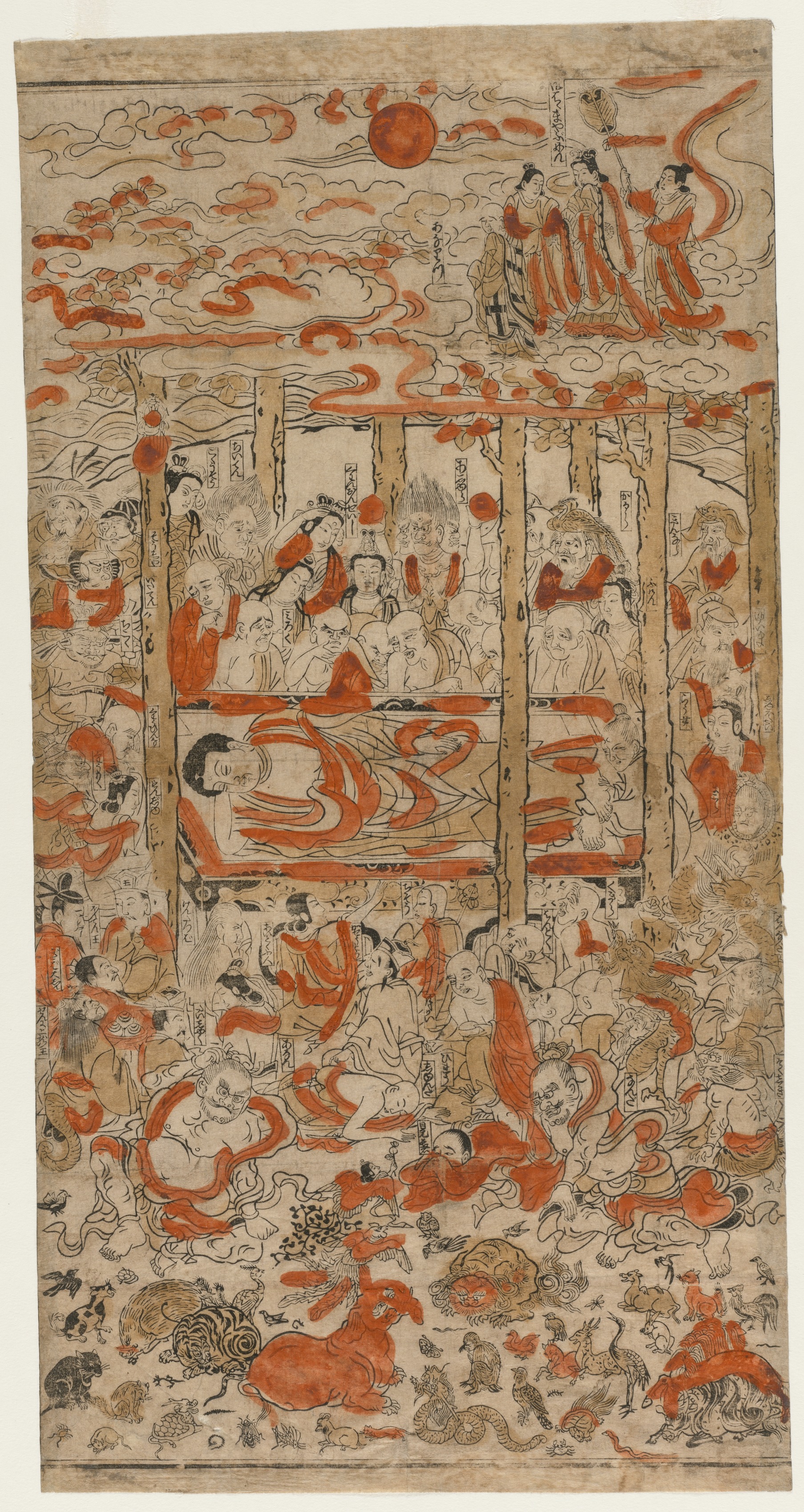
Cleveland 1916.1141. The print is two colours plus paper: vermilion (*tan*) hand-applied over a black-line woodblock outline. The c. 1710s dating places the sheet in the early Edo *tan-e* period — Hōei / Shōtoku / early Kyōhō — when devotional broadsheets were sold at temple gates for use in the annual Nehan-e ceremony on the eighth day of the second lunar month.
The same scene Heian court painters spent years on a single silk hanging — the Buddha’s death — printed for mass devotional use in two ink colours plus paper. Cleveland 1916.1141 is a c. 1710s tan-e: a black-line woodblock outline with vermilion hand-coloured in selected areas, sold at temple gates as a devotional broadsheet for the annual Nehan-e ceremony.
What you’re looking at
A tall vertical sheet, 54 × 27.8 cm, slightly more than half a metre top to bottom. The composition reads in four horizontal registers.
Top register: a clouded sky, the curling clouds drawn in black line with selective vermilion edges. A small red disc upper-left — the Cleveland catalog identifies the scene as “a cloudy night under a full moon,” and the disc is the moon, rendered in tan rather than left as paper. Upper right: Queen Maya, the Buddha’s mother, descending on a cloud with two attendants, identified in the catalog text as “the Buddha’s mother, two attendants, and a monk.” Her robes are coloured.
Middle register: a canopied platform framed by four vertical posts. The Buddha reclines on the platform, head to the viewer’s left, on his right side, in vermilion robes. Above and behind the platform, a densely packed row of standing bodhisattvas and disciples — several haloed, several not — with small rectangular cartouches attached to identify the figures by name (the catalog text notes the cartouches explicitly).
Lower middle register: a chaotic mass of grieving lay believers, monks, and disciples in the foreground. Arms raised, robes torn, some figures collapsed. The Cleveland catalog text names an old woman at the Buddha’s feet who is part of this lower-grief register.
Bottom register: the animals. A vermilion-coloured elephant at the centre-bottom; a tiger at the lower right corner; smaller animals throughout (deer, rabbit, oxen, monkey, birds, fish). The Cleveland catalog identifies the multitude as “acknowledging that the Buddha’s law applies to all living creatures.”
The print is two-colour plus paper. The black is a single line-block; the vermilion (tan, made from red lead) is hand-applied over the print in selected areas — the Buddha’s robes, Queen Maya’s robes, selected bodhisattvas’ robes, the elephant, the moon disc, the cloud edges. Most figures are line-only. The selective application of colour is what tan-e names as a technique.
What is a Nehan-zu
The Parinirvāṇa (Skt. parinirvāṇa, Jp. nehan 涅槃) is the Buddha’s final passing — the moment, traditionally located at Kuśinagara in present-day Uttar Pradesh, when Śākyamuni reclined between two sal trees and entered final extinction. The painted memorial, Nehan-zu 涅槃図 (literally “extinction picture”), has been the central image of the Japanese Buddhist liturgical calendar for the Nehan-e (涅槃会) ceremony since the Heian period. The ceremony is held on the eighth day of the second lunar month — traditionally 15 February in the modern solar calendar — and is one of the three major annual observances at a Japanese Buddhist temple, alongside the Buddha’s birthday (Kanbutsu-e, 8 April) and the Buddha’s enlightenment (Jōdō-e, 8 December).
The canonical iconographic programme stabilises by the late Heian period and holds remarkably consistently through the Kamakura, Muromachi, and Edo periods. The reclining Buddha occupies the centre, head pointing north (in the canonical reading), lying on his right side. The two sal trees stand at the head and foot of the platform, traditionally with the south-east pair in full bloom and the north-west pair withered — the trees mourn by dying alongside the Buddha. Queen Maya descends on a cloud from Tuṣita Heaven to be present at her son’s death. The bodhisattvas, calmer because they understand what is happening, occupy the middle register. The immediate monastic disciples (the saṅgha) weep, faint, and tear their robes in the foreground. The deva hosts above include Indra and Brahmā. And — most beloved by Japanese viewers in every century the genre has been painted — the entire animal kingdom comes to mourn at the lowest register.
Yoshiko Kanda’s Iconography of the Parinirvāṇa in Artibus Asiae 17 (1954) was the foundational mid-twentieth-century English-language study of the canonical cast and the animal inventory. Subsequent scholarship (treated in Elizabeth ten Grotenhuis’s Japanese Mandalas: Representations of Sacred Geography, 1999) places the Nehan-zu within the broader Japanese Buddhist devotional-painting calendar.
From court silk to temple-gate broadsheet
The genre’s canonical reference is the Kongōbu-ji Buddha-Nyorai-nehan-zu on Mount Kōya, dated 1086 (Ōtoku 3) by inscription, late Heian period, painted on silk in full polychromy, approximately 267 × 271 cm. The Kongōbu-ji painting is life-size, ceremonial, designed for annual hanging at the Shingon mountain centre, and is a National Treasure. It is the canonical anchor of the Japanese Nehan-zu tradition.
The Met holds two Public Domain silk Nehan-zu that bridge between Kongōbu-ji and the Cleveland tan-e:
| Object | Met accession | Period | Date | Medium |
|---|---|---|---|---|
| Death of the Historical Buddha (Nehan-zu) | 12.134.10 | Kamakura | 14th century | Hanging scroll; ink, color, and gold on silk |
| Death of the Historical Buddha (Nehan-zu) | 44.35.1 | Muromachi | 15th century | Hanging scroll; ink, color, and gold on silk |
| The Parinirvana of the Buddha | Cleveland 1916.1141 | Edo | c. 1710s | Tan-e — color woodblock print with hand-applied vermilion |
The two Met hanging scrolls are the silk court-temple version of the same iconographic programme Cleveland 1916.1141 carries in print form. Both Met scrolls work in the full Kongōbu-ji-derived register: ink, color, and gold on silk, ceremonial scale, intended for institutional temple display rather than household devotion. Cleveland’s print is at the opposite end of the genre’s economic spectrum: small (54 × 27.8 cm), mass-produced, two-colour, intended for purchase by a pilgrim or lay devotee at a temple gate.
The compression Cleveland 1916.1141 performs on the Kongōbu-ji canon is the article’s most legible iconographic claim. The animal cast is reduced from the silk paintings’ species inventory (Kanda 1954 catalogues over thirty species in some major examples) to a representative sample at the lower register. The deva hosts are compressed into a single upper cloud register. The bodhisattvas and disciples are still individually identified — the cartouches do the work that scale-and-portraiture do in the silk hangings — but the differentiation is by label rather than by individuated figure-painting. The result is iconographically complete and economically reduced.
Tan-e: hand-colour over a black-line block
Tan-e (丹絵, literally “tan picture”) names the early-Edo print technique that produced Cleveland 1916.1141. Tan is red lead (Pb₃O₄), a vermilion-orange pigment that had been used in Japanese painting and Buddhist temple architecture for centuries before it entered the Edo print medium. In tan-e the line block is printed in black, and the tan is applied by hand with a brush in selected areas of each individual print. Each impression is therefore not identical: the colour placement varies subtly from sheet to sheet, and condition variations across surviving examples are partly attributable to this hand-finishing rather than print-run variation alone.
The technique is concentrated in roughly the second decade of the eighteenth century. The c. 1710s Cleveland dating sits inside the typical tan-e production window — the Hōei (1704–1711), Shōtoku (1711–1716), and early Kyōhō (1716–1736) eras of the Edo period. Tan-e is succeeded historically by beni-e (紅絵, hand-applied benibana pink, c. 1720s–1740s), benizuri-e (紅摺絵, two- or three-block printed colour, c. 1740s–1750s), and finally the full polychrome nishiki-e (錦絵, “brocade pictures”) from c. 1765 forward. Richard Lane’s Images from the Floating World (1978) treats this technology sequence as the standard chronology of the Edo print medium.
The medium choice carries a doctrinal point. Tan-e was the affordable colour-print technology of its decade; printing a Nehan-zu in tan-e in the 1710s was the equivalent of producing a devotional broadsheet at the most accessible price point available in early-Edo urban Japan. The pilgrim or temple-visitor who bought the sheet was not commissioning a court painting. He or she was buying a portable image at the price the medium allowed — for use at home, for hanging on the second day of the second lunar month, or for distribution to family.
The cartouches and the labelling habit
Several of the standing bodhisattvas and disciples in the middle register carry small rectangular cartouches. The Cleveland catalog text notes them explicitly: “various rectangular cartouches identify the followers.” This labelling habit is characteristic of Edo-period devotional prints and of certain medieval Japanese Buddhist paintings: each figure is named, and the named figure becomes a discrete focus of meditation or recitation.
The cartouches turn the Nehan-zu into something between an icon and a litany. The viewer can move from cartouche to cartouche, sounding the names of the bodhisattvas and disciples, and so re-enact the Parinirvāṇa as a recited rather than purely visual event. This is a feature the silk court Nehan-zu rarely needs, because their figures are individually portrayed and named in convention; the print medium reintroduces the labels because the compressed figures are otherwise less distinguishable.
The labelling is also a literacy aid. By the early eighteenth century, lay literacy in urban Japan was substantial, and a Nehan-zu print with cartouches turned the image into something readable. The print does devotional work and educational work — naming the cast of the canonical scene for a viewer whose access to the Kongōbu-ji original is unimaginable.
Where the reading commits and where it varies
The reading commits to: the medium as tan-e (hand-applied vermilion over a black line block, not Ōtsu-e folk painting); the dating to c. 1710s within the early-Edo tan-e window; the iconographic programme as canonical Nehan-zu descended from the Kongōbu-ji 1086 silk hanging; the use-context as devotional broadsheet for the annual Nehan-e ceremony or household devotion; the cartouches as a labelling habit characteristic of Edo popular Buddhist prints.
The reading defers on: the specific publisher and engraver (the print is unsigned, and no Cleveland or other-institution-published attribution is available); the specific temple or shrine at which the sheet would have been sold (the print’s labels do not name a temple of origin, and the dimensions do not identify a particular pilgrimage circuit); the precise reading of the small upper-left red disc (the Cleveland catalog says “full moon” but at this resolution the disc could plausibly read as either moon or sun — the cloudy-night framing of the catalog text supports moon); whether the cartouches name canonical figures or also include local kami or sectarian attendants (a higher-resolution reading of the legible cartouches would resolve this).
The reading also defers on the institutional question: how many surviving impressions of this specific block exist, and at what range of institutions? Without a census of Edo Nehan-zu tan-e by block, the print’s rarity-or-commonness within the surviving corpus is not characterisable. The Cleveland catalog does not address the question.
What the reading does not defer on is the iconographic claim. The print is a Nehan-zu in canonical iconographic form, compressed into devotional broadsheet economy, executed in the affordable colour technology of its decade. The compression is the iconography.
Related
Sources
-
Cleveland's catalog records the work as a c. 1710s color woodblock print, sheet 54 × 27.8 cm. Provenance: Mr. Jeptha Homer Wade II [1857–1926] and Mrs. Ellen Garretson Wade [1859–1917], Cleveland, OH; given to Cleveland Museum of Art 1916. The descriptive text identifies the figures: the Buddha lying on a platform on his right side with his right hand behind his head; followers in various states of grief, curiosity, or calm acceptance; an old woman at the Buddha's feet; the Buddha's mother (Queen Maya), two attendants, and a monk at the upper right; the multitude of animals as recognition that the Buddha's law applies to all living creatures; various rectangular cartouches identifying the followers.
-
Met OA API record verified Public Domain 2026-05-12. A fourteenth-century Kamakura Nehan-zu — full court-silk register with gold ground — that anchors the canonical silk-painting tradition the Cleveland tan-e descends from. Same iconographic programme as Cleveland 1916.1141 (reclining Buddha, sal trees, Queen Maya, weeping disciples, bodhisattvas, deva hosts, animal cast), executed in the opposite economy: gold-ground silk for temple devotion versus two-colour woodblock for popular devotion.
-
Met OA API record verified Public Domain 2026-05-12. A fifteenth-century Muromachi Nehan-zu — the bridge between the Kamakura court tradition and the Edo popular-devotion register. Useful as the middle-of-the-chain comparandum showing the iconographic stability of the genre across three centuries before it reached the early-Edo woodblock medium represented by Cleveland 1916.1141.
-
The canonical reference point for the Japanese Nehan-zu tradition. The Kongōbu-ji *Buddha-Nyorai-nehan-zu* is dated 1086 (Ōtoku 3) by inscription, late Heian period, painted on silk in full polychromy, approximately 267 × 271 cm — life-size and intended for ceremonial temple display. Designated a National Treasure. Cleveland 1916.1141 is at the opposite end of the genre's economic spectrum: small (54 × 27.8 cm), printed, two-colour, mass-produced. The two objects share an iconographic programme separated by six centuries and a medium revolution.
-
Foundational mid-twentieth-century study of the Nehan-zu canonical attendees and animal cast. Cited at the framework level; the specific page anchors and the full list of canonical attendees from this article have not been verified.
-
Standard English-language treatment of Japanese Buddhist devotional images including the role of formal painted Nehan-zu within temple liturgical calendars. Cited at the framework level for the Nehan-e ceremony context within which the Cleveland tan-e would have circulated.
-
Standard English-language treatment of Edo-period visual culture, including popular religious imagery and the relationship between formal Buddhist painting and devotional print production. Cited at the framework level.
-
Standard English-language history of the Japanese woodblock print. Cited for the framework that places the c. 1710s tan-e medium — hand-applied vermilion over a black line block — within the early Edo print technology sequence preceding the polychrome *nishiki-e* of the 1760s.