The Met's thousand-armed Kannon embroidery: late-Muromachi devotion in stitched silk
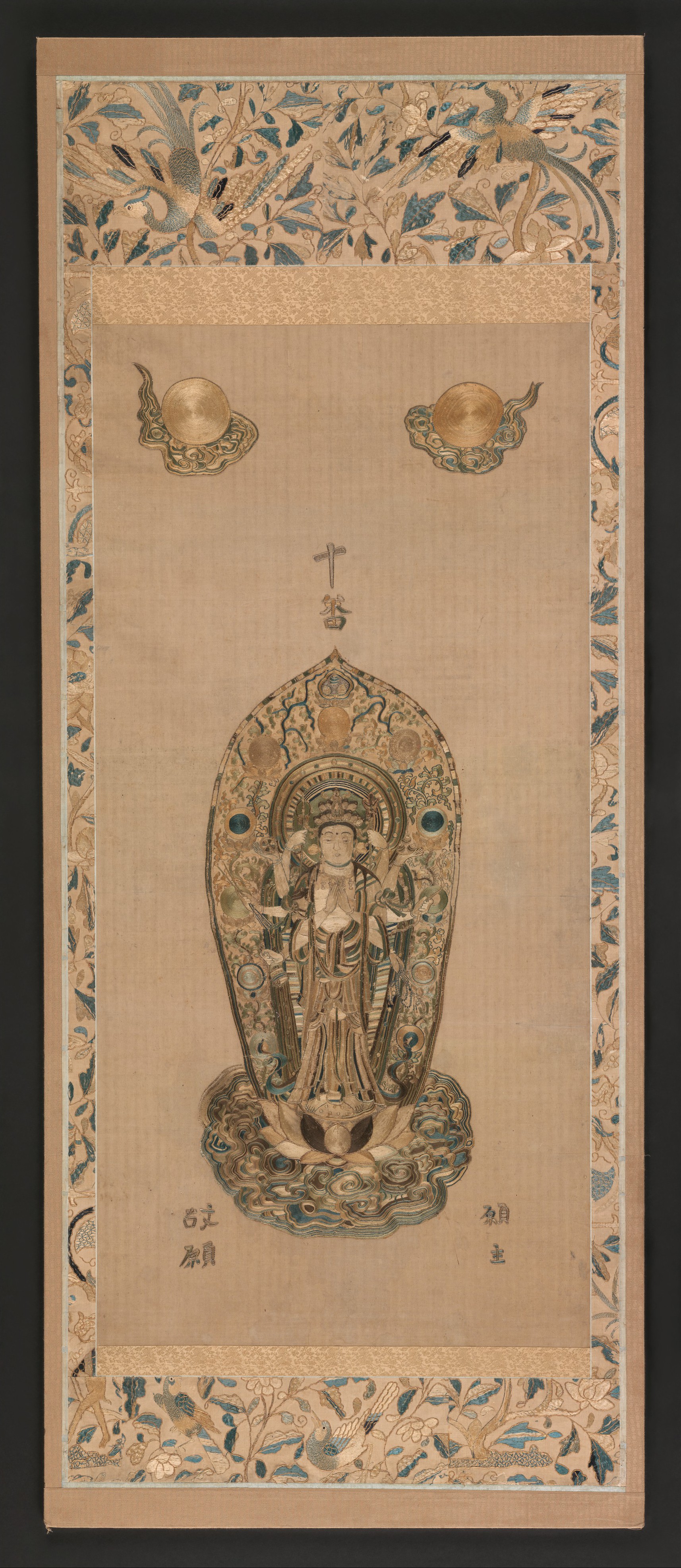
- Title
- Embroidery of a Thousand-Armed Kannon (千手観音刺繍) — Met 2013.114, late Muromachi
- Period
- Muromachi period (1392–1573), probably late 15th – early 16th century
- Region
- Japan
- Medium
- Hanging scroll remounted on a panel; embroidered silk appliquéed to cotton backing
- Dimensions
- Overall: 195 × 79 cm (76 3/4 × 31 1/8 in.)
- Collection
- Metropolitan Museum of Art, New York
- Accession
-
2013.114 - Rights
- Public Domain. The Metropolitan Museum of Art, Purchase, Sue Cassidy Clark Gift, in memory of Terry Satsuki Milhaupt, 2013 (acc. 2013.114). Met Open Access (OASC).
Met 2013.114, late 15th – early 16th c., Muromachi. The work is hanging-scroll scale (195 cm tall) and entirely embroidered. Radiocarbon dating of thread samples confirms the stylistic date. Senju Kannon iconography rendered in a medium more closely associated with kesa, altar cloths, and *shūbutsu* (繍仏 — embroidered Buddhas) than with the painted *kakemono* hanging-scroll register.
The Sanjūsangen-dō programme (Tankei’s 1254 chief image and the 1,000 standing Senju Kannon ranged in the long hall at Rengeō-in) is what most readers think of when they think of Senju Kannon. The Kamakura wood-carving canon, the 42-arm convention, the 11-head stack, the Esoteric implement programme: it all lives in the Kyoto programme. The Met’s late-Muromachi embroidery, made roughly two centuries after Tankei finished the chief image, asks what the same iconographic programme looks like when devotion is rendered not in carved hinoki but in stitched silk thread.
It is one of the rare cases where the medium itself is the differentiator. The iconography is essentially what the Sanjūsangen-dō chief image carries: eleven heads, central gasshō hands, the radiating outer arms holding the canonical Esoteric implement set. The medium is what the Sanjūsangen-dō chief image is not. Embroidery at this scale (195 × 79 cm) was not commissioned for portable use; it was commissioned for temple display, hung as a kakejiku in front of the altar or in a side hall, the merit accruing both to the act of stitching and to the act of viewing.
A devotion stitched, not painted
The first thing to register is the medium. Most late-medieval Japanese Buddhist devotional images are painting on silk or paper (kakemono, hanging-scroll painting), sculpture (wood, lacquer, occasionally bronze), or printed image (xylographic block on paper). Embroidered Buddhist images, shūbutsu (繍仏), are a separate, smaller tradition. They exist throughout the medieval and early modern periods, but they exist as a minor register inside the Buddhist visual programme, not as a primary medium.
The Met curatorial text calls the work “an exceedingly rare example of late medieval Buddhist embroidery.” That phrasing is not promotional. Shūbutsu survive in single-digit numbers from the late Muromachi period in Western collections. Most extant examples are smaller scale: altar cloths, kesa (monastic robes) with figural panels, sleeve fragments, or kimono panels with Buddhist motifs. A 195 × 79 cm full-figure shūbutsu of Senju Kannon, hanging-scroll scale, the entire iconographic programme rendered in stitched silk, is unusual at any period and especially unusual for the Muromachi.
The reading question is what the medium adds. Painting on silk gives line and wash, the brush register that the Sanjūsangen-dō chief image’s painted Heian comparanda (the Nara NM 1105 Senju Kannon painting, for example) uses to articulate the implement set. Sculpture gives volumetric mass, the chassis on which polychromy and kirikane are applied. Embroidery gives a third register: stitch direction and stitch density become the visible articulation. The arms in the Met embroidery read as bands of differently-directed stitch, the highlights catching the light at angles painting cannot match. The eleven heads stack with the same vertical compression as carved heads, but each head is a small embroidered ovoid rather than a carved volume.
The medium also encodes its own labour-time. Embroidery at this scale and density represents hundreds of hours of skilled stitching. The curatorial text names the practice explicitly: “such elaborate textiles were painstakingly stitched as an act of devotion with individuals or groups of believers commissioning them to gain religious merit.” This is the shūbutsu logic. The labour of stitching is itself merit-generating; the finished textile is then the merit-accumulated object that lives in the temple. The painting equivalent (commissioning a painted Senju Kannon from a workshop) accumulates merit through the commissioning, but the shūbutsu embroidery accumulates merit through the doing, which is one reason the medium continues to be used long after silk painting has become technically easier.
What the eleven heads and the implements say
The iconographic programme is the same Esoteric programme that the existing Senju Kannon iconographic-reading guide reads at length. Eleven heads stacked above the principal face, the eleven of Jūichimen Kannon (十一面観音, Ekādaśamukha) adopted into the Senju Kannon programme. Two principal hands pressed together in gasshō. The outer arms holding the canonical Esoteric implement set.
The Met curatorial text names the implements visible in the embroidery: hand drum, pilgrim’s staff, trident, Dharma wheel, wish-granting jewels, bow and arrows, bell, and prayer beads. Cross-referenced against the canonical 40-outer-arm programme catalogued in E. Dale Saunders’s Mudrā: A Study of Symbolic Gestures in Japanese Buddhist Sculpture (Princeton / Bollingen, 1960, pp. 107–112), these are eight of the forty conventional implements: the cintāmaṇi (wish-granting jewel), the shakujō (pilgrim’s staff with rings), the trident (sanko-shō), the Dharma wheel (hōrin), the bow and arrow pair, the small hand drum, the bell, and the prayer beads. The remaining thirty-two implements are presumably also present in the embroidery (the curatorial text names a partial set), but eight named implements is enough to confirm the work observes the standard programme rather than an iconographic variant.
What changes in the embroidered rendering is the legibility of the small implements. In a carved Sanjūsangen-dō figure, each implement is a small carved object held in a small carved hand. In the embroidered rendering, each implement is a small embroidered shape against the embroidered ground: easier to read at distance, harder to read up close, the iconographic legibility shifted toward the viewer at kakejiku hanging-scroll viewing distance.
Silk thread on cotton: how the embroidery was made
The Met catalog gives the materials: “embroidered silk appliquéed to cotton backing.” The hanging scroll has been remounted on a panel, a conservation intervention, not original to the work. The original mounting was probably a standard kakejiku hanging scroll with silk borders top and bottom; the panel remounting stabilises a delicate textile for vitrine display.
The technique of shūbutsu embroidery at this scale uses dyed silk threads stitched onto a foundation cloth (here, cotton) with the iconographic outlines laid in first as a base drawing, then filled with directional satin stitch, split stitch, and outline stitch. The silk threads are appliquéd, that is, sewn onto rather than embroidered through the foundation, which preserves the cotton backing as a single sheet while building up the figural image in raised silk on the front. The technique is closely related to the nuihaku (繍箔) technique used on Nō robes from the Muromachi period onward, where embroidery and gold-leaf application are combined on silk. Whether this Senju Kannon embroidery uses gold leaf is not visible in the catalog text; the photographic record suggests a primarily silk-embroidery register without major gilt passages.
The labour estimate at this scale is roughly six months to a year of skilled work for a single experienced embroiderer, or three to four months for a small workshop of three to five embroiderers working in parallel on different sections. The commission would have come from a temple or from a private donor or donor group commissioning on behalf of a temple. The merit-accumulation logic distributes evenly across the labour (every stitch is a stitch of merit), which is one reason group commissions are common for shūbutsu.
Radiocarbon and style converge: late 15th – early 16th century
Two independent dating methods are available for this work, and they converge. Stylistic dating (the figural treatment, the implement programme, the proportional scheme, the relationship of the embroidered figure to the surrounding ground) places it in the late fifteenth or early sixteenth century. Radiocarbon dating of thread samples taken from the embroidery returns a date range that concurs with the stylistic dating.
This convergence is unusual for Japanese Buddhist textile because radiocarbon dating is unusual for Japanese Buddhist textile. Most textile dating is done stylistically: by comparison to dated comparanda, by analysis of weave and stitch technique, by reference to documented provenance. Radiocarbon dating of textile samples is a destructive (though minimally) procedure that requires removing thread material; it is not done routinely. That the Met has applied it to this work indicates the institutional view that the work is significant enough to warrant the procedure, and the published convergence (“concurs with radiocarbon dating of thread samples”) indicates the procedure returned a date range consistent with the stylistic estimate rather than disrupting it.
The c. 1490s–1510s window puts this shūbutsu roughly 240 years after Tankei’s 1254 Sanjūsangen-dō chief image. The Muromachi period had by then absorbed and replicated the Kamakura iconographic programmes through painted and sculptural workshop production; the embroidered form is a tertiary medium that comes after both the canonical sculpture and the canonical painted recensions are established. This is consistent with the embroidery’s stylistic register: it reads the iconography correctly without innovating on it.
After Tankei: the post-1254 Senju Kannon afterlife
The Sanjūsangen-dō programme is the Kamakura crystallisation moment for Senju Kannon: Tankei’s chief image of 1254, the 124 Heian survivors of the 1249 fire, the 876 standing figures carved between 1251 and 1266. After 1266 the iconographic programme is fixed. Subsequent Senju Kannon devotional images do not innovate on the implement set; they reproduce it.
What does change after 1266 is the medium distribution. Sculptural commissions decline through the late Kamakura period as the great Esoteric and Pure Land programmes shift their patronage focus: first toward Pure Land devotional painting (the raigō tradition), then toward Zen monastic painting (ink and wash), then in the Muromachi toward portable and printed devotional formats. Senju Kannon as a primary devotional figure shifts from the public hall (the Sanjūsangen-dō register) toward the private hall (sub-temple altars, portable shrines, embroidered hanging scrolls for individual donor commission).
The Met embroidery sits in that later devotional register. It is not the temple programme; it is the post-temple-programme private commission, performing the same iconographic work at a different scale of social and economic patronage. Reading the embroidery against the existing Senju Kannon iconographic-reading guide clarifies what is iconographically inherited (everything: the eleven heads, the gasshō, the implement set, the lotus pedestal) and what is mediumly shifted (the rendering, the labour-merit logic, the patronage scale).
The Terry Satsuki Milhaupt acquisition
The 2013 Met accession was made through a purchase funded by a Sue Cassidy Clark gift, made in memory of Terry Satsuki Milhaupt (1959–2012). The credit line is on the catalog page: “Purchase, Sue Cassidy Clark Gift, in memory of Terry Satsuki Milhaupt, 2013.”
Milhaupt was at the time of her death the incoming Met Associate Curator of Asian Textiles. She held a PhD in Art History from Washington University in St. Louis (dissertation: Flowers at the Crossroads: The Four-Hundred Year Life of a Japanese Textile, on the tsujigahana technique). Her monograph Kimono: A Modern History was published posthumously by Reaktion Books in 2014. The Met’s 2014–2015 Kimono: A Modern History exhibition was built from her research. She had moved from Sotheby’s Asian art specialist roles into the Met curatorial appointment that her early death (November 21, 2012) interrupted before she could take it up.
The 2013 Senju Kannon embroidery purchase is institutionally legible as a memorial: an unusually rare late-medieval Japanese Buddhist textile, brought into the Met’s permanent Asian textile collection through a named donor’s gift in the year after the scholar who would have curated it died. The Asian Textile area was the area Milhaupt was about to lead; the acquisition deepens it in her absence. This is not the kind of context that shows up in the visual analysis of the work, but it is part of the documentary anchor that distinguishes the Met’s textile holdings from other institutions’ holdings.
What stays open
The work is firm where the Met catalog is firm. Late Muromachi date (1490s–1510s); embroidered silk appliquéed to cotton; 195 × 79 cm; eleven heads; eight named implements out of the canonical forty. Radiocarbon-confirmed stylistic dating. 2013 Met acquisition through the Milhaupt memorial gift.
What stays open: the original temple provenance (where this embroidery was made for, who commissioned it, what hall or sub-hall it was hung in) is not in the public record. The pre-1913 (or pre-2013, depending on when it entered the Western art market) ownership chain is not in the catalog. The remaining thirty-two implements not named in the curatorial text would benefit from a full iconographic close-reading, ideally cross-referenced against the Saunders 1960 forty-implement programme and any extant late-Muromachi shūbutsu comparanda.
There is also a structural question about shūbutsu survival rates. The Met catalog calls this “exceedingly rare” without providing a comparative population figure. Other extant late-Muromachi shūbutsu of comparable scale would be the obvious comparanda; the population is small enough that a complete inventory would be feasible and would deepen the rarity claim. That inventory is not in the Met catalog text and is not the kind of thing that has been done in English-language scholarship.
Related
- Senju Kannon: reading the thousand arms: Sanjūsangen-dō programme, Tankei 1254 chief image, the 42-arm convention and the canonical implement set.
- Jūichimen Kannon: the eleven heads canonical stack: the eleven-head programme inherited by Senju Kannon.
- Byakue Kannon: the white robes: Kannon iconography in a different medium-and-period register (ink-painting Kōzan-ji circle).
- Kake-botoke Kannon: hanging plaque: Kannon as ritual-hardware register.
Sources
-
[1]2026-05-12The Metropolitan Museum of Art, New York collectionapi.metmuseum.org/public/collection/v1/objects/78211Met Open Access API entry. Confirms: accession 2013.114; period Muromachi; date probably late 15th – early 16th century; medium 'Hanging scroll remounted on a panel; embroidered silk appliquéed to cotton backing'; dimensions 195 × 79 cm; classification Textiles-Embroidered; public domain (CC0); credit line 'Purchase, Sue Cassidy Clark Gift, in memory of Terry Satsuki Milhaupt, 2013'.
-
Met curatorial text (consulted via search-result excerpt, as the www.metmuseum.org page could not be loaded directly) describes the work as 'an exceedingly rare example of late medieval Buddhist embroidery,' notes that 'such elaborate textiles were painstakingly stitched as an act of devotion with individuals or groups of believers commissioning them to gain religious merit,' and confirms that 'stylistic considerations place this work in the late fifteenth or early sixteenth century, which concurs with radiocarbon dating of thread samples.' The implement set named in the curatorial text: hand drum, pilgrim's staff, trident, Dharma wheel, wish-granting jewels, bow and arrows, bell, and prayer beads.
-
Published posthumously in 2014. The scholar in whose memory the Met's 2013 purchase was made. Milhaupt (1959–2012) was the incoming Met Associate Curator of Asian Textiles at the time of her death; the 2013 Sue Cassidy Clark gift acknowledges the institutional loss. The 2015 Met *Kimono: A Modern History* exhibition, based on Milhaupt's research, ran in the same window.
-
Confirms: Milhaupt born May 15, 1959, Kailua, Hawaii; died November 21, 2012, New York City. PhD in Art History, Washington University in St. Louis. Specialised in Japanese textile history; was due to take up the Met Associate Curator of Asian Textiles position. HoMA holds one of the tsujigahana fragments she researched for her doctoral dissertation.
-
bodhi iconographic-reading guide for Senju Kannon. Covers the 42-arm convention (40 outer × 25 worlds + two principal in *gasshō*), the implement programme, and the Sanjūsangen-dō 1,001-figure Kamakura programme (Tankei 1254 chief image + 124 Heian survivors + 876 carved 1251–1266). This article does not re-cover the iconographic basics; it reads the late-Muromachi medium-shift against the canonical Kamakura sculptural anchor.
-
The Met 2014–2015 exhibition based on Milhaupt's posthumous Reaktion monograph. The 2013 *Thousand-Armed Kannon Embroidery* acquisition is the curatorial bracket — the institution's textile collection deepening in the years around her death and the exhibition. The Senju Kannon embroidery is medieval Buddhist textile rather than modern kimono, but sits in the same Met curatorial-area chronological span that Milhaupt's work was opening up.
-
The 1,001-figure Senju Kannon programme reference point — Tankei's 1254 chief image plus 1,000 standing Senju Kannon, of which 124 are Heian survivors of the 1249 fire and 876 are 1251–1266 Kamakura recarvings. The Met embroidery (1490s–1510s) is the post-Tankei medium-shifted afterlife of the same iconographic programme.