Byakue Kannon: white robes and an ink-loaded rock
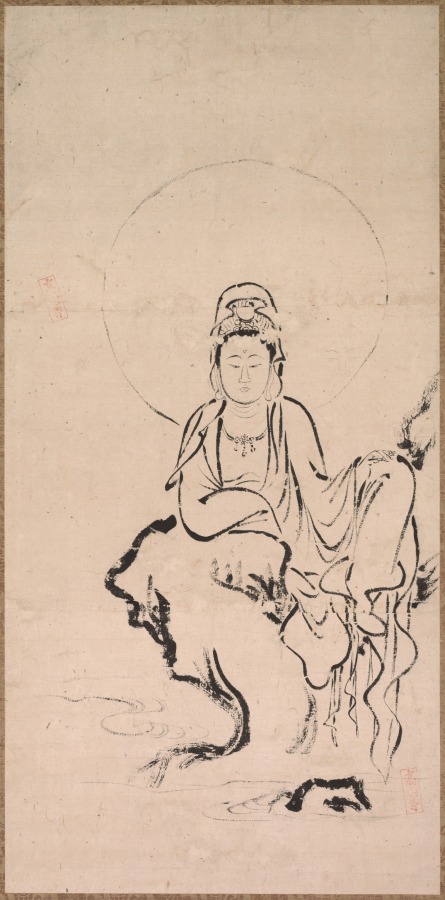
- Title
- White-Robed Kannon (Byakue Kannon) / 白衣観音像
- Period
- Kamakura period (1185–1333), c. 1200
- Region
- Japan
- Medium
- Hanging scroll; ink on paper
- Collection
- Cleveland Museum of Art
- Accession
-
1951.540 - Rights
- Cleveland Museum of Art (CC0). John L. Severance Fund, 1951.540.
Image 91.4 × 45.1 cm. Provenance: Kōzan-ji, northwest Kyoto. Catalog text: 'subdued ink tones and plain brushwork reflect the taste of Zen Buddhism, which began to have an impact on the visual arts in 13th-century Japan.'
The diagnostic glyph in this painting is the halo. One thin ink line, drawn as one circle behind the head, no spokes, no flame, no jewel inset. Find that circle and you have located the Byakue Kannon type. The Cleveland scroll’s larger argument is what sits inside the circle: a figure in royal-ease posture on a rock that is the most ink-saturated thing on the page, surrounded by paper the artist declined to mark.
What you’re looking at
Byakue Kannon (白衣観音, byakue = “white robe”) is the monochrome ink-painting form of Avalokiteśvara (Kannon), and one of the thirty-three forms enumerated in the 25th chapter of the Lotus Sutra.
The Cleveland scroll comes from Kōzan-ji, the temple in northwest Kyoto founded in 1206 by Myōe Shōnin (1173–1232), the Kegon revivalist whose dream-record practice and Kannon devotion defined a particular early-Kamakura register of Buddhist visual culture.
The catalog dates the scroll to c. 1200, that is, to the formative window around Kōzan-ji’s establishment, and well before the better- known Mu Qi reception in Japan.
Reading the iconography of this figure
The catalog text is two sentences. “Kannon is a deity of mercy and compassion in the Buddhist faith. This monochrome sketch comes from Kōzan-ji, a temple in northwest Kyoto. The subdued ink tones and plain brushwork reflect the taste of Zen Buddhism, which began to have an impact on the visual arts in 13th-century Japan.” The catalog calls it a sketch, not a finished painting, and the characterisation is fair.
What the brushwork lays down:
- The pose: royal-ease (lalitāsana). Not seated lotus. The figure’s right knee is raised, the right foot tucked back near the body, the left leg pendant. This is the relaxed, asymmetric bodhisattva posture associated with the Water-Moon Kannon (Suigetsu) and Willow Kannon (Yōryū) variants of the type.
- The halo: one circle. Drawn with what reads as a single ink line, slightly varying in weight as the brush moves around. The circle is unfilled, ungilded, unflamed.
- The robe. A continuous outer garment that hoods the head and falls to the rock. The brushwork models the body underneath: the raised knee is clearly defined as a knee, the lap reads as a lap, the fall of fabric over the pendant leg has weight. The robe is not “no body underneath, only fabric” the way some pure-line baimiao Buddhist drawings achieve. It is fluid drapery over observed volume.
- The crown / diadem. Visible at the brow under the veil, a small ornament that on Byakue Kannon iconographic precedent carries a miniature Amida Buddha (the Pure Land affiliation) or a jewel. At the museum’s publication resolution we can see the crown but not securely identify the inset.
- The necklace. Drawn as a small jeweled element at the throat.
- The rock. This is the ink-loaded passage of the painting. The boulder under the figure is rendered in the wet-and-dark boku (po-mo) ink-wash manner: a black mass with broken edges, much more saturated than anything else on the sheet. The rock is the one place where the brush settles in.
- The water. Four or five ink hooks at the lower edge, schematic. This is Mount Potalaka (Kannon’s Pure Land), reduced to a few wave-marks.
- The right edge. A vertical element (possibly a willow stalk, bamboo, or a bottle / vase containing one of these) runs along the right side at the level of the figure’s shoulder. The Yōryū (Willow) Kannon and Suigetsu (Water-Moon) Kannon traditions include a willow attribute. We cannot securely identify this element from the museum image.
- The seals. Multiple red collector / temple seals: at upper- left, at lower-right (two), and at the figure’s hip. These are acquisition / provenance marks accumulated over the scroll’s history; the catalog does not annotate them.
Why the date matters
The Cleveland catalog says the brushwork “reflect[s] the taste of Zen Buddhism, which began to have an impact on the visual arts in 13th-century Japan.” That sentence does the work of placing this scroll near the leading edge of Zen-aesthetic absorption in Japan, without claiming a specific Chan source.
This matters because the most-copied Byakue Kannon prototype in Japanese painting history (Mu Qi’s white-robed Guanyin from the Daitoku-ji Guanyin / Crane / Gibbons triptych) is later than the Cleveland scroll. Mu Qi (1210–1269) was probably ten years old when Cleveland 1951.540 was painted.
The Daitoku-ji triptych is first documented as a unified set in the Ashikaga shogunal records of 1466, in the Inryōken Nichiroku. The Mu Qi reception in Japan is therefore a Muromachi phenomenon, and the dense Japanese Byakue Kannon corpus that flows from it (through Sesshū, the Kano workshops, and eventually Hakuin in the 18th century) is two centuries downstream of the Cleveland scroll.
What sits behind a c. 1200 Japanese ink Kannon is something else: the Northern Song baimiao (白描, “plain depiction”) line-drawing tradition that Li Gonglin (1049–1106) had codified for Buddhist subjects a hundred years earlier in China; the broader corpus of Song-import devotional ink scrolls that travelled to Japan with goods, monks, and pilgrim networks; and a domestic Japanese ink-Buddhism practice that Kōzan-ji itself was actively developing under Myōe and his immediate circle.
The Kōzan-ji context
Kōzan-ji (高山寺) was granted to Myōe by Emperor Go-Toba in 1206 on land at Toganō, northwest of Kyoto. It became one of the early Kamakura period’s centres of textual scholarship (the temple’s Tripiṭaka holdings are exceptional) and of devotional ink practice.
The Chōjū-jinbutsu-giga (the Animal Caricature Scrolls) are the most famous Kōzan-ji ink-paintings; the Myōe Shōnin zazenzō (the famous portrait of Myōe meditating in a forked tree) is the second-best-known. The Cleveland Byakue Kannon belongs to the same temple’s third register: devotional sketches in monochrome ink, made for individual practice and small-group veneration rather than for major public ritual.
What this means about reading the scroll: this is not a Chan-monk display painting. It is a temple-internal devotional image from a specific Kegon-school context, made within or very close to the generation around Myōe’s founding. The “Zen taste” the catalog refers to is real but should be read as part of a broader Sino- Japanese ink-painting absorption that included Kegon, Tendai, and nascent Zen practice all at once. Boundaries between sects in the visual arts of c. 1200 Japan were soft.
The visual argument
Read the Cleveland scroll top-to-bottom and the painting builds an argument about restraint. The halo is a single circle. The body is hooded. The face is small and contained. The drapery is generous but clearly pulled back from any decorative excess: there are no pattern motifs in the robe, no jewelled accessories beyond the necklace and crown, no swirling clouds, no descending bodhisattva attendants, no Amida triad above. The painting will not paint the Pure Land. It will paint Kannon and a rock and four wave-marks.
And then the rock. The rock is heavy with ink. The painter who held back on the figure made a decision to load the rock, to give the figure something dense and material to sit on, while leaving the figure herself partly transparent. This is a technical choice as much as a religious one. The contrast between unfussed-figure and ink-saturated-rock is what gives the painting its weight; without the rock the composition would float off the paper.
Comparanda
- Mu Qi, Guanyin, Daitoku-ji, Kyoto (Southern Song, c. 1250s, ink and colour on silk). The canonical Chinese prototype that defined the Byakue Kannon type for Muromachi-and-after Japanese workshops. Three-quarter view, more elaborate, on silk. Later than the Cleveland scroll.
- Chōjū-jinbutsu-giga, Kōzan-ji (Heian–Kamakura, 12th–13th c., ink on paper). Same temple, same medium, completely different subject, useful for showing the bandwidth of ink practice at Kōzan-ji.
- Myōe Shōnin zazenzō, Kōzan-ji (Kamakura, 13th c., colour on silk). The portrait of Myōe meditating in a tree. Different medium and subject; same religious-cultural milieu.
- Hakuin Ekaku, Kannon by a Lotus Pond (Edo, 18th c., ink on paper). Five centuries downstream of the Cleveland scroll, in the full Mu Qi reception lineage. Useful for seeing what the type becomes in the Zen-master practice tradition.
What stays unverified
- Authorship. Catalog gives no attribution. Whether the scroll was painted at Kōzan-ji or imported and accessioned, by a monk- painter or a layperson, by a single hand or after an existing prototype: none of this is specified, and we are not making a guess.
- The vertical element on the right. A willow stalk, a bamboo, a vase with willow, or something else. Better-resolution image inspection would settle it.
- The crown’s central inset. The Byakue Kannon iconographic tradition often carries a miniature Amida; whether this scroll’s crown explicitly shows one is not securable at the publication resolution.
- The collector seals. Not annotated by the catalog. Reading these seals would give the scroll’s transmission history through Edo and Meiji private collections, work for a future pass.
- Direct Mu Qi influence: categorically excluded for the c. 1200 dating, but worth flagging that some scholars push back on early Kamakura datings for paintings of this type. If 1951.540 were redated later (mid-13th c.), Mu Qi influence would become conceivable. We follow the published catalog date.
How to read it next time
Find the halo first. One thin ink line, behind the head, drawn once. Then look at the rock and ask why it is so much darker than everything else. The contrast (light figure, heavy seat, empty paper) is the painting.
If you are at Kōzan-ji or in front of an early Kamakura ink-Kannon, you are in the part of the corpus that predates Mu Qi; if you are in front of a Sesshū, a Kano, or a Hakuin Kannon, you are in the long downstream tradition that flows out of the Daitoku-ji triptych. The Cleveland scroll is upstream of that.
Sources
-
Catalog entry, accessed 2026-05-07. C. 1200, hanging scroll, ink on paper, Kōzan-ji provenance.
-
[2]— Yukio Lippit, Painting of the Realm: The Kano House of Painters in Seventeenth-Century Japan (Seattle: University of Washington Press, 2012) print referenceReception of Mu Qi and Chinese ink-painting in Japanese workshops; relevant for the later (Muromachi/Edo) layer of the Byakue Kannon corpus, not for the c. 1200 Cleveland scroll directly.
-
[3]— Robert E. Morrell, Early Kamakura Buddhism: A Minority Report (Berkeley: Asian Humanities Press, 1987) print referenceMyōe Shōnin and the Kegon revival; Kōzan-ji as a centre of textual and devotional Kannon practice in the early Kamakura period.
-
[4]— Karen L. Brock, 'The Case of the Missing Patron: Or, A Tale of Two Heian Lay Buddhist Devotees' in Chanoyu Quarterly and related Brock work on Myōe and Kōzan-ji ink-painting print referenceBackground on Kōzan-ji's early ink-painting tradition (Chōjū-jinbutsu-giga, Myōe portrait, devotional sketches).
-
Mu Qi's dates and the Daitoku-ji Guanyin / Crane / Gibbons triptych (first documented as a triptych in the *Inryōken Nichiroku*, 1466) — useful for dating the Mu Qi reception in Japan.