Hōryū-ji's Yumedono Guze Kannon: the hibutsu the temple keeps wrapped
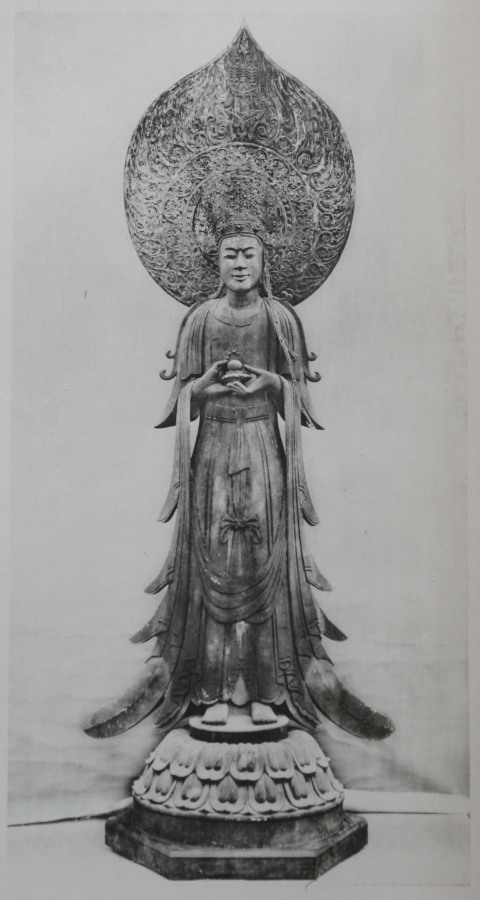
- Title
- Guze Kannon (救世観音菩薩立像)
- Period
- Asuka
- Medium
- Single-block camphor wood with gilding; separately-cast gilt-bronze openwork crown; gilt-wood flame-mandorla
- Dimensions
- Figure 180 cm; crown 30 cm; mandorla 111 cm
- Collection
- Hōryū-ji Tō-in Yumedono
- Accession
-
National Treasure of Japan - Rights
- Public domain (PD-Japan-oldphoto); 1918 photograph from *Hōryūji Okagami*, Tokyo Bijutsu Gakkō, vol. 51, published January 30, 1918. Image hosted on Wikimedia Commons.
The figure that stays wrapped most of the year
The Guze Kannon enshrined in the Yumedono — the octagonal Hall of Dreams in Hōryū-ji’s eastern precinct — is a hibutsu. The word, written 秘仏, names the category of Buddhist image kept hidden from public view. In the Yumedono’s specific case the figure is wound in white cloth for most of the year and uncovered only across two short seasonal windows: roughly five weeks in spring, beginning on April 11, and roughly a month in autumn, beginning on October 22. Outside those windows the visitor enters the hall and sees the closed shrine, a high object draped in fabric, the figure inside legible only by silhouette.
The arithmetic, if one wants to do it, runs to about nine months a year wrapped. Over the documented life of the practice — which by the late Edo period was already deeply established and which conservation history suggests reaches back centuries before that — most years of the figure’s existence have been years in which nobody saw it. The hibutsu condition is a positive doctrinal choice and not a curatorial accident: the image’s hiddenness is the point. The visitor’s experience is structured around the fact of the wrapping, not around the figure beneath it.
The 1918 photograph reproduced above was made by the Tokyo Bijutsu Gakkō — the predecessor of the Tokyo University of the Arts — for the Hōryūji Okagami survey publication. It is among the earliest widely circulated photographs of the figure, and it captures the work in a moment of designated visibility: shrine doors open, lighting arranged for the camera, the long body and the spreading mandorla legible in something close to the condition the spring and autumn windows produce for living visitors.
Asuka body, Asuka face
The figure stands at c.180 cm — a little taller than life-size — and is carved from a single block of camphor wood, the canonical Asuka-period material for large devotional sculpture. The body’s vertical axis is exceptionally severe. The hips do not break; the shoulders sit square; the head sets straight above the line of the chin. The drapery falls along the front of the body in a series of stylised, parallel zigzag folds — what art historians read as a flat, two-dimensionally legible drapery pattern characteristic of the Asuka workshop tradition. The hands carry a hōju, the wish-fulfilling jewel, against the chest with both palms supporting it from below.
The face is the part of the figure that, in the literature, has provoked the most discussion. The eyes are narrow, almost closed, set at a sharp diagonal; the mouth turns up at the corners in what the Western literature began calling, in the early twentieth century, an archaic smile. The cheeks are full, the chin small, the forehead broad. The whole face reads forward — directly at the viewer’s eye-level — rather than inclined downward as later Heian and Kamakura Kannon images would be inclined.
The crown is a separate object: a gilt-bronze openwork piece, 30 cm tall, set onto the head of the figure rather than carved into the head’s surface. The crown’s openwork is florid and complex, and behind the crown a gilt-wood flame mandorla 111 cm tall rises from the back of the figure to enclose its head and shoulders in a halo-and-aureole composition that scholars read as deliberately Continental — modelled on Chinese Northern Wei and Sui precedent rather than developed independently within Japan.
The Tori workshop signature
The literature on Asuka-period sculpture attributes a small group of seventh-century works to the Tori workshop — the atelier of Kuratsukuri no Tori, known in art history as Tori Busshi (止利仏師, “Tori the Buddha-maker”). The workshop’s anchor work is the Hōryū-ji Shaka triad in the Kondō (Main Hall), inscribed with a date corresponding to 623 and with Tori’s name. The Yumedono Guze Kannon is not inscribed and not signed; the attribution is a stylistic one, made on the basis of the family resemblance the figure carries to the Shaka triad: the same flat, parallel-zigzag drapery, the same narrow-eyed elongated face, the same frontal vertical body.
What the Tori-workshop attribution carries — and what the absence of inscription cannot establish — is the line connecting the Yumedono figure to the historical figure of Prince Shōtoku (574–622). Hōryū-ji as an institution holds itself to be Shōtoku’s foundation, and a long-running tradition reads the Guze Kannon specifically as a portrait-image (omokage) of the Prince. The art-historical literature treats the portrait-claim cautiously: Mizuno Seiichi, writing on the Asuka tradition, frames it as an institutional reading rather than as a workshop intention recoverable from the object itself.
The Fenollosa–Okakura unveiling, 1884
In 1884 Ernest Fenollosa — an American philosopher then teaching at Tokyo Imperial University — and Okakura Kakuzō, his student and translator, were members of a government survey of Buddhist temple art. They reached Hōryū-ji and applied for permission to see the Yumedono Guze Kannon. The temple’s resistance is recorded in Fenollosa’s own account: the monks warned that unwrapping the figure would cause an earthquake. Fenollosa pressed and was granted access. The two men, working with the abbot, unwound an estimated five hundred yards of cloth from the figure. What they saw — to read Fenollosa’s Epochs of Chinese and Japanese Art on the moment — was a sculpture in unusually fine condition, the gilding preserved beneath the wrapping rather than damaged by it.
The episode has the structure of a small historical hinge. Before 1884 the Guze Kannon is a sealed object known to its temple custodians and a small Edo-period scholarly community. After 1884 it is documented, photographed (eventually), measured, and entered into the canon of early Japanese sculpture as that canon was beginning to be constructed for both Japanese national-art and international art-historical audiences. The 1918 photograph used here is one consequence of that hinge: the figure has entered a regime of periodic visibility, with the spring and autumn viewing windows now formalised and with publication-quality photography permitted within those windows.
The unwrapping does not change what the figure is, in the temple’s terms. It changes what the figure is to others. The hibutsu condition — the nine months of wrapping per year, the controlled access during the open windows, the continuing sense that the figure is fundamentally hidden — has been retained at the Yumedono right through to the present. Fenollosa opened the question; the temple closed it back.
Reading the Guze Kannon against the Met asuka-buddha-triad-tile (2015.300.249)
The Met’s small terracotta Asuka-period Buddha-triad tile, 2015.300.249, dates to roughly the same century as the Yumedono Guze Kannon and shares the stylistic vocabulary that the Tori workshop attribution rests on: the same frontal vertical bodies, the same parallel-zigzag drapery, the same elongated narrow-eyed face. The tile is small — a domestic-scale or wayside-shrine object — and it is sub-iconic, in the sense that the figures it depicts are not centrally identified by attribute or by inscription.
Read together, the two objects bracket the Asuka workshop tradition at its two scales of operation. The Yumedono Guze Kannon is the workshop tradition at the temple-image scale, in single-block camphor wood, with the separately-cast bronze crown and the wood flame mandorla — the grand mode. The Met tile is the workshop tradition at the small-object scale, in terracotta and in repeating pattern — the distributed mode in which the same drapery formula and the same face type are reproduced for non-monumental contexts.
What the comparison clarifies is that the Yumedono figure is not a singular invention. It belongs to a workshop tradition with a recognisable formal vocabulary, and the vocabulary is operating across material, scale, and patronage at the same historical moment. The figure’s singularity is institutional — its hidden status, its identification with Shōtoku, its enshrinement in the Yumedono — not formal.
What stays open
Three things stay open about the Yumedono Guze Kannon as the article’s draft closes.
The first is the dating window. The literature places the figure in the early seventh century but disagrees about how early. The narrower readings push the carving to c.621 — the year before Shōtoku’s death — and treat the figure as a near-contemporary commemorative image; the broader readings allow c.640s, which would place it after the Tori workshop’s documented activity around the Kondō triad of 623 and would soften the Shōtoku-portrait claim by chronological distance. The article carries the conservative range (c.621–643) and flags both readings.
The second is the question of what was original on the figure versus what was restored when. The 1884 unwrapping documents a preservation state that conservation surveys since have refined: the gilding is largely original but has been retouched, the crown has been re-mounted, the mandorla shows evidence of repair. Pinning what is workshop-original to the seventh century versus what is later intervention is the standing scholarly task; the temple’s conservation reports, which are published in Japanese only and not in full open distribution, are the primary source on this question and are not drawn on here.
The third is the broader question the hibutsu category puts in front of the reader. The Yumedono figure has been seen by far fewer people across its history than almost any sculpture of comparable historical importance. Most years of its existence are years in which it was wrapped and invisible. The reader who travels to Hōryū-ji during a spring or autumn viewing window enters into a tradition of brief, conditional access that has been the figure’s actual mode of being-seen for the better part of a millennium. The unwrapping in 1884 produced a photographic record and a place in the canon; it did not end the hibutsu condition, and the temple’s continuing decision to retain that condition is itself one of the things the visitor is, in attending the open window, witnessing.
Sources
-
The figure is enshrined in the octagonal Yumedono in Hōryū-ji's eastern precinct. Hibutsu opening windows: April 11 – May 18 (spring); October 22 – November 22 (autumn).
-
Tori workshop attribution and the stylistic framework for early-7th-century camphor-wood sculpture; institutional reading of the Shōtoku-portrait identification.
-
First-person account of the 1884 unwrapping of the Yumedono Guze Kannon.
-
January 30, 1918. Source publication for the cover photograph used in this article; PD-Japan-oldphoto.
-
Conservation-history scaffolding (Japanese-language; pin specific volume on next-pass elevation).
-
Comparandum cited in §5.
-
Image clearance evidence: PD-Japan-oldphoto; PD-1996. Source: Hōryūji Okagami vol. 51, 1918.