The sutra mound: burying the Dharma against the end of the age
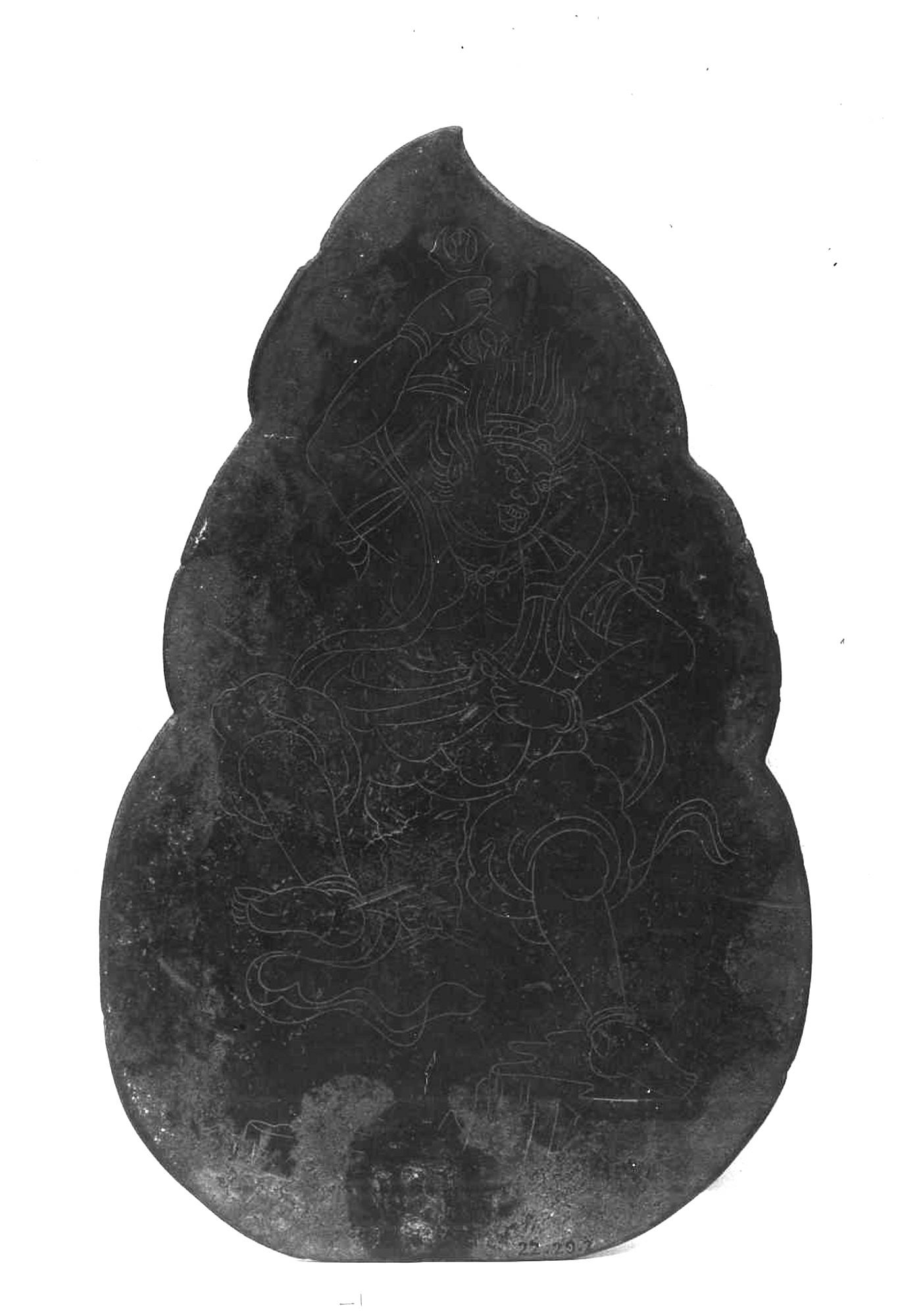
- Title
- Votive plaque of Zaō Gongen (recovered from a Kinpusen sutra mound)
- Period
- Heian period (794–1185), 11th century
- Region
- Japan; Kinpusen (Mount Kinpu), Yoshino, Yamato — find context
- Medium
- Bronze, incised
- Dimensions
- H. 21.6 cm (8 1/2 in.); W. 13.3 cm (5 1/4 in.)
- Collection
- The Metropolitan Museum of Art
- Accession
-
22.29.2 - Rights
- The Metropolitan Museum of Art, Open Access (Public Domain). Rogers Fund, 1922.
A sutra mound (kyōzuka) is scripture deliberately buried to outlast the age of decline, addressed to the future Buddha Maitreya across a gap the depositor never expected any institution to survive. Michinaga’s 1007 Kinpusen deposit is the earliest dated case, and a leaf of his buried Lotus Sutra survives, water-eaten, in the Keio collection. The scholarship now splits three ways on what the practice was even for.
A preservation method that destroyed what it preserved
Scripture was buried to save it, and the burial is what killed it. That is the contradiction at the centre of the kyōzuka and the right place to start, because every other feature of the practice follows from it. A kyōzuka (経塚, “sutra mound”) is a deposit of copied Buddhist scripture deliberately interred, usually on a mountain or in a temple precinct, sealed inside a metal cylinder with a small assemblage of other objects. The Kyoto National Museum’s dictionary entry gives the standard form without ornament: an earthenware jar or a stone chamber holding a cylindrical bronze container, the container holding the text.1 The Japanese name for the cylinder is kyōzutsu (経筒), the sutra tube. It is the load-bearing object of the whole operation, and across eight or nine centuries in wet ground it is usually the only part that comes back up intact.
What does not come back up is the scripture. At the Hanase Bessho mounds on a ridge 700 metres up, north of Kyoto, the texts inside the containers had mostly deteriorated over roughly eight hundred years; the surviving scraps from one mound could only be identified as Lotus Sutra by their fragments.1 The point of burial was preservation. The literal paper rarely lasted. What lasted was the container, the kit sealed in beside it, and the gesture. That asymmetry, between the durable apparatus and the perishable text it was built around, is what the rest of this article is about.
What actually came back up
Two objects make the asymmetry concrete, and they should be looked at before any doctrine, because the doctrine is the part the database can give you and these are not.
The first is a single sheet of paper in the Century Akao Collection at Keio University (object AW-CEN-002534): twenty-three lines of the Lotus Sutra’s thirteenth chapter, “Exhortation to Hold Firm,” from the fifth scroll, in gold ink on indigo paper, 13.8 by 46.5 cm.2 It is a leaf of the set Michinaga buried on Kinpusen, the text copied in Chōtoku 4 (998), deposited in 1007. The Keio record states the damage flatly: the lower half of the sutra is gone to water, and the gold-charactered recto stuck fast to the paper behind it in the ground, so that what remains is a half-leaf whose surviving gold, by the museum’s own account, sits brighter for having been pressed and partly stripped.2 This is the buried Lotus Sutra of the earliest dated mound, and it is half a page, legible because it failed to stay sealed.
The second is bronze. The Metropolitan Museum holds, as accession 22.29.2, a flame-shaped plaque a little under nine inches tall, incised rather than cast, the metal gone dark and pitted across its face. It shows Zaō Gongen on a rocky outcrop, right foot raised in the deity’s wide stride, a three-pronged vajra (sankōshō) in the raised right hand, the left hand in the sword mudra (ken-in).3 The Met dates it to the eleventh century and records the find context that carries the article: it came out of a sutra mound on Kinpusen, the same mountain, in roughly the same horizon as Michinaga’s deposit. A votive plaque of a mountain deity is not, on its face, scripture. It is the kind of thing that went into the ground with the scripture, in the same chamber, as part of the same act.
Where the plaque now sits inverts where it was made to be. It reads at arm’s length, flat against a case wall under gallery light, the incised lines catching only when a viewer moves to the side, hung at standing-eye height like any small bronze. Every condition of that encounter is the reverse of the intended one. The plaque was made to be set into a stone or earthen chamber on a mountain summit, in the dark, against a sealed cylinder, looked at by no one. The pitting is the trace of the encounter it was built for. The vitrine is the encounter it was built to prevent. The Keio half-leaf says the same thing in paper: both objects are in collections today only because the ground gave them up, which the practice was designed to make impossible.
Why the Dharma had to be hidden
The motive the literature most often gives is mappō (末法), the last of the three ages of the Dharma (True, then Semblance, then Final), the last an age in which the teaching survives as word but no longer produces awakening, and after which it disappears until the next Buddha. In Japan the Final Dharma was calculated to begin in 1052. Li quotes the contemporary chronicle Fusō ryakuki recording the year in the first person: “[we] stepped into the Final Dharma this year” (Li 2017, p. 286).4 The conviction was specific, dated, and shared at the top of the aristocracy.
The far end of the calculation is the part to slow on. After the Final Dharma runs out, the future Buddha Maitreya (Miroku, 弥勒) descends to teach again, and the interval given for that descent is on the order of 5,670,000,000 years. The Tokyo National Museum used exactly that figure as the title of its sutra-mound exhibition, “Time Capsules for 5,670,000,000 Years.”5 The buried sutra was not addressed to a reader in the depositor’s century, or the next. It was addressed past every standing temple, every recited lineage, and every above-ground copy the depositor expected the interval to destroy, to an audience that did not yet exist.
The burial follows from that. If the institutions that carry the teaching are themselves expected to fail, the teaching cannot be left with the institutions; it has to go to the ground, sealed against the continuity it can no longer trust. The mound is at once an admission that the ordinary channels were believed to be ending and a wager that the earth would keep what the lineages could not.
Michinaga on the Peak of Gold, 1007
The earliest dated sutra mound is also the most fully documented, because its central object survived and carries an inscription. On the eleventh day of the eighth month of 1007, the regent Fujiwara no Michinaga (966–1028) climbed Kinpusen and buried, at the summit, fifteen scrolls he had commissioned and in part copied: the Lotus Sutra with associated texts, sealed in a gilded bronze kyōzutsu (Li 2017, p. 286).4 Li records on the same page that this container carries the longest inscription so far found on any sutra container, turning on rebirth and on preservation until Maitreya.4 The cylinders were recovered on the mountain around 1691 (Genroku 4); they are now National Treasures in the Kyoto National Museum, while the surviving scroll leaves are split between Kinpusenji, the Tokyo National Museum, and collections such as Keio’s. That recovery is the route by which the deposit’s text became legible to scholarship at all.
Two things about the 1007 deposit set the pattern. First, the patron is at the very top: Michinaga was the dominant figure of the court, and the act of burial is a regental act, not a monastic one. Sutra burial in its formative phase is an aristocratic merit practice, funded and performed by the lay elite, and Kinpusen in the eleventh century is a destination for exactly that elite. Second, the mountain is not incidental. Kinpusen was identified in the period’s mythogeography with the dwelling of Maitreya, so that burying a text there to await Maitreya’s descent placed the deposit at the site where the descent was expected to land. The text was not put in any ground. It was put in that ground.
This is the seam where the scholarship divides, and it now divides three ways, not two. The standard account, which the museum exhibition framing and D. Max Moerman’s reading both carry, makes mappō anxiety the engine: the practice is the archaeology of a civilization that believed its religion was ending and acted to outlast the ending.6 Heather Blair, working specifically from the Kinpusen evidence, argues that on this mountain the burial was bound up with the site’s own deity and meanings, and that the Kinpusen material gives little direct sign that decline-anxiety was the central motive. She reads it through the mountain’s Maitreyan associations and through what she calls the ritual regimes of regents and retired emperors, not through eschatological dread.7 Jonathan Thumas takes the third position, and the most radical. In Cambridge Archaeological Journal 32(4) (2022) he argues that scripture was not even the central feature of these deposits. They “resulted from a range of highly variable contexts of religious and social practice, not limited to a focus on scripture,” and should be read as complex assemblages implicating “diverse religious meanings, time frames and social actors” rather than as scripture-preservation acts at all.8
These do not collapse into each other. Moerman is arguing from doctrine and chronicle, Blair from one mountain’s institutional history, Thumas from the assemblage as excavated across hundreds of sites. bodhi follows Blair against Moerman on the narrow point that the Kinpusen evidence is too thin to read every deposit as a panic response, and finds Thumas’s assemblage caution well taken for the deposits read as a class: the kit is too elaborate and too internally varied to be a frame around the text and nothing else. The mappō frame is kept where the inscriptions and chronicles supply it, as they do for the future-Maitreya horizon at Kinpusen, and not extended past them. The residual uncertainty is that motive is exactly what a bronze cylinder does not record: the inscriptions give the doctrinal logic, not the depositor’s interior state, and the inference from the one to the other is the open ground all three readings are still fighting over.
The kit around the text
A sutra mound is rarely just a text in a tube. The objects buried alongside form a recognizable assemblage, and the Met plaque belongs to it.
The Kyoto National Museum’s account of Hanase Bessho Mound 1, a deposit dated by its container inscription to 1153, lists what came out of one well-documented case: the bronze sutra container with a roof-shaped lid, a small gilt-bronze Bishamonten in a miniature shrine, a bronze incense burner and flower vase, six bronze plates, a Japanese mirror, short swords, and Chinese Song-dynasty porcelain.1 The patrons are named in the container inscription, a low-ranking courtier surnamed Saeki and a nun, which is itself informative: by the mid-twelfth century the practice had spread well below Michinaga’s stratum. The Tokyo National Museum’s material confirms the same vocabulary across northern Kyushu, with containers datable in series (Shiojiyama 1123, Sefuriyama 1142, Dazaifu Tenmangū 1147), showing the practice as a dated, spreading habit rather than a single aristocratic gesture.5 Yiwen Li’s interest is in one part of the kit specifically: the imported Chinese objects, tracked as evidence of trade as much as of devotion. Of 182 sutra-mound mirrors she surveys, fifty-one (28%) carry the stamp of the Shi family workshop, and mirrors from Chinese tombs bear the identical stamp: same workshop, two destinations (Li 2017, pp. 296–297).4 Small Chinese porcelain boxes that held cosmetics in China held glass beads in Japan; one from a site on Mount Asama held twenty-eight (Li 2017, p. 293).4 This is the assemblage Thumas reads against a scripture-first interpretation: a deposit doing trade-history and devotional work at once, the text only one register in it.
The mirror is the recurring puzzle. It is in deposit after deposit, including deposits at Kinpusen, where bronze mirrors incised with Zaō Gongen are a documented type. The Met plaque sits in this category of accompanying metalwork: a flat incised bronze image of the mountain’s deity, made to go down with the scripture, not to be displayed. Read against the rest of the kit, it is doing what the Bishamonten statuette at Hanase and the Zaō mirrors at Kinpusen do. It puts the protective deity of the place in the hole with the text, as a guardian sealed in alongside what it guards. The plaque is not the scripture and not a substitute for it. It is the practice’s idea of an escort.
The buried sutra is not the recited sutra
The act that defines this practice is best seen by contrast with its opposite, because the same scripture treated two ways yields two entirely different objects.
A recited or displayed sutra is in use. It is unrolled, read aloud, turned in the air at a tendoku rite, kept in a repository and brought out, copied onward. That is the case bodhi treats separately in the Daihannya-kyō repository, where the lacquered box and the guardian figures on its doors exist so the text can be used with the dignity it was held to deserve. A buried sutra is the inverse on every count. It is sealed so it cannot be opened, placed where it will not be found, and accompanied by objects (a mirror, a guardian image) themselves taken out of circulation. Its worth is in not being reached: pulled out of use and held in reserve.
This is the conceptual core of the kyōzuka and the reason it belongs in a transmission history rather than a study of book culture. Both the displayed sutra and the buried sutra are acts of merit, and both are acts of transmission, but they transmit in opposite directions. The displayed sutra transmits laterally and now, to a present community that hears and copies it. The buried sutra transmits forward and later, to Maitreya, across a gap the depositor never expected the present community to survive. The merit is real in both cases by the period’s own accounting, but its addressee differs. One sutra is given to readers. The other is given to the future, on the explicit understanding that no reader in the depositor’s world will ever open it again.
The contrast also explains the kit. A repository sutra is guarded by figures painted where they can be seen, on doors and panels, because the guarding is part of the display. A buried sutra is guarded by a Zaō plaque or a Bishamonten statuette sealed in the dark, because the guarding has to work in a place no one will look. The Met’s plaque only makes sense once this is in view. It is a guardian made for an audience of none, for a stretch of time no institution claimed it could cover, doing its work underground for the descent of a Buddha five and a half billion years out.
What the surviving witness can and cannot say
The limits should be stated, not smoothed. The Met catalog places accession 22.29.2 in the eleventh century and assigns it the Kinpusen sutra-mound find context; the full catalogue entry was not consulted, so the object data here rests on the museum’s Open Access record, authoritative for accession, date, medium, and dimensions but silent in that channel on excavation particulars.3 The plaque cannot be tied by published evidence to Michinaga’s 1007 deposit rather than to one of the later Kinpusen interments. “From a Kinpusen sutra mound” is the level at which the find context is secure; a named deposit would be more than the record carries. The reading offered here, the plaque as a buried guardian inside the standard assemblage, is an inference from the well-documented comparanda (the Hanase Bessho kit, the Kinpusen Zaō mirrors) applied to an object whose own excavation particulars are not in the open record.
What the two objects secure is the practice’s physical reality at a level the chronicles cannot. The texts give the doctrine: the Final Dharma, the long wait, the descent of Maitreya. The Keio half-leaf and the Met plaque give the consequence in paper and metal: a sutra copied in gold and reduced to a water-eaten fragment, a deity image cast to go underground and not return, both legible now only because the ground was opened against the original intent. The deepest uncertainty is not the one a single object carries but the one Thumas presses on the whole class — whether “sutra mound,” with scripture as the noun, names the thing correctly at all, or whether the text was one element among many in a deposit doing several kinds of work at once. The objects on their stands are a small, double failure of the practice’s wager: the wager that nothing would ever reach them, and the wager that what was reached would still, unambiguously, be a buried scripture.
Sources
| Source | Type | Citation |
|---|---|---|
| The Metropolitan Museum of Art, acc. 22.29.2 (object 59978) | museum record | Open Access; public domain (CC0); 11th c., flame-shaped incised bronze, vajra + ken-in mudra, Kinpusen sutra-mound find context |
| Keio University, Object Hub 140 (Shidō Bunko, Century Akao Coll. AW-CEN-002534) | museum record | leaf of Michinaga’s buried Lotus Sutra, gold on indigo, 13.8 × 46.5 cm; lower half water-lost |
| Jonathan Thumas, “Buried Scripture and the Interpretation of Ritual” | article | Cambridge Archaeological Journal 32(4) (2022): 585–599; assemblage-not-scripture argument; verbatim abstract quoted |
| Heather Blair, Real and Imagined: The Peak of Gold in Heian Japan | book | Harvard University Asia Center, 2015; Kinpusen sutra burial and site-specific meaning; page numbers not verified |
| D. Max Moerman, “The Archeology of Anxiety” | book chapter | in Centers and Peripheries in Heian Japan, U. Hawai’i Press, 2007; mappō and the underground record; page numbers not verified |
| D. Max Moerman, “The Death of the Dharma: Sutra Burials in Early Medieval Japan” | book chapter | in The Death of Sacred Texts, ed. Myrvold, Ashgate, 2010; page numbers not verified |
| Yiwen Li, “Chinese Objects Recovered from Sutra Mounds in Japan, 1000–1300” | book chapter | in Visual and Material Cultures in Middle Period China, Brill, 2017, pp. 284–317; pp. 286, 293, 296–297 pinned |
| Kyoto National Museum, “Relics from the Hanase Bessho Sutra Mounds” | museum record | Museum Dictionary; Mound 1 dated 1153; deposit kit |
| Tokyo National Museum sutra-mound exhibitions (Kyushu; “Time Capsules”) | museum record | exhibition records; 5.67-billion horizon; Kyushu series 1123/1142/1147 |
Related
- Zaō Gongen and the Kinpusen mountain cult
- The Daihannya-kyō repository — the housed and turned sutra, the buried sutra’s opposite
- Honji-suijaku — the doctrine behind Kinpusen’s deity
- The decorated sutra — scripture made to be seen, not buried
- Kyōzuka (entity)
- Mappō (entity)
- Miroku / Maitreya (entity)
- Kinpusen (entity)
Footnotes
-
Kyoto National Museum, “Relics from the Hanase Bessho Sutra Mounds,” Museum Dictionary (kyohaku.go.jp/eng/learn/home/dictio/kouko/41hanase, accessed 2026-05-16). Used for the standard kyōzuka form (earthenware jar or stone chamber holding a cylindrical bronze container), for the Hanase Bessho Mound 1 deposit kit (bronze container with roof-shaped lid, gilt-bronze Bishamonten in a miniature shrine, incense burner and vase, six bronze plates, a mirror, short swords, Song porcelain), for the container-inscription patrons (a low-ranking courtier surnamed Saeki and a nun), for the 1153 date of Mound 1, and for the survival fact that Lotus Sutra fragments at the site were largely gone after roughly eight centuries. Reference-tier museum text; specific page/section numbers not applicable to the web entry. ↩ ↩2 ↩3
-
Keio University, Institute of Oriental Classics (Shidō Bunko), Century Akao Collection, “Part of The Lotus Sutra (Found at Mount Kinpu),” object AW-CEN-002534, Keio Object Hub record 140 (objecthub.keio.ac.jp/en/object/140, accessed 2026-05-18). Cited for: a single sheet, 13.8 × 46.5 cm, twenty-three lines of Lotus Sutra chapter 13 (“Exhortation to Hold Firm”) from volume 5, gold ink on indigo paper; text copied Chōtoku 4 (998), part of the fifteen-scroll set Michinaga buried on Kinpusen on the eleventh day of the eighth month, 1007, deposit recovered around 1691; condition — lower half lost to water, gold-charactered recto stuck to the verso in the ground, surviving gold rendered brighter by the pressing. Reference-tier museum object record; the condition and find-context statements are the museum’s own. ↩ ↩2
-
The Metropolitan Museum of Art, Votive plaque of Zaō Gongen, accession 22.29.2 (object id 59978), Heian period, 11th century, bronze, H. 21.6 cm, Rogers Fund, 1922; recovered from a sutra mound on Kinpusen, Yoshino. Object data (accession, date, medium, dimensions, credit line, public-domain status) taken from the Met Collection Open Access API, re-confirmed 2026-05-16. The iconographic description used here — flame-shaped plaque, right foot raised, three-pronged vajra (sankōshō) in the raised right hand, left hand in the sword mudra (ken-in) — is from the Met object record as consulted 2026-05-18 (not “left hand at the hip”). No full curatorial essay or excavation report was consulted; the find context is cited at the level the open record secures (“from a Kinpusen sutra mound”) and is NOT pushed to a named deposit. The same accession is cited as a comparandum in the published bodhi article on Zaō Gongen. ↩ ↩2
-
Yiwen Li, “Chinese Objects Recovered from Sutra Mounds in Japan, 1000–1300,” chapter 8 in Visual and Material Cultures in Middle Period China, ed. Patricia Buckley Ebrey and Shih-shan Susan Huang (Brill, 2017), pp. 284–317. Specific in-chapter pages pinned 2026-05-18 from the author’s deposited copy: p. 286 — the Fusō ryakuki notice quoted “[we] stepped into the Final Dharma this year” (1052), and Michinaga’s 1007 burial of fifteen scrolls in a gilded bronze container on Kinpusen carrying “the longest inscription that has so far been found on any sutra container,” turning on rebirth and preservation until Maitreya; p. 293 — Chinese porcelain cosmetic boxes reused in Japan to hold glass beads, with a box from a Mount Asama site holding twenty-eight beads; pp. 296–297 — of 182 sutra-mound mirrors surveyed, fifty-one (28%) carry the Shi-family workshop stamp, identical to the stamp on mirrors excavated from Chinese tombs, indicating one workshop and two destinations. The general claim that devotees buried sutras with donated objects to preserve them through the age of decline runs across the chapter. Volume, editors, publisher, and page range verified from the publisher index; the three pinned pages verified from the deposited chapter text. ↩ ↩2 ↩3 ↩4 ↩5
-
Tokyo National Museum, two sutra-mound presentations: “Sutra Mounds: Time Capsules for 5,670,000,000 Years,” special exhibition item list (tnm.jp, accessed 2026-05-16), cited for the 5,670,000,000-year Maitreyan horizon as the organizing figure; and “Ancient Sutra Mounds of Kyushu,” Heiseikan thematic exhibition, Dec 2010–Mar 2011 (tnm.jp, accessed 2026-05-18), cited for the dated northern-Kyushu container series — Shiojiyama (Fukuoka) 1123, Sefuriyama (Saga) 1142, Dazaifu Tenmangū (Fukuoka) 1147 — and for the 1052 mappō framing. Reference-tier museum exhibition text; page numbers not applicable. ↩ ↩2
-
D. Max Moerman, “The Archeology of Anxiety: An Underground History of Heian Religion,” in Centers and Peripheries in Heian Japan, ed. Mikael Adolphson, Edward Kamens, and Stacie Matsumoto (University of Hawai’i Press, 2007); see also Moerman, “The Death of the Dharma: Sutra Burials in Early Medieval Japan,” in The Death of Sacred Texts: Ritual Disposal and Renovation of Texts in the World Religions, ed. Kristina Myrvold (Ashgate, 2010). Cited as the standard scholarly account that reads sutra burial through the lens of Heian decline-anxiety and the preservation of scripture against an anticipated age of lawlessness — the position against which Blair’s site-specific reading is set in §“Michinaga on the Peak of Gold.” The full chapter text was not consulted; the bibliographic metadata is verified from the publisher and review record. Specific page numbers not given. ↩
-
Heather Blair, Real and Imagined: The Peak of Gold in Heian Japan (Harvard University Asia Center / Harvard University Press, 2015). Cited for the argument that sutra burial on Kinpusen was tied to meanings and symbolism specific to that mountain and its principal deity, and that the Kinpusen evidence gives little direct indication that decline-anxiety (mappō) was the central motivating factor most often assumed in the scholarly literature; and for Blair’s “ritual regimes” framing linking regents and retired emperors to signature sites, rites, and texts. Standard English-language treatment of Heian Kinpusen; the same source is cited in the published bodhi article on Zaō Gongen for the Heian institutional formation of the Kinpusen cult. Cited at work level with claim clauses; specific page numbers not verified. ↩
-
Jonathan Thumas, “Buried Scripture and the Interpretation of Ritual,” Cambridge Archaeological Journal 32, no. 4 (2022): 585–599, DOI 10.1017/S0959774322000038 (abstract and publication metadata verified 2026-05-18; full article behind paywall, body text not retrieved). Cited for the argument, quoted verbatim from the abstract, that Japanese scripture-burial deposits “resulted from a range of highly variable contexts of religious and social practice, not limited to a focus on scripture” and were “complex assemblages that implicated diverse religious meanings, time frames and social actors” — the third position set against Moerman (mappō-engine) and Blair (Kinpusen site-specific) in §“Michinaga on the Peak of Gold.” Specific case-study sites and in-text page numbers not given (full text not consulted); the claim is cited at abstract level with the verbatim quotation marked as such. ↩