Reading a nehan-zu: the death of the Buddha
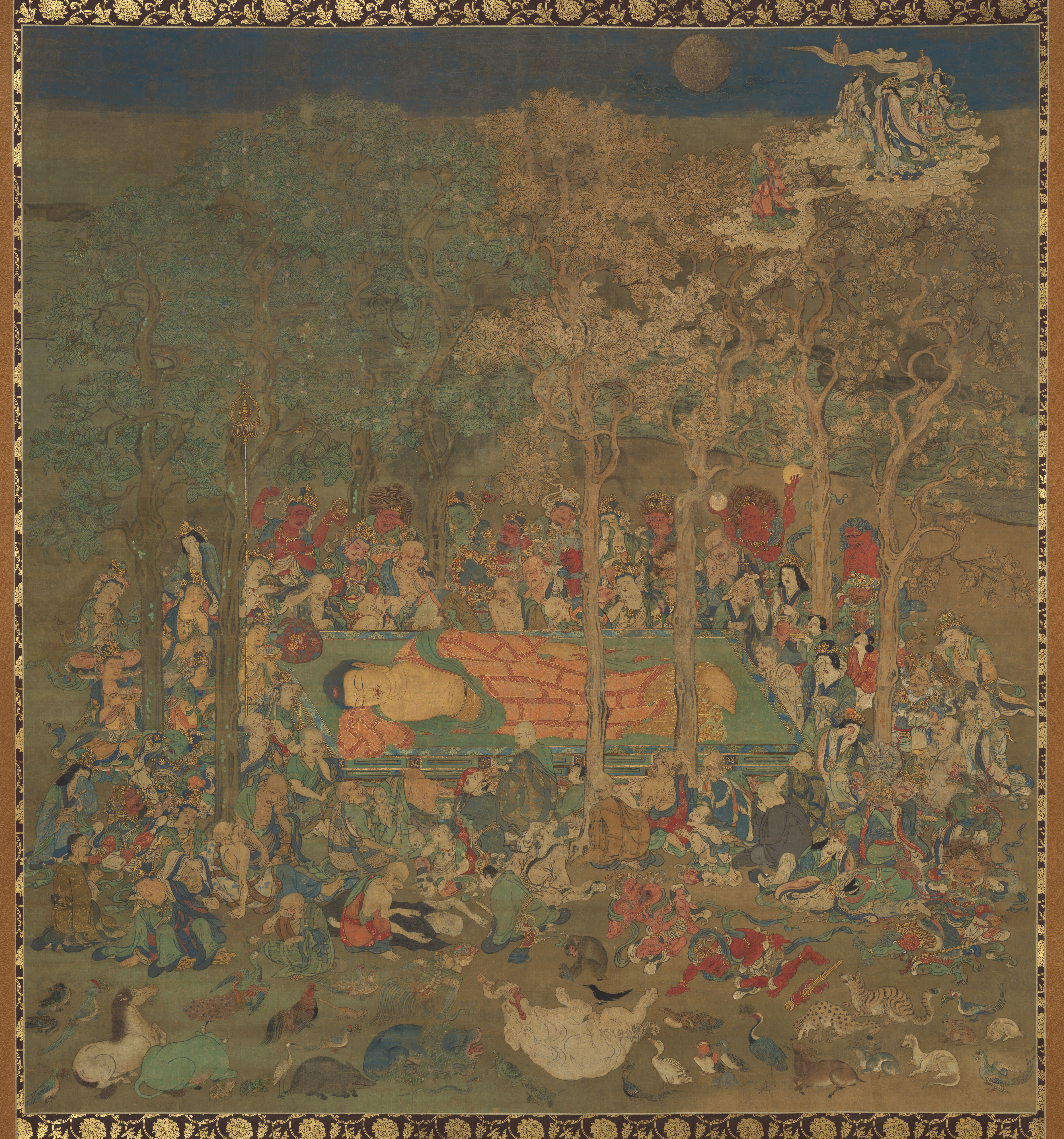
- Title
- Death of the Historical Buddha (Nehan-zu)
- Period
- Kamakura period (1185–1333), 14th century
- Region
- Japan
- Medium
- Hanging scroll; ink, color, and gold on silk
- Dimensions
- Image 196.9 × 188.6 cm (77 1/2 × 74 1/4 in.); overall with mounting 330.2 × 196.9 cm
- Collection
- The Metropolitan Museum of Art
- Accession
-
12.134.10 - Rights
- The Metropolitan Museum of Art, Open Access (Public Domain). Rogers Fund, 1912.
Met 12.134.10. A Kamakura developed-Type-II nehan-zu: the oversized reclining Buddha head-north on the jewelled couch, eight sala trees living and bare, the calm-to-grief mourner gradient, and Māyā's cloud at the upper right — the silk canon the Edo temple-gate print later compresses.
A nehan-zu is the painted death of the Buddha, unrolled once a year for the Nehan-e on the fifteenth of the second month and then put away. The reading is positional, not narrative: find the Buddha by posture (right side, head-north), count the eight sala trees living against bare, locate Māyā off-ground at the upper right, then read the mourners as a calm-to-grief gradient down to the animal catalogue. The canonical anchor is the Kongōbu-ji scroll of 1086; the scholarship that maps the type is Kanda 1954 and Wheelwright 1985.
What a nehan-zu is, and the one day it is seen
A nehan-zu (涅槃図) is the painted death of the Buddha: Śākyamuni reclining at Kuśinagara between the sala trees, entering parinirvāṇa, with the assembled world gathered to mourn. The genre name is literal, “extinction picture,” and so is its function. A nehan-zu is not, in its institutional life, a painting that hangs on a wall to be looked at. It is a liturgical object unrolled once a year, for the Nehan-e (涅槃会), the memorial service held on the fifteenth day of the second month, and then rolled up again.1 That single-day visibility is the first fact the reading needs, because it explains the scale and the legibility: a nehan-zu is built to be read across a hall by a standing congregation on one occasion, not pored over in a study. The composition is a diagram before it is a picture.
The Met’s Kamakura scroll, Death of the Historical Buddha (12.134.10), is read here because it carries the canon at the scale the canon was meant for. The painted image is roughly 197 by 189 centimetres: close to square, near life-size, ink, colour and gold on silk.2 On the silk the orientation is immediate even before any figure is identified: a long pale horizontal mass slightly above centre, the reclining Buddha, larger than everything else in the field, with the whole population of the painting banked below and around it and a single descending group dropped in at the upper right. The painting tells the reader where to start by making one thing bigger than it could physically be. Scale is the first piece of iconography, not a stylistic accident.
The Buddha: head-north, right side down, on a jewelled couch
Find the Buddha first, and read his posture before anything else, because the posture is doctrinally fixed and the rest of the composition is arranged around it. He lies on his right side, right hand under his cheek, left arm along the flank, on a raised rectangular couch. His head points to the painting’s left and his face turns away from the congregation: in the canonical reading, head to the north and face to the west.3 This is not a sleeping pose borrowed for pathos. It is the posture the early accounts assign to the death itself: at Kuśinagara the Buddha had Ānanda prepare a place between two sala trees and lay down on his right side with his head to the north.2 A nehan-zu that gets the side or the head-direction wrong is not a nehan-zu; it is a reclining-figure painting of some other subject.
The couch is the second fixed element. It is rendered as a low jewelled or lacquered platform, sometimes railed, and it carries a quiet doctrinal weight: it raises the dying body above the ground and above the grief, sets it apart from the mourners who collapse onto the earth around it, and gives the composition its stable horizontal spine. Note the proportion the painter is forced into. The Buddha is too large for the couch and too large for the trees; an attendant beside the platform comes up only to its level. The disproportion is the doctrine made visible: the body that is passing is not the same order of thing as the bodies that mourn it. A reader who corrects the scale in their head, treating the small figures as “background,” has read the painting backwards.
Eight sala trees, half living and half dead
Above and behind the couch stand the sala trees, and the trees are the single most reliable diagnostic the genre has. The canonical arrangement is eight: four pairs, one pair at each of the four directions around the couch.1 Their state is the iconographic point. Four are in leaf, sometimes flowering out of season; four are withered, blanched, bare, in one museum description “dry and bleached, resembling white cranes.”4 The trees do not merely frame the scene. They register the event in their own bodies: the southern and eastern pairs hold their foliage, the northern and western pairs die back, so that the grove itself is shown half alive and half dead at the moment of the passing.
This is the genre’s most legible single test, and it is also where the popular caption most often goes wrong. The casual reading treats withered branches as decay or as a damaged painting; the iconographic reading treats them as a deliberate split state, paired by direction, carrying the same north-and-west weighting as the Buddha’s own orientation. The eye should not look for healthy trees and read the dead ones as loss. It should count: four and four, living set against bare, the bare ones on the side the head points to. A nehan-zu with eight uniformly green trees would be the iconographic error; the canon wants the grove caught in the act of dying with its teacher.
Māyā descending, and the bowl and staff in the branches
At the upper right, dropped in on a bank of cloud, a small group descends from heaven. This is Queen Māyā, the Buddha’s mother, who died seven days after his birth and is reborn in the Trāyastriṃśa heaven; she comes down to her son’s deathbed, arriving, in the narrative the painting follows, too late.4 She is the one figure the reader should expect to find off the ground and outside the main ring, and her position is fixed by the story, not by composition: she enters from above and from the right, attended, often guided down by the disciple Anuruddha, her sleeve raised to her face.
Two details near Māyā are worth slowing for, because they are textual rather than obvious and they separate a careful reading from a glancing one. First, the cluster of objects hanging in the branches of one tree: a bowl, sometimes a staff and a bag. The standard explanation derives these from the apocryphal Mahāmāyā Sūtra and the Sūtra on the Buddha’s Mother: Māyā casts down a medicine bowl and staff to her dying son, and they catch in the sala branches.4 In the Japanese reception this acquired a vernacular tail, the bowl thrown from heaven and the staff caught in the tree, retold in the Konjaku Monogatari tale collection, so the hanging objects are not stray decoration but a compressed citation of the late-arriving-mother episode.3 Second, the small foreground vignette of one disciple reviving another with water: Anuruddha tending Ānanda, who has fainted in grief. A nehan-zu rewards the reader who knows these are named events and not generic mourning.
The rings of mourners, read from calm outward to grief
The population around the couch is not a crowd. It is a graded system, and the gradient is the iconography. Read it as concentric bands moving outward from the body.
Closest, and calmest, are the bodhisattvas. They understand what is happening (a parinirvāṇa is an attainment, not a defeat) and so they are shown composed, sometimes seated, faces still. In the Met scroll’s tradition the green-robed figure near the couch reads as Kṣitigarbha (Jizō); the bodhisattva band is the one place in the painting where the faces are not contorted.3 Next out are the great disciples, the historical monks of the saṅgha, and here the painting changes register completely: they weep, faint, tear at their robes, throw up their hands. The single canonical exception is the monk who does not grieve, in some accounts Subhadra, the last convert, composed because he has understood; a reader who finds the one calm face in the weeping band has found a deliberate iconographic marker, not an oversight.3 Beyond the disciples come the laypeople, the kings and nobles, and the deva hosts: Indra, Brahmā, Vaiśravaṇa and their retinues, ranked above the human mourners and below Māyā’s cloud.
The compositional history runs along exactly this gradient, and naming it is how a reader dates the type by eye. The earlier Heian formula, the Type I of the standard art-historical division, keeps the cast small and the emphasis on the reclining Buddha himself; the later formula, Type II, multiplies the mourners and the animals and pushes the emotional register outward, so that the grief at the edges does more of the work.1 Carolyn Wheelwright’s “Late Medieval Japanese Nirvāṇa Painting” (Archives of Asian Art 38, 1985, pp. 67–94) is the dedicated English-language study of that developed phase, and it does not treat the swelling cast as mere elaboration: the late-medieval scroll recruits the perimeter to carry the doctrine the small Heian field stated quietly.5 The Met Kamakura scroll sits on the developed side of that line: a dense, banked, many-figure field in which the calm centre is set against an agitated perimeter.
There is a named reading of what that crowd is doing, and it is the one a popular caption never reaches. Mimi Hall Yiengpruksawan, working from the closely comparable Shōnami-workshop Type II scroll at Yale (acc. 2005.58.1a-b, ca. 1320–40, Kōfuku-ji Ichijōin office), reads the swollen Type II perimeter as an interstitial field: not a decorative throng but the whole population of the Buddhist cosmos, the human ranks and the monstrous ones, packed into the gap the dying body opens, the assembly rendered with the unruly density of a Nara street rather than the order of a Heian court.6 Set that against Wheelwright’s structural account and the two are not rivals: Wheelwright explains why the cast grew (the perimeter took over the doctrinal labor), Yiengpruksawan explains what the grown cast became (a cosmos crowding the threshold). This guide commits to both as complementary, and names the residual uncertainty: neither argument certifies that the Met scroll specifically was made for the same Saidaiji-adjacent Nara network the Yale scroll documents, and the Met record carries no provenance that could decide it. ten Grotenhuis places the whole genre inside the annual devotional-painting calendar rather than treating it as a single masterwork lineage, which is the right frame for a reading guide: the nehan-zu is a recurring liturgical type, and its conventions are stable precisely because it was repainted, not invented.7
The animal catalogue, and the cat that is not there
The lowest band is the animals, and for Japanese viewers in every century the genre was painted it has been the most beloved part of the picture. The doctrinal claim is plain: the Buddha’s passing is mourned by all sentient beings, so the painting itemises them. The catalogue is long and, in the developed Type II compositions, deliberately various: elephant, lion, ox, deer, horse, dog, the small mammals, birds, snakes, insects, fish; the Boston Itchō nehan-zu is praised in its conservation literature precisely for the individuation of “the grieving members of the animal kingdom,” each species given its own posture of distress.8 The animals are not filler. They are the proof-text for the universality claim, rendered as an inventory a reader can literally count through.
One absence is itself iconographic, and it is the detail that most reliably catches a careless caption. The cat is, by strong convention, not in the standard nehan-zu. The vernacular explanation is that the cat alone did not come to mourn (variously, that it was chasing the rat sent to fetch Māyā’s medicine, or simply that it failed to attend) and its exclusion became a fixed feature of the orthodox composition, conspicuous enough that the celebrated later paintings which do include a cat (Itō Jakuchū’s vegetable parody, the Tōfuku-ji Chō Densu painting traditionally said to include one) are remembered specifically as exceptions. The reading discipline here is exact: a cat in a nehan-zu is not a charming addition, it is a marked departure from the canon, and a reading that does not notice the absence has not read the animal band as a system.
Where this reading commits, and where it is open
This reading commits to the positional method: identify the Buddha by posture and orientation (right side, head-north, face-west) before identifying anyone else; read the eight sala trees as a directional half-living/half-dead diagnostic, not as condition damage; locate Māyā off-ground at the upper right and the bowl-and-staff in the branches as a textual citation of the late-arriving mother; read the mourners as a calm-to-grief gradient with the bodhisattvas composed and the disciples broken; and treat the animal catalogue, including the canonical absence of the cat, as the universality claim made countable. It commits to the Kongōbu-ji scroll on Mount Kōya as the fixed canonical anchor the later scrolls hold to: a large painting in colour on silk, roughly 268 by 271 centimetres, carrying an ink inscription dated Ōtoku 3 (1086), the oldest surviving Japanese nehan-zu and the textbook Type I exemplar (small cast, the reclining Buddha dominant). The Kamakura Met scroll is read here as a developed Type II carrier of that same canon, the cast multiplied and the grief pushed to the edges.15
It is open on the things the scholarship has not settled and the Met record does not fix. The Type I / Type II division is a useful art-historical convenience, not a hard chronological law: provincial and late workshop paintings mix the registers, and an individual scroll can carry Type I economy with Type II animal abundance, so the type-by-eye dating is a tendency, not a proof. The bowl-and-staff iconography is securely from the apocryphal Mahāmāyā tradition, but exactly which objects appear, and whether a bag is read as medicine or as something else, varies by workshop and is not standardised across the corpus. And the named-figure identifications in the mourner bands (which bodhisattva, which of the great disciples is the calm one) are conventionally assigned but not universally consistent between scrolls; the safe reading names the gradient and the marked exceptions, and leaves the individual roll-call to the cartouches when a given painting supplies them. The Edo printed nehan-zu, where this whole court-silk canon is compressed into a temple-gate broadsheet, is read separately as its own single-work study; this guide is the silk-painting method that the print presupposes.
Sources
| Source | Type | Citation |
|---|---|---|
| Yoshiko Kanda, “The Iconography of the Parinirvāṇa” | article | Artibus Asiae 17, 3/4 (1954); foundational English-language study of the canonical cast, the sala-tree convention and the Type I / Type II division. Article-level only; internal pages not cited. |
| Carolyn Wheelwright, “Late Medieval Japanese Nirvāṇa Painting” | article | Archives of Asian Art 38 (1985), pp. 67–94; the dedicated English-language study of the developed Type II phase. Volume/year/page range verified via JSTOR ToC; internal pages not cited. |
| Mimi Hall Yiengpruksawan, “The Interstitial Buddha” | article | Yale University Art Gallery Bulletin (2007), pp. 44–63; the named scholarly reading of the Type II mourner-crowd as an interstitial cosmos. Citation verified; full text NOT read; argument-level. |
| Elizabeth ten Grotenhuis, Japanese Mandalas | book | University of Hawai’i Press, 1999; places the nehan-zu within the annual devotional-painting calendar. Cited without page numbers. |
| Met 12.134.10 / objectID 44841 | museum record | Death of the Historical Buddha (Nehan-zu), Kamakura, 14th c.; CC0, Met Open Access API authoritative for accession/date/medium/PD. Catalog narrative recovered via mirror (Met HTML 429’d). |
| Met 44.35.1 / objectID 45417 | museum record | Death of the Historical Buddha (Nehan-zu), Muromachi, 15th c.; CC0; cited as comparandum only. |
| Yale University Art Gallery, The Final Death of Buddha Shakyamuni | museum record | Shōnami workshop, Kōfuku-ji; Type II, named disciples/bodhisattvas, Subhadra, Nehan-e on the 15th of the 2nd month. |
| Hyogo Prefectural Museum of History, Painting of the Buddha Attaining Nirvana | museum record | Māyā’s descent, the apocryphal Mahāmāyā Sūtra / Sūtra on the Buddha’s Mother, the bowl and staff in the trees, the bleached sala pairs. |
| MFA Boston, Conservation in Action: Preserving Nirvana | museum record | Hanabusa Itchō nehan-zu; the individuated animal cast and the out-of-season sala bloom. |
Related
- The Dunhuang ban — a ritual banner the Met labels two ways
- The Parinirvāṇa as devotional broadsheet: the Edo tan-e single-work study
- Amida raigō: the welcoming descent
- Reading a suijaku mandara: the companion reading method
- Śākyamuni (Shaka Nyorai): entity
- Parinirvāṇa: entity
- Nehan-e: the memorial service
Footnotes
-
Yoshiko Kanda, “The Iconography of the Parinirvāṇa,” Artibus Asiae 17, 3/4 (1954): the foundational English-language treatment of the canonical cast, the eight-tree directional convention, and the Type I (Heian, reclining-Buddha focus) versus Type II (developed, mourner-and-animal focus) division; the Kongōbu-ji painting of 1086 (Ōtoku 3) on Mount Kōya is the National Treasure anchor the later scrolls hold to. Cited at article level; internal pages not cited (see Sources note). ↩ ↩2 ↩3 ↩4
-
The Metropolitan Museum of Art, Death of the Historical Buddha (Nehan-zu), accession 12.134.10, objectID 44841, Kamakura period, 14th century, hanging scroll, ink, colour and gold on silk, image 196.9 × 188.6 cm, Rogers Fund 1912; public domain (CC0) re-confirmed via the Met Open Access API 2026-05-16. Catalog narrative (“had his young disciple Ananda prepare a place for him between twin sala trees… lay down on his right side with his head facing north”) recovered via mirror, the Met catalog HTML being 429’d as expected. ↩ ↩2
-
Yale University Art Gallery, The Final Death (Parinirvana or Nehan) of Buddha Shakyamuni, Shōnami workshop under the Ichijōin office of Kōfuku-ji, Nara. Type II composition; named disciples (Ānanda, Aniruddha/Anuruddha, Nanda), bodhisattvas (Kṣitigarbha in green), the single non-grieving monk (Subhadra), Nehan-e on the fifteenth of the second lunar month; the Konjaku Monogatari tail on Māyā casting the staff. ↩ ↩2 ↩3 ↩4
-
Hyogo Prefectural Museum of History, Painting of the Buddha Attaining Nirvana: Māyā descending weeping from the upper right; the bleached sala pairs “resembling white cranes”; the disciple guiding Māyā and “the devotional bowl and staff hanging in the trees… derived from the apocryphal Mahamaya Sutra and Sutra on the Buddha’s Mother.” ↩ ↩2 ↩3
-
Carolyn Wheelwright, “Late Medieval Japanese Nirvāṇa Painting,” Archives of Asian Art 38 (1985), pp. 67–94. Journal, volume, year and page range verified 2026-05-18 against the JSTOR volume-38 table of contents (stable/i20111149) and the citation given in the English Wikipedia article on the Yale Shōnami nehan-zu. Cited at article/argument level for the developed-phase (Type II) Nirvana painting as the dedicated English-language treatment; the claim borrowed is that the late-medieval scroll’s swelling perimeter is doing doctrinal work, not decorative elaboration. Internal pages within 67–94 not cited; the JSTOR full text was not consulted. The article is named as the controlling Type II scholarship alongside Kanda 1954. ↩ ↩2
-
Mimi Hall Yiengpruksawan, “The Interstitial Buddha: Picturing the Death of Śākyamuni,” Yale University Art Gallery Bulletin (2007), pp. 44–63. Citation (journal, year, pages) verified 2026-05-18 against the English Wikipedia references for the Yale Shōnami scroll and the author’s Yale History of Art CV. Subject work: the Yale Type II nehan-zu, Shōnami workshop under the Ichijōin office of Kōfuku-ji, accession 2005.58.1a-b, ca. 1320–40, the Yale catalog associating it with a group of Nara nuns. Claim borrowed: the Type II perimeter read as an interstitial field: the whole cosmos, human and monstrous, packed into the gap the dying body opens, with the unruly density the catalog literature glosses as a “Kyoto street fair.” Argument summary taken from the verified abstract, the Yale catalog entry, and the published reviews, not a full-text read of the Bulletin. The reading is presented as complementary to Wheelwright’s structural account, not as a rival to it. ↩
-
Elizabeth ten Grotenhuis, Japanese Mandalas: Representations of Sacred Geography (University of Hawai’i Press, 1999): places the nehan-zu within the annual Japanese devotional-painting calendar (Nehan-e alongside Kanbutsu-e and Jōdō-e), the frame that treats the genre as a recurring liturgical type rather than a single-masterwork lineage. Cited without page numbers. ↩
-
Museum of Fine Arts, Boston, Conservation in Action: Preserving Nirvana, on the Hanabusa Itchō nehan-zu: the individuated “grieving members of the animal kingdom,” the out-of-season sala bloom, and the inorganic pigment programme (azurite, malachite). ↩
Sources
-
[8]2026-05-16Hyogo Prefectural Museum of History rekihaku.pref.hyogo.lg.jp/en/digital_museum/maya/world/ex0010