Tōkannon-ji's 1271 Batō Kannon kakebotoke: an Adachi commission in gilt bronze
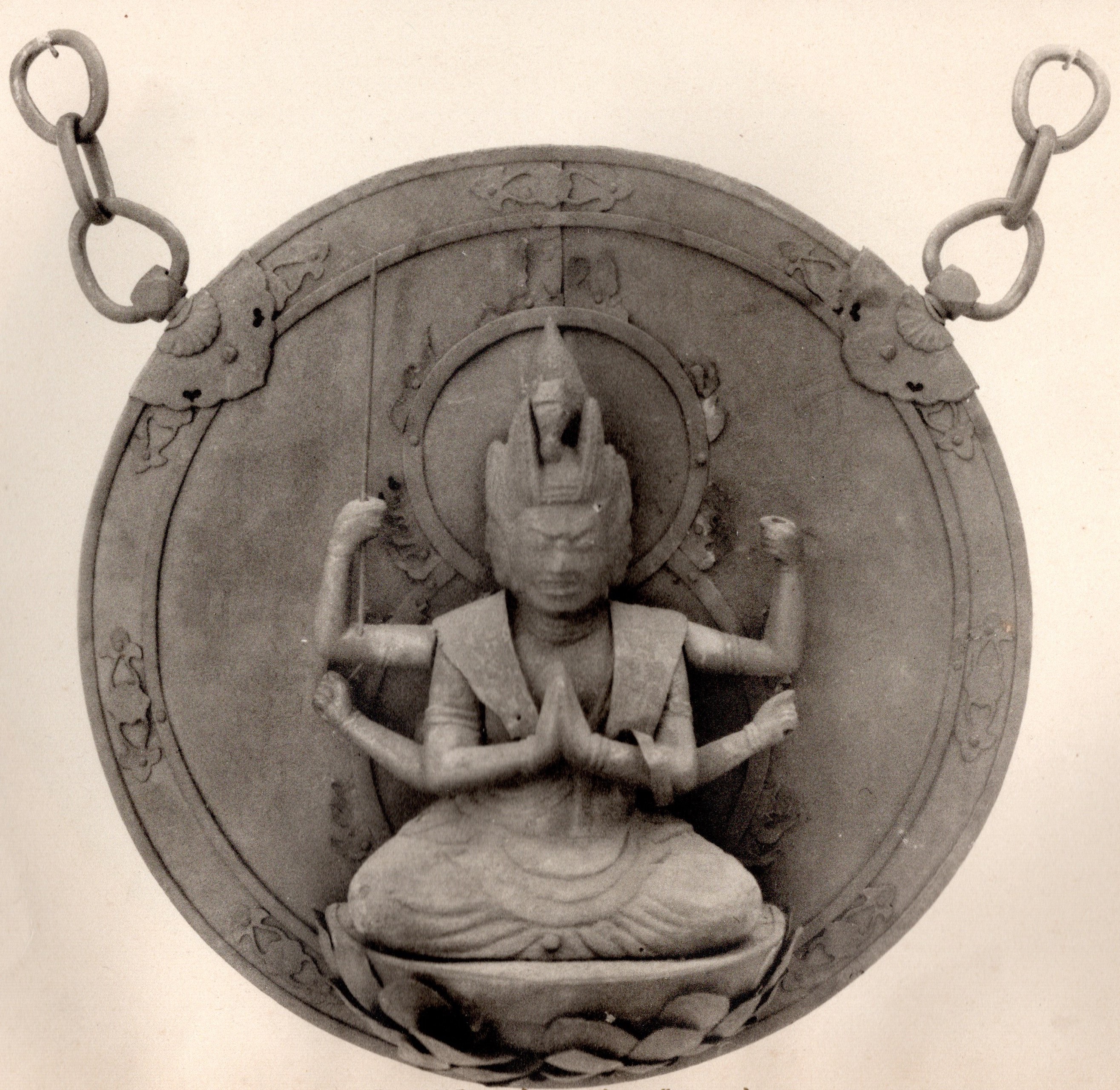
- Title
- Gilt bronze Batō Kannon kakebotoke (鋳銅馬頭観音懸仏)
- Period
- Kamakura period (1185–1333), Bunei 8 (1271)
- Region
- Japan, Mikawa Province (now Aichi Prefecture)
- Medium
- Gilt bronze, cast and chased
- Dimensions
- Disc diameter not published in current open sources
- Collection
- Tōkannon-ji (東観音寺), Toyohashi, Aichi
- Accession
-
Important Cultural Property (1271 dated) - Rights
- Public domain — photograph published in Atsumi-gun District Office, Atsumi-gun shi (Illustrated Atsumi District History), 1923. PD-Japan-oldphoto via Wikimedia Commons.
Gilt bronze Batō Kannon kakebotoke at Tōkannon-ji, Toyohashi (Aichi). Inscribed Bunei 8 (1271); donor Adachi Yasumori, shugo of Mikawa Province. The temple holds the work as one of its principal cultural properties; the photographic record reproduced here is from the 1923 Atsumi-gun shi. Public domain (PD-Japan-oldphoto).
A dated disc
What is unusual about this plaque is that it has a date.
Most surviving kakebotoke from the Heian and Kamakura periods are stylistically dated: to a century, sometimes to a generation, never to a year. The inscription on the back of the Tōkannon-ji disc reads Bunei 8 (文永八年, 1271), and it names the donor: Adachi Yasumori (安達泰盛, 1231–1285), then in the fourth year of his appointment as shugo (military governor) of Mikawa Province.
The dating clause is the article. It bolts an object-class that is otherwise a free-floating stylistic field down to a specific year, a specific Mikawa Shingon temple, and a specific Kamakura-shogunate official whose biography is documented in the Azuma kagami. The kakebotoke at Tōkannon-ji is what other kakebotoke would be if their inscriptions had survived.
It is also one of the earliest documented examples in which the wrathful horse-headed form of Kannon (Batō Kannon) appears in the hanging-icon register at all, and the only one bodhi knows of with a securely-dated 13th-century inscription.
Bunei 8 and the Adachi commission
Adachi Yasumori was not a Mikawa local. He was the eldest son of Adachi Yoshikage, hereditary retainer to the Hōjō regents, and from 1267 onward shugo of Mikawa, a strategically positioned province on the Tōkaidō, between the imperial centre at Kyoto and the shogunate at Kamakura. His tenure overlapped exactly with the two Mongol invasions: Bun’ei (1274) and Kōan (1281). The 1271 dating of the Tōkannon-ji kakebotoke sits in the run-up, three years before the first invasion.
His daughter married Hōjō Sadatoki, the future ninth regent. Yasumori himself eventually became the dominant figure of the regency after Hōjō Tokimune’s death in 1284, and was killed the following year, with most of the Adachi line, in the Shimotsuki Incident of 1285. The dynasty he had been building for the previous two decades was extinguished in a single day. Most of what the Adachi commissioned in those decades is lost. The 1271 Tōkannon-ji kakebotoke survives because it was a temple holding rather than a household one.
The choice of Batō Kannon for an Adachi commission is not random. Batō Kannon is the wrathful Kannon of the warrior caste, the Kannon who travels with the cavalryman, who reigns in animal forms, who runs in front of armies. The Adachi were a military family in a year between two Mongol fleets. The 1271 commission is the gesture of a man who is in charge of the Tōkaidō supply lines, and who has chosen which of the Six Kannon to put his name behind on the wall of his province’s principal Mikawa temple.
Hayagrīva in the metal hanging-icon register
Batō Kannon (馬頭観音, Hayagrīva) is the wrathful horse-headed form of Avalokiteśvara. The canonical iconography stabilises in Japan from the Heian period onward: three faces, six or eight arms, a small horse-head emerging from the foliated crown above the principal head, a flame mandorla, attributes that vary between the batō-in mudra at the chest and a programme of weapons (axe, sword, lasso, vajra) appropriate to the wrathful register. The horse-head is the diagnostic. Without it, the figure reads as a generic wrathful bodhisattva.
The Cleveland Museum’s painted-wood Batō Kannon (acc. 1981.1.a–b, Nanbokuchō 14th c.) is the bodhi anchor for the form in the figural register; it carries the iconographic programme at half-life-size, with the horse-head clearly readable in the foliated crown. The Tōkannon-ji 1271 disc carries the same programme (three faces, multiple arms, the horse-head emerging from the crown), but in a different physical register: a circular gilt-bronze plaque, photographed in 1923 from the temple’s holdings, with the figure rendered in cast and chased metal rather than carved wood.
The metal register changes what the iconography can do. A painted-wood Batō Kannon at half-life-size occupies a side hall and is approached frontally; a kakebotoke disc is suspended at eye-level or above, hangs against a sanctuary door or temple eave, and reads as a flat circle of deity against the architecture rather than as a sculptural body in its own pictorial space. The wrathful programme that would carry across a temple hall on a wooden figure now carries through a sixty-centimetre bronze disc on a temple wall. The compression is the medium.
This compression is what makes the kakebotoke form important in the Japanese Buddhist visual economy. A temple that could not afford a temple-honzon-scale sculpted Batō Kannon could afford a bronze hanging-icon. A temple that already had a sculpted honzon could supplement it with hanging discs along the eaves, each disc materialising another form in the deity programme. By the late Kamakura period the form had become standardised enough that catalogues of national-temple holdings record kakebotoke by the hundreds in shrine and temple inventories.
The kakebotoke as object class
A kakebotoke (懸仏) is a circular plaque, usually bronze and often gilt, with a deity in relief or repoussé on the obverse and suspension fittings (typically two animal-faced cartouches) at the upper edge. The disc was hung on the doors of a shrine sanctuary or along the eaves of a Buddhist temple hall, where it materialised the Buddhist honji (the original Buddhist deity) of which the local kami enshrined in the sanctuary was the suijaku, the manifest trace.
The form belongs to the honji-suijaku combinatory theology that organised medieval Japanese religious institutions for roughly seven centuries, from the late Heian period until the Meiji shinbutsu bunri edicts of 1868 separated Buddhist from Shintō holdings and triggered the destruction or dispersal of tens of thousands of these plaques out of shrine installations. (Teeuwen and Rambelli, Buddhas and Kami in Japan, 2003, is the standard English-language framing of the doctrinal scaffolding; the bodhi article on Cleveland 1985.16 treats the institutional history at object-class length.)
Tōkannon-ji’s 1271 disc sits inside this institutional fabric but with a twist that the Cleveland 1985.16 piece does not carry. The Cleveland plaque was acquired by the museum after its original installation was lost; the temple or shrine it once hung in is unknown, and the work is studied as a free-floating example of the genre. The Tōkannon-ji disc is still at the temple it was made for. The donor inscription names the institutional context. The relationship between the kakebotoke and the temple’s honzon (both are Batō Kannon) is preserved as a single iconographic programme across two physical registers within the same hall.
This is the rarer of the two situations. Most surviving kakebotoke are read as detached objects in museum collections. The Tōkannon-ji disc is read as part of a temple’s continuing iconographic life, with the donor’s name still attached and the deity it depicts still serving as the honzon of the institution that holds it.
The temple it still inhabits
Tōkannon-ji’s institutional history is the other thing that makes the disc interesting. The temple was traditionally founded in 733 by the wandering Nara-period monk Gyōki, the same founding legend attached to dozens of provincial temples in the Tōkaidō and Kansai regions, and one that should be read as institutional self-assertion rather than as a documented date.
The temple’s documented sect affiliation is Shingon from the Heian period onward, which is the institutional setting in which the 1271 kakebotoke was commissioned. Adachi Yasumori commissioned a Shingon-school object for a Shingon temple. The doctrinal Mikkyō register that Tōkannon-ji belonged to in 1271 is the register in which Batō Kannon is read as a wrathful expansion of the Avalokiteśvara mantra-system, with the horse-head emerging from the foliated crown as the visual seal of the wrathful transformation. The Adachi commission carries that doctrinal grammar without ambiguity.
During the Muromachi period the temple shifted to the Rinzai Zen line, specifically the Myōshin-ji branch, a sect-transition that should have meant the loss of Mikkyō ritual objects, since Rinzai Zen does not run a Goma-rite practice and does not maintain the kind of esoteric ritual hall in which a Batō Kannon plaque would have been the central focus of devotion. The 1271 kakebotoke survived the sect-shift, presumably because the honzon itself (Batō Kannon) survived it, and the disc was read in the new Rinzai context as a temple treasure attached to the honzon rather than as a free-standing ritual implement of a no-longer-practiced rite.
The work therefore preserves an iconography from a sect that no longer runs in the hall, held by a sect that did not commission it. The temple’s institutional memory has carried the object across a roughly two-hundred-year shift in religious practice. That is a different fact about the work than its iconography or its donor inscription is. It is the temple’s continuing decision to retain.
Reading 1271 against the Cleveland disc
The principal comparandum in Western-museum-accessible form is Cleveland 1985.16, a Nanbokuchō (mid- to late 14th-century) bronze kakebotoke with a seated Kannon in vitarka mudra on a multi-tiered lotus throne, 52.5 cm in diameter. Reading the two discs against each other tracks the genre’s stylistic shift across one century, and lets the iconographic shape of each work read more cleanly.
The Cleveland disc is serene. The Kannon at its centre is the canonical seated bodhisattva: princely crown, thin ring halo with three stylised flame-emanations, vitarka mudra, no asymmetry in the face. The disc is a honji image: the Buddhist original of a kami enshrined behind it, in a shrine context where the disc’s purpose is institutional rather than apotropaic.
The Tōkannon-ji disc is wrathful. The Batō Kannon at its centre is the canonical horse-headed Kannon: multiple faces, multiple arms, the horse-head in the crown, the flame mandorla, the wrathful attribute programme. The disc is a honzon image: the central deity of the temple itself, in a Mikkyō context where the disc’s purpose is doctrinal and ritual rather than syncretic. The compositional logic of the two discs is similar (circular plaque, central seated figure, animal-faced suspension cartouches), but the iconographic register is opposite.
The Adachi commission of 1271 is the earlier of the two and the more important institutionally. It dates the wrathful-kakebotoke programme to a generation before the Mongol invasions, names a specific shogunate official as donor, locates the practice in a Mikawa Shingon temple, and survives in situ. The Cleveland disc dates the serene-kakebotoke programme to a generation after the institutional consolidation of honji-suijaku theology, is anonymous in donor and provenance, and is read in a museum vitrine.
What stays open
The English-language record on the Tōkannon-ji disc is thin. Several specific questions remain unresolved in the open sources bodhi has been able to consult.
The disc’s measured diameter is not in the open Wikipedia records, the Bunka-chō ICP designation summary, or the temple’s English-language presence. The 1923 Atsumi-gun shi illustration shows a circular plaque of the kakebotoke standard form but does not give dimensions. The Bunka-chō paper records likely include the disc’s measured diameter; the figure is not yet on the open web in a form bodhi can pin to a single source.
The exact wording of the inscription is also not in the open record. The dating to Bunei 8 (1271) and the naming of Adachi Yasumori as donor are reported in the Japanese Wikipedia summary, presumably from temple-published or Bunka-chō sources. The exact transcription (whether the inscription is a colophon-style dedication, a date-and-name pair, or a longer dedicatory text) is not yet in a publicly verifiable form.
Whether the disc was hung in the main hall of the temple in 1271, or in a side hall, or against a sanctuary door, is not recorded. The Tōkannon-ji honzon is Batō Kannon, the same iconography as the kakebotoke, which suggests the disc was a complementary hanging of the temple’s central icon rather than a substitute for it. But the original installation context is not documented in the open Western-language record.
What is clear, and what makes the work worth reading, is the dating. One inscribed year, Bunei 8, 1271, bolts an entire object class to a fixed point in Kamakura institutional history. The article that 1271 belongs to is partly the work itself and partly the chronology it stabilises for the kakebotoke as a class.
Related
- Batō Kannon: the wrathful horse-headed form: the figural-register companion to the Tōkannon-ji disc
- Kannon kakebotoke: a Nanbokuchō hanging-Buddha plaque at Cleveland (1985.16): the kakebotoke object class at length
- Six Kannon (Roku Kannon): the canonical sextet: the iconographic system in which Batō Kannon occupies the wrathful/animal-realm position
- Fukūkenjaku Kannon: lasso and three-eyed face: the lasso-bearing Kannon that pairs with the wrathful-bodhisattva register
Sources
-
The temple's honzon is Batō Kannon. The 1271 gilt bronze kakebotoke is held as an Important Cultural Property in its treasure programme.
-
Designated under the metalwork category. The inscription on the disc records the dating to Bunei 8 (1271) and names the donor.
-
The 1923 illustrated district history contains the photographic record of the Tōkannon-ji kakebotoke reproduced on Wikimedia Commons. The volume entered the public domain in Japan under the 1899 Copyright Act and is the source image for the present article.
-
Summary article on Tōkannon-ji, Toyohashi: traditional founding 733 by Gyōki; initially Shingon under the Heian-Kamakura institutional regime; sect-shift to Rinzai (Myōshin-ji branch) during the Muromachi period; Batō Kannon honzon retained across the sect transition; the 1271 kakebotoke specified as an Adachi Yasumori commission. Cross-checked 2026-05-13.
-
The standard English-language collection on the honji-suijaku theological framework that organised medieval Japanese ritual objects — including kakebotoke — across the Buddhist-kami institutional fusion. Cited for the doctrinal background to the hanging-icon class.
-
Cleveland's Nanbokuchō bronze kakebotoke with a seated Kannon in repoussé. The principal Western-collection comparandum for the Tōkannon-ji 1271 disc; the bodhi article on Cleveland 1985.16 treats the kakebotoke form at object-class length. Accessed 2026-05-13.
-
Cleveland's Nanbokuchō painted-wood Batō Kannon figure, the bodhi anchor work for the wrathful horse-headed form in the painted-wood register. Accessed 2026-05-13.